

NAAC Accreditation: Challenges & Solutions


The National Assessment and Accreditation Council (NAAC) is an autonomous body established by the University Grants Commission (UGC) with the primary objective of assessing, accrediting, and assuring quality in higher education institutions (HEIs) across India. Over the years, NAAC accreditation has emerged as a critical quality benchmark, helping institutions demonstrate academic excellence, governance effectiveness, infrastructure strength, and overall institutional credibility.
Moreover, NAAC accreditation plays a vital role in institutional reputation, funding opportunities, student admissions, and policy alignment, especially in the context of NEP 2020, which emphasizes transparency, accountability, and outcome-based education. As a result, securing a good NAAC grade has become increasingly important for universities and colleges striving for long-term sustainability and global competitiveness.
However, the NAAC accreditation process is complex and demanding. It requires institutions to compile, validate, and present vast amounts of data related to curriculum, faculty performance, research output, student progression, infrastructure, governance, and quality assurance mechanisms. From data inconsistencies and documentation gaps to DVV clarifications and tight timelines, institutions often face multiple challenges throughout the accreditation journey.
Therefore, this blog explores the key challenges of NAAC accreditation and, more importantly, offers practical solutions and best practices to help higher education institutions navigate the process smoothly, improve compliance, and achieve better accreditation outcomes.
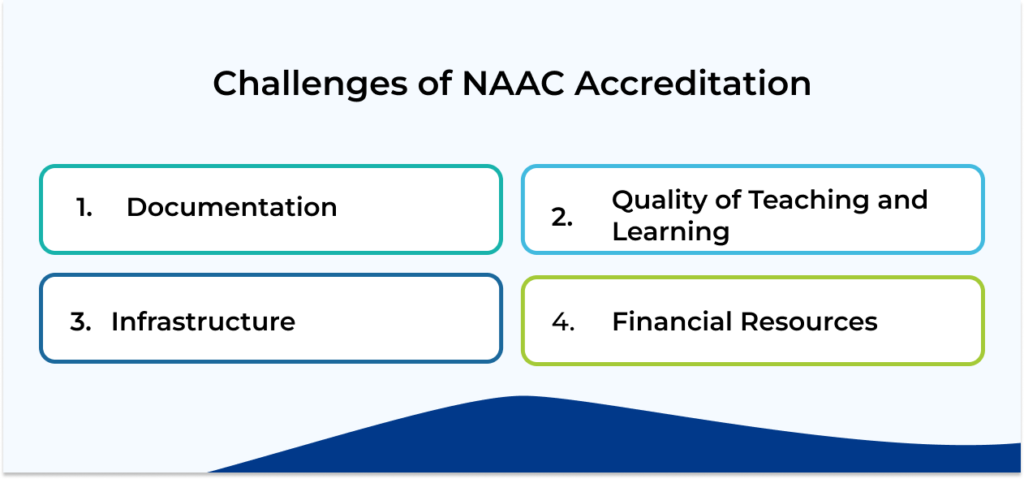
Challenges of NAAC Accreditation:
1. Documentation:
One of the biggest challenges in getting NAAC accreditation is documentation. NAAC requires a vast amount of documentation, including institutional data, self-assessment reports, academic and administrative audit reports, and student feedback. Preparing these documents can be time-consuming and requires a lot of effort, highlighting the need to address NAAC challenges AI through automation and efficient data management solutions.
LearnQoch, an integrated ERP & LMS Software, can help institutions to store and manage their documents securely. It has a document management system that allows institutions to create, store, and share documents easily. The software also has a self-study report module that can help institutions to prepare their self-study report.
2. Quality of Teaching and Learning:
NAAC assesses the quality of teaching and learning in the institution, which is a significant challenge. The institution needs to ensure that the faculty members are well-qualified, experienced, and skilled in their subject areas. The teaching methods should be innovative, and the curriculum should be up-to-date.
LearnQoch’s learning management system software allows institutions to create and manage courses, assign tasks, and track student progress. The software also has a faculty performance assessment module that can help institutions to evaluate the performance of their faculty members.
Also, LearnQoch aims to enhance the learning and teaching interest of students & teachers.
3. Infrastructure:
NAAC accreditation also requires institutions to have adequate infrastructure, including classrooms, laboratories, libraries, and sports facilities. The infrastructure should be of high quality and should meet the standards set by NAAC, making it essential for institutions to adopt effective accreditation solutions to plan, monitor, and upgrade their facilities.
LearnQoch, NBA & NAAC Accreditation software, can help institutions manage their infrastructure effectively. It has an asset management module that allows institutions to track their assets, such as classrooms, laboratories, libraries, and sports facilities. The software also has a maintenance management module that can help institutions schedule and track maintenance activities.
4. Financial Resources:
The institutions need to have sufficient financial resources to support their academic and research activities. NAAC assesses the financial resources of the institution and its ability to generate revenue.
Solutions From LearnQoch
1. Digitalization: The process of documentation can be simplified by digitalization. Institutions can use document management software to store and manage their documents. This will not only make the documentation process easier but will also ensure that the documents are easily accessible and secure.
ERP (Enterprise Resource Planning) and LMS (Learning Management System) software are two essential tools that can help organizations with digitization. Both software solutions can be used to streamline processes, automate routine tasks, and enhance communication and collaboration among stakeholders.
2. Training Programs: The institution can conduct training programs for faculty members to enhance their teaching skills. The institution can also provide training on research methodologies, and encourage faculty members to participate in research activities.
LearnQoch Software, integrated ERP & LMS Software, organizing and delivering training content. With LMS, organizations can create and manage online courses, track learners’ progress, and evaluate their performance. The software allows learners to access training content anytime, anywhere, using any device. On the other hand, ERP software can help in managing training logistics, such as scheduling, resource allocation, and budgeting. By using ERP and LMS software, organizations can enhance the effectiveness and efficiency of their training programs, reduce training costs, and improve knowledge retention among learners.
3. Collaboration: Collaboration with other institutions can help in improving the quality of teaching and learning. The institution can collaborate with other institutions to share resources, expertise, and best practices.
4. ERP and LMS Software: ERP and LMS software can help institutions to manage their academic and administrative activities effectively. LearnQoch is one such software that can help institutions to streamline their processes, automate routine tasks, and enhance communication and collaboration among stakeholders.
Conclusion
To conclude, obtaining NAAC accreditation is a significant challenge for higher education institutions in India, and it requires careful planning, documentation, and resource management. However, the challenges can be overcome by using digital solutions such as LearnQoch Vidarbha, an ERP and LMS software. LearnQoch can help institutions to digitize their academic and administrative activities, manage their resources effectively, enhance the quality of teaching and learning, and streamline the NAAC accreditation process.
By leveraging the power of technology, institutions can improve their performance, gain credibility, and provide a better learning experience for their students. Therefore, it is crucial for institutions to embrace digital solutions such as LearnQoch to meet the challenges of NAAC accreditation and succeed in the competitive higher education landscape, ensuring strong Mumbai compliance with quality standards and regulatory requirements.
LearnQoch has built an ERP & LMS system that simplifies and automates lengthy processes.
It helps institutions to store the various institution reports – admission, program details, and student reports etc, and generate various
reports related to NBA & NAAC Accreditation.
To enhance Accreditation-related data & enhance the quality assurance standards of your institution, choose LearnQoch Software.
The LearnQoch AI powered Academic Platform
LearnQoch goes further by providing an integrated platform that covers all aspects of institutional growth:

Institutional Digital Ecosystem: Categories & Modules
A. LearnQoch AI powered Core Academic & Learning Solutions
Facilitates modern teaching and learning while tracking student progress, assignments, assessments, and course outcomes.
Focuses on measuring learning outcomes to ensure skills, competencies, and academic objectives are met effectively.
- LearnQoch AI powered Academic Calendar & Events
Maintains academic schedules, holidays, events, and exam timelines for seamless yearly planning.
- LearnQoch AI powered Class Module
Manages class creation, faculty allocation, and student grouping while supporting timetable integration.
B. LearnQoch AI powered Examination & Evaluation Management
LearnQoch AI Powered Exam Management Module
A unified system that digitizes the entire exam cycle—right from planning, subject allocation, ATKT processing, and scheduling to question paper creation, assessments, evaluation, and result generation. It ensures transparency, accuracy, and smooth coordination across all departments.
C. LearnQoch AI powered Campus Administration & Operations
Streamlines administrative activities, simplifies student data management, and ensures workflow automation across all departments.
- LearnQoch AI powered Task Management
Organizes, prioritizes, and tracks institutional tasks to improve productivity and accountability.
- LearnQoch AI powered Committee Module
Handles committee formation, roles, activities, and meeting records to maintain governance transparency.
- LearnQoch AI powered Document Management
Stores, organizes, and retrieves institutional documents with version control and compliance tracking.
- LearnQoch AI powered Certificate Management
Manages creation and issuance of academic and administrative certificates such as Bonafide, character, and leaving certificates.
D. LearnQoch AI powered Finance & Fees Management
- LearnQoch AI powered Finance Module – Receivable (Fees)
Tracks payments, manages fee categories, handles tuition/fines, and maintains fee-related records.
- LearnQoch AI powered Advanced Fees
Payments made before the due date, helping institutions and parents manage fee planning efficiently.
- LearnQoch AI powered Excess Fees
Extra amount paid unintentionally; recorded for adjustment in future payments or refunded when necessary.
E. LearnQoch AI powered Library & Resource Management
LearnQoch AI powered Library Module
Manages book registration, issue-return process, renewals, student access, and availability tracking for efficient library operations.
F. LearnQoch AI powered Placement & Career Development
- LearnQoch AI powered Placement Module
Manages job postings, student registration, interview updates, and final offer letters with complete transparency for TPOs and students.
- LearnQoch AI powered Skill Development Solutions
Equips students with future-ready skills to enhance employability and prepare for global career opportunities.
G. LearnQoch AI powered Accreditation & Compliance
LearnQoch AI powered NAAC, NBA & NIRF Compliance
Simplifies reporting, monitoring, and auditing with ready-to-use compliance tools that reduce institutional workload.
H. LearnQoch AI powered Digital Presence & Branding
LearnQoch AI powered Website & Digital Marketing Solutions
Helps institutions build a strong online presence, attract prospective students, and engage key stakeholders effectively.
Don’t Just Take Our Word for It—Try LearnQoch Yourself!
We invite you to experience the transformative impact of LearnQoch’s AI powered Digitize Platform with a 14-Day Free Trial.
During this period, our team will implement the software for your institution, allowing you to explore its features firsthand and see the difference it can make in academic management.
👉 Are you ready to lead your institution into the future of campus management?
📞 Contact us at +91 84519 01079
📧 Email: info@learnqoch.com / sales@learnqoch.com
Explore What LearnQoch Offers:
Visit www.learnqoch.com for Full Details
Also read,
A Boon for Teachers: How LearnQoch NAAC Accreditation Software Transforms Academic Workload
Where Is the Criteria-Wise Data From June 2024 to Date for NAAC Submission?
IMPORTANT: Big Changes Ahead! NAAC Accreditation Changes Explained Action Plan for HEIs in 2025
FAQs
1. Why is NAAC accreditation important for higher education institutions?
NAAC accreditation enhances institutional credibility, improves academic quality, supports funding eligibility, and strengthens trust among students, parents, and stakeholders.
2. What are the major challenges institutions face during NAAC accreditation?
Common challenges include data inconsistency, lack of proper documentation, DVV queries, limited awareness of revised NAAC metrics, and tight submission timelines.
3. How can institutions overcome NAAC accreditation challenges?
Institutions can overcome these challenges by adopting digital NAAC-compliant systems, maintaining centralized data records, conducting internal audits, and aligning processes with NEP 2020 guidelines.
4. How does DVV impact the NAAC grading process?
DVV validates and verifies institutional data through third-party assessment, ensuring accuracy, transparency, and credibility, which directly influences NAAC grades.