



The Role of Full Stack Web Developers in Modern Web Development


In past days, at the advent of web development, the term “Full Stack Web Developers” did not exist. Companies had to adopt a fragmented approach to web development and hire individual front-end – and back-end web developers to manage different parts of the web application. This resulted in communication gaps due to coordination challenges. Over time, as digital transformation took greater shape within modern business scenarios, organizations demanded faster, scalable, and cost-effective web solutions. This shift clearly highlights the role of full stack developers in bridging gaps and delivering complete web solutions efficiently. Hence, the term “Full Stack Web Developers” was introduced as a necessity at the current stage of web development.
In addition, full stack developers possess expertise in both client and server technologies, which enable them to manage the entire development life cycle effectively and efficiently. Additionally, full stack developers contribute to minimizing costs, improving collaborative efforts, and expediting project execution.
Consequently, full stack developers are becoming essential for building high-performance, responsive, and effective web applications within an organization. In fact, their versatility and adaptability make them fundamental for any modern and expanding digital product development and business success.
The Fragmented Approach in Early Web Development
During the initial years of web development, organizations used a diversified methodology in developing websites by hiring individual front-end as well as back-end experts. Front-end developers, during the initial years, only concentrated on building visually appealing websites and enhancing customer experience. They made use of various front-end skillsets, including HTML, CSS, JavaScript, and so on. They were primarily concerned with developing websites that had proper navigation and a decent look. Over time, these focused roles evolved into broader full stack responsibilities that combine both design and functionality.
On the other side, the back-end developers handled the server side, where the programming languages applied were such as PHP, Java, and .NET, which were applied in the management of the database, server, and functionality of the applications, respectively. However, the applications were also required to be secure, scalable, and to exhibit efficiency in terms of handling user traffic on the internet. But the separation comes with its own communication problems, hence difficulties in the process, which motivated the business sector to look for full stack developers to solve the problems encountered in the development process.
The Challenges Faced
The fragmented approach to web development posed several challenges for companies. First and foremost, communication and coordination between front-end and back-end developers were essential but often cumbersome. Misunderstandings and misalignments could arise, leading to delays and inconsistencies in the development process. These issues often slowed down overall web application development and affected project efficiency.
Additionally, maintaining a consistent design of language and user experience across the website was a challenge. Without a full stack developer overseeing the entire development process, there was a risk of inconsistencies in design, user interface elements, and overall user experience. These discrepancies could negatively impact the brand image and user engagement.
Moreover, in the absence of full-stack developers, companies had to rely on the expertise of multiple individuals to troubleshoot and debug issues. When problems arose, a collaboration between front-end and back-end developers was necessary to identify and resolve the root cause. This often led to delays and increased the complexity of issue resolution.
The emergence of Full Stack Developers
As technology advanced and the complexity of web development increased, the need for a more streamlined approach became apparent. Enter the full-stack developer. These versatile professionals emerged as a solution to the challenges companies face in the fragmented approach to web development.
Full-stack developers possess a deep understanding of both front-end and back-end technologies. Their broad skill set enables them to handle various aspects of web development independently, eliminating the need for multiple specialized individuals. With their ability to work seamlessly across the entire development process, full stack developers bring cohesion and efficiency to web development projects.
By having full-stack developers onboard, companies benefit from improved communication, streamlined processes, and quicker issue resolution. These professionals take charge of both the client-side and server-side aspects, ensuring a cohesive design, smooth functionality, and optimal user experience.
Benefits of Full Stack Developers
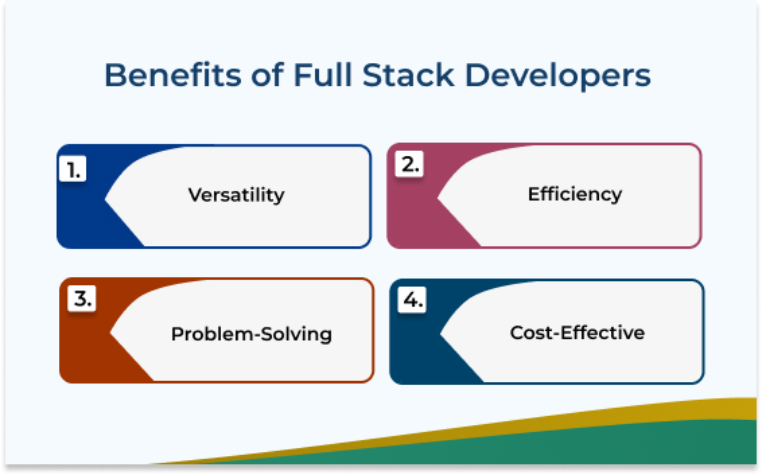
Versatility
The full-stack developers can handle both the front-end and back-end development aspects, which means they can handle several aspects of web development, and this is where the companies are benefiting from having fewer technical requirements. They have proved to be the most valuable for businesses, especially startups.
Efficiency:
It allows full stack developers to manage a wide range of development tasks on their own, which significantly improves the execution pace of projects. What’s more, by being able to switch between client and server sides, they ensure smooth coordination of workflows, reduce delays in development, and increase productivity on web development projects.
Problem-Solving:
Full-stack developers have broader knowledge of the whole development cycle. For this reason, it will be easy for them to find a technical problem in different layers of the application. Their troubleshooting skills help to fix the bugs of the client-side and the server-side rapidly and to get better performance with the long-term stability of the application.
Cost-Effective:
Employing full stack developers can enable businesses to reduce costs associated with running a business, specifically full stack developers because they can save businesses from having to maintain many developers for multiple core functionalities for a business.
Presently, full stack developers have assumed an important role in web development as they form a link among front end and back-end technologies. Furthermore, the knowledge base possessed by full stack developers allows them to not only ensure the visual appeal of the interface they have created or are creating but also to develop high-performing web applications.
Also, the Certified Course on Professional Full Stack Web Development offered at LearnQoch, in association with Future Skills Prime and NASSCOM, provides training in full-stack web development through modules of trending technologies and development techniques. Further, learners can develop expertise in applying HTML, CSS, JavaScript, and React JS when they undergo hybrid learning of more than 400 hours, including live projects and hands-on learning. The course aligns with NSQF standards, which are designed according to NSDC guidelines, so that students are provided with career-oriented training in web development.
Enroll today and take the first step towards a successful career in full-stack web development.
Conclusion
Clearly, the evolution of web development has greatly emphasized the importance of full stack web developers regarding the ever-evolving digital landscape characterizing our modern world. Whereas, in the past, development processes were divided into segments where both the front-end and back-end developers worked concurrently, the new wave of full stack developers has effectively solved the problems emanating from such a disorganized approach, bringing us the best of versatility and efficiency.
It is also important to note that full stack developers are not only instrumental in simplifying the execution of a project but also ensure a consistent flow of design, functionality, and overall user experience. With the benefits and advantages of using full stack developers within an organization, it can be stated that as the business continues to evolve and transform at a faster speed, full stack developers’ demand would only increase.
Such programs, such as LearnQoch’s Certified Course on Professional Full Stack Web Development, are of paramount importance in providing aspiring IT professionals with the necessary skills and project exposure before venturing into the profession. Therefore, these learning programs enable students with significant competencies, enabling them to embrace the changing demands of this dynamic field of web development.
The LearnQoch AI powered Academic Platform
LearnQoch goes further by providing an integrated platform that covers all aspects of institutional growth:

Institutional Digital Ecosystem: Categories & Modules
A. LearnQoch AI powered Core Academic & Learning Solutions
Facilitates modern teaching and learning while tracking student progress, assignments, assessments, and course outcomes.
Focuses on measuring learning outcomes to ensure skills, competencies, and academic objectives are met effectively.
- LearnQoch AI powered Academic Calendar & Events
Maintains academic schedules, holidays, events, and exam timelines for seamless yearly planning.
- LearnQoch AI powered Class Module
Manages class creation, faculty allocation, and student grouping while supporting timetable integration.
B. LearnQoch AI powered Examination & Evaluation Management
LearnQoch AI Powered Exam Management Module
A unified system that digitizes the entire exam cycle—right from planning, subject allocation, ATKT processing, and scheduling to question paper creation, assessments, evaluation, and result generation. It ensures transparency, accuracy, and smooth coordination across all departments.
C. LearnQoch AI powered Campus Administration & Operations
Streamlines administrative activities, simplifies student data management, and ensures workflow automation across all departments.
- LearnQoch AI powered Task Management
Organizes, prioritizes, and tracks institutional tasks to improve productivity and accountability.
- LearnQoch AI powered Committee Module
Handles committee formation, roles, activities, and meeting records to maintain governance transparency.
- LearnQoch AI powered Document Management
Stores, organizes, and retrieves institutional documents with version control and compliance tracking.
- LearnQoch AI powered Certificate Management
Manages creation and issuance of academic and administrative certificates such as Bonafide, character, and leaving certificates.
D. LearnQoch AI powered Finance & Fees Management
- LearnQoch AI powered Finance Module – Receivable (Fees)
Tracks payments, manages fee categories, handles tuition/fines, and maintains fee-related records.
- LearnQoch AI powered Advanced Fees
Payments made before the due date, helping institutions and parents manage fee planning efficiently.
- LearnQoch AI powered Excess Fees
Extra amount paid unintentionally; recorded for adjustment in future payments or refunded when necessary.
E. LearnQoch AI powered Library & Resource Management
LearnQoch AI powered Library Module
Manages book registration, issue-return process, renewals, student access, and availability tracking for efficient library operations.
F. LearnQoch AI powered Placement & Career Development
- LearnQoch AI powered Placement Module
Manages job postings, student registration, interview updates, and final offer letters with complete transparency for TPOs and students.
- LearnQoch AI powered Skill Development Solutions
Equips students with future-ready skills to enhance employability and prepare for global career opportunities.
G. LearnQoch AI powered Accreditation & Compliance
LearnQoch AI powered NAAC, NBA & NIRF Compliance
Simplifies reporting, monitoring, and auditing with ready-to-use compliance tools that reduce institutional workload.
H. LearnQoch AI powered Digital Presence & Branding
LearnQoch AI powered Website & Digital Marketing Solutions
Helps institutions build a strong online presence, attract prospective students, and engage key stakeholders effectively.
Don’t Just Take Our Word for It—Try LearnQoch Yourself!
We invite you to experience the transformative impact of LearnQoch’s Digitize Platform with a 14-Day Free Trial.
During this period, our team will implement the software for your institution, allowing you to explore its features firsthand and see the difference it can make in academic management.
👉 Are you ready to lead your institution into the future of campus management?
📞 Contact us at +91 84519 01079
📧 Email: info@learnqoch.com /sales@learnqoch.com
Explore What LearnQoch Offers:
Visit www.learnqoch.com for Full Details
Also read,
Top 14 Full Stack Web Developer Interview Question and Answers
8 things you need to know about a full-stack web developer
Top 10 high in demand tech skills for jobs in 2023