


Using Technology Tools for Effective Student Evaluation


Transforming Student Assessment with Technology
The world of education is evolving rapidly, and so are the ways we evaluate student performance. Traditional pen-and-paper tests are no longer the only method for measuring understanding. Today, technology provides educators with innovative LMS evaluation tools to assess students more effectively and efficiently.
Digital assessments, online quizzes, interactive assignments, and learning analytics allow teachers to track progress in real time. These tools support student evaluation, provide instant feedback, highlight areas of improvement, and help personalize learning for each student.
Technology also enables a more holistic evaluation, incorporating participation, projects, and collaborative work alongside traditional exams. By integrating LMS evaluation tools into education, schools can create fairer, more accurate, and engaging assessment systems. Modern student evaluation is no longer just about grades—it is about understanding and supporting each learner’s growth.
The Evolution of Student Evaluation
Traditionally, student evaluation largely consisted of standardized tests, quizzes, and essays, which were often time-consuming to grade and provided only a snapshot of a student’s knowledge. These methods had limitations in assessing skills such as critical thinking, problem-solving, and creativity. Moreover, they rarely offered timely feedback to students, hindering their ability to learn from their mistakes and improve.
The emergence of technology in education has paved the way for a more comprehensive and dynamic approach to student evaluation. Today, teachers in Mumbai schools, Nagpur colleges, and Vidarbha schools have access to a wide range of tools and platforms that enable them to assess students in real-time, track their progress over time, and provide personalized feedback. Let’s delve into how these technology tools are reshaping student evaluation..
1. Online Assessments and Quizzes
Traditional paper tests are being replaced by online quizzes and assessments. These save time for teachers and provide instant feedback to students. Online tests can be adapted to a student’s level and include multiple-choice, short-answer, and interactive simulation questions, giving a more complete picture of learning.
2. Learning Management Systems (LMS)
LMS platforms allow teachers to create and manage assignments, quizzes, and discussions in one place. Students can access materials, submit work, and receive feedback online. Teachers can track progress, identify areas for improvement, and adjust lessons, accordingly, making evaluation more organized and efficient.
3. Formative Assessment Tools
Tools like clickers, interactive whiteboards, and online polls allow real-time assessments during lessons. Teachers can gauge understanding instantly and modify instructions to improve learning.
4. Digital Portfolios
Digital portfolios let students compile essays, projects, artwork, and multimedia presentations. Teachers can assess progress over time, offering feedback on both the process and the final work.
5. Automated Grading and Analytics
AI-powered tools can grade multiple-choice questions, essays, and coding tasks quickly and accurately. Analytics help identify patterns in performance, allowing targeted support for students who need it.
6. Virtual Reality (VR) and Simulations
VR and simulations provide immersive experiences for subjects like science and engineering. Students can explore complex concepts safely, and teachers can evaluate problem-solving and decision-making skills.
7. Personalized Learning Platforms
Adaptive platforms tailor content to each student’s needs. They continuously adjust difficulty based on performance, ensuring students are challenged appropriately, and progress is accurately measured.
Benefits of Using Technology for Student Evaluation
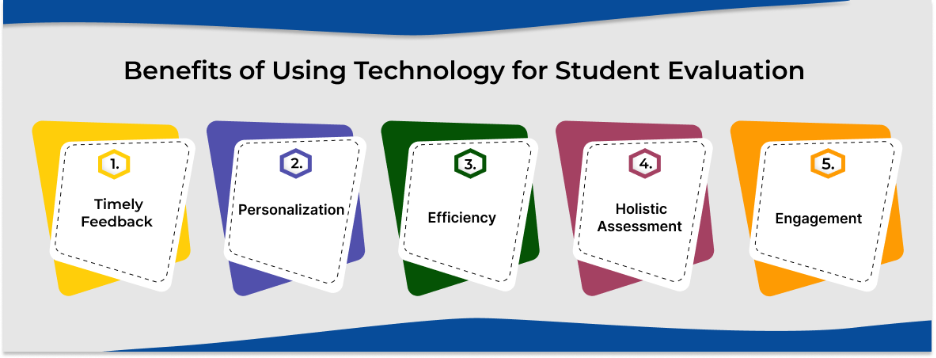
Integrating technology into student assessment provides numerous advantages for both teachers and students:
Timely Feedback
First and foremost, digital assessment tools provide instant feedback, allowing students to quickly identify mistakes and understand areas that need improvement. As a result, learners can correct errors immediately, reinforce concepts, and strengthen their understanding without long delays. Consequently, this continuous feedback loop significantly enhances the overall learning experience.
Personalization
In addition, adaptive technologies personalize assessments by adjusting to each student’s learning pace, strengths, and learning style. This ensures that evaluations are more accurate and fairer. Moreover, personalized assessments help students learn confidently at their own speed, leading to better engagement and improved academic performance.
Efficiency
Furthermore, automated grading systems and performance analytics drastically reduce the time teachers spend on manual evaluation. This increased efficiency enables educators to dedicate more time to lesson planning, student mentoring, and academic support. As a result, both teaching quality and classroom productivity improve.
Holistic Assessment
At the same time, digital portfolios and interactive assessments provide a comprehensive view of a student’s progress over time. Rather than focusing only on exam scores, educators can assess skills, creativity, participation, and overall development. Consequently, this holistic approach supports more meaningful and balanced student evaluations.
Engagement
Moreover, technology-driven assessments make learning more interactive and engaging through quizzes, simulations, and multimedia content. This encourages students to actively participate in the assessment process, thereby increasing motivation and reducing exam-related anxiety.
Data-Driven Insights
Finally, detailed analytics and reports offer valuable data-driven insights for educators and institutions. By tracking performance trends and identifying learning gaps, teachers can make informed decisions to enhance teaching strategies and curriculum design. Ultimately, this leads to improved academic outcomes and a more effective learning environment.
Revolutionizing Student Evaluation with LearnQoch ERP & LMS
Technology is changing the way students are assessed, making evaluation more personalized, efficient, and insightful.
LearnQoch, a leading ERP and LMS software, helps schools manage both administrative tasks and student learning on one platform. Its ERP features simplify admissions, attendance, and resource management, giving teachers more time to focus on teaching and assessing students.
The LearnQoch LMS allows educators to manage assignments and assessments in one place, track student progress in real time, and use adaptive learning to tailor education to each student’s needs. This ensures evaluations are accurate and meaningful.
By using LearnQoch LMS , schools can create a smarter, more efficient learning environment. Students receive better support, teachers gain deeper insights, and overall learning outcomes improve. LearnQoch LMS makes modern student evaluation simpler, faster, and more effective, helping schools achieve continuous improvement.
conclusion
In conclusion, technology tools play a crucial role in effective student evaluation by ensuring timely feedback, personalization, and efficiency. Moreover, data-driven insights and holistic assessment methods support informed academic decisions. Ultimately, by integrating digital tools into evaluation processes, institutions can enhance learning outcomes, improve teaching strategies, and create a more engaging and student-centered education system.
The LearnQoch AI powered Academic Platform
LearnQoch goes further by providing an integrated platform that covers all aspects of institutional growth:

Institutional Digital Ecosystem: Categories & Modules
A. LearnQoch AI powered Core Academic & Learning Solutions
Facilitates modern teaching and learning while tracking student progress, assignments, assessments, and course outcomes.
Focuses on measuring learning outcomes to ensure skills, competencies, and academic objectives are met effectively.
- LearnQoch AI powered Academic Calendar & Events
Maintains academic schedules, holidays, events, and exam timelines for seamless yearly planning.
- LearnQoch AI powered Class Module
Manages class creation, faculty allocation, and student grouping while supporting timetable integration.
B. LearnQoch AI powered Examination & Evaluation Management
LearnQoch AI Powered Exam Management Module
A unified system that digitizes the entire exam cycle—right from planning, subject allocation, ATKT processing, and scheduling to question paper creation, assessments, evaluation, and result generation. It ensures transparency, accuracy, and smooth coordination across all departments.
C. LearnQoch AI powered Campus Administration & Operations
Streamlines administrative activities, simplifies student data management, and ensures workflow automation across all departments.
- LearnQoch AI powered Task Management
Organizes, prioritizes, and tracks institutional tasks to improve productivity and accountability.
- LearnQoch AI powered Committee Module
Handles committee formation, roles, activities, and meeting records to maintain governance transparency.
- LearnQoch AI powered Document Management
Stores, organizes, and retrieves institutional documents with version control and compliance tracking.
- LearnQoch AI powered Certificate Management
Manages creation and issuance of academic and administrative certificates such as Bonafide, character, and leaving certificates.
D. LearnQoch AI powered Finance & Fees Management
- LearnQoch AI powered Finance Module – Receivable (Fees)
Tracks payments, manages fee categories, handles tuition/fines, and maintains fee-related records.
- LearnQoch AI powered Advanced Fees
Payments made before the due date, helping institutions and parents manage fee planning efficiently.
- LearnQoch AI powered Excess Fees
Extra amount paid unintentionally; recorded for adjustment in future payments or refunded when necessary.
E. LearnQoch AI powered Library & Resource Management
LearnQoch AI powered Library Module
Manages book registration, issue-return process, renewals, student access, and availability tracking for efficient library operations.
F. LearnQoch AI powered Placement & Career Development
- LearnQoch AI powered Placement Module
Manages job postings, student registration, interview updates, and final offer letters with complete transparency for TPOs and students.
- LearnQoch AI powered Skill Development Solutions
Equips students with future-ready skills to enhance employability and prepare for global career opportunities.
G. LearnQoch AI powered Accreditation & Compliance
LearnQoch AI powered NAAC, NBA & NIRF Compliance
Simplifies reporting, monitoring, and auditing with ready-to-use compliance tools that reduce institutional workload.
H. LearnQoch AI powered Digital Presence & Branding
LearnQoch AI powered Website & Digital Marketing Solutions
Helps institutions build a strong online presence, attract prospective students, and engage key stakeholders effectively.
Don’t Just Take Our Word for It—Try LearnQoch Yourself!
We invite you to experience the transformative impact of LearnQoch’s Digitize Platform with a 14-Day Free Trial.
During this period, our team will implement the software for your institution, allowing you to explore its features firsthand and see the difference it can make in academic management.
👉 Are you ready to lead your institution into the future of campus management?
📞 Contact us at +91 84519 01079
📧 Email: info@learnqoch.com /sales@learnqoch.com
Explore What LearnQoch Offers:
Visit www.learnqoch.com for Full Details
Also read,
Teachers as Ed-Tech Integrators: Navigating the Transition
Unlocking Student Success: How Assessment and Feedback Tools in LMS Improve Learning Outcomes
Interactive Best LMS in Mumbai Features: The Secret to Engaging Classrooms with LearnQoch
Personalized Learning Journey: Customizing Education with Technology Tools
- How to read the minds of students to check their concept of understanding on a daily basis?
Ans: By using daily quizzes, polls, interactive questions, and real-time feedback tools to assess student understanding continuously.
- The guide on Online learning platforms for schools & its benefits
Ans: Online learning platforms enable flexible, interactive, and personalized education while improving accessibility, engagement, and academic outcomes.
- How to manage content in LMS for Schools?
Ans: Schools can manage LMS content by organizing lessons, assignments, videos, and assessments into structured courses with easy access for teachers and students.
- 8 Benefits of LMS for Schools
Ans: An LMS improves learning flexibility, student engagement, progress tracking, collaboration, personalization, content management, assessment efficiency, and communication.
- How to select the best LMS for school
Ans: The best LMS should be user-friendly, scalable, secure, curriculum-aligned, mobile-compatible, and rich in analytics and support features.