



Hybrid Learning : The Mix of Offline and Online Classes


The COVID-19 pandemic changed the world in many ways, but one of the most affected areas was education. Almost overnight, schools and colleges were forced to shut their doors. Classrooms became empty, playgrounds fell silent, and learning shifted to screens through hybrid learning, a balanced mix of offline and online classes. Students, teachers, and parents had to adjust quickly to online education, often without proper preparation or support.
While many industries managed to move smoothly into the digital world, the education sector struggled to maintain the same quality of learning. This struggle highlighted a major gap—the lack of digital readiness in schools, especially the absence of strong Educational Resource Planning (ERP) systems and Best LearnQoch Learning Management Systems (LMS) in Mumbai, capable of supporting effective hybrid learning across offline and online environments.
The pandemic taught us an important lesson: education must be flexible, adaptable, and future-ready. The National Education Policy (NEP) 2020 emphasizes this need by advocating for innovative teaching methods, blended learning approaches, and integration of technology in education. This is where the concept of hybrid learning—a balanced mix of offline and online classes—comes into focus, benefiting Mumbai schools, Nagpur colleges, and Vidarbha schools, and aligning perfectly with the vision of NEP 2020 for a more holistic, flexible, and digitally empowered education system.
How Other Industries Adapted Quickly?
During the pandemic, industries like banking, IT, entertainment, and e-commerce continued smoothly because they were already digitally prepared. They had the tools and infrastructure to adapt quickly, unlike the education sector, which struggled due to lack of digital readiness.
Challenges Faced by the Education Sector
The sudden shift to online learning revealed major gaps. Many schools lacked digital platforms, teachers were unfamiliar with online tools, and students faced connectivity and engagement issues. Learning loss increased as classes became one-way, assessments were harder, and teacher-student interaction weakened. The problem was not online learning itself, but the lack of preparedness.
Why Hybrid Learning Is the Solution?
It is important to understand that online learning alone cannot replace traditional classroom education. Face-to-face interaction, peer learning, and classroom discipline play a crucial role in a child’s development. At the same time, digital tools offer flexibility, personalized learning, and access to rich educational resources.
Hybrid learning combines the strengths of both offline and online education.
In a hybrid model:
- Classroom teaching builds strong teacher-student relationships
- Online tools support revision, practice, and assessments
- Learning continues even during disruptions
- Students learn at their own pace using digital content
Hybrid learning ensures that education does not stop, no matter the situation.
The Role of NEP 2020 in Digital Education
India’s National Education Policy (NEP) 2020 recognized the need for digital transformation in education. The policy emphasized:
- Use of technology to improve teaching and learning
- Strengthening teacher-student relationships
- Ensuring uninterrupted education through digital platforms
- Promoting blended and online learning models
NEP 2020 made it clear that the future of education lies in using technology wisely, without losing the human touch of teaching.
Importance of ERP and Best LMS in Institutes
To successfully implement hybrid learning, schools need the right digital tools. Two of the most important tools are:
Educational Resource Planning (ERP)
An ERP system helps schools manage administrative tasks such as:
- Student admissions
- Attendance tracking
- Timetables
- Fees and finance
- Communication with parents
Best Learning Management System LearnQoch (LMS) in Mumbai
An LearnQoch LMS focuses on teaching and learning activities, including:
- Online classes
- Digital study materials
- Assignments and quizzes
- Assessments and reports
- Student progress tracking
When ERP and LMS work together, schools can operate smoothly while delivering quality education.
LearnQoch: Supporting Hybrid Learning for Institutes
This is where LearnQoch plays a key role. LearnQoch is a powerful LMS designed specifically for schools, with integrated ERP features. It understands the real needs of educators, students, and school administrators.
LearnQoch uses technology to improve, not replace, traditional teaching. Its goal is to support schools in creating an effective hybrid learning environment.
How LearnQoch Makes Hybrid Learning Easy
LearnQoch offers a balanced approach by combining classroom teaching with digital tools. Some of its key benefits include:
Seamless Transition Between Offline and Online
Whether classes are conducted in school or online, LearnQoch ensures continuity. Teachers can upload lesson plans, assignments, and study materials that students can access anytime.
Engaging Learning Experience
With interactive content, quizzes, videos, and discussion forums, learning becomes more interesting and effective for students.
Personalized Learning
Students learn at different speeds. LearnQoch allows teachers to provide personalized support based on each student’s performance and learning needs.
Real-Time Feedback
Teachers can quickly evaluate assignments and assessments, giving timely feedback that helps students improve.
Reduced Administrative Burden
By managing attendance, reports, and communication digitally, teachers can focus more on teaching rather than paperwork.
Why Hybrid Learning Is Better Than Only Online Learning?
Online learning alone has limitations. Long screen time can affect students’ health and attention span. Younger students, especially, need physical interaction and classroom discipline.
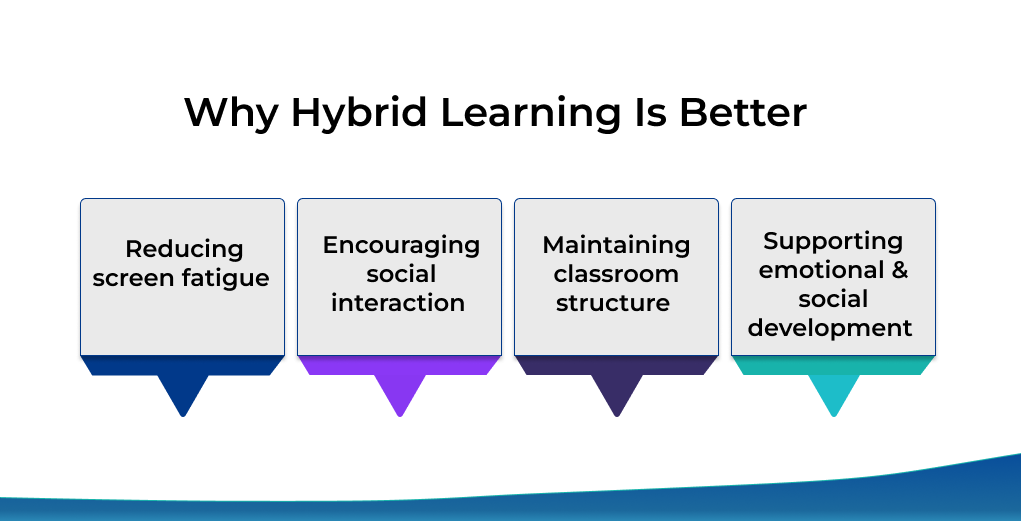
Hybrid learning solves these problems by:
- Reducing screen fatigue
- Encouraging social interaction
- Maintaining classroom structure
- Supporting emotional and social development
At the same time, digital tools ensure learning continues beyond the classroom.
Teachers’ Role in Hybrid Learning
Teachers remain at the heart of education, even in a digital world. Hybrid learning empowers teachers by giving them tools to:
- Track student progress easily
- Use innovative teaching methods
- Reach students beyond classroom hours
- Provide extra support when needed
LearnQoch supports teachers through easy-to-use features and training, helping them confidently integrate technology into their teaching.
Preparing Students for the Future
The world is becoming increasingly digital. Students need skills such as:
- Digital literacy
- Self-learning ability
- Problem-solving skills
- Adaptability
Hybrid learning prepares students for this future by combining academic learning with digital exposure. Platforms like LearnQoch help students become confident, independent learners.
Learning from the Pandemic
The pandemic showed us that education cannot depend only on physical classrooms. Schools must be ready for unexpected disruptions, whether due to health crises, natural disasters, or other challenges.
Hybrid learning ensures that education continues without major interruptions. It builds a resilient education system that can adapt to changing situations.
Why the Institute Must Act Now?
The pandemic may change form, but disruptions will continue in some way or another. Schools that fail to adopt digital solutions risk falling behind.
By implementing a best-in-class LMS like LearnQoch in Mumbai, Institutes can:
- Improve learning outcomes
- Enhance teaching quality
- Build strong digital infrastructure
- Stay aligned with NEP 2020
The Future of Education Is Hybrid
As we look ahead, one thing is clear: the future of education lies in finding the right balance between offline and online learning. Hybrid learning is not a temporary solution—it is a long-term strategy for quality education.
LearnQoch provides schools with a roadmap to successfully implement blended learning, ensuring that students receive a complete, uninterrupted education regardless of circumstances.
Conclusion
The COVID-19 pandemic exposed the digital gaps in the education sector. While many industries adapted smoothly, schools struggled due to a lack of digital preparedness. However, with supportive policies like NEP 2020 and innovative platforms like LearnQoch, the education system now has the opportunity to rebuild stronger.
Hybrid learning models supported by LearnQoch ensure flexibility, continuity, and quality in education. By combining the strengths of classroom teaching and digital tools, schools can create resilient learning environments that prepare students for the future.
An LMS is also highly beneficial for teachers as it simplifies daily academic tasks and reduces administrative workload. Teachers can create and share learning materials, conduct online assessments, track student progress, manage attendance, communicate with students and parents, and access performance reports from a single platform. This allows teachers to spend less time on manual processes and more time on delivering effective, personalized learning experiences.
The LearnQoch AI powered Academic Platform
LearnQoch goes further by providing an integrated platform that covers all aspects of institutional growth:

Institutional Digital Ecosystem: Categories & Modules
A. LearnQoch AI powered Core Academic & Learning Solutions
Facilitates modern teaching and learning while tracking student progress, assignments, assessments, and course outcomes.
Focuses on measuring learning outcomes to ensure skills, competencies, and academic objectives are met effectively.
- LearnQoch AI powered Academic Calendar & Events
Maintains academic schedules, holidays, events, and exam timelines for seamless yearly planning.
- LearnQoch AI powered Class Module
Manages class creation, faculty allocation, and student grouping while supporting timetable integration.
B. LearnQoch AI powered Examination & Evaluation Management
LearnQoch AI Powered Exam Management Module
A unified system that digitizes the entire exam cycle—right from planning, subject allocation, ATKT processing, and scheduling to question paper creation, assessments, evaluation, and result generation. It ensures transparency, accuracy, and smooth coordination across all departments.
C. LearnQoch AI powered Campus Administration & Operations
Streamlines administrative activities, simplifies student data management, and ensures workflow automation across all departments.
- LearnQoch AI powered Task Management
Organizes, prioritizes, and tracks institutional tasks to improve productivity and accountability.
- LearnQoch AI powered Committee Module
Handles committee formation, roles, activities, and meeting records to maintain governance transparency.
- LearnQoch AI powered Document Management
Stores, organizes, and retrieves institutional documents with version control and compliance tracking.
- LearnQoch AI powered Certificate Management
Manages creation and issuance of academic and administrative certificates such as Bonafide, character, and leaving certificates.
D. LearnQoch AI powered Finance & Fees Management
- LearnQoch AI powered Finance Module – Receivable (Fees)
Tracks payments, manages fee categories, handles tuition/fines, and maintains fee-related records.
- LearnQoch AI powered Advanced Fees
Payments made before the due date, helping institutions and parents manage fee planning efficiently.
- LearnQoch AI powered Excess Fees
Extra amount paid unintentionally; recorded for adjustment in future payments or refunded when necessary.
E. LearnQoch AI powered Library & Resource Management
LearnQoch AI powered Library Module
Manages book registration, issue-return process, renewals, student access, and availability tracking for efficient library operations.
F. LearnQoch AI powered Placement & Career Development
- LearnQoch AI powered Placement Module
Manages job postings, student registration, interview updates, and final offer letters with complete transparency for TPOs and students.
- LearnQoch AI powered Skill Development Solutions
Equips students with future-ready skills to enhance employability and prepare for global career opportunities.
G. LearnQoch AI powered Accreditation & Compliance
LearnQoch AI powered NAAC, NBA & NIRF Compliance
Simplifies reporting, monitoring, and auditing with ready-to-use compliance tools that reduce institutional workload.
H. LearnQoch AI powered Digital Presence & Branding
LearnQoch AI powered Website & Digital Marketing Solutions
Helps institutions build a strong online presence, attract prospective students, and engage key stakeholders effectively.
Don’t Just Take Our Word for It—Try LearnQoch Yourself!
We invite you to experience the transformative impact of LearnQoch’s Digitize Platform with a 14-Day Free Trial.
During this period, our team will implement the software for your institution, allowing you to explore its features firsthand and see the difference it can make in academic management.
👉 Are you ready to lead your institution into the future of campus management?
📞 Contact us at +91 84519 01079
📧 Email: info@learnqoch.com /sales@learnqoch.com
Explore What LearnQoch Offers:
Visit www.learnqoch.com for Full Details