



Exploring the Benefits of STEM Education Through Coding and Robotics


Imagine your child’s school journey as a thrilling adventure, where they’re not just learning the basics but unlocking future-ready super skills. And here’s the exciting part—learning to code and work with robots! Before we dive into the fun, let’s talk about something called STEM education, a foundation that drives innovation, problem-solving, and creativity. This approach is at the heart of STEM coding and robotics in Mumbai, where students explore technology hands-on while building skills for a rapidly evolving future.
STEM stands for Science, Technology, Engineering, and Mathematics. It’s like a powerhouse of exciting opportunities. When your child engages in STEM, they become a mini-scientist, tech innovator, and problem-solver all rolled into one.
Now, why is STEM so important? It’s like the secret sauce that prepares your child for the future. The world is changing rapidly, and jobs are becoming more technology-driven, innovative, and high-tech. STEM skills act as keys to unlock these incredible career opportunities. They help your child think critically, solve complex problems, and adapt confidently to new challenges.
And here’s where it gets even more exciting! Learning to code and work with robots are the superhero moves of STEM education. They’re not just skills—they’re superpowers that help your child stand out, innovate, and thrive in the dynamic world ahead.
As emphasized in NEP 2020, early integration of coding, computational thinking, and technology-led learning is crucial to equip students with 21st-century skills. By fostering creativity, problem-solving, and digital literacy from a young age, NEP 2020 ensures learners are future-ready and globally competitive in the rapidly evolving digital landscape.
Now, let’s see how a friendly guide like LearnQoch can make this STEM adventure engaging, interactive, and easy to navigate, helping your child build confidence, creativity, and future-ready tech skills while having fun!
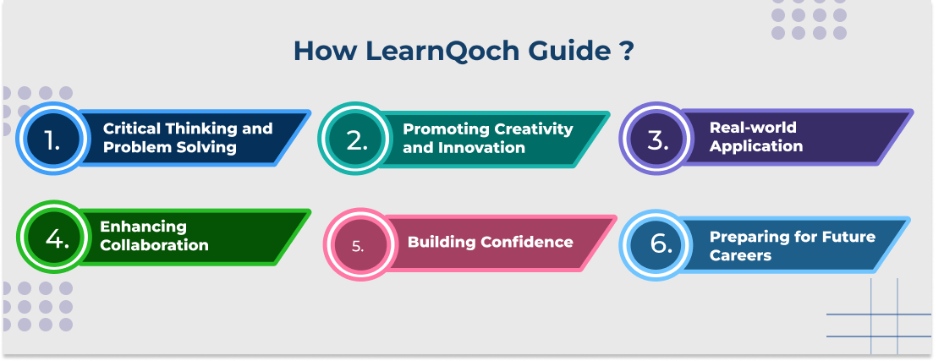
How LearnQoch Guide ?
Fostering Critical Thinking and Problem Solving:
Coding and robotics encourage students to think critically and solve complex problems. While engaging in coding exercises or working on robotics projects, learners analyze challenges, break them down into smaller components, and develop logical, structured solutions. This process of decomposition and solution-building lays the foundation for strong problem-solving skills, a critical asset in any STEM-related field.
Promoting Creativity and Innovation:
STEM education through coding and robotics provides an ideal platform for students to unleash their creativity and innovative thinking. Coding, often regarded as a form of digital artistry, allows students to design programs, apps, and games that reflect their unique ideas. In robotics, students design, build, and program robots, fostering hands-on innovation. These activities not only spark creativity but also cultivate curiosity, experimentation, and a passion for discovery.
Real-world Application:
A key feature of coding and robotics in STEM education is their direct connection to real-world applications. Students are not limited to theoretical knowledge—they actively engage in projects that mirror practical scenarios. Whether writing code for a software application or programming a robot to execute specific tasks, learners acquire hands-on, applicable skills that extend far beyond the classroom. This experiential approach is central to STEM coding and robotics in Mumbai, enabling students to translate learning into real-world problem-solving and innovation.
Enhancing Collaboration and Teamwork:
Coding and robotics projects often require collaboration and effective teamwork. Students work together to brainstorm ideas, troubleshoot problems, and bring projects to completion. This collaborative environment mirrors professional settings, where interdisciplinary teams solve complex challenges. Learning to communicate, coordinate, and contribute effectively in a team is a transferable skill valuable across all career paths.
Building Confidence and Perseverance:
Coding and robotics can be challenging, demanding patience, perseverance, and resilience. As students overcome difficulties in their projects, they build self-confidence and belief in their abilities. The iterative nature of coding, where trial and error are integral, fosters a growth mindset, teaching students that mistakes are stepping stones to success rather than setbacks.
Preparing for Future Careers:
The demand for STEM professionals is growing rapidly, and proficiency in coding and robotics is becoming a core requirement for many emerging career paths. Early exposure equips students with a competitive edge in an increasingly technology-driven job market. STEM education through coding and robotics also introduces learners to a broad spectrum of opportunities, including software development, robotics engineering, artificial intelligence, and data science, preparing them to thrive in high-tech, future-focused careers.
LearnQoch: Guiding the Next Generation
LearnQoch is an online, code-leading platform for kids that seamlessly blends coding and STEM-based learning. By combining interactive lessons, engaging projects, and hands-on activities, it empowers students to explore, experiment, and develop essential future-ready skills. This innovative approach defines LearnQoch STEM in Mumbai, where young learners gain practical knowledge, creativity, and problem-solving abilities in a fun and immersive environment. LearnQoch nurtures problem-solving abilities, creativity, collaboration, and technical skills, empowering students to become confident, innovative, and future-ready technology leaders.
Conclusion
The world of coding and robotics is no longer a distant future—it is shaping the present
In today’s fast-evolving digital world, coding and robotics have emerged as essential pillars of STEM education, equipping students with future-ready skills such as critical thinking, creativity, problem-solving, and collaboration. Early exposure to these disciplines not only enhances technical proficiency but also nurtures confidence, resilience, and innovation, preparing learners to excel in a variety of technology-driven careers. This approach is at the core of STEM education in Nagpur, where students gain hands-on experience and practical skills to thrive in the digital era.
Aligned with the National Education Policy (NEP 2020), which emphasizes 21st-century skills, experiential learning, and technology integration, STEM education ensures students are prepared for the digital economy and global opportunities. By learning to code and work with robots, children gain hands-on experience that translates into real-world applications, making them capable, adaptable, and forward-thinking problem-solvers.
LearnQoch plays a pivotal role in this educational journey by providing an interactive, engaging, and comprehensive online platform where kids can explore coding and robotics, complete hands-on projects, and develop skills that go beyond the classroom. With LearnQoch, children don’t just learn—they create, innovate, and build a strong foundation for success in high-tech careers.
Ultimately, coding and robotics are more than just skills—they are superpowers for the next generation. By fostering curiosity, experimentation, and critical thinking, these disciplines empower students to thrive in a technology-driven, competitive world and become the innovators, leaders, and problem-solvers of tomorrow. This transformative impact highlights the coding and robotics benefits in Vidarbha, preparing students to navigate and excel in the challenges of the future.
The LearnQoch AI powered Academic Platform
LearnQoch goes further by providing an integrated platform that covers all aspects of institutional growth:

Institutional Digital Ecosystem: Categories & Modules
A. LearnQoch AI powered Core Academic & Learning Solutions
Facilitates modern teaching and learning while tracking student progress, assignments, assessments, and course outcomes.
Focuses on measuring learning outcomes to ensure skills, competencies, and academic objectives are met effectively.
- LearnQoch AI powered Academic Calendar & Events
Maintains academic schedules, holidays, events, and exam timelines for seamless yearly planning.
- LearnQoch AI powered Class Module
Manages class creation, faculty allocation, and student grouping while supporting timetable integration.
B. LearnQoch AI powered Examination & Evaluation Management
LearnQoch AI Powered Exam Management Module
A unified system that digitizes the entire exam cycle—right from planning, subject allocation, ATKT processing, and scheduling to question paper creation, assessments, evaluation, and result generation. It ensures transparency, accuracy, and smooth coordination across all departments.
C. LearnQoch AI powered Campus Administration & Operations
Streamlines administrative activities, simplifies student data management, and ensures workflow automation across all departments.
- LearnQoch AI powered Task Management
Organizes, prioritizes, and tracks institutional tasks to improve productivity and accountability.
- LearnQoch AI powered Committee Module
Handles committee formation, roles, activities, and meeting records to maintain governance transparency.
- LearnQoch AI powered Document Management
Stores, organizes, and retrieves institutional documents with version control and compliance tracking.
- LearnQoch AI powered Certificate Management
Manages creation and issuance of academic and administrative certificates such as Bonafide, character, and leaving certificates.
D. LearnQoch AI powered Finance & Fees Management
- LearnQoch AI powered Finance Module – Receivable (Fees)
Tracks payments, manages fee categories, handles tuition/fines, and maintains fee-related records.
- LearnQoch AI powered Advanced Fees
Payments made before the due date, helping institutions and parents manage fee planning efficiently.
- LearnQoch AI powered Excess Fees
Extra amount paid unintentionally; recorded for adjustment in future payments or refunded when necessary.
E. LearnQoch AI powered Library & Resource Management
LearnQoch AI powered Library Module
Manages book registration, issue-return process, renewals, student access, and availability tracking for efficient library operations.
F. LearnQoch AI powered Placement & Career Development
- LearnQoch AI powered Placement Module
Manages job postings, student registration, interview updates, and final offer letters with complete transparency for TPOs and students.
- LearnQoch AI powered Skill Development Solutions
Equips students with future-ready skills to enhance employability and prepare for global career opportunities.
G. LearnQoch AI powered Accreditation & Compliance
LearnQoch AI powered NAAC, NBA & NIRF Compliance
Simplifies reporting, monitoring, and auditing with ready-to-use compliance tools that reduce institutional workload.
H. LearnQoch AI powered Digital Presence & Branding
LearnQoch AI powered Website & Digital Marketing Solutions
Helps institutions build a strong online presence, attract prospective students, and engage key stakeholders effectively.
Don’t Just Take Our Word for It—Try LearnQoch Yourself!
We invite you to experience the transformative impact of LearnQoch’s AI powered Digitize Platform with a 14-Day Free Trial.
During this period, our team will implement the software for your institution, allowing you to explore its features firsthand and see the difference it can make in academic management.
👉 Are you ready to lead your institution into the future of campus management?
📞 Contact us at +91 84519 01079
📧 Email: info@learnqoch.com / sales@learnqoch.com
Explore What LearnQoch Offers:
Visit www.learnqoch.com for Full Details
FAQs: Exploring the Benefits of STEM Education Through Coding and Robotics
1. How do coding and robotics support STEM education?
Coding and robotics make STEM learning practical and hands-on by helping students apply science, technology, engineering, and mathematics concepts to real-world problem-solving.
2. What skills do students gain from learning coding and robotics?
Students develop critical thinking, creativity, logical reasoning, collaboration, and early exposure to technologies such as AI, automation, and computational thinking.
3. At what age can students start learning coding and robotics?
Students can begin as early as primary school with age-appropriate tools, gradually progressing to advanced concepts as their understanding grows.
4. How does STEM education prepare students for future careers?
STEM education builds future-ready skills aligned with emerging industries, enabling students to adapt to technological advancements and diverse career pathways.
Also read,
From Inquiry to Enrollment: Mapping the Student Journey via Your Website
5 Things Every Principal Needs to Know About Exam Management Technology
Coding and Robotics in Remote Learning: Strategies for Success
Best LMS for Schools: The Future of Learning Management Systems