


Role of Technology in Streamlining NAAC Documentation


In the realm of education, accreditation from reputable bodies like the National Assessment and Accreditation Council (NAAC) serves as a hallmark of quality and institutional excellence. Moreover, in today’s rapidly evolving academic landscape, accreditation is not just a recognition but also a necessity for ensuring continuous improvement and accountability.
At the same time, with the introduction of the National Education Policy 2020 (NEP 2020), the focus on quality education, outcome-based learning, and institutional transparency has significantly increased. Consequently, educational institutions are now expected to maintain more structured, data-driven, and evidence-based documentation to align with both NAAC standards and NEP 2020 guidelines.
However, achieving and sustaining accreditation is a multifaceted process. In particular, one of the most challenging aspects is managing extensive documentation related to academics, administration, faculty performance, and student outcomes. Traditionally, this process has been manual, time-consuming, and prone to errors. Therefore, institutions often struggle to keep data updated, organized, and readily accessible during audits and evaluations.
This is where technology plays a transformative role. By digitizing documentation and automating workflows, institutions can significantly streamline the NAAC process. Furthermore, modern solutions enable real-time data management, seamless collaboration, and accurate reporting, thereby reducing the administrative burden.
In this blog post, we will explore how technology is revolutionizing NAAC documentation. Additionally, we will highlight how institutions can leverage digital tools to make their accreditation journey more efficient, accurate, and fully aligned with the vision of NEP 2020.
The Complexity of NAAC Documentation
NAAC accreditation demands a comprehensive and well-documented representation of an institution’s policies, practices, and outcomes. The documentation process covers diverse areas such as curriculum design, faculty development, infrastructure, governance, and more. As institutions aim for higher accreditation grades, the documentation requirements become more intricate, requiring a strategic approach to organization and presentation.
One of the biggest challenges in getting NAAC accreditation is documentation. NAAC requires a vast amount of documentation, including institutional data, self-assessment reports, academic and administrative audit reports, and student feedback. Preparing these documents can be time-consuming and requires a lot of effort. In this context, NAAC documentation tech plays a crucial role by digitizing, organizing, and automating document management, making the accreditation process faster, more accurate, and less burdensome for institutions.
LearnQoch, an integrated ERP & LMS Software, can help institutions store and manage their documents securely. It has a document management system that allows institutions to create, store, and share documents easily. The software also includes a self-study report module that helps institutions prepare their self-study report efficiently, with the added support of LearnQoch Mumbai to ensure region-specific guidance and streamlined implementation.
Challenges in Manual Documentation
Historically, institutions relied heavily on manual documentation processes, involving a plethora of paperwork, spreadsheets, and cumbersome filing systems. This approach posed several challenges, and in the context of Vidarbha role, it highlights the critical need for region-focused digital solutions that streamline documentation, reduce errors, and enhance efficiency in accreditation and administrative workflows:
- Time-Consuming: Manual documentation is time-intensive, diverting valuable resources from core educational activities.
- Error-Prone: Human errors are inherent in manual processes, potentially compromising the accuracy of the information presented during NAAC evaluations.
- Version Control: Managing multiple versions of documents, updates, and revisions becomes a logistical challenge without a centralized system.
- Limited Accessibility: Physical documents and traditional filing systems restrict accessibility, hindering collaboration among different departments.
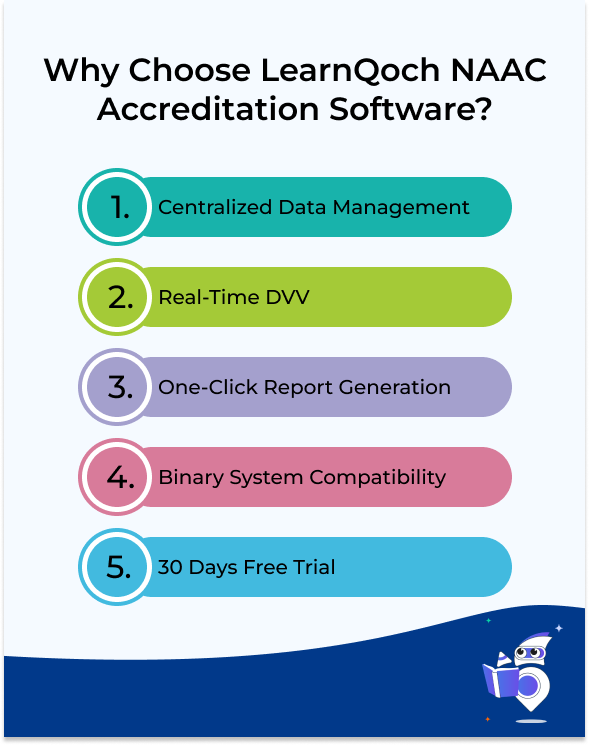
Why Choose LearnQoch NAAC Accreditation Software?
1. Centralized Data Management
Manage all your NAAC-related data in one unified platform, eliminating scattered records. This ensures easy access, better accuracy, and faster decision-making during the accreditation process.
2. Real-Time DVV
Stay updated with real-time Data Validation and Verification (DVV) insights. This helps institutions quickly identify gaps and make necessary corrections without delays, making DVV automation a crucial tool for ensuring accuracy, compliance, and efficiency in the accreditation process.
3. One-Click Report Generation
Generate comprehensive NAAC reports instantly with just a click. This not only saves time but also reduces manual errors and ensures compliance with NAAC standards.
4. Binary System Compatibility
Seamlessly integrate with existing institutional systems through advanced compatibility features. As a result, data flow remains smooth without disrupting current operations.
5. 30 Days Free Trial
Experience the full potential of LearnQoch with a risk-free 30-day trial. This allows institutions to explore features, evaluate benefits, and make confident decisions.
How LearnQoch can help in NAAC Documentation
Advancements in technology have brought about a paradigm shift in the way institutions approach documentation for accreditation purposes. Here’s how technology, when strategically implemented, can streamline NAAC documentation, making processes more efficient, accurate, and audit-ready, in the context of AI streamlining.
1. Centralized Document Management Systems:
Modern Document Management Systems (DMS) provide a centralized platform for storing, organizing, and retrieving documents. This eliminates the need for scattered physical files and enables institutions to have a single repository for all accreditation-related documents. These systems often include version control features, ensuring that the most up-to-date information is readily available.
2. Electronic Portfolios:
Transitioning from traditional binders to electronic portfolios simplifies the presentation of documentation during NAAC evaluations. Electronic portfolios allow institutions to showcase evidence of compliance, including reports, policies, and outcomes, in a more organized and visually appealing manner. This not only enhances the evaluators’ experience but also makes it easier for institutions to navigate the accreditation process.
3. Collaborative Tools for Teamwork:
Institutions are complex ecosystems involving multiple departments and stakeholders. Collaborative tools, such as cloud-based platforms and project management software, facilitate teamwork and streamline the collaborative aspects of documentation. These tools enable real-time collaboration, ensuring that everyone involved has access to the latest information and can contribute seamlessly to the documentation process.
4. Automation of Routine Processes:
Automation technologies can be employed to streamline routine processes involved in documentation. For example, workflow automation can be implemented to route documents for approvals, track progress, and send notifications for upcoming deadlines. This not only reduces administrative burdens but also minimizes the risk of overlooking critical steps in the documentation process.
5. Data Analytics for Insights:
Technology enables institutions to go beyond mere documentation and extract valuable insights from the data collected. Data analytics tools can help identify trends, assess the impact of implemented policies, and demonstrate the effectiveness of various initiatives. These insights not only contribute to accreditation efforts but also inform strategic decision-making within the institution.
6. Mobile Accessibility:
In an era of remote work and flexible schedules, mobile accessibility is paramount. Accreditation documentation platforms that offer mobile apps or responsive web interfaces empower users to access and contribute to documentation from anywhere, fostering a more agile and responsive approach to accreditation requirements.
7. Integration with Existing Systems:
To maximize efficiency, technology solutions for NAAC documentation should seamlessly integrate with existing institutional systems, such as Enterprise Resource Planning (ERP) and Learning Management Systems (LMS). This integration ensures that relevant data is readily available for documentation purposes, reducing redundancy and enhancing data accuracy.
8. Digitization
The process of documentation can be simplified by digitalization. Institutions can use document management software to store and manage their documents. This will not only make the documentation process easier but will also ensure that the documents are easily accessible and secure.
ERP (Enterprise Resource Planning) and LMS (Learning Management System) software are two essential tools that can help organizations with digitization. Both software solutions can be used to streamline processes, automate routine tasks, and enhance communication and collaboration among stakeholders.
By leveraging the power of technology, institutions can improve their performance, gain credibility, and provide a better learning experience for their students. Therefore, institutions must embrace digital solutions such as LearnQoch to meet the challenges of NAAC accreditation and succeed in the competitive higher education landscape.
LearnQoch has built an ERP & LMS system that simplifies and automates lengthy processes.
It helps institutions store the various institution reports – admission, program details, student reports, etc and generates various
reports related to NBA & NAAC Accreditation.
To enhance Accreditation-related data & enhance the quality assurance standards of your institution, choose LearnQoch Software.
The LearnQoch AI powered Academic Platform
LearnQoch goes further by providing an integrated platform that covers all aspects of institutional growth:

Institutional Digital Ecosystem: Categories & Modules
A. LearnQoch AI powered Core Academic & Learning Solutions
Facilitates modern teaching and learning while tracking student progress, assignments, assessments, and course outcomes.
Focuses on measuring learning outcomes to ensure skills, competencies, and academic objectives are met effectively.
- LearnQoch AI powered Academic Calendar & Events
Maintains academic schedules, holidays, events, and exam timelines for seamless yearly planning.
- LearnQoch AI powered Class Module
Manages class creation, faculty allocation, and student grouping while supporting timetable integration.
B. LearnQoch AI powered Examination & Evaluation Management
LearnQoch AI Powered Exam Management Module
A unified system that digitizes the entire exam cycle—right from planning, subject allocation, ATKT processing, and scheduling to question paper creation, assessments, evaluation, and result generation. It ensures transparency, accuracy, and smooth coordination across all departments.
C. LearnQoch AI powered Campus Administration & Operations
Streamlines administrative activities, simplifies student data management, and ensures workflow automation across all departments.
- LearnQoch AI powered Task Management
Organizes, prioritizes, and tracks institutional tasks to improve productivity and accountability.
- LearnQoch AI powered Committee Module
Handles committee formation, roles, activities, and meeting records to maintain governance transparency.
- LearnQoch AI powered Document Management
Stores, organizes, and retrieves institutional documents with version control and compliance tracking.
- LearnQoch AI powered Certificate Management
Manages creation and issuance of academic and administrative certificates such as Bonafide, character, and leaving certificates.
D. LearnQoch AI powered Finance & Fees Management
- LearnQoch AI powered Finance Module – Receivable (Fees)
Tracks payments, manages fee categories, handles tuition/fines, and maintains fee-related records.
- LearnQoch AI powered Advanced Fees
Payments made before the due date, helping institutions and parents manage fee planning efficiently.
- LearnQoch AI powered Excess Fees
Extra amount paid unintentionally; recorded for adjustment in future payments or refunded when necessary.
E. LearnQoch AI powered Library & Resource Management
LearnQoch AI powered Library Module
Manages book registration, issue-return process, renewals, student access, and availability tracking for efficient library operations.
F. LearnQoch AI powered Placement & Career Development
- LearnQoch AI powered Placement Module
Manages job postings, student registration, interview updates, and final offer letters with complete transparency for TPOs and students.
- LearnQoch AI powered Skill Development Solutions
Equips students with future-ready skills to enhance employability and prepare for global career opportunities.
G. LearnQoch AI powered Accreditation & Compliance
LearnQoch AI powered NAAC, NBA & NIRF Compliance
Simplifies reporting, monitoring, and auditing with ready-to-use compliance tools that reduce institutional workload.
H. LearnQoch AI powered Digital Presence & Branding
LearnQoch AI powered Website & Digital Marketing Solutions
Helps institutions build a strong online presence, attract prospective students, and engage key stakeholders effectively.
Don’t Just Take Our Word for It—Try LearnQoch Yourself!
We invite you to experience the transformative impact of LearnQoch’s AI powered Digitize Platform with a 14-Day Free Trial.
During this period, our team will implement the software for your institution, allowing you to explore its features firsthand and see the difference it can make in academic management.
👉 Are you ready to lead your institution into the future of campus management?
📞 Contact us at +91 84519 01079
📧 Email: info@learnqoch.com / sales@learnqoch.com
Explore What LearnQoch Offers:
Visit www.learnqoch.com for Full Details
Also Read,
A Boon for Teachers: How LearnQoch NAAC Accreditation Software Transforms Academic Workload
Where Is the Criteria-Wise Data From June 2024 to Date for NAAC Submission?
New NAAC Accreditation System: How Colleges Can Adapt with LearnQoch