
Unlocking Student Success: How Assessment and Feedback Tools in LMS Improve Learning Outcomes


Education today is no longer about memorizing facts or waiting until the final exam to understand how well a student has learned. True learning is active, reflective, and continuous. It thrives in an environment where students receive timely guidance, understand their strengths and weaknesses, and are encouraged to improve step by step—an approach strongly aligned with the vision of National Education Policy 2020 through effective LMS assessment and continuous feedback.
Imagine a classroom where students don’t anxiously wait for end-term grades to know their performance. Instead, they receive ongoing, meaningful feedback that supports competency-based learning, self-improvement, and holistic development. This is not a futuristic dream—it is the reality made possible by LMS assessment and feedback tools in Learning Management Systems (LMS), as envisioned under NEP 2020’s focus on formative and continuous evaluation.
Modern LMS platforms are redefining how educators teach and how students learn. They go far beyond hosting content or conducting online exams. With robust assessment and feedback tools, an LMS enables personalized learning pathways, continuous assessment, and outcome-based education—driving stronger learning outcomes in line with the principles of National Education Policy 2020.
In this blog, we explore how assessment and feedback tools in LMS unlock student success, support NEP 2020’s learner-centric framework, and how platforms like LearnQoch empower institutions to build feedback-rich, transparent, and future-ready learning environments.
LMS: More Than a Content Delivery Platform
Traditionally, LMS platforms were viewed as repositories for notes, presentations, and recorded lectures across Mumbai schools, Nagpur colleges, and Vidarbha schools. While content delivery is important, it is only one part of the learning journey.
A modern LMS functions as a virtual classroom—a space where teaching, learning, assessment, and feedback happen continuously. When assessment and feedback tools are used effectively, an LMS can transform learning experiences in Mumbai schools, Nagpur colleges, and Vidarbha schools by:
- Personalize learning for every student
- Track academic progress in real time
- Identify learning gaps early
- Encourage self-reflection and improvement
- Support educators with actionable insights
In short, assessment and feedback transform LearnQoch LMS platforms from passive systems into active learning ecosystems.
Key Assessment and Feedback Tools in LMS
1. Quizzes and Tests
Quizzes are among the most widely used assessment tools in LearnQoch LMS platforms. However, modern LearnQoch LMS quizzes are far more advanced than traditional paper-based tests.
Key features include:
- Instant feedback after submission
- Multiple formats (MCQs, true/false, short answers, matching)
- Time-bound and adaptive assessments
- Automated grading and analytics
- Question banks with randomization
Immediate feedback helps students identify mistakes instantly, reinforcing learning while the concept is still fresh
2. Assignments and Projects
Assignments allow students to demonstrate learning creatively and practically. LearnQoch LMS platforms simplify the entire workflow—from submission to grading and feedback.
Benefits include:
- Digital submission of documents, videos, or presentations
- Clear deadlines and plagiarism checks
- Rubric-based evaluation
- Detailed instructor comments and annotations
Timely and structured feedback on assignments helps students improve skills such as writing, analysis, problem-solving, and research.
3. Discussion Forums
Discussion forums promote collaborative learning and peer interaction. They encourage students to express ideas, ask questions, and engage in meaningful academic dialogue.
Why forums matter:
- Encourage critical thinking and communication
- Reveal conceptual misunderstandings
- Foster peer-to-peer learning
- Provide qualitative assessment insights
Educators can assess participation, depth of understanding, and engagement beyond test scores.
4. Surveys and Polls
Surveys and polls are quick yet powerful tools to capture student opinions and feedback.
Use cases include:
- Understanding student confidence levels
- Evaluating course effectiveness
- Gathering anonymous feedback
- Adjusting teaching strategies in real time
These tools help institutions create learner-centric environments where student voices matter.
5. Self-Assessments
Self-assessment tools encourage students to reflect on their own learning journey.
Benefits include:
- Promoting self-awareness and responsibility
- Encouraging goal setting and improvement
- Developing lifelong learning skills
When students evaluate their own performance, learning becomes more meaningful and personalized.
The Power of a Feedback Loop in LMS
Assessment is not just about grading—it is a conversation between educators and learners. A strong feedback loop ensures that assessment results lead to improvement rather than anxiety.
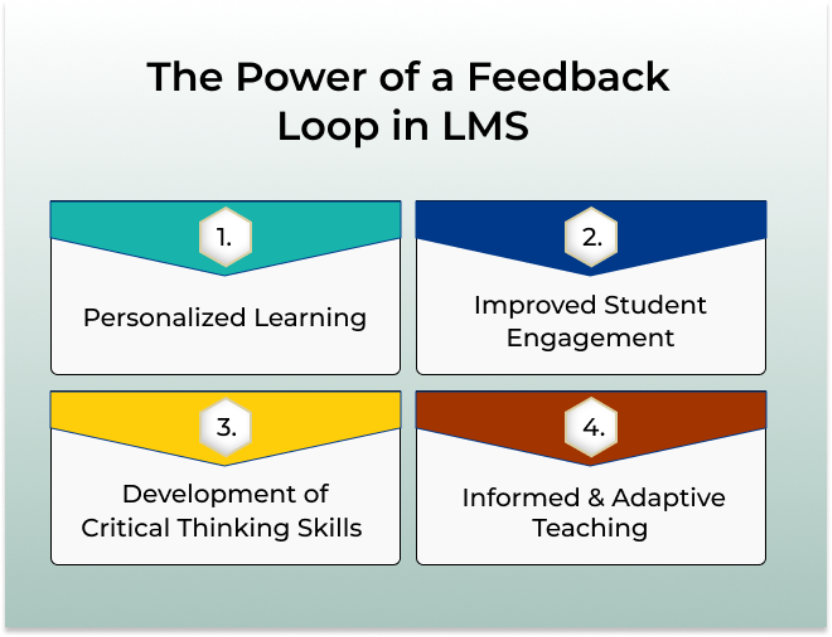
Here’s how a feedback loop transforms learning:
1. Personalized Learning
Every student learns at a different pace and in different ways. LMS analytics help educators identify individual learning gaps and strengths.
Result:
- Feedback tailored to each student’s needs
- Targeted remediation and enrichment
- Improved learning confidence
Personalized feedback turns assessments into growth opportunities.
2. Improved Student Engagement
Regular, constructive feedback keeps students motivated. When learners see their progress, they feel encouraged to stay engaged.
Impact:
- Higher participation rates
- Better course completion
- Reduced dropout rates
Feedback makes learning visible and rewarding.
3. Development of Critical Thinking Skills
Feedback helps students analyze mistakes, reflect on performance, and apply corrections.
Outcome:
- Stronger problem-solving skills
- Improved analytical thinking
- Greater independence in learning
Learning becomes deeper and more meaningful.
4. Informed and Adaptive Teaching
Educators benefit just as much from LMS feedback tools. Real-time analytics provide insights into what works and what doesn’t work.
Advantages for teachers:
- Adjust lesson plans based on student performance
- Improve content delivery
- Identify struggling learners early
Teaching becomes data-driven and responsive.
Why Assessment and Feedback Tools Matter for NEP 2020
India’s National Education Policy (NEP) 2020 emphasizes personalized, competency-based, and holistic education, and LMS-based assessment and feedback tools play a critical role in achieving these goals.
With LMS tools, institutions can implement formative and continuous assessments, support self-paced and adaptive learning, promote reflection and self-assessment, maintain transparent digital academic records, and shift the focus from rote learning to true competency development.
Additionally, LMS platforms enable data-driven decision-making, inclusive evaluation practices, and timely academic interventions aligned with NEP 2020’s learner-centric vision. By integrating LMS-based assessments, institutions move beyond compliance and become truly NEP-ready, future-focused, and outcome-driven.
Conclusion:
Assessment today goes beyond final evaluations—it drives continuous learning and improvement. Modern LMS platforms enable real-time insights, personalized feedback, and holistic assessment, helping students take ownership of their learning while supporting educators with actionable data. Aligned with NEP 2020, these tools promote competency-based, formative, and learner-centric education. By embracing assessment as an ongoing process, institutions can create transparent, future-ready systems that truly enhance student success.
The LearnQoch AI powered Academic Platform
LearnQoch goes further by providing an integrated platform that covers all aspects of institutional growth:

Institutional Digital Ecosystem: Categories & Modules
A. LearnQoch AI powered Core Academic & Learning Solutions
Facilitates modern teaching and learning while tracking student progress, assignments, assessments, and course outcomes.
Focuses on measuring learning outcomes to ensure skills, competencies, and academic objectives are met effectively.
- LearnQoch AI powered Academic Calendar & Events
Maintains academic schedules, holidays, events, and exam timelines for seamless yearly planning.
- LearnQoch AI powered Class Module
Manages class creation, faculty allocation, and student grouping while supporting timetable integration.
B. LearnQoch AI powered Examination & Evaluation Management
LearnQoch AI Powered Exam Management Module
A unified system that digitizes the entire exam cycle—right from planning, subject allocation, ATKT processing, and scheduling to question paper creation, assessments, evaluation, and result generation. It ensures transparency, accuracy, and smooth coordination across all departments.
C. LearnQoch AI powered Campus Administration & Operations
Streamlines administrative activities, simplifies student data management, and ensures workflow automation across all departments.
- LearnQoch AI powered Task Management
Organizes, prioritizes, and tracks institutional tasks to improve productivity and accountability.
- LearnQoch AI powered Committee Module
Handles committee formation, roles, activities, and meeting records to maintain governance transparency.
- LearnQoch AI powered Document Management
Stores, organizes, and retrieves institutional documents with version control and compliance tracking.
- LearnQoch AI powered Certificate Management
Manages creation and issuance of academic and administrative certificates such as Bonafide, character, and leaving certificates.
D. LearnQoch AI powered Finance & Fees Management
- LearnQoch AI powered Finance Module – Receivable (Fees)
Tracks payments, manages fee categories, handles tuition/fines, and maintains fee-related records.
- LearnQoch AI powered Advanced Fees
Payments made before the due date, helping institutions and parents manage fee planning efficiently.
- LearnQoch AI powered Excess Fees
Extra amount paid unintentionally; recorded for adjustment in future payments or refunded when necessary.
E. LearnQoch AI powered Library & Resource Management
LearnQoch AI powered Library Module
Manages book registration, issue-return process, renewals, student access, and availability tracking for efficient library operations.
F. LearnQoch AI powered Placement & Career Development
- LearnQoch AI powered Placement Module
Manages job postings, student registration, interview updates, and final offer letters with complete transparency for TPOs and students.
- LearnQoch AI powered Skill Development Solutions
Equips students with future-ready skills to enhance employability and prepare for global career opportunities.
G. LearnQoch AI powered Accreditation & Compliance
LearnQoch AI powered NAAC, NBA & NIRF Compliance
Simplifies reporting, monitoring, and auditing with ready-to-use compliance tools that reduce institutional workload.
H. LearnQoch AI powered Digital Presence & Branding
LearnQoch AI powered Website & Digital Marketing Solutions
Helps institutions build a strong online presence, attract prospective students, and engage key stakeholders effectively.
Don’t Just Take Our Word for It—Try LearnQoch Yourself!
We invite you to experience the transformative impact of LearnQoch’s Digitize Platform with a 14-Day Free Trial.
During this period, our team will implement the software for your institution, allowing you to explore its features firsthand and see the difference it can make in academic management.
👉 Are you ready to lead your institution into the future of campus management?
📞 Contact us at +91 84519 01079
📧 Email: info@learnqoch.com /sales@learnqoch.com
Explore What LearnQoch Offers:
Visit www.learnqoch.com for Full Details
Also Read,
How LMS Empowers Teachers to Focus on What Matters Most
How to Check Students’ Concept Understanding Daily?
Bridging the Gap Between Institutional Goals and Student Outcomes