



The Future of School ERP Systems: Trends Transforming Education


The educational landscape is undergoing rapid and far-reaching digital transformation. Traditional practices such as paper-based records, manual processes, and siloed departmental operations are steadily becoming obsolete. In their place, schools are increasingly adopting School ERP (Enterprise Resource Planning) systems, shaping the future of ERP by streamlining administrative tasks, improving operational efficiency, and delivering a more seamless experience for students, parents, teachers, and administrators alike.
As institutions continue to adapt to changing expectations, ERP systems have evolved from simple administrative tools to strategic platforms that support data-driven decision-making and holistic school management. Moreover, with growing student populations and increasing regulatory requirements, schools need flexible, scalable solutions that can adapt to their unique needs—highlighting the future of ERP as an essential component of modern educational infrastructure.
Looking ahead, the future of School ERP systems will be shaped by a range of emerging technologies and trends. Advancements in artificial intelligence, analytics, and automation are expected to enhance personalization, predictive insights, and operational efficiency. At the same time, cloud-based platforms and mobile accessibility will ensure greater flexibility and real-time access to information. Additionally, closer alignment with policies like NEP 2020 will drive the adoption of student-centric, technology-enabled solutions, defining AI‑ERP trends for smart schools.
In essence, School ERP systems are no longer just tools for managing operations—they are becoming enablers of innovation and transformation. As we look toward the future, these systems will play a pivotal role in shaping smarter, more connected, and future-ready educational institutions.
This blog explores …..
This blog explores how School ERP systems are transforming modern education through digital innovation. It highlights the shift from manual processes to integrated, technology-driven platforms that improve efficiency and transparency. Additionally, it discusses emerging trends such as AI, automation, and cloud-based solutions shaping the future of ERP systems. The blog also emphasizes how these systems support better decision-making and align with evolving educational policies like NEP 2020, featuring predictive analytics for Mumbai schools.
Cloud-Based Solutions Take Center Stage
One of the biggest shifts in the future of School ERP systems is the rise of cloud-based solutions. These systems offer:
- Accessibility from any internet-connected device
- Elimination of on-site servers
- Easier IT management
- Real-time data access for teachers, students, and administrators
Cloud-based ERPs are cost-effective, scalable, and perfect for schools looking to modernize their infrastructure.
Artificial Intelligence (AI) Is Driving Personalization
AI integration is revolutionizing education. In School ERP systems, AI helps:
- Analyze student data
- Recognize learning patterns
- Recommend personalized learning paths
- Automate administrative tasks like scheduling and fee tracking
With AI, educators can focus more on teaching while leaders make data-driven decisions using predictive analytics.
Security and Privacy Remain Paramount
The future of School ERP systems depends heavily on robust data security and privacy. With sensitive student information stored digitally, the following measures are essential:
- Advanced encryption
- Multi-factor authentication
- Threat monitoring systems
Schools must invest in ERP platforms that prioritize cybersecurity.
Mobile Apps: Access at Your Fingertips
Mobile usage in education is soaring. The best School ERP systems now offer dedicated mobile apps for:
- Real-time communication
- Assignment tracking
- Accessing attendance and results
- Notifications and alerts
These apps ensure that students, parents, and teachers stay connected from anywhere, anytime.
ERP and LMS Integration: One Unified Platform
Integrating School ERP systems with Learning Management Systems (LMS) is no longer a luxury—it’s a necessity. This integration provides:
- Streamlined academic and administrative processes
- Centralized access to learning content and reports
- Improved collaboration between departments
The result is a seamless digital learning environment that boosts both efficiency and student engagement.
Immersive Learning with VR and AR
Virtual Reality (VR) and Augmented Reality (AR) are set to become major components of the future of School ERP systems. These tools enable:
- Virtual field trips
- Immersive science experiments
- Interactive history lessons
ERP systems can schedule, monitor, and manage these experiences, offering students a rich, engaging educational journey.
Internet of Things (IoT) for Smart Schools
The Internet of Things (IoT) refers to a network of connected devices that collect and share data. In education, IoT integration with ERP systems means:
- Smart classrooms with connected boards and sensors
- Automated attendance via RFID or facial recognition
- Monitoring classroom conditions for safety and comfort
IoT helps schools make data-informed decisions to improve learning environments.
LearnQoch: Powering the Future of School ERP Systems
To navigate the future with confidence, schools need a platform built for innovation. That’s where LearnQoch comes in.
Why Choose LearnQoch?
LearnQoch offers a seamlessly integrated ERP and LMS designed specifically for K-12 schools. Key features include:
- Admissions, fee, HR, inventory, and finance management
- Real-time data dashboards
- Integrated LMS for online courses, assessments, and performance tracking
- Mobile apps for teachers, parents, and students
- AI-powered automation and reporting tools
Whether you’re looking to reduce paperwork, improve communication, or enhance learning outcomes—LearnQoch is your one-stop solution.
A Digital Future for Every School
The future of School ERP systems is bright and full of promise. By embracing trends like cloud computing, AI, VR/AR, mobile apps, IoT, and LMS integration, schools can:
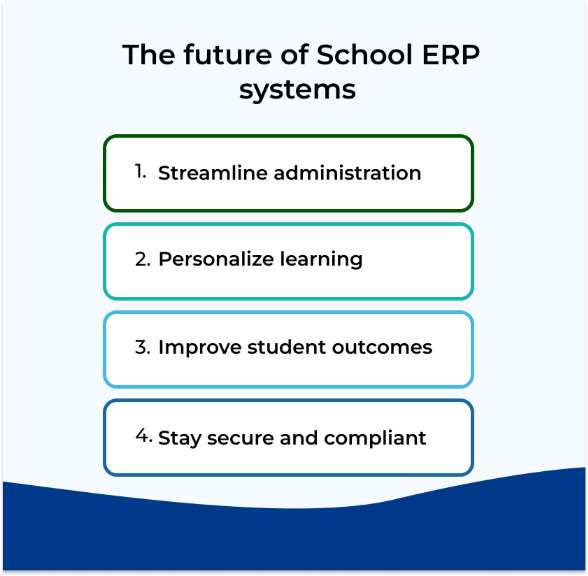
- Streamline administration
- Personalize learning
- Improve student outcomes
- Stay secure and compliant
Conclusion
In a concluding remark, it can be stated that as the educational sector continues to grow in an increasingly technology-first world, the implementation of School ERP systems is not merely advantageous, but the need of the hour. By replacing traditional manual and system-centric practices, such technology helps institutions achieve greater efficiency, transparency, and uniformity across all activities and operations. Additionally, with emerging technologies like artificial intelligence, automation, and advanced data analysis, School ERP systems become more powerful, flexible, and adaptive to the evolving needs of educational institutions. They also support the implementation of visionary educational policies like NEP 2020, empowering institutions through technology-based governance and student-centric education for Nagpur elementary-to-higher schools, Vidarbha institutes, and LearnQoch ERP users.
The LearnQoch AI powered Academic Platform
LearnQoch goes further by providing an integrated platform that covers all aspects of institutional growth:

Institutional Digital Ecosystem: Categories & Modules
A. LearnQoch AI powered Core Academic & Learning Solutions
Facilitates modern teaching and learning while tracking student progress, assignments, assessments, and course outcomes.
Focuses on measuring learning outcomes to ensure skills, competencies, and academic objectives are met effectively.
- LearnQoch AI powered Academic Calendar & Events
Maintains academic schedules, holidays, events, and exam timelines for seamless yearly planning.
- LearnQoch AI powered Class Module
Manages class creation, faculty allocation, and student grouping while supporting timetable integration.
B. LearnQoch AI powered Examination & Evaluation Management
LearnQoch AI Powered Exam Management Module
A unified system that digitizes the entire exam cycle—right from planning, subject allocation, ATKT processing, and scheduling to question paper creation, assessments, evaluation, and result generation. It ensures transparency, accuracy, and smooth coordination across all departments.
C. LearnQoch AI powered Campus Administration & Operations
Streamlines administrative activities, simplifies student data management, and ensures workflow automation across all departments.
- LearnQoch AI powered Task Management
Organizes, prioritizes, and tracks institutional tasks to improve productivity and accountability.
- LearnQoch AI powered Committee Module
Handles committee formation, roles, activities, and meeting records to maintain governance transparency.
- LearnQoch AI powered Document Management
Stores, organizes, and retrieves institutional documents with version control and compliance tracking.
- LearnQoch AI powered Certificate Management
Manages creation and issuance of academic and administrative certificates such as Bonafide, character, and leaving certificates.
D. LearnQoch AI powered Finance & Fees Management
- LearnQoch AI powered Finance Module – Receivable (Fees)
Tracks payments, manages fee categories, handles tuition/fines, and maintains fee-related records.
- LearnQoch AI powered Advanced Fees
Payments made before the due date, helping institutions and parents manage fee planning efficiently.
- LearnQoch AI powered Excess Fees
Extra amount paid unintentionally; recorded for adjustment in future payments or refunded when necessary.
E. LearnQoch AI powered Library & Resource Management
LearnQoch AI powered Library Module
Manages book registration, issue-return process, renewals, student access, and availability tracking for efficient library operations.
F. LearnQoch AI powered Placement & Career Development
- LearnQoch AI powered Placement Module
Manages job postings, student registration, interview updates, and final offer letters with complete transparency for TPOs and students.
- LearnQoch AI powered Skill Development Solutions
Equips students with future-ready skills to enhance employability and prepare for global career opportunities.
G. LearnQoch AI powered Accreditation & Compliance
LearnQoch AI powered NAAC, NBA & NIRF Compliance
Simplifies reporting, monitoring, and auditing with ready-to-use compliance tools that reduce institutional workload.
H. LearnQoch AI powered Digital Presence & Branding
LearnQoch AI powered Website & Digital Marketing Solutions
Helps institutions build a strong online presence, attract prospective students, and engage key stakeholders effectively.
Don’t Just Take Our Word for It—Try LearnQoch Yourself!
We invite you to experience the transformative impact of LearnQoch’s Digitize Platform with a 14-Day Free Trial.
During this period, our team will implement the software for your institution, allowing you to explore its features firsthand and see the difference it can make in academic management.
👉 Are you ready to lead your institution into the future of campus management?
📞 Contact us at +91 84519 01079
📧 Email: info@learnqoch.com /sales@learnqoch.com
Explore What LearnQoch Offers:
Visit www.learnqoch.com for Full Details
Q1. What is a School ERP system?
A School ERP is a centralized digital platform that integrates academic, administrative, and financial processes into one system.
Q2. Why are schools adopting ERP systems?
Schools adopt ERP systems to automate tasks, reduce manual work, improve efficiency, and enhance communication among stakeholders.
Q3. How will School ERP systems evolve in the future?
Future ERP systems will leverage AI, automation, analytics, and cloud technology to offer smarter insights and personalized experiences.
Q4. How does ERP support NEP 2020 goals?
ERP systems align with NEP 2020 by enabling digital governance, data-driven planning, transparency, and student-centric education.
Q5. Who benefits most from a School ERP system?
Students, parents, teachers, administrators, and management all benefit through improved access, efficiency, and communication.