


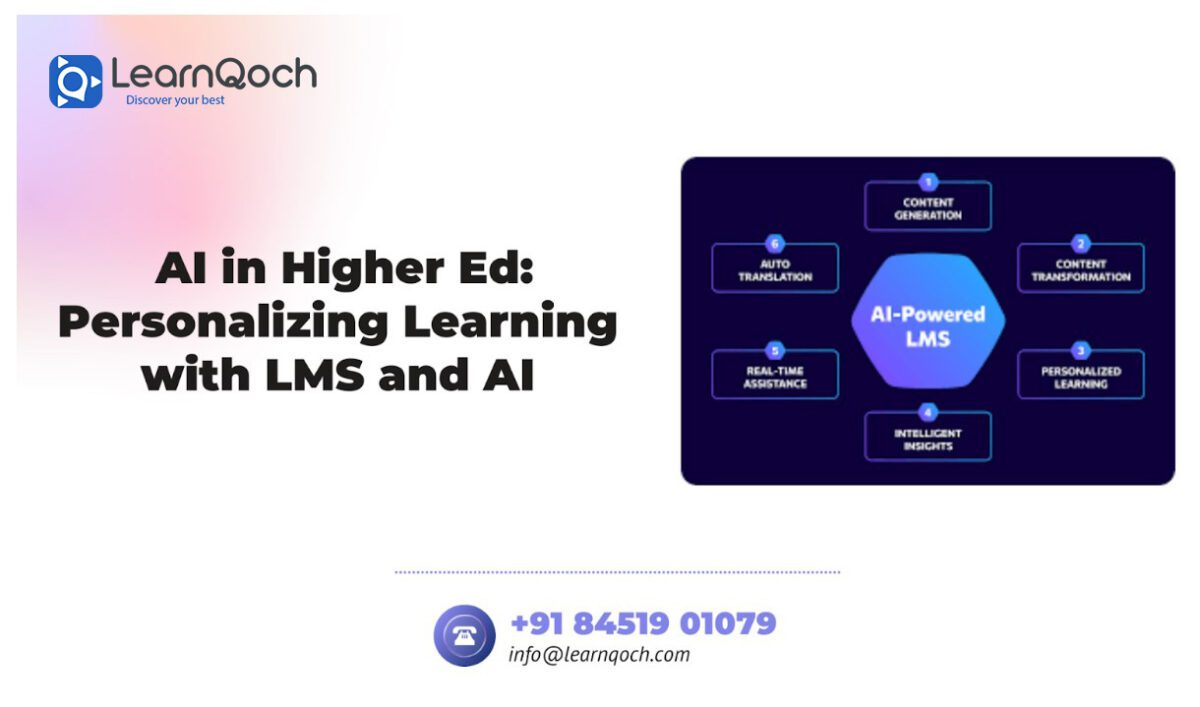
AI-Powered LMS: Transforming Higher Education with Personalized Learning


The landscape of higher education is evolving at an unprecedented pace. Traditional teaching methods, once sufficient for decades, are now being challenged by the growing expectations of digitally native students and the increasing complexity of academic administration. Today’s learners demand flexibility, personalization, instant feedback, and engaging digital experiences. Meeting these expectations requires more than just online content—it requires intelligent systems that can adapt, analyze, and improve continuously through an AI-powered LMS that enables true personalized learning.
This transformation is largely driven by Artificial Intelligence (AI). When integrated into Best Learning Management Systems (LMS) in Mumbai, AI becomes a powerful force that reshapes how students learn, how educators teach, and how institutions operate. AI-powered LMS platforms are no longer optional innovations; they are becoming essential tools for delivering high-quality, personalized learning at scale through an advanced AI-powered LMS.
This blog explores how AI-powered LMS solutions are transforming higher education, the benefits they bring to students and institutions, and why platforms like LearnQoch, with integrated ERP and LMS capabilities, are leading the future of personalized learning.
The Rise of AI in Higher Education
Artificial Intelligence is no longer a futuristic concept limited to research labs or science fiction. It is already embedded in everyday tools—from recommendation engines and virtual assistants to automated customer support systems. In higher education, AI is revolutionizing the way institutions approach teaching, learning, and administration.
Universities and colleges generate massive volumes of data every day. This includes student attendance records, assessment results, interaction logs, course progress, feedback, and administrative data. Manually analyzing this data is nearly impossible. AI bridges this gap by transforming raw data into actionable insights, enabling institutions in higher education to make smarter, faster, and more informed decisions.
By embedding AI into Best LearnQoch LMS platforms in Mumbai, higher education institutions can create intelligent learning environments that continuously adapt to student needs and institutional goals.
The Role of AI in Higher Education
1. Data-Driven Insights for Better Decision-Making
AI excels at analyzing large datasets quickly and accurately. In an academic environment, AI-powered LearnQoch LMS platforms evaluate:
- Student assessment performance
- Participation in discussions and activities
- Learning behavior and engagement patterns
- Course completion rates and academic progress
These insights help educators identify trends that would otherwise go unnoticed. For example, AI can highlight which modules consistently cause difficulty, which teaching strategies yield better outcomes, or which students may need additional support. Administrators can use these insights to improve curriculum design, optimize resource allocation, and enhance institutional performance.
2. Personalized Learning Experiences
One of the most impactful contributions of AI in education is personalization. Every student learns differently—some grasp concepts quickly, while others need more time and reinforcement. Traditional classrooms often struggle to accommodate this diversity.
AI-powered LMS platforms adapt learning content and pacing based on individual student performance. They provide:
- Remedial support for students who are struggling
- Advanced or enrichment content for high-performing learners
- Customized assessments aligned with a student’s progress
This individualized approach ensures that no student is left behind and no learner is held back.
3. Predictive Analytics for Student Success
AI doesn’t just analyze past data—it predicts future outcomes. Predictive analytics plays a crucial role in identifying students who may be at risk of dropping out or underperforming.
By monitoring indicators such as:
- Attendance patterns
- Assignment submission behavior
- Assessment trends
- Engagement levels
AI systems can alert educators early and recommend timely interventions. This proactive approach significantly improves student retention, academic success, and overall satisfaction.
4. Automation of Administrative Tasks
Academic institutions often struggle with time-consuming administrative processes. AI automates routine tasks such as:
- Grading objective assessments
- Attendance tracking
- Class scheduling
- Report generation
Automation reduces human error, saves time, and allows educators to focus on what matters most—teaching, mentoring, and student engagement.
How AI-Driven LearnQoch LMS Personalizes Learning
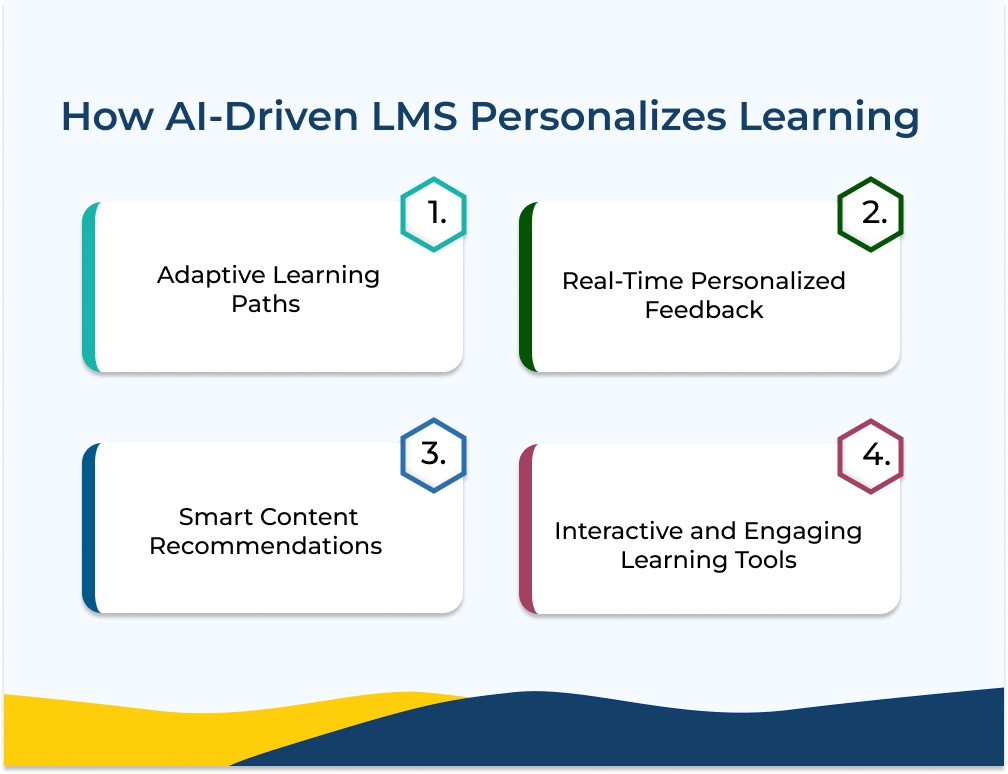
1. Adaptive Learning Paths
AI-powered LearnQoch LMS platforms create adaptive learning paths tailored to each student’s abilities and progress. Instead of following a rigid curriculum, students experience a dynamic learning journey where:
- Content recommendations change based on performance
- Complex topics are revisited with additional resources
- Students advance faster once mastery is achieved
This approach ensures optimal learning outcomes by aligning instructions with individual needs.
2. Real-Time Personalized Feedback
Timely feedback is essential for effective learning. AI-driven LMS systems provide instant and personalized feedback by:
- Identifying learning gaps
- Highlighting recurring mistakes
- Suggesting corrective actions and study materials
This immediate feedback loop helps students correct misunderstandings early, improving comprehension and confidence.
3. Smart Content Recommendations
Much like streaming platforms recommend movies or shows, AI-powered LMS platforms recommend educational content. Based on student behavior, interests, and performance, AI suggests:
- Videos and recorded lectures
- Articles and reading materials
- Quizzes and practice exercises
- Interactive learning modules
These intelligent recommendations keep students engaged and motivated by delivering relevant and timely content.
4. Interactive and Engaging Learning Tools
AI enhances student engagement by supporting interactive tools such as:
- Gamified quizzes and challenges
- Virtual labs and simulations
- AI-powered chatbots for academic and technical support
These tools transform passive learning into active participation, making education more immersive and enjoyable.
Scalability and Inclusivity in Higher Education
One of the biggest challenges in higher education is scaling quality education without increasing costs disproportionately. AI-powered LMS platforms address this challenge effectively.
Scalability Benefits
AI-driven systems can:
- Support thousands of learners simultaneously
- Deliver consistent educational quality across departments
- Scale without compromising performance or personalization
This makes AI-powered LMS solutions ideal for large universities, distance learning programs, and online institutions.
Promoting Inclusivity and Accessibility
AI also plays a critical role in making education more inclusive. AI-powered LMS platforms support diverse learners by:
- Adapting content to different learning styles
- Integrating accessibility tools for learners with disabilities
- Providing multilingual support to overcome language barriers
These features ensure equitable learning opportunities for students from varied backgrounds and abilities.
Why LearnQoch Stands Out: An All-in-One ERP + LMS Platform
While many LMS platforms focus solely on content delivery, LearnQoch goes a step further by integrating ERP and LMS functionalities into a unified AI-powered ecosystem designed specifically for higher education institutions.
Key Features of LearnQoch
AI-Driven Personalization
LearnQoch leverages AI to tailor learning experiences for every student, ensuring optimal engagement and academic success.
Centralized Resource Management
All academic resources, assessments, faculty data, and administrative processes are managed from a single platform, reducing complexity and inefficiency.
Advanced Performance Analytics
Real-time dashboards and analytics enable institutions to track student progress, faculty performance, and institutional metrics with precision.
Scalable and Future-Ready Architecture
LearnQoch grows seamlessly with institutional needs, supporting expansion without system limitations.
The Institutional Benefits of AI-Powered LMS
Adopting an AI-driven LMS like LearnQoch offers long-term strategic advantages:
- Improved student retention and success rates
- Enhanced faculty productivity and satisfaction
- Reduced operational costs through automation
- Data-backed academic and administrative decisions
- Stronger institutional reputation and competitiveness
Institutions that invest in AI-powered learning systems position themselves as leaders in digital education.
Conclusion: The Future of Higher Education Is Personalized
The future of higher education lies in personalization, intelligence, and adaptability. AI-powered LMS platforms are redefining education by placing students at the center of the learning experience while empowering educators and administrators with powerful tools across Mumbai universities, Nagpur colleges, and Vidarbha universities.
Institutions that embrace AI-driven learning are not merely adapting to change—they are shaping the future of education. By combining advanced AI capabilities with a comprehensive ERP + LMS ecosystem, LearnQoch enables institutions to deliver smarter, more efficient, and truly student-centric education in Mumbai universities, Nagpur colleges, and Vidarbha universities.
As higher education continues to evolve, AI-powered LMS platforms will remain at the core of innovation, ensuring that learning is not just digital—but intelligent, inclusive, and transformative.
The LearnQoch AI powered Academic Platform
LearnQoch goes further by providing an integrated platform that covers all aspects of institutional growth:

Institutional Digital Ecosystem: Categories & Modules
A. LearnQoch AI powered Core Academic & Learning Solutions
Facilitates modern teaching and learning while tracking student progress, assignments, assessments, and course outcomes.
Focuses on measuring learning outcomes to ensure skills, competencies, and academic objectives are met effectively.
- LearnQoch AI powered Academic Calendar & Events
Maintains academic schedules, holidays, events, and exam timelines for seamless yearly planning.
- LearnQoch AI powered Class Module
Manages class creation, faculty allocation, and student grouping while supporting timetable integration.
B. LearnQoch AI powered Examination & Evaluation Management
LearnQoch AI Powered Exam Management Module
A unified system that digitizes the entire exam cycle—right from planning, subject allocation, ATKT processing, and scheduling to question paper creation, assessments, evaluation, and result generation. It ensures transparency, accuracy, and smooth coordination across all departments.
C. LearnQoch AI powered Campus Administration & Operations
Streamlines administrative activities, simplifies student data management, and ensures workflow automation across all departments.
- LearnQoch AI powered Task Management
Organizes, prioritizes, and tracks institutional tasks to improve productivity and accountability.
- LearnQoch AI powered Committee Module
Handles committee formation, roles, activities, and meeting records to maintain governance transparency.
- LearnQoch AI powered Document Management
Stores, organizes, and retrieves institutional documents with version control and compliance tracking.
- LearnQoch AI powered Certificate Management
Manages creation and issuance of academic and administrative certificates such as Bonafide, character, and leaving certificates.
D. LearnQoch AI powered Finance & Fees Management
- LearnQoch AI powered Finance Module – Receivable (Fees)
Tracks payments, manages fee categories, handles tuition/fines, and maintains fee-related records.
- LearnQoch AI powered Advanced Fees
Payments made before the due date, helping institutions and parents manage fee planning efficiently.
- LearnQoch AI powered Excess Fees
Extra amount paid unintentionally; recorded for adjustment in future payments or refunded when necessary.
E. LearnQoch AI powered Library & Resource Management
LearnQoch AI powered Library Module
Manages book registration, issue-return process, renewals, student access, and availability tracking for efficient library operations.
F. LearnQoch AI powered Placement & Career Development
- LearnQoch AI powered Placement Module
Manages job postings, student registration, interview updates, and final offer letters with complete transparency for TPOs and students.
- LearnQoch AI powered Skill Development Solutions
Equips students with future-ready skills to enhance employability and prepare for global career opportunities.
G. LearnQoch AI powered Accreditation & Compliance
LearnQoch AI powered NAAC, NBA & NIRF Compliance
Simplifies reporting, monitoring, and auditing with ready-to-use compliance tools that reduce institutional workload.
H. LearnQoch AI powered Digital Presence & Branding
LearnQoch AI powered Website & Digital Marketing Solutions
Helps institutions build a strong online presence, attract prospective students, and engage key stakeholders effectively.
Don’t Just Take Our Word for It—Try LearnQoch Yourself!
We invite you to experience the transformative impact of LearnQoch’s Digitize Platform with a 14-Day Free Trial.
During this period, our team will implement the software for your institution, allowing you to explore its features firsthand and see the difference it can make in academic management.
👉 Are you ready to lead your institution into the future of campus management?
📞 Contact us at +91 84519 01079
📧 Email: info@learnqoch.com /sales@learnqoch.com
Explore What LearnQoch Offers:
Visit www.learnqoch.com for Full Details