


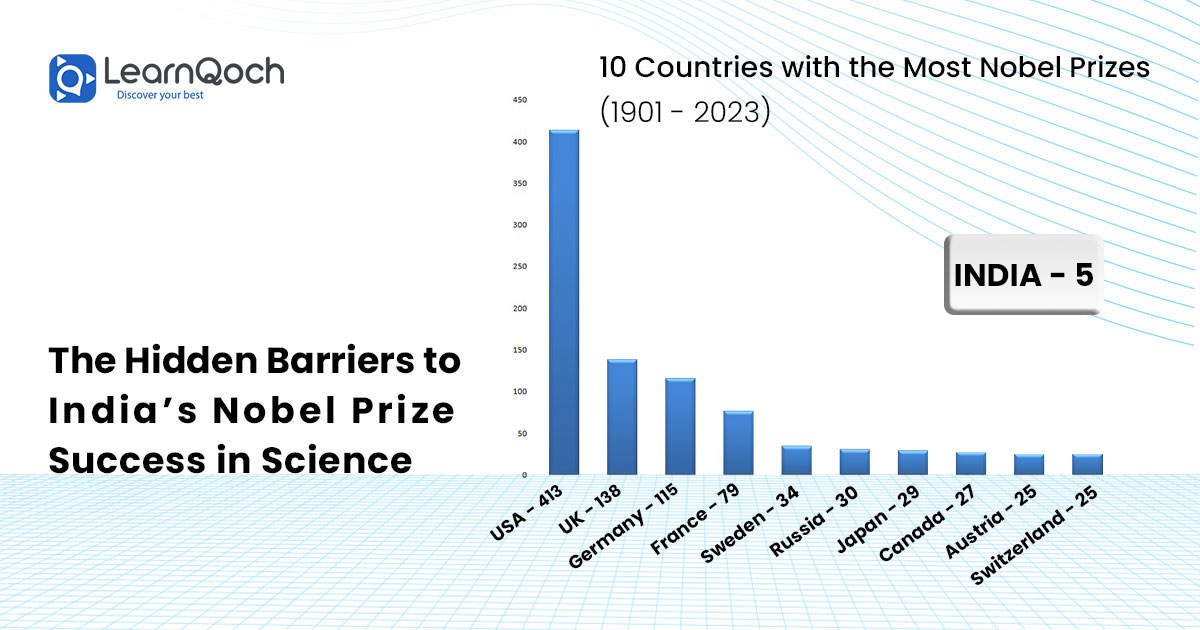
The Hidden Barriers to India’s Nobel Prize Success in Science


India, a land known for its ancient wisdom, mathematical brilliance, and scientific heritage, presents a striking paradox in the modern research landscape. Despite its vast population, expanding economy, and growing academic ecosystem, India Nobel Prize success in science research remains limited. C. V. Raman, awarded the Nobel Prize in Physics in 1930 for discovering the Raman Effect, still stands as the sole Indian scientist to receive this honor in the science category. Overall, only five Indian citizens have ever won a Nobel Prize across all fields, raising an important question: what is holding back India science from becoming a global research powerhouse?
A Brief History of the Nobel Prize
The Nobel Prize, established in 1895 through the will of Alfred Nobel, was created to recognize individuals who confer the “greatest benefit to humankind.” First awarded in 1901, the prizes initially covered Physics, Chemistry, Medicine, Literature, and Peace, with Economics added later in 1968. Over the decades, the Nobel Prize has become the most prestigious global recognition for excellence in discovery and scientific innovation. Understanding the Nobel Prize barriers requires examining the research culture that shapes how nations nurture breakthrough contributions.
Why Does India Struggle in Research and Development?
Lack of a Culture that Celebrates Innovation
In India, there is often a preference for quick wins rather than building something new and original. Society has cultivated a culture of trading and service-based industries, which yield faster returns but can limit long-term innovation. Additionally, there is limited recognition of the value of failure, which is crucial for scientific progress. Innovation requires trial and error, but without a culture that encourages risk-taking, it becomes challenging for Indian researchers to develop a strong research mindset. Strengthening higher education research through supportive science policy and enabling platforms like LearnQoch can help foster environments where experimentation, persistence, and discovery are truly valued.
Pressure to Score Grades, Not to Innovate
In the India K-12 landscape, the India education system often emphasizes grades over nurturing curiosity and creativity. Many parents prioritize coaching classes that boost exam scores rather than encouraging hands-on experiments in science labs. Each year, the country produces nearly 1.5 million engineering graduates, yet many struggle to find meaningful jobs because they lack research-oriented skills. Shifting the focus toward inquiry, experimentation, and academic excellence is essential to bridge this gap.
Limited Appeal of STEM Careers Beyond Engineering and Medicine
Careers in STEM (Science, Technology, Engineering, and Mathematics) are still overshadowed by traditional professions like engineering and medicine. There’s a lack of emphasis on developing young minds to pursue research-driven careers within these fields. A culture that rewards curiosity and innovative thinking is essential to nurture the next generation of scientists.
Absence of a Robust R&D Community in Education
Unlike other countries, India lacks a strong research and development (R&D) ecosystem at both the K-12 and higher education levels. There is no structured platform where students, educators, and industry experts can collaborate to work on groundbreaking research. Creating such communities within schools, colleges, and universities could significantly impact students’ approach to learning and innovation.
Insufficient Government Incentives for R&D in Education
While the government has made some efforts to promote R&D, there is still a long way to go. Schools, colleges, and universities often do not receive structured rewards or funding for promoting research-oriented activities. Without adequate incentives, educational institutions have little motivation to prioritize research.
Can India Lead the World in Research and Development?
Absolutely. With over 300 million students spanning from kindergarten to post-graduate (KG to PG), even if 0.1% of these students are identified and nurtured for their potential in research, India could create a significant global impact.
What Steps Should India Take to Become a Global R&D Hub?
India must increase R&D investment, strengthen industry–academia collaboration, and promote curiosity-driven research. By reducing bureaucracy, nurturing talent, and encouraging innovation from early education, India can emerge as a global research and development hub.
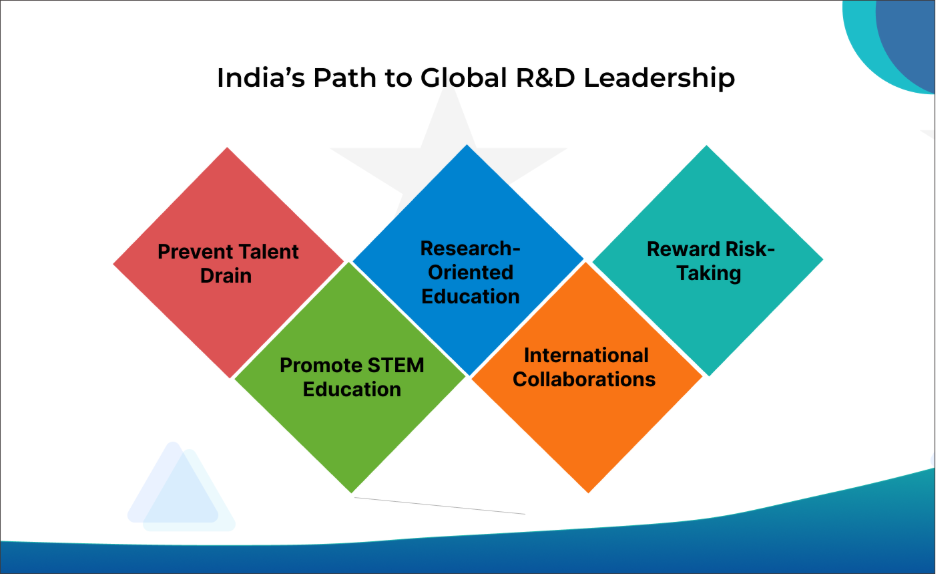
- Prevent Talent Drain
It is vital to recognize students who show promise in research and reward them early. Scholarships, awards, and funding can help retain talent and reduce the need for researchers to leave the country in search of better opportunities.
- Promote STEM Education with Practical Learning
Encourage students to engage with real-world problems through hands-on experiences in science labs instead of focusing solely on theoretical knowledge. Cultivating a spirit of inquiry from an early age will help create a new generation of scientists who think outside the box.
- Establish High-Tech Research-Oriented Educational Institutions
India needs specialized research-oriented schools, colleges, and universities that focus on developing students’ research skills and technological expertise. These institutions should foster an environment where innovative thinking is the norm.
- Provide Funding for International Collaborations
Allocate 100% funding for students and researchers who want to collaborate on international research projects. Scholarships and grants can enable them to gain exposure and bring global perspectives back to India.
- Celebrate Failures and Reward Risk-Taking
In science, failure is not the opposite of success but a part of it. Encouraging students to take risks and rewarding attempts, even if they fail, can cultivate a culture of innovation where students are motivated to create something new rather than opting for safe, conventional careers.
The Road Ahead
With a GDP of around $3.57 trillion in 2023 and projections to reach $6 trillion by the end of the decade, India has the economic muscle to boost its investment in research and development. The government and private sector should work hand-in-hand to allocate more funds to R&D and create an environment where future Nobel laureates can emerge from India.
It’s time for India to shift its focus towards building a future that celebrates innovation, encourages risk-taking, and places value on research. Let’s create a country where young minds grow up not just aspiring to be doctors or engineers but aiming to push the boundaries of human knowledge and make a global impact.
Learn more about the Nobel Prize and its history.
#NobelPrizeIndia #IndianInnovation #STEMEducation #ResearchAndDevelopment
The LearnQoch AI powered Academic Platform
LearnQoch goes further by providing an integrated platform that covers all aspects of institutional growth:

Institutional Digital Ecosystem: Categories & Modules
A. LearnQoch AI powered Core Academic & Learning Solutions
Facilitates modern teaching and learning while tracking student progress, assignments, assessments, and course outcomes.
Focuses on measuring learning outcomes to ensure skills, competencies, and academic objectives are met effectively.
- LearnQoch AI powered Academic Calendar & Events
Maintains academic schedules, holidays, events, and exam timelines for seamless yearly planning.
- LearnQoch AI powered Class Module
Manages class creation, faculty allocation, and student grouping while supporting timetable integration.
B. LearnQoch AI powered Examination & Evaluation Management
LearnQoch AI Powered Exam Management Module
A unified system that digitizes the entire exam cycle—right from planning, subject allocation, ATKT processing, and scheduling to question paper creation, assessments, evaluation, and result generation. It ensures transparency, accuracy, and smooth coordination across all departments.
C. LearnQoch AI powered Campus Administration & Operations
Streamlines administrative activities, simplifies student data management, and ensures workflow automation across all departments.
- LearnQoch AI powered Task Management
Organizes, prioritizes, and tracks institutional tasks to improve productivity and accountability.
- LearnQoch AI powered Committee Module
Handles committee formation, roles, activities, and meeting records to maintain governance transparency.
- LearnQoch AI powered Document Management
Stores, organizes, and retrieves institutional documents with version control and compliance tracking.
- LearnQoch AI powered Certificate Management
Manages creation and issuance of academic and administrative certificates such as Bonafide, character, and leaving certificates.
D. LearnQoch AI powered Finance & Fees Management
- LearnQoch AI powered Finance Module – Receivable (Fees)
Tracks payments, manages fee categories, handles tuition/fines, and maintains fee-related records.
- LearnQoch AI powered Advanced Fees
Payments made before the due date, helping institutions and parents manage fee planning efficiently.
- LearnQoch AI powered Excess Fees
Extra amount paid unintentionally; recorded for adjustment in future payments or refunded when necessary.
E. LearnQoch AI powered Library & Resource Management
LearnQoch AI powered Library Module
Manages book registration, issue-return process, renewals, student access, and availability tracking for efficient library operations.
F. LearnQoch AI powered Placement & Career Development
- LearnQoch AI powered Placement Module
Manages job postings, student registration, interview updates, and final offer letters with complete transparency for TPOs and students.
- LearnQoch AI powered Skill Development Solutions
Equips students with future-ready skills to enhance employability and prepare for global career opportunities.
G. LearnQoch AI powered Accreditation & Compliance
LearnQoch AI powered NAAC, NBA & NIRF Compliance
Simplifies reporting, monitoring, and auditing with ready-to-use compliance tools that reduce institutional workload.
H. LearnQoch AI powered Digital Presence & Branding
LearnQoch AI powered Website & Digital Marketing Solutions
Helps institutions build a strong online presence, attract prospective students, and engage key stakeholders effectively.
Don’t Just Take Our Word for It—Try LearnQoch Yourself!
We invite you to experience the transformative impact of LearnQoch’s Digitize Platform with a 14-Day Free Trial.
During this period, our team will implement the software for your institution, allowing you to explore its features firsthand and see the difference it can make in academic management.
👉 Are you ready to lead your institution into the future of campus management?
📞 Contact us at +91 84519 01079
📧 Email: info@learnqoch.com /sales@learnqoch.com
Explore What LearnQoch Offers:
Visit www.learnqoch.com for Full Details
People Also Ask:
1. How to check students’ concept understanding daily?
Use quick quizzes, polls, exit tickets, discussions, and LMS analytics to track daily learning gaps.
2. Online learning platforms for schools & benefits
They centralize learning, enable anytime access, improve engagement, track progress, and reduce administrative work.
3. How to manage content in an LMS for schools?
Organize content by class and subject, upload multiple formats, set deadlines, and monitor usage through reports.
4. How to create questions in an LMS for schools?
Select question types, align with learning outcomes, set difficulty levels, enable auto-grading, and use question banks.
Also read,
Teachers mould students future. Let’s help them to mould it effortlessly.
The Hidden Barriers to India’s Nobel Prize Success in Science
How EdTech Solutions Can Help Indian Higher Education Compete Globally
Simplify the Complex: Strategies for Stress-Free Leadership in Education
The Role of AI in Education: Personalizing Learning for Every Student