


How EdTech Solutions Can Help Indian Higher Education Compete Globally


As global leaders in higher education, the United States and China have built significant competitive advantages through top-ranked universities, high research output, advanced digital infrastructure, and strong international student inflows. In contrast, India—despite its vast talent pool and academic potential—is steadily progressing toward establishing a stronger global presence. Bridging this gap requires more than intent; it demands structural reform supported by EdTech solutions that can strengthen Indian higher education through technology-driven transformation.
This is precisely where the National Education Policy 2020 plays a transformative role. NEP 2020 lays a clear roadmap for elevating India’s higher education system by promoting multidisciplinary learning, research innovation, digital education, and global academic collaboration. However, succeeding in global competition depends on adopting scalable education technology and leveraging AI in education to effectively implement these reforms at scale.
EdTech platforms like LearnQoch act as critical enablers in this journey by translating the vision of the National Education Policy 2020 into practical, measurable outcomes. Through integrated LMS capabilities, outcome-based education frameworks, analytics-driven governance, and robust digital learning ecosystems, LearnQoch supports higher education India in enhancing academic quality and strengthening university innovation. Consequently, by aligning NEP 2020 reforms with advanced EdTech solutions, Indian institutions are well-positioned not only to compete but to emerge as global leaders in the evolving knowledge economy.
Lets see, what Above countries Focused On?
India, the United Kingdom, and China each play a significant role in the global higher education landscape, yet their approaches reflect different stages of policy maturity and digital adoption. The UK focuses on quality assurance, research-led teaching, and strong global collaboration, while China emphasizes large-scale innovation, technology integration, and rapid expansion of research capacity. India, guided by the National Education Policy 2020, is advancing toward flexible, multidisciplinary, and outcome-based education to strengthen its global competitiveness and drive academic excellence through LearnQoch AI-powered solutions.
Across India, the United Kingdom, and China, national education policies increasingly prioritize digital learning, skill development, research excellence, and global mobility. Whether through the National Education Policy 2020, higher education reforms in the UK, or China’s education modernization initiatives, the common goal remains the same—leveraging technology to enhance quality, inclusivity, and future readiness. Together, these reforms signal a global shift toward policy-driven, technology-enabled ecosystems, strengthening EdTech India and shaping the future of education.
This blog includes…
This blog explores how India can strengthen its position in global higher education by aligning NEP 2020 reforms with advanced EdTech solutions. It compares India’s progress with global leaders like the U.S. and China, highlighting existing gaps and opportunities. The blog explains how technology-enabled platforms such as LearnQoch help institutions implement NEP 2020 effectively. Readers will gain insights into how digital transformation can enhance academic quality, global competitiveness, and institutional excellence.
1. Global University Rankings: How India Can Climb the Ladder
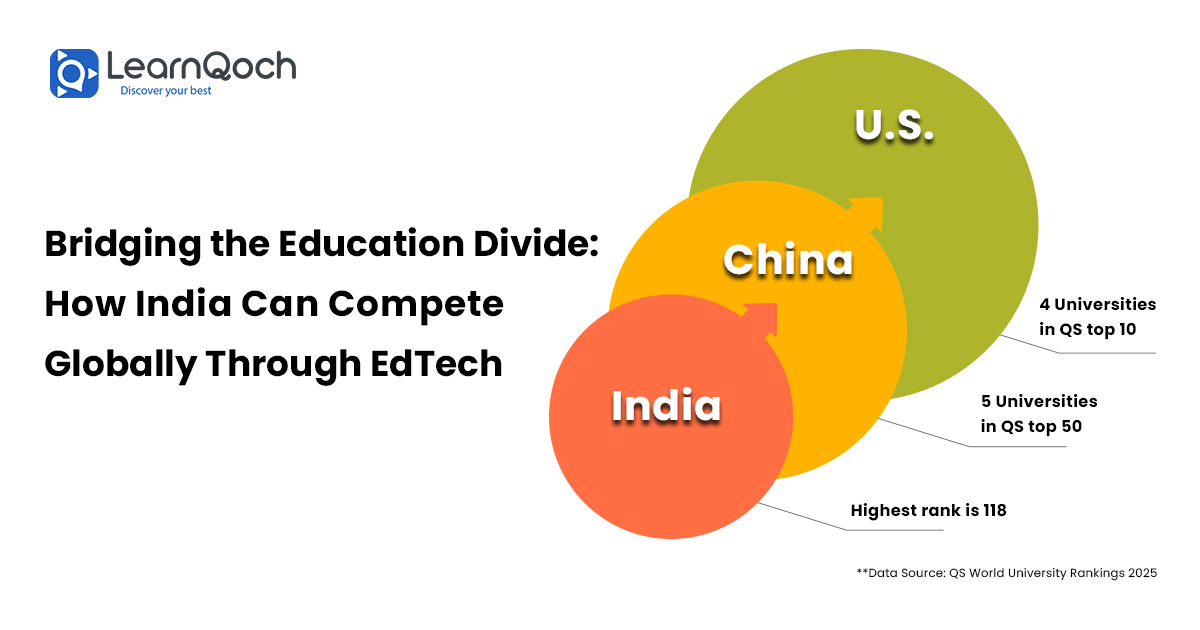
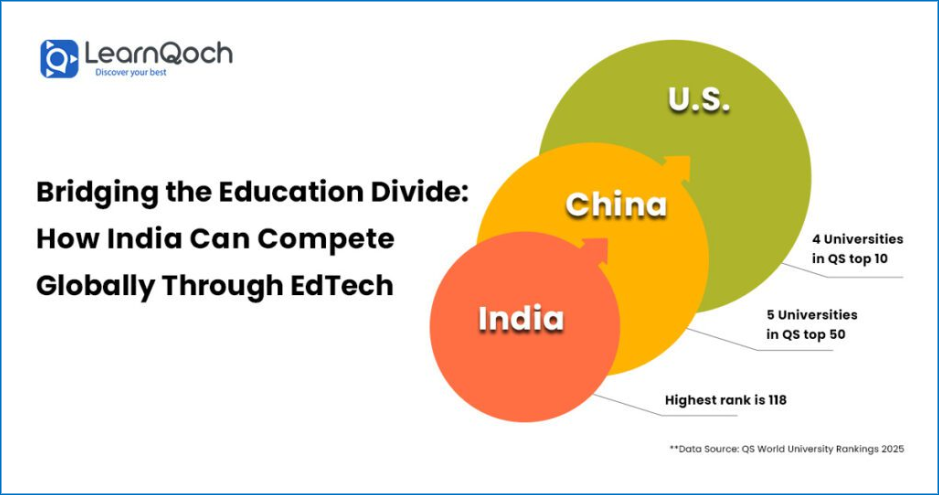
In the QS World University Rankings 2024, the United States claimed 4 of the top 10 spots, while China placed 5 universities in the top 50. India’s highest-ranked institution, the Indian Institute of Science, sits at #118.
While the gap may seem significant, EdTech solutions in Indian higher education can accelerate progress. Online certifications, skill-based programs, and digitally enabled learning platforms help Indian institutions deliver world-class education, boost graduate outcomes, and improve their global reputation.
Global University Rankings Comparison
| Country | Top Universities (QS 100) | Highest Rank | Source |
| United States | 18 | #1 (MIT) | QS World University Rankings 2024 |
| China | 7 | #14(Tsinghua University) | QS 2024 |
| India | 2 | #118 (IISc) | QS 2024 |
2. Education Spending: EdTech as the Equalizer
Education investment plays a crucial role in shaping national outcomes. The U.S. spends 6.2% of its GDP on education, China around 4%, while India currently spends just 3.1%.
This funding gap limits infrastructure and faculty development. However, affordable EdTech solutions like LearnQoch’s LMS and academic ERP can democratize quality education, enabling even remote institutions to access modern tools, resources, and scalable teaching infrastructure.
Education Spending (% of GDP)
| Country | Education Spending | Source |
| United States | 6.2% | World Bank |
| China | 4.0% | UNESCO |
| India | 3.1% | Ministry of Education, India |
3. Research Output: Empowering Innovation through Technology
The U.S. produces over 400,000 research papers annually, China around 300,000, while India publishes approximately 135,000.
This reflects a need for better research infrastructure, access to journals, collaboration platforms, and data analysis tools. With AI-powered EdTech, Indian researchers can improve efficiency, gain deeper insights, and collaborate globally driving innovation from campus labs to international conferences.
Annual Research Output
| Country | Research Papers Annually | Source |
| United States | 400,000+ | SCImago Journal & Country Rank |
| China | 300,000 | SCImago |
| India | 135,000 | SCImago |
4. International Students: Creating Global Appeal through EdTech
The U.S. and China host 1 million+ and 500,000 international students respectively. India attracts only around 50,000.
With a shift to online learning, Indian colleges and universities can develop programs tailored for international students—combining quality, flexibility, and affordability. By using virtual classrooms and digital admissions tools, India can attract students globally, driving both cultural exchange and revenue.
International Student Enrollment
| Country | International Students | Source |
| United States | 1,000,000+ | Institute of International Ed. |
| China | 500,000 | Chinese Ministry of Education |
| India | 50,000 | Ministry of Education, India |
The Road Ahead: Why EdTech is Essential for India’s Global Education Goals
India has the vision and talent to become a global education leader. The next step is closing the gap with technology-driven systems that promote quality, efficiency, and innovation. By aligning NEP 2020 reforms with intelligent EdTech platforms, institutions can transform policy goals into measurable academic outcomes. This strategic integration will not only elevate global competitiveness but also position India as a hub for future-ready, world-class education.
LearnQoch’s EdTech solutions for Indian higher education offer:
- End-to-end digital campus transformation
- Seamless online learning experiences
- Real-time data and reporting tools
With the right technology, Indian institutions can improve global rankings, increase research impact, and attract international students—creating a strong presence on the world stage.
conclusion
In conclusion, while global leaders like the U.S. and China have established strong footholds in higher education through research excellence and digital maturity, India’s rise on the global academic stage depends on how effectively it implements transformative reforms. NEP 2020 provides the vision, but its success lies in execution driven by technology and innovation. By leveraging advanced EdTech solutions like LearnQoch, Indian institutions can bridge existing gaps, enhance academic quality, strengthen global competitiveness, and foster future-ready learners. Ultimately, the integration of NEP 2020 with intelligent digital platforms positions India not just to compete globally, but to lead in shaping the future of higher education.
The LearnQoch AI powered Academic Platform
LearnQoch goes further by providing an integrated platform that covers all aspects of institutional growth:

Institutional Digital Ecosystem: Categories & Modules
A. LearnQoch AI powered Core Academic & Learning Solutions
Facilitates modern teaching and learning while tracking student progress, assignments, assessments, and course outcomes.
Focuses on measuring learning outcomes to ensure skills, competencies, and academic objectives are met effectively.
- LearnQoch AI powered Academic Calendar & Events
Maintains academic schedules, holidays, events, and exam timelines for seamless yearly planning.
- LearnQoch AI powered Class Module
Manages class creation, faculty allocation, and student grouping while supporting timetable integration.
B. LearnQoch AI powered Examination & Evaluation Management
LearnQoch AI Powered Exam Management Module
A unified system that digitizes the entire exam cycle—right from planning, subject allocation, ATKT processing, and scheduling to question paper creation, assessments, evaluation, and result generation. It ensures transparency, accuracy, and smooth coordination across all departments.
C. LearnQoch AI powered Campus Administration & Operations
Streamlines administrative activities, simplifies student data management, and ensures workflow automation across all departments.
- LearnQoch AI powered Task Management
Organizes, prioritizes, and tracks institutional tasks to improve productivity and accountability.
- LearnQoch AI powered Committee Module
Handles committee formation, roles, activities, and meeting records to maintain governance transparency.
- LearnQoch AI powered Document Management
Stores, organizes, and retrieves institutional documents with version control and compliance tracking.
- LearnQoch AI powered Certificate Management
Manages creation and issuance of academic and administrative certificates such as Bonafide, character, and leaving certificates.
D. LearnQoch AI powered Finance & Fees Management
- LearnQoch AI powered Finance Module – Receivable (Fees)
Tracks payments, manages fee categories, handles tuition/fines, and maintains fee-related records.
- LearnQoch AI powered Advanced Fees
Payments made before the due date, helping institutions and parents manage fee planning efficiently.
- LearnQoch AI powered Excess Fees
Extra amount paid unintentionally; recorded for adjustment in future payments or refunded when necessary.
E. LearnQoch AI powered Library & Resource Management
LearnQoch AI powered Library Module
Manages book registration, issue-return process, renewals, student access, and availability tracking for efficient library operations.
F. LearnQoch AI powered Placement & Career Development
- LearnQoch AI powered Placement Module
Manages job postings, student registration, interview updates, and final offer letters with complete transparency for TPOs and students.
- LearnQoch AI powered Skill Development Solutions
Equips students with future-ready skills to enhance employability and prepare for global career opportunities.
G. LearnQoch AI powered Accreditation & Compliance
LearnQoch AI powered NAAC, NBA & NIRF Compliance
Simplifies reporting, monitoring, and auditing with ready-to-use compliance tools that reduce institutional workload.
H. LearnQoch AI powered Digital Presence & Branding
LearnQoch AI powered Website & Digital Marketing Solutions
Helps institutions build a strong online presence, attract prospective students, and engage key stakeholders effectively.
Don’t Just Take Our Word for It—Try LearnQoch Yourself!
We invite you to experience the transformative impact of LearnQoch’s Digitize Platform with a 14-Day Free Trial.
During this period, our team will implement the software for your institution, allowing you to explore its features firsthand and see the difference it can make in academic management.
👉 Are you ready to lead your institution into the future of campus management?
📞 Contact us at +91 84519 01079
📧 Email: info@learnqoch.com /sales@learnqoch.com
Explore What LearnQoch Offers:
Visit www.learnqoch.com for Full Details
Also read,
Teachers mould students future. Let’s help them to mould it effortlessly.
The Hidden Barriers to India’s Nobel Prize Success in Science
How EdTech Solutions Can Help Indian Higher Education Compete Globally
Simplify the Complex: Strategies for Stress-Free Leadership in Education
The Role of AI in Education: Personalizing Learning for Every Student