


Where Is the Criteria-Wise Data From June 2024 to Date for NAAC Submission?


For educators and administrators, the question above is not merely a passing concern—it represents a significant and ongoing challenge. Managing, compiling, and validating vast amounts of NAAC criteria data for accreditation often feels like a monumental task. At the same time, faculty members are expected to balance teaching responsibilities, research commitments, student mentoring, and institutional duties. Consequently, accreditation preparation frequently becomes overwhelming, time-consuming, and prone to last-minute pressure.
Moreover, with the implementation of the National Education Policy (NEP) 2020, institutions are now expected to demonstrate outcome-based education, digital governance, transparency, and continuous quality improvement. These expectations have further intensified documentation and data-tracking requirements. Adding to this complexity, the new NAAC guidelines, including Basic (Binary) Accreditation and Maturity-Based Graded Levels (MBGL), demand consistent, real-time data readiness rather than one-time submissions. As a result, HEIs must move away from manual and fragmented processes toward more structured and technology-driven systems.
In this evolving accreditation landscape, simply collecting data is no longer sufficient. Institutions must also analyze trends, track progress across criteria, and maintain year-on-year comparability. However, without the right tools, this level of preparedness can place an unsustainable burden on faculty and IQAC teams.
This is precisely where LearnQoch NAAC Accreditation Software emerges as a powerful solution. By automating data collection, centralizing documentation, and aligning workflows with NEP 2020 and the latest NAAC framework, LearnQoch simplifies accreditation management. Ultimately, it enables educators and administrators to focus less on paperwork and more on academic quality, innovation, and institutional growth.
The Daily Hustle of Educators: NAAC Accreditation Perspective
A teacher or professor wears multiple hats every single day, balancing academic excellence with institutional responsibilities. Beyond classroom teaching, educators play a crucial role in shaping quality benchmarks that directly impact NAAC accreditation and overall institutional performance.
Planning and Delivering Lectures
Educators invest significant time in planning, preparing, and delivering lectures that are not only syllabus-oriented but also engaging and outcome-driven. They continuously adapt teaching methodologies to accommodate diverse learners, integrate technology, and ensure alignment with learning outcomes—an important parameter under NAAC’s Teaching-Learning and Evaluation criteria.
Developing Course Curriculum
Faculty members actively contribute to curriculum design and revision, ensuring courses remain relevant, industry-aligned, and compliant with academic regulations. This involves mapping course objectives with program outcomes, incorporating interdisciplinary elements, and embedding skill-based learning as encouraged by NEP 2020 and NAAC frameworks.
Assessments and Grading
Evaluating student performance fairly and consistently is another major responsibility. Educators design assessments, conduct examinations, evaluate answer scripts, and provide constructive feedback—all while maintaining transparency and documentation required for NAAC quality audits.
Conducting Research and Publishing Papers
Research is a vital component of an educator’s role. Faculty members engage in research activities, publish papers in reputed journals, apply for grants, and contribute to innovation—directly influencing NAAC criteria related to research, innovation, and extension.
Guiding Research Students
Mentoring postgraduate and doctoral students requires continuous guidance, academic supervision, and progress monitoring. This mentorship strengthens institutional research culture and enhances academic credibility.
Departmental Tasks and Event Coordination
In addition to teaching and research, educators support departmental administration, coordinate academic events, manage committees, and assist in institutional planning—often critical during NAAC preparation cycles.
Attending Workshops and Seminars
Finally, educators regularly participate in faculty development programs, workshops, and seminars to stay updated with emerging trends, pedagogical innovations, and accreditation requirements, ensuring continuous professional growth.
Together, these responsibilities highlight the intensive daily hustle of educators, making efficient systems and digital support essential—especially in the context of NAAC accreditation and quality assurance.
Amidst these demanding responsibilities, educators are also expected to handle the NAAC accreditation process. This process involves gathering extensive data, validating it, and compiling reports a time-consuming and tedious job. Most institutions lack a dedicated system for managing such critical data, leaving educators to rely on fragmented and manual methods.
The Key Questions
As the NAAC submission deadline approaches, educators often face these pressing questions:
- Where can I find the criteria-wise data for NAAC accreditation?
- Is there a system in place to document and organize all necessary information?
- Do we have a platform that simplifies the management of NAAC accreditation data?
If these questions resonate with you, it’s time to explore a smarter solution.
Introducing LearnQoch NAAC Accreditation Software
LearnQoch offers an all-in-one platform to address these challenges. Designed with educators in mind, it streamlines the NAAC accreditation process, saving time and effort while ensuring accuracy and compliance. Here’s how it works:
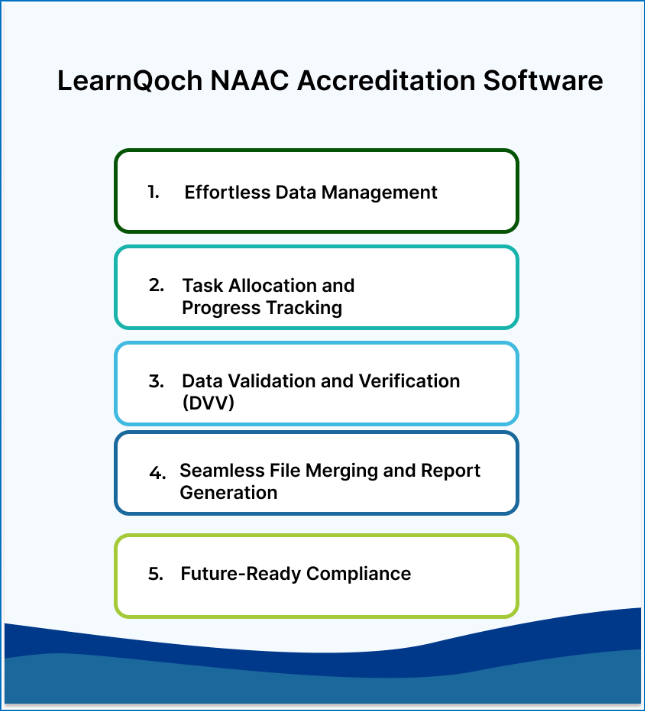
1. Effortless Data Management for NAAC Accreditation
LearnQoch allows you to manage both historical and current-year data seamlessly on a single dashboard. Say goodbye to hunting through piles of paperwork or scattered digital files. Everything you need is organized and readily accessible.
2. Task Allocation and Progress Tracking
With LearnQoch Mumbai, tasks can be easily assigned to criteria owners, ensuring clear accountability across departments. Real-time notifications keep everyone informed about deadlines and progress, making sure that no detail falls through the cracks and accreditation processes stay on track.
3. Data Validation and Verification (DVV)
The software includes tools for Data Validation & Verification (DVV), helping you identify gaps and areas for improvement through benchmarking and SWOC (Strengths, Weaknesses, Opportunities, and Challenges) analysis. This ensures your data is accurate and comprehensive.
4. Seamless File Merging and Report Generation
LearnQoch simplifies the process of merging various file types and generates AQAR (Annual Quality Assurance Report) and SSR (Self-Study Report) effortlessly. For institutions focusing on Vidarbha AQAR requirements, this feature ensures seamless report creation, accuracy, and compliance—saving countless hours of manual effort and reducing the risk of errors.
5. Future-Ready Compliance
The software is designed to adapt to future changes, such as the NAAC binary system, ensuring that your institution remains compliant with evolving guidelines.
The Benefits: More Time for What Matters along with NAAC Accreditation
By automating tedious tasks, LearnQoch empowers educators and administrators to focus on what truly matters enhancing the quality of education. With less time spent on managing data and reports, you can:
- Devote more attention to your students and their learning outcomes.
- Engage in meaningful research and academic projects.
- Contribute to your institution’s strategic growth and vision. .
Conclusion
If you’re tired of the endless paperwork and fragmented processes involved in NAAC accreditation, it’s time to make the switch to LearnQoch NAAC Accreditation Software. With its comprehensive features and intuitive design, it’s more than just a tool it’s a partner in your journey toward academic excellence.
So, the next time someone asks, “Where is the criteria-wise data from June 2024 to date for NAAC submission?” you can confidently answer: “It’s all managed efficiently with LearnQoch,” powered by 2024 submission AI that ensures accurate, real-time data tracking and effortless accreditation readiness.
Ready to transform your accreditation process? Contact us today to learn more and schedule a demo now!
Don’t let tedious processes hold you back. Transform your NAAC accreditation journey with LearnQoch today!
Say goodbye to tedious manual work and embrace automation with LearnQoch NAAC Accreditation Software your partner in hassle-free accreditation.
The LearnQoch AI powered Academic Platform
LearnQoch goes further by providing an integrated platform that covers all aspects of institutional growth:

Institutional Digital Ecosystem: Categories & Modules
A. LearnQoch AI powered Core Academic & Learning Solutions
Facilitates modern teaching and learning while tracking student progress, assignments, assessments, and course outcomes.
Focuses on measuring learning outcomes to ensure skills, competencies, and academic objectives are met effectively.
- LearnQoch AI powered Academic Calendar & Events
Maintains academic schedules, holidays, events, and exam timelines for seamless yearly planning.
- LearnQoch AI powered Class Module
Manages class creation, faculty allocation, and student grouping while supporting timetable integration.
B. LearnQoch AI powered Examination & Evaluation Management
LearnQoch AI Powered Exam Management Module
A unified system that digitizes the entire exam cycle—right from planning, subject allocation, ATKT processing, and scheduling to question paper creation, assessments, evaluation, and result generation. It ensures transparency, accuracy, and smooth coordination across all departments.
C. LearnQoch AI powered Campus Administration & Operations
Streamlines administrative activities, simplifies student data management, and ensures workflow automation across all departments.
- LearnQoch AI powered Task Management
Organizes, prioritizes, and tracks institutional tasks to improve productivity and accountability.
- LearnQoch AI powered Committee Module
Handles committee formation, roles, activities, and meeting records to maintain governance transparency.
- LearnQoch AI powered Document Management
Stores, organizes, and retrieves institutional documents with version control and compliance tracking.
- LearnQoch AI powered Certificate Management
Manages creation and issuance of academic and administrative certificates such as Bonafide, character, and leaving certificates.
D. LearnQoch AI powered Finance & Fees Management
- LearnQoch AI powered Finance Module – Receivable (Fees)
Tracks payments, manages fee categories, handles tuition/fines, and maintains fee-related records.
- LearnQoch AI powered Advanced Fees
Payments made before the due date, helping institutions and parents manage fee planning efficiently.
- LearnQoch AI powered Excess Fees
Extra amount paid unintentionally; recorded for adjustment in future payments or refunded when necessary.
E. LearnQoch AI powered Library & Resource Management
LearnQoch AI powered Library Module
Manages book registration, issue-return process, renewals, student access, and availability tracking for efficient library operations.
F. LearnQoch AI powered Placement & Career Development
- LearnQoch AI powered Placement Module
Manages job postings, student registration, interview updates, and final offer letters with complete transparency for TPOs and students.
- LearnQoch AI powered Skill Development Solutions
Equips students with future-ready skills to enhance employability and prepare for global career opportunities.
G. LearnQoch AI powered Accreditation & Compliance
LearnQoch AI powered NAAC, NBA & NIRF Compliance
Simplifies reporting, monitoring, and auditing with ready-to-use compliance tools that reduce institutional workload.
H. LearnQoch AI powered Digital Presence & Branding
LearnQoch AI powered Website & Digital Marketing Solutions
Helps institutions build a strong online presence, attract prospective students, and engage key stakeholders effectively.
Don’t Just Take Our Word for It—Try LearnQoch Yourself!
We invite you to experience the transformative impact of LearnQoch’s AI powered Digitize Platform with a 14-Day Free Trial.
During this period, our team will implement the software for your institution, allowing you to explore its features firsthand and see the difference it can make in academic management.
👉 Are you ready to lead your institution into the future of campus management?
📞 Contact us at +91 84519 01079
📧 Email: info@learnqoch.com / sales@learnqoch.com
Explore What LearnQoch Offers:
Visit www.learnqoch.com for Full Details
Also read,
One Login, Infinite Possibilities: NBA, and NIRF Accreditation
A Proven Approach to Ensure NAAC Compliance and Elevate Education Outcomes
NAAC’s New IT Circular: Simplify Compliance with LearnQoch’s Integrated Software
NAAC Accreditation Update: Blockchain Credential Verification Made Simple with LearnQoch ERP