



Fee Collection Without Friction: How ERP Transforms Institutes


Introduction
Managing finances in an educational institution has never been easy. With multiple departments, hundreds or thousands of students, and a wide range of fee categories, even the smallest accounting error can cause confusion, frustration, and loss of trust. This is why an efficient fee collection system is essential to ensure accuracy, transparency, and smoother financial operations.
Traditionally, schools and colleges depended on manual processes — handwritten receipts, offline challans, and long queues at fee counters. While these methods were once the norm, they no longer meet the demands of today’s fast-paced digital world. This is where fee collection becomes smarter and more reliable through fee automation, reducing errors, saving time, and bringing much-needed financial transparency to institutions.
Parents expect the same convenience and transparency from educational institutions as they get from banks, shopping apps, and government portals. Meanwhile, administrators are under pressure to ensure accuracy, maintain compliance, and deliver timely financial reports.
In such a dynamic environment, manual fee collection systems simply can’t keep up. That’s where ERP-powered fee management systems come in — streamlining the entire process from payment to reconciliation while improving accuracy, efficiency, and transparency for all stakeholders.
Why Traditional Fee Collection is Fading Out?
Many institutes — from small schools to large universities — still rely on traditional fee collection methods. These systems involve printing challans, manually updating ledgers, sending paper receipts, and reconciling transactions at the end of each term. Such outdated processes make school finance management complex and time-consuming, while creating delays and errors in the institution’s billing workflows.
At first glance, these methods might seem manageable. But as institutions grow, so does the complexity. The result?
- Delayed payments because parents can only pay during limited office hours
- Confusion around due dates and partial payments
- Accounting errors from manual data entry
- Reconciliation headaches at the end of every month
- Inaccurate or incomplete records that complicate audits
These outdated methods slow down operations and frustrate both administrators and parents.
More importantly, they prevent institutions from accessing real-time data, forecasting revenue accurately, and making informed financial decisions.
It’s clear — the old way of managing fees doesn’t fit the needs of 21st-century education systems. Without proper payment tracking and visibility into outstanding fees, institutions struggle to maintain financial clarity and operational efficiency.
How ERP Makes Fee Collection Seamless?
A comprehensive Education ERP (Enterprise Resource Planning) system revolutionizes the fee collection journey by digitizing, automating, and centralizing every step.
Here’s how ERP transforms a time-consuming process into a simple, efficient, and transparent experience:
| Feature | Function | Benefit |
| Online Fee Payment | Parents can pay from anywhere using UPI, Net Banking, or Cards | Convenience and flexibility |
| Auto-Generated Receipts | Instant digital receipts after payment | Accuracy and reduced paperwork |
| Customized Fee Structures | Fees defined by course, semester, hostel, transport, etc. | Tailored invoicing and transparency |
| Automated Reminders | Alerts via SMS, email, and app notifications | Higher on-time payments |
| Payment History Dashboard | Real-time access for parents and administrators | Easy tracking and clarity |
| Secure Transactions | Encrypted gateways ensure data safety | Builds trust and compliance |
Source: LearnQoch Product Insights Report, 2023
With these features, ERP doesn’t just simplify payments — it builds confidence among stakeholders, ensuring that finances are handled with efficiency, transparency, and accountability.
Transforming Institutional Finance Operations
Digitizing fee management goes far beyond making payments easier. It redefines how an institute handles every aspect of financial administration through ERP finance, enabling accurate records, real-time reporting, automated reconciliation, and complete financial transparency.
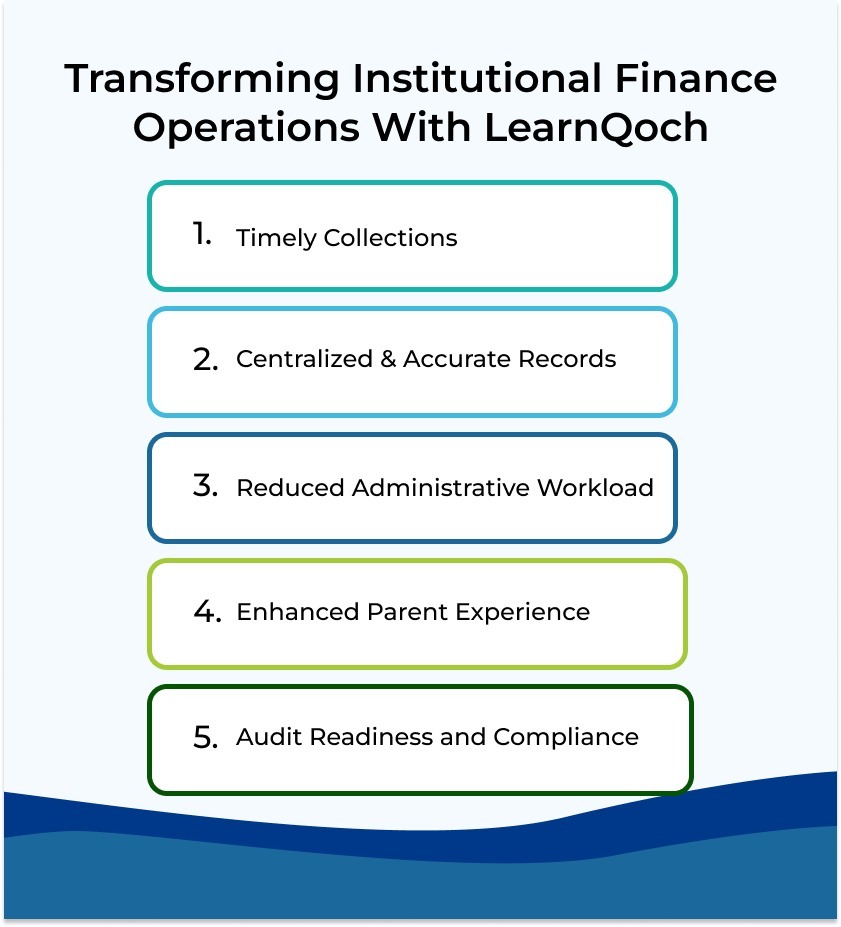
1. Timely Collections
ERP systems automate reminders through multiple channels — SMS, email, and push notifications. Parents receive alerts about due dates, pending payments, and overdue fees, reducing delays significantly.
As a result, institutions experience improved cash flow and more predictable revenue cycles — making it easier to plan budgets, allocate resources, and invest in quality education.
2. Centralized and Accurate Records
Every payment — online or offline — is automatically recorded and stored in a centralized digital ledger. Administrators no longer need to juggle spreadsheets or worry about lost receipts.
With ERP, institutions can instantly access transaction details, filter data by student, batch, or category, and even generate comprehensive audit-ready reports.
3. Reduced Administrative Workload
Manual fee collection involves a huge amount of repetitive work — from issuing receipts and maintaining registers to reconciling mismatched entries. ERP automates all these tasks, allowing finance teams to focus on strategic planning and service improvement.
What once required hours of manual effort can now be done in minutes, reducing staff workload and minimizing the chances of human error.
4. Enhanced Parent Experience
For parents, convenience matters. ERP-powered payment systems provide multiple payment options, instant receipts, and clear visibility into payment history.
Instead of waiting in queues or tracking payments manually, parents can complete transactions in just a few clicks. This creates a sense of reliability and transparency that enhances the institution’s reputation.
5. Audit Readiness and Compliance
ERP systems ensure that every transaction is securely recorded and easily retrievable. Institutions can generate detailed reports for auditors or government compliance without spending weeks compiling data.
These automated, time-stamped records make financial management compliance-ready and stress-free.
The Numbers Tell the Story
The shift from manual to ERP-based fee management isn’t just theoretical — it delivers measurable results.
A pan-India study comparing institutions using traditional fee methods versus ERP-powered solutions found striking differences:
| Parameter | Traditional Methods | ERP-Based Collection |
| Fee Collection on Due Date | 55% | 89% |
| Payment Queries from Parents | High | Low |
| Administrative Effort (Monthly Avg) | 30+ hours | Less than 5 hours |
| Receipt Errors | 10%+ | <1% |
Source: EdTech India Efficiency Survey, 2023 (Sample size: 80 institutions)
These results highlight the time savings, error reduction, and improved cash flow that ERP systems bring to educational institutions.
By automating workflows and enabling digital transparency, ERP doesn’t just simplify operations — it drives institutional excellence.
Parents Love It Too!
While administrators benefit from smoother processes, parents experience a level of ease and confidence that traditional systems could never provide.
When fee payment becomes as simple as shopping online, parents feel empowered. They can:
- Pay anytime, anywhere using preferred modes
- Receive instant confirmation through email or SMS
- Access detailed payment history for transparency
- Set reminders for upcoming payments
- Trust the institution’s professionalism and security
This convenience improves parent satisfaction, strengthens relationships, and builds long-term trust in the institution’s brand.
Why LearnQoch Leads the Way?
LearnQoch isn’t just a software provider — it’s a digital partner for education excellence.
Built specifically for Indian institutions, LearnQoch understands the unique challenges of fee management, accreditation, and academic operations.
Here’s what makes LearnQoch ERP stand out:
- End-to-End Integration: One platform for academics, finance, communication, and compliance.
- User-Friendly Interface: Easy for both staff and parents — minimal training required.
- Secure Cloud Infrastructure: Protects data with advanced encryption and access control.
- Scalable Modules: Grows with your institution — suitable for schools, colleges, and universities.
- Real-Time Reporting: Generate insights instantly for faster decision-making.
By digitizing every layer of campus operations, LearnQoch enables institutions to save time, cut costs, and enhance satisfaction across stakeholders.
The Future of Fee Management Is Digital
Education is evolving — and so should the systems that sustain it. As digital transformation sweeps through campuses, fee management has become one of the most critical areas for modernization.
Institutions that adopt ERP today are positioning themselves for sustainable growth and operational excellence. They gain real-time financial visibility, reduce administrative burdens, and build trust among parents.
The future belongs to data-driven institutions that value efficiency, transparency, and innovation — all of which are made possible through ERP technology like LearnQoch ERP for forward-thinking Mumbai institutes.
Parents Love It Too!
Let’s not forget the user on the other side — parents. A smooth fee payment experience is a huge value-add. When parents can pay securely from their phone, get a receipt instantly, and even get notified before the due date — they feel respected and informed. This directly improves trust in the institution.
The LearnQoch AI powered Academic Platform
LearnQoch goes further by providing an integrated platform that covers all aspects of institutional growth:

Institutional Digital Ecosystem: Categories & Modules
A. LearnQoch AI powered Core Academic & Learning Solutions
Facilitates modern teaching and learning while tracking student progress, assignments, assessments, and course outcomes.
Focuses on measuring learning outcomes to ensure skills, competencies, and academic objectives are met effectively.
- LearnQoch AI powered Academic Calendar & Events
Maintains academic schedules, holidays, events, and exam timelines for seamless yearly planning.
- LearnQoch AI powered Class Module
Manages class creation, faculty allocation, and student grouping while supporting timetable integration.
B. LearnQoch AI powered Examination & Evaluation Management
LearnQoch AI Powered Exam Management Module
A unified system that digitizes the entire exam cycle—right from planning, subject allocation, ATKT processing, and scheduling to question paper creation, assessments, evaluation, and result generation. It ensures transparency, accuracy, and smooth coordination across all departments.
C. LearnQoch AI powered Campus Administration & Operations
Streamlines administrative activities, simplifies student data management, and ensures workflow automation across all departments.
- LearnQoch AI powered Task Management
Organizes, prioritizes, and tracks institutional tasks to improve productivity and accountability.
- LearnQoch AI powered Committee Module
Handles committee formation, roles, activities, and meeting records to maintain governance transparency.
- LearnQoch AI powered Document Management
Stores, organizes, and retrieves institutional documents with version control and compliance tracking.
- LearnQoch AI powered Certificate Management
Manages creation and issuance of academic and administrative certificates such as Bonafide, character, and leaving certificates.
D. LearnQoch AI powered Finance & Fees Management
- LearnQoch AI powered Finance Module – Receivable (Fees)
Tracks payments, manages fee categories, handles tuition/fines, and maintains fee-related records.
- LearnQoch AI powered Advanced Fees
Payments made before the due date, helping institutions and parents manage fee planning efficiently.
- LearnQoch AI powered Excess Fees
Extra amount paid unintentionally; recorded for adjustment in future payments or refunded when necessary.
E. LearnQoch AI powered Library & Resource Management
LearnQoch AI powered Library Module
Manages book registration, issue-return process, renewals, student access, and availability tracking for efficient library operations.
F. LearnQoch AI powered Placement & Career Development
- LearnQoch AI powered Placement Module
Manages job postings, student registration, interview updates, and final offer letters with complete transparency for TPOs and students.
- LearnQoch AI powered Skill Development Solutions
Equips students with future-ready skills to enhance employability and prepare for global career opportunities.
G. LearnQoch AI powered Accreditation & Compliance
LearnQoch AI powered NAAC, NBA & NIRF Compliance
Simplifies reporting, monitoring, and auditing with ready-to-use compliance tools that reduce institutional workload.
H. LearnQoch AI powered Digital Presence & Branding
LearnQoch AI powered Website & Digital Marketing Solutions
Helps institutions build a strong online presence, attract prospective students, and engage key stakeholders effectively.
Don’t Just Take Our Word for It—Try LearnQoch Yourself!
We invite you to experience the transformative impact of LearnQoch’s Digitize Platform with a 14-Day Free Trial.
During this period, our team will implement the software for your institution, allowing you to explore its features firsthand and see the difference it can make in academic management.
👉 Are you ready to lead your institution into the future of campus management?
📞 Contact us at +91 84519 01079
📧 Email: info@learnqoch.com /sales@learnqoch.com
Explore What LearnQoch Offers:
Visit www.learnqoch.com for Full Details