
Why Institutions Prefer Real-Time Performance Tracking?


In today’s rapidly evolving academic and organizational environment, performance can no longer rely on memory, perception, or annual reviews. Institutions now operate with higher expectations, dynamic responsibilities, and a strong need for measurable outcomes. Aligned with the vision of National Education Policy 2020, organizations are moving toward transparency and data-driven decision-making.
However, many institutions still face unclear roles, inconsistent outcomes, and difficulty recognizing employee contributions. Without Real-Time Performance Tracking, achievements often go unnoticed while performance gaps remain unaddressed until it’s too late.
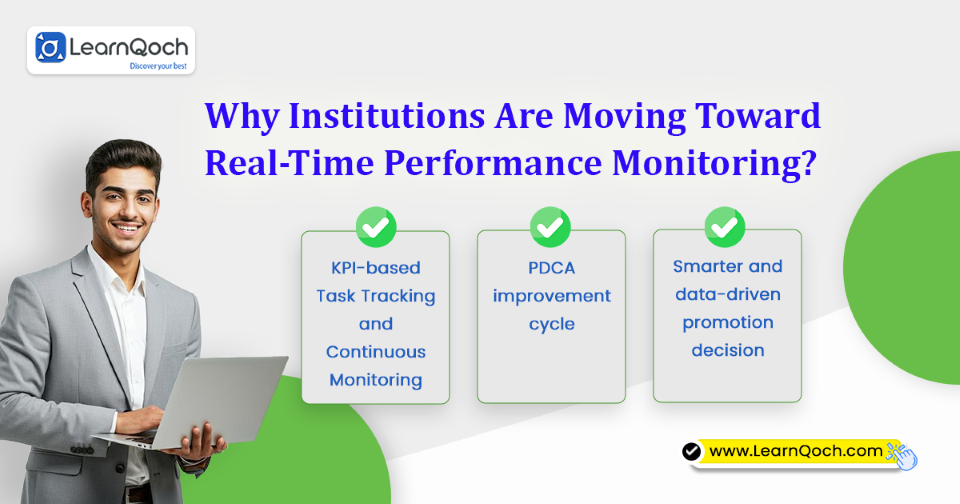
A structured system powered by Real-Time Performance Tracking enables continuous monitoring, fair evaluation, and timely feedback. It helps institutions shift from reactive to proactive management.
LearnQoch AI powered Modern Performance Management, built on KPI-based tracking and the PDCA cycle, uses Real-Time Performance Tracking to drive continuous improvement—transforming performance evaluation into an ongoing growth journey aligned with NEP 2020.
What is Performance Management?
Performance management is a systematic and continuous process used by institutions to ensure that employees work efficiently, grow professionally, and contribute meaningfully to organizational success. It goes beyond annual reviews — it is a strategic cycle that helps individuals understand expectations, stay aligned with institutional goals, and continuously improve their performance.
It involves four key stages:
- Planning:
Clearly define what work needs to be done, why it is important, and how success will be measured. This includes setting goals, outlining responsibilities, and aligning individual objectives with institutional mission and vision.
- Doing:
Employees perform their assigned duties with focus, clarity, and consistency. They follow defined processes, maintain work standards, collaborate effectively, and take ownership of their responsibilities.
- Checking:
Monitoring performance regularly through measurable KPIs, feedback systems, reports, observations, and self-assessment. This ensures transparency and helps identify strengths, challenges, and progress toward goals.
- Acting:
Taking informed action to support, improve, and reward performance. This may include coaching, training, role adjustments, recognition, increments, promotions, or corrective steps where needed.
By linking everyday tasks to long-term institutional objectives, performance management builds:
- Alignment — Everyone works toward shared goals
- Accountability — Performance is transparent and measurable
- Growth — Employees receive feedback and development opportunities
- Impact — Individual efforts contribute to institutional excellence
In short, performance management transforms work culture from routine task execution to purpose-driven, measurable, and continuously improving performance — benefiting both employees and the institution.
How Does Performance Management Work?
Performance management works by setting clear expectations for employees and aligning their goals with institutional objectives. Employees then carry out their tasks while managers provide guidance and support. Progress is monitored through regular reviews, measurable KPIs, and feedback. Based on performance insights, institutions take action such as offering training, recognition, or performance improvement support. This continuous cycle ensures accountability, encourages professional growth, and drives overall institutional success.
Effective performance management happens in layers of regular observation, not occasional review:
| Stage | Action | Purpose |
| Plan | Define KPIs, targets & responsibilities | Sets clarity and direction |
| Do | Employees execute tasks | Builds consistency & accountability |
| Check | Review data, dashboards & weekly results | Highlights achievements & gaps |
| Act | Improve methods, provide feedback, reward or support | Drives growth & performance culture |
Instead of relying on annual appraisals, this approach delivers:
Daily performance becomes clear and accountable
Daily tasks, attendance, discipline, and work habits are visible, helping managers understand how consistently an employee contributes each day. This avoids last-minute rush or bias and encourages steady performance.
Weekly efforts are acknowledged and appreciated
Weekly reviews or check-ins highlight effort, teamwork, problem-solving, and initiative. Employees receive timely recognition or guidance instead of waiting months, keeping motivation and productivity high.
Monthly progress is tracked and measured with data
Monthly reports and KPIs help measure actual results — targets met, tasks completed, goals achieved, and skills improved. This ensures continuous monitoring and data-based assessment of performance.
Quarterly improvements are reviewed and supported with action
Every quarter, performance gaps, improvement areas, and achievements are evaluated. Based on this, managers can provide training, guidance, or corrective support, so employees grow consistently.
Yearly appraisals become transparent, fair, and well-justified
By reviewing daily work, weekly efforts, monthly results, and quarterly improvements, the final annual appraisal is unbiased and accurate. This ensures increments, promotions, and rewards are fair and backed by real performance data.
Why Institutions Need Performance Management Today?
Modern educational and professional institutions are operating in a rapidly evolving environment where efficiency, accountability, and talent growth are critical. Without a structured performance management system, institutions often struggle with issues such as:
- Uneven workloads – Tasks and responsibilities are not distributed fairly, leading to burnout in some staff while others remain underutilized.
- Unclear job expectations – Employees may not fully understand what is expected from them, resulting in inconsistent work quality and missed goals.
- Wide variation in performance levels – Differing work standards across staff members affect institutional productivity, student satisfaction, and operational output.
- Difficulty identifying top vs. low performers – When performance isn’t measured transparently, recognizing excellence or addressing poor performance becomes challenging.
- Confusion during appraisals and promotions – Decisions about promotions, increments, and recognition become subjective, often leading to dissatisfaction, bias of concerns, and demotivation.
A robust performance management framework solves these challenges by replacing assumption-based assessments with measurable, data-driven insights.
With clear goals, standardized evaluation criteria, regular feedback cycles, and transparent performance records, institutions can:
- Improve fairness and accountability
- Optimize workload distribution
- Motivate employees through recognition and clarity
- Increase productivity and institutional effectiveness
- Build a culture of growth, transparency, and excellence
Ultimately, performance management enables institutions to make informed, unbiased, and strategic decisions, thus creating a thriving environment where both employees and the institution succeed in turn.
Benefits of Modern Performance Management
Modern performance management provides institutions with a powerful framework to develop people, drive accountability, and achieve strategic goals. Unlike traditional systems that rely on annual reviews and subjective judgment, modern performance management is continuous, data-driven, and employee-centric, therefore ensuring more accurate and timely evaluations.
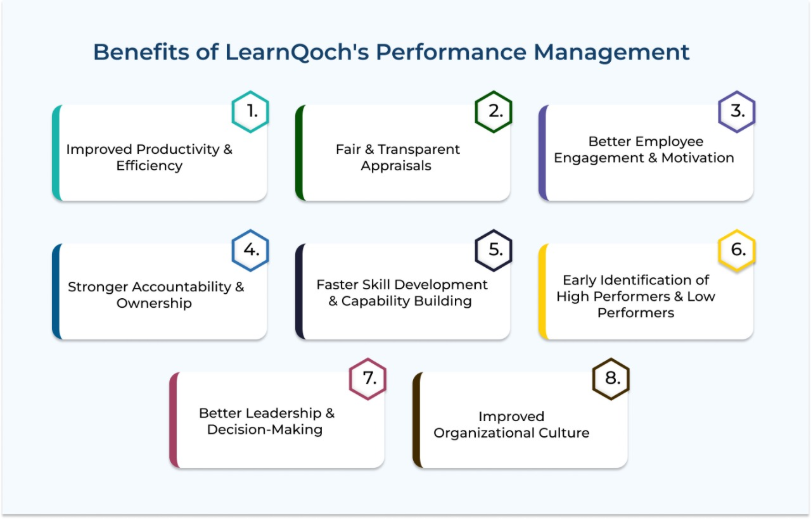
It offers several key benefits:
- Improved Productivity & Efficiency
Continuous goal tracking, feedback, and clear role expectations help employees stay focused, work smarter, and deliver consistent results.
- Fair & Transparent Appraisals
Furthermore, performance is measured using real data and ongoing evidence rather than assumptions or bias, thereby ensuring fair increments, promotions, and recognition as a result.
- Better Employee Engagement & Motivation
Regular appreciation, meaningful feedback, and growth opportunities boost morale, job satisfaction, and commitment to institutional success.
- Stronger Accountability & Ownership
Defined KPIs and clear responsibilities ensure every employee understands their role and remains accountable for their outcomes.
- Faster Skill Development & Capability Building
Performance insights help identify training needs, enabling timely coaching, learning interventions, and continuous professional development.
- Early Identification of High Performers & Low Performers
Top achievers can be rewarded and nurtured, while those struggling receive support or improvement plans before issues escalate.
- Better Leadership & Decision-Making
Leaders gain accurate performance data that supports strategic decisions related to workforce planning, promotions, and resource allocation.
- Improved Organizational Culture
Encouraging open communication, fairness, transparency, and growth build a healthy, future-ready workplace culture.
When performance is visible, growth becomes achievable.
Real-World Examples of KPI Application
1. Digital Marketing Team
| KPI | Frequency | Outcome |
| Write & publish 2 blogs/week | Weekly | Ensures consistent digital visibility |
| Run 1 email campaign/week | Weekly | Improves engagement & admission inquiries |
| Create performance report | Monthly | Measures outreach efforts and ROI |
| Track lead conversions | Ongoing | Shows real impact on institutional growth |
Result: Clear accountability → Clear results → Clear recognition.
2. Academic / Teaching Staff
| KPI | Tracking Level | Impact |
| Lesson planning & syllabus coverage | Weekly | Ensures learning continuity |
| Student performance & engagement | Monthly | Improves academic outcomes |
| Assessment readiness & evaluation | Per exam cycle | Smooth exam execution |
| Parent interaction & feedback documentation | Per term | Builds trust & communication |
Result: Teaching becomes more structured, measurable, and guided.
What Happens When Performance Is Measured?
Institutions gain the ability to:
- Identify high performers ready for growth and leadership roles
- Recognize staff who require training, mentoring, or support
- Understand which departments excel and which need improvement
- Make promotion, increment, and appraisal decisions confidently
Clear processes stop confusion.
Transparent data ends bias.
Realtime insights remove guesswork.
Only real, trackable performance data.
What to Expect in This Blog Series?
Over the next blogs, we will cover:
| Blog Topic | Purpose |
| Setting role-based KPIs | Define measurable performance standards |
| Designing Daily Task Sheets | Track real work, real time |
| Weekly & Monthly Review Methods | How leaders can evaluate progress easily |
| Performance Dashboards | Turning data into decisions |
| PDCA Cycle in Action | Building a culture of continuous improvement |
| Case Studies | Real examples from institutions |
| Transparent Appraisal Model | Fair growth, fair recognition |
Each blog will include templates, examples, strategies, and implementation steps.
Conclusion
Performance management is not about pressure — it is about empowerment.
It ensures every effort is valued, every improvement is recognized, and every role is aligned with institutional success.
When institutions adopt KPI-based performance tracking and the PDCA improvement approach, they build:
- Stronger teams
- Higher efficiency
- Better collaboration
- Transparent appraisal systems
- And a culture where excellence is natural
When performance grows, the institution grows.
And when people feel valued, they perform their best.
The LearnQoch AI powered Academic Platform
LearnQoch goes further by providing an integrated platform that covers all aspects of institutional growth:

Institutional Digital Ecosystem: Categories & Modules
A. LearnQoch AI powered Core Academic & Learning Solutions
Facilitates modern teaching and learning while tracking student progress, assignments, assessments, and course outcomes.
Focuses on measuring learning outcomes to ensure skills, competencies, and academic objectives are met effectively.
- LearnQoch AI powered Academic Calendar & Events
Maintains academic schedules, holidays, events, and exam timelines for seamless yearly planning.
- LearnQoch AI powered Class Module
Manages class creation, faculty allocation, and student grouping while supporting timetable integration.
B. LearnQoch AI powered Examination & Evaluation Management
LearnQoch AI Powered Exam Management Module
A unified system that digitizes the entire exam cycle—right from planning, subject allocation, ATKT processing, and scheduling to question paper creation, assessments, evaluation, and result generation. It ensures transparency, accuracy, and smooth coordination across all departments.
C. LearnQoch AI powered Campus Administration & Operations
Streamlines administrative activities, simplifies student data management, and ensures workflow automation across all departments.
- LearnQoch AI powered Task Management
Organizes, prioritizes, and tracks institutional tasks to improve productivity and accountability.
- LearnQoch AI powered Committee Module
Handles committee formation, roles, activities, and meeting records to maintain governance transparency.
- LearnQoch AI powered Document Management
Stores, organizes, and retrieves institutional documents with version control and compliance tracking.
- LearnQoch AI powered Certificate Management
Manages creation and issuance of academic and administrative certificates such as Bonafide, character, and leaving certificates.
D. LearnQoch AI powered Finance & Fees Management
- LearnQoch AI powered Finance Module – Receivable (Fees)
Tracks payments, manages fee categories, handles tuition/fines, and maintains fee-related records.
- LearnQoch AI powered Advanced Fees
Payments made before the due date, helping institutions and parents manage fee planning efficiently.
- LearnQoch AI powered Excess Fees
Extra amount paid unintentionally; recorded for adjustment in future payments or refunded when necessary.
E. LearnQoch AI powered Library & Resource Management
LearnQoch AI powered Library Module
Manages book registration, issue-return process, renewals, student access, and availability tracking for efficient library operations.
F. LearnQoch AI powered Placement & Career Development
- LearnQoch AI powered Placement Module
Manages job postings, student registration, interview updates, and final offer letters with complete transparency for TPOs and students.
- LearnQoch AI powered Skill Development Solutions
Equips students with future-ready skills to enhance employability and prepare for global career opportunities.
G. LearnQoch AI powered Accreditation & Compliance
LearnQoch AI powered NAAC, NBA & NIRF Compliance
Simplifies reporting, monitoring, and auditing with ready-to-use compliance tools that reduce institutional workload.
H. LearnQoch AI powered Digital Presence & Branding
LearnQoch AI powered Website & Digital Marketing Solutions
Helps institutions build a strong online presence, attract prospective students, and engage key stakeholders effectively.
Don’t Just Take Our Word for It—Try LearnQoch Yourself!
We invite you to experience the transformative impact of LearnQoch’s AI powered Digitize Platform with a 14-Day Free Trial.
During this period, our team will implement the software for your institution, allowing you to explore its features firsthand and see the difference it can make in academic management.
👉 Are you ready to lead your institution into the future of campus management?
📞 Contact us at +91 84519 01079
📧 Email: info@learnqoch.com / sales@learnqoch.com
Explore What LearnQoch Offers:
Visit www.learnqoch.com for Full Details
Also Read,
Achieve More Every Day with Task Management Software: Organize, Prioritize, and Track Tasks
Automatically Create Class Timetable with LearnQoch Software.
The Secret Behind Error-Free Timetables: How Smart Automation Creates Perfect Timetable?
Struggling with Scheduling? Try LearnQoch Timetable Software
One Platform, Integrated Solutions: Use LMS with Timetable by LearnQoch.