



The Secret Behind Error-Free Timetables: How Smart Automation Creates Perfect Timetable?


Timetable creation is one of the most critical yet challenging administrative tasks for schools, colleges, and universities. When done manually, the process becomes time-consuming, error-prone, and highly dependent on individual effort. Overlapping lectures, classroom unavailability, workload imbalance, and inconsistent schedules often lead to academic disruptions and operational inefficiency.
With automation becoming a necessity in modern education, institutions require a reliable solution that ensures accuracy, transparency, and resource optimization. LearnQoch’s Smart Timetable Software transforms the entire scheduling process from a manual burden into a seamless, intelligent, and highly efficient system.
From Previous Blog …
The LearnQoch blog on smart timetable software highlights how educational institutes have long struggled with manual scheduling, last-minute adjustments, and faculty workload imbalance. Earlier, timetable creation required hours of coordination, repeated revisions, and constant conflict resolution. The blog explains how traditional methods often led to class overlaps, resource mismanagement, and academic inefficiencies. Recognizing these recurring challenges, LearnQoch introduced an intelligent Timetable Management System that automates scheduling with precision. The blog showcases how this digital approach brings accuracy, transparency, and real-time flexibility to academic planning. It marks LearnQoch’s commitment to helping institutes move from stressful manual planning to seamless, data-driven scheduling.
In this blog, we explore teacher who struggles every year with timetable chaos—clashes, last-minute changes, workload imbalance, and endless corrections. Through this journey, we discover how smart automation (like LearnQoch’s Timetable Software) solves these long-standing problems. and Howeducational institutes can eliminate timetable errors using smart automation. You’ll learn:
- Why manual timetable creation leads to conflicts and workload stress
- How automated timetable software works behind the scenes
- The key benefits of switching to smart scheduling
- How LearnQoch helps institutes reduce errors, save time, and create perfectly optimized timetables every time
If only timetables could bend to teacher availability … — Every Teacher, Ever
I still remember sitting in the staff room, staring hopelessly at the sheet full of crossed-out timings and red-marked overlaps. It was timetable week — the most dreaded week of the academic year.
“Ma’am, your lecture is clashing with Mr. Akash’s class.”
“Sir, we don’t have that classroom free at 11 AM.”
“Can someone swap with me? I have two back-to-back lectures again!”
It felt like a puzzle with missing pieces.
And guess who was expected to fix everything?
Us — the teachers
Why Manual Timetables Fail
Relying on manual timetables, whether on paper or spreadsheets, often creates chaos instead of clarity. The process is prone to mistakes, consumes excessive time, and struggles to adapt to teacher availability or sudden changes, making day-to-day management cumbersome.
Key Limitations:
- High probability of human error: Manual scheduling increases the risk of overlapping classes, incorrect assignments, or missed sessions.
- Time-consuming iterations and corrections: Adjusting schedules repeatedly for changes in subjects, teachers, or resources wastes valuable administrative time.
- Difficulty in managing teacher availability: Coordinating multiple teachers’ schedules manually is challenging, especially for part-time or substitute staff.
- Limited visibility of classroom and lab resources: Without real-time tracking, classrooms or labs may be double-booked or underutilized.
- No automated mechanism for last-minute changes: Any sudden leave or emergency requires manual reshuffling, which is prone to errors and delays.
- Challenges in managing substitutes during teacher absence: Identifying available staff and reallocating periods is tedious and inefficient.
- Lack of integration with attendance, academics, and ERP: Manual timetables do not sync with other systems, causing fragmented information and extra work for staff.
These issues not only affect staff productivity but also disturb academic flow and student learning outcomes.
How Smart Automation Transforms Timetable Creation
LearnQoch Smart Timetable Software introduces a structured, technology-driven approach to scheduling. By automating key processes, it ensures accuracy, eliminates conflicts, and enhances academic planning.
1. One-Time Data Input for Long-Term Efficiency
All essential information is entered once by the administration, including:
- Faculty details and availability
- Subject distribution
- Classroom capacity and types
- Lab/resource schedules
- Academic calendar
- Working days and period structure
Once the data is fed into the system, the platform automatically uses it across daily, monthly, and yearly timetables—without requiring repeated input.
2. Daily, Period-Wise, Monthly, and Yearly Scheduling
The system provides multiple viewing and planning formats:
- Daily Timetables
For teachers and students to understand their day efficiently.
- Period-Wise Schedules
Clear mapping of subjects, classrooms, and faculty assignment.
- Monthly Academic Plans
Useful for scheduling practicals, assessments, and co-curricular activities.
- Yearly Scheduling
Supports long-term academic planning with complete structural visibility.
This multi-view approach enhances planning accuracy for all stakeholders.
3. Automated Conflict-Free Timetables
The system ensures zero clashes by preventing:
- Double bookings of teachers
- Overlapping class sessions
- Classroom unavailability
- Lab and resource conflicts
- Back-to-back overload for faculty
Every generated timetable is consistent, balanced, and accurate.
4. Intelligent Absentee Management
One of the most advanced features is automated substitution during teacher absence.
The platform instantly identifies:
- Which teachers are free during the affected period
- Subject-qualified teachers for substitution
- Teachers with balanced workload
- Availability based on timetable and academic structure
This ensures that no class remains unattended and learning continuity is maintained without administrative pressure.
5. Real-Time Updates and Centralized Control
Any change made in the system is instantly reflected across:
- Teacher timetables
- Student schedules
- Attendance systems
- ERP workflows
- Academic planning modules
This eliminates confusion and ensures campus-wide clarity.
6. Improves Faculty Workload Management
With automated scheduling, institutions can maintain:
- A balanced teaching load
- No overburdening
- Proper distribution of periods
- Efficient substitution planning
Teachers benefitted from organized schedules and improved academic productivity.
7. Integrated with ERP, Academics, and Attendance
Timetables created through LearnQoch automatically sync with:
- Online attendance
- LMS academic plans
- Workload reports
- Resource allocation
- Substitution logs
This integration ensures transparency, uniformity, and institutional accuracy.
8. Enhances Overall Institutional Efficiency
Automation:
- Reduces timetable creation time by up to 90%
- Eliminates rework and human errors
- Improves student discipline
- Ensures optimum use of classrooms and labs
- Strengthens academic planning
Ultimately, it enhances institutional effectiveness while reducing administrative workload.
Benefits of LearnQoch Timetable Automation
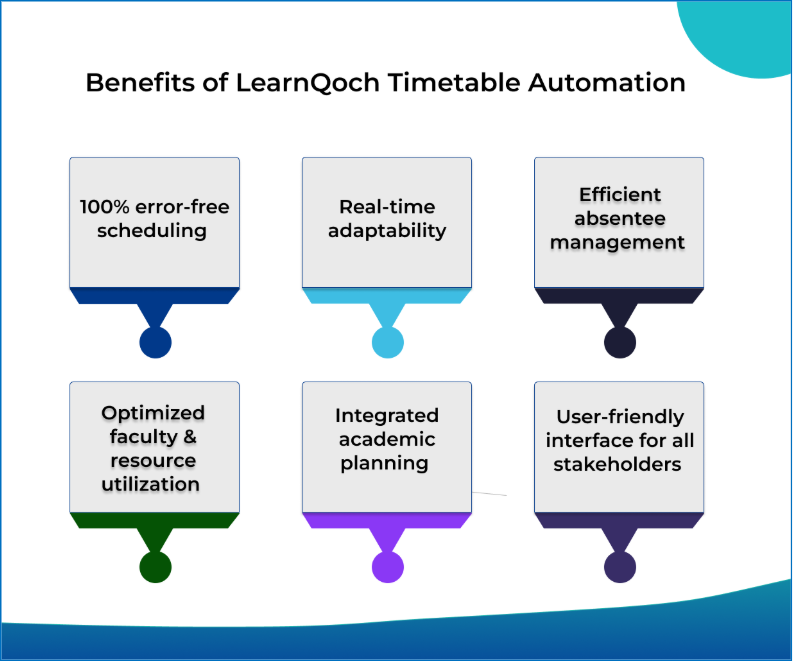
LearnQoch Timetable Automation transforms the way educational institutions manage schedules. By automating the process, it eliminates errors, adapts to real-time changes, and ensures optimal use of teachers and resources, making administration seamless and efficient.
Key Advantages:
- 100% error-free scheduling: Automated algorithms prevent overlapping classes, double-booked labs, and other common human errors.
- Real-time adaptability: Timetables can instantly adjust to teacher leaves, classroom changes, or last-minute modifications without disrupting the flow.
- Efficient absentee management: When a teacher is absent, the system identifies available staff and reallocates classes automatically.
- Optimized faculty and resource utilization: Ensures classrooms, labs, and teachers are used to their full potential without conflicts or downtime.
- Integrated academic planning: Connects seamlessly with attendance, academics, and ERP systems for cohesive institutional management.
- User-friendly interface for all stakeholders: Teachers, students, and administrators can access and interact with the timetable effortlessly, improving communication and transparency.
The LearnQoch AI powered Academic Platform
LearnQoch goes further by providing an integrated platform that covers all aspects of institutional growth:

Institutional Digital Ecosystem: Categories & Modules
A. LearnQoch AI powered Core Academic & Learning Solutions
Facilitates modern teaching and learning while tracking student progress, assignments, assessments, and course outcomes.
Focuses on measuring learning outcomes to ensure skills, competencies, and academic objectives are met effectively.
- LearnQoch AI powered Academic Calendar & Events
Maintains academic schedules, holidays, events, and exam timelines for seamless yearly planning.
- LearnQoch AI powered Class Module
Manages class creation, faculty allocation, and student grouping while supporting timetable integration.
B. LearnQoch AI powered Examination & Evaluation Management
LearnQoch AI Powered Exam Management Module
A unified system that digitizes the entire exam cycle—right from planning, subject allocation, ATKT processing, and scheduling to question paper creation, assessments, evaluation, and result generation. It ensures transparency, accuracy, and smooth coordination across all departments.
C. LearnQoch AI powered Campus Administration & Operations
Streamlines administrative activities, simplifies student data management, and ensures workflow automation across all departments.
- LearnQoch AI powered Task Management
Organizes, prioritizes, and tracks institutional tasks to improve productivity and accountability.
- LearnQoch AI powered Committee Module
Handles committee formation, roles, activities, and meeting records to maintain governance transparency.
- LearnQoch AI powered Document Management
Stores, organizes, and retrieves institutional documents with version control and compliance tracking.
- LearnQoch AI powered Certificate Management
Manages creation and issuance of academic and administrative certificates such as Bonafide, character, and leaving certificates.
D. LearnQoch AI powered Finance & Fees Management
- LearnQoch AI powered Finance Module – Receivable (Fees)
Tracks payments, manages fee categories, handles tuition/fines, and maintains fee-related records.
- LearnQoch AI powered Advanced Fees
Payments made before the due date, helping institutions and parents manage fee planning efficiently.
- LearnQoch AI powered Excess Fees
Extra amount paid unintentionally; recorded for adjustment in future payments or refunded when necessary.
E. LearnQoch AI powered Library & Resource Management
LearnQoch AI powered Library Module
Manages book registration, issue-return process, renewals, student access, and availability tracking for efficient library operations.
F. LearnQoch AI powered Placement & Career Development
- LearnQoch AI powered Placement Module
Manages job postings, student registration, interview updates, and final offer letters with complete transparency for TPOs and students.
- LearnQoch AI powered Skill Development Solutions
Equips students with future-ready skills to enhance employability and prepare for global career opportunities.
G. LearnQoch AI powered Accreditation & Compliance
LearnQoch AI powered NAAC, NBA & NIRF Compliance
Simplifies reporting, monitoring, and auditing with ready-to-use compliance tools that reduce institutional workload.
H. LearnQoch AI powered Digital Presence & Branding
LearnQoch AI powered Website & Digital Marketing Solutions
Helps institutions build a strong online presence, attract prospective students, and engage key stakeholders effectively.
Don’t Just Take Our Word for It—Try LearnQoch Yourself!
We invite you to experience the transformative impact of LearnQoch’s AI powered Digitize Platform with a 14-Day Free Trial.
During this period, our team will implement the software for your institution, allowing you to explore its features firsthand and see the difference it can make in academic management.
👉 Are you ready to lead your institution into the future of campus management?
📞 Contact us at +91 84519 01079
📧 Email: info@learnqoch.com / sales@learnqoch.com
Explore What LearnQoch Offers:
Visit www.learnqoch.com for Full Details
Also Read,
Automatically Create Class Timetable with LearnQoch Software.
The Secret Behind Error-Free Timetables: How Smart Automation Creates Perfect Timetable?
Struggling with Scheduling? Try LearnQoch Timetable Software
One Platform, Integrated Solutions: Use LMS with Timetable by LearnQoch.