


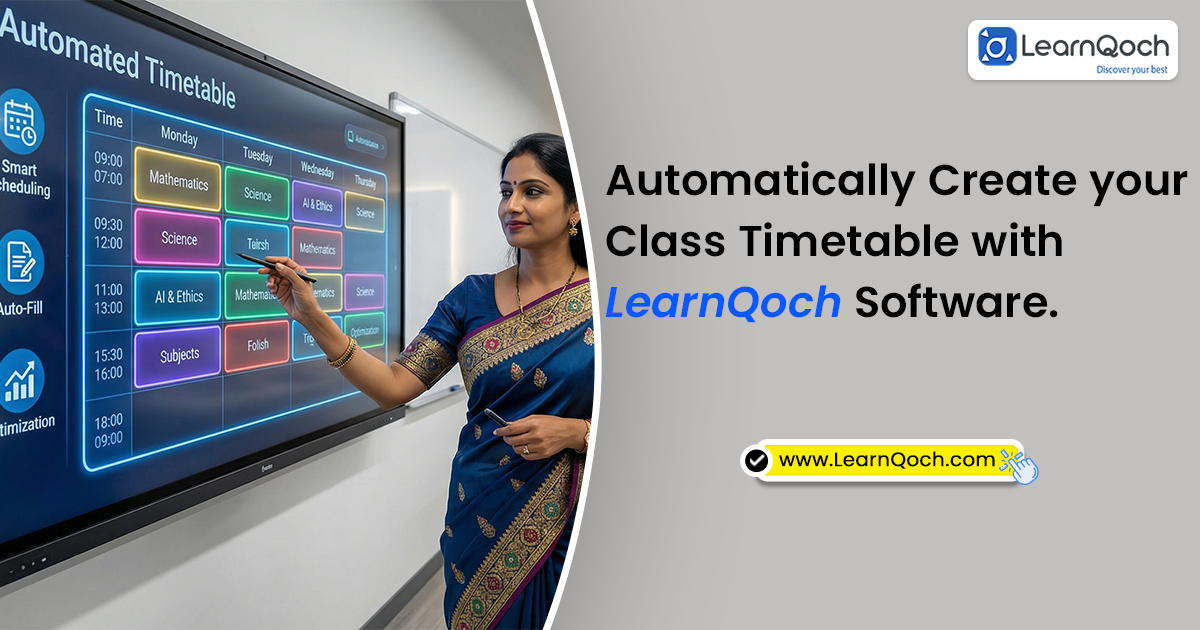
Automatically Create Class Timetable with LearnQoch Software.


Timetable conflicts are one of the biggest hidden challenges in academic planning. From overlapping classes and double-booked teachers to last-minute schedule changes, even a single clash can disrupt an entire day of learning. When schedules rely on manual planning, spreadsheets, or handwritten charts, mistakes become almost unavoidable — especially in institutions with multiple departments, diverse subjects, activity periods, and complex workloads.This is where LearnQoch Timetable Management helps institutions eliminate inefficiencies and ensure accurate scheduling from the start.
With the implementation of NEP 2020, schools and colleges, Universities are now encouraged to offer flexible learning hours, multidisciplinary subjects, skill-based modules, and activity-based periods. This makes manual timetable creation even more difficult. More subjects, more choices, mixed-age group classes, and teacher mobility demand a highly accurate and dynamic scheduling system — something traditional methods simply cannot handle.LearnQoch Timetable Management is designed to meet these evolving requirements by supporting flexible, NEP-aligned scheduling with ease.
Smart timetable automation eliminates these challenges before they even begin. By intelligently mapping teacher availability, classroom capacity, subject requirements, NEP-aligned activity blocks, and institutional rules, automation creates perfectly balanced schedules with zero clashes. It replaces guesswork with logic, reduces administrative pressure, and ensures smooth academic flow across the entire campus.
With automated scheduling, institutes shift from reactive problem-solving to proactive NEP-ready planning — ensuring clarity, flexibility, and academic excellence every single day through LearnQoch Timetable Management
From the Previous one
The Secret Behind Error-Free Timetables: How Smart Automation Creates Perfect Timetable?
This blog explains how timetable creation, though essential, often becomes chaotic due to manual planning, teacher availability conflicts, class overlaps, and last-minute changes. It highlights how automated timetable systems eliminate these common issues by intelligently mapping subjects, teachers, classrooms, and time slots. The blog shows how automation reduces errors, saves administrative time, and creates perfectly balanced schedules. Real examples demonstrate how institutions can avoid clashes, manage substitutions smoothly, and maintain academic rhythm without disruption.
What Comes in this Blog
The blog(Stop Timetable Conflicts Before They Start: Switch to Smart Automation) Naturally progresses to how automation handles real-time timetable changes and substitution management. It will explain how schools can manage teacher absences, class reallocations, and urgent schedule adjustments without chaos. This blog will show how LearnQoch helps identify free teachers instantly, ensures class continuity, and keeps students and staff informed — making daily operations easy and stress-free.
Everyday Struggles: A Conversation Between Teachers
Varsha Ma’am:
“Every week I feel like our timetable is falling apart. Either two teachers get assigned to the same class or I’m told to rush to a room I didn’t even know I had.”
Kundan Sir:
“Same here! Yesterday I had a class scheduled in Lab 1, but another batch was already inside. And the admin thought I was free during 2nd period — but I actually had a substituted class.”
Neha Ma’am (Admin):
“Trust me… we try our best. But one small change — someone on leave, a room booked for a seminar, an exam change — and suddenly the entire timetable collapses like dominoes.”
Varsha Ma’am:
“Exactly! And the worst part is… the same issues keep repeating every term.”
Neha Ma’am (Admin):
“Honestly, with manual timetables, avoiding conflicts feels impossible. Maybe it’s time we switch to smart automation?“
Why Timetable Conflicts Happen (And Why They Keep Repeating)
Before solving the problem, let’s understand the real reasons behind scheduling chaos.
1. Multiple Dependencies and Human Limitations
Timetables have countless moving parts—teachers, subjects, classrooms, labs, workloads, period limits, breaks, institutional rules, and more.
A human planner simply cannot track all these dependencies accurately.
2. Last-Minute Changes Break the Entire Plan
A teacher takes emergency leave → another teacher gets reassigned → two subjects shift → a room becomes unavailable → and suddenly four other classes get affected.
3. No Real-Time Visibility
When data is scattered in files, registers, or separate devices, planners cannot see clashes instantly.
By the time they notice, students and teachers have already experienced the disruption.
4. Different Departments Work in Silos
Science, Arts, Commerce, Junior College, Degree College—everyone prepares their own structure.
The result?
Cross-department clashes that no one notices until it’s too late.
5. Complex Teacher Workloads
Every teacher has:
- Teaching hours per week
- Subject limitations
- Preferred slots
- Non-teaching duties
- Exam responsibilities
- Break allocations
Tracking all these manually is almost impossible.
The Rising Need for Smart Timetable Automation
With the complexity of education increasing, manual timetables no longer match today’s needs. Institutes require:
- Zero conflicts
- Balanced workloads
- Accuracy across departments
- Quick substitutions
- Instant timetable adjustments
- Transparency for students and teachers
And most importantly—a system that prevents errors instead of fixing them later.
That’s where smart automation becomes essential.
Benefits of LearnQoch Timetable Software
1. Smart Class Adjustment When a Teacher Is Absent
Teacher absences usually create confusion, wasted periods, and last-minute manual adjustments.
LearnQoch removes this chaos completely.
How it helps:
- Automatically identifies which teachers are free in that period
- Checks subject expertise and assigns the most suitable substitute
- Finds available classrooms automatically
- Updates the timetable for students, teachers, and admin instantly
2. Mentoring / Combined Class When Subject Teachers Are the Same
In many institutions, two teachers teach the same subject or same level (e.g., two English teachers for Grade 8, two Physics teachers for science stream).
When one teacher is absent, LearnQoch allows combined or mentoring classes, so learning does not stop.
How it works:
- The software checks which teacher teaching the same subject is free
- If Teacher A and Teacher B both teach the same subject
- And Teacher B is absent
- The system schedules Teacher A to take a combined class
- Automatically selects a classroom with enough capacity
- Students continue learning without gaps
3. NEP 2020 Vertical Scheduling Support
NEP 2020 introduces subject verticals, where learning is organized into flexible groups or learning domains — such as
- Language vertical
- Math & Computational Thinking vertical
- Science vertical
- Arts vertical
- Skills vertical
LearnQoch timetable automation fully supports this structure.
How it helps:
- Allows grouping of classes based on verticals (instead of only subjects)
- Ensures teachers assigned to a vertical can support multiple sections without clashes
- Helps schedule vertical-based sessions, skill-based modules, and competency classes
- Supports combined vertical classes when required
- Makes it easy to coordinate interdisciplinary sessions (exactly as NEP recommends)
Example:
If two teachers belong to the Science Vertical, LearnQoch ensures:
- No overlapping science sessions
- Smooth distribution of vertical teaching hours
- Automatic adjustment if one teacher is unavailable
- Vertical-based mentoring sessions without timetable clashes
The LearnQoch Advantage: Smarter Scheduling for Modern Institutes
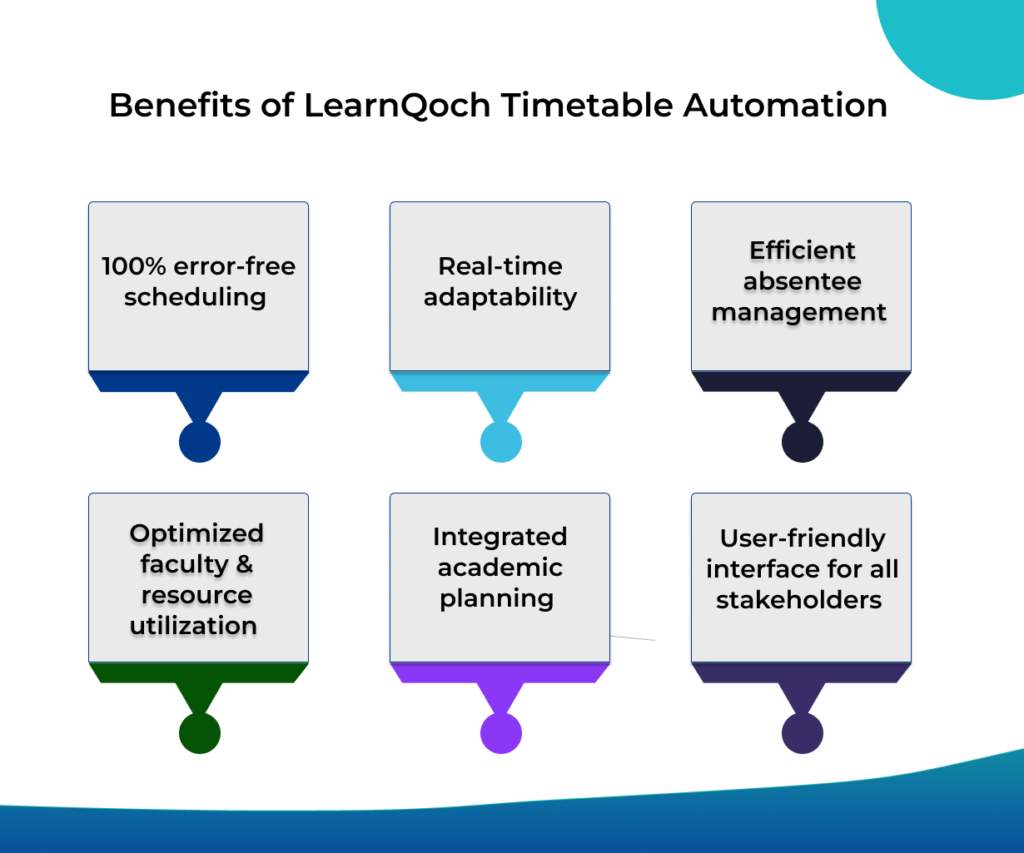
1. 100% Conflict-Free Timetables
LearnQoch’s AI-driven engine checks every period, teacher, subject, and classroom before finalizing a timetable.
This ensures no double bookings, no clashes between classes, and zero overlapping schedules.
2. Reduced Planning Time (10 days → 10 minutes)
What once took days of manual work — cross-checking teachers, subjects, and availability — now gets completed in minutes.
Institutes can generate a full timetable swiftly, accurately, and without repetitive corrections.
3. Quick Substitution Handling
When a teacher is absent, the system instantly identifies available teachers with the right subject expertise.
This ensures classes continue smoothly without delays, confusion, or manual searching.
4. Multi-Department Scheduling with Zero Overlaps
Whether it’s science, commerce, arts, or multiple grade levels, LearnQoch handles all scheduling needs.
The engine ensures no teacher or classroom is double-assigned across departments — even during busy academic periods.
5. Complete Transparency
All stakeholders — teachers, administrators, students, and parents — receive real-time updates.
Any change in schedule is instantly visible, ensuring clarity and accountability across the campus.
6. Real-Time Adjustments Without Errors
If a last-minute change is required, admins simply update the system.
LearnQoch recalculates the timetable automatically, ensuring the new version remains conflict-free and perfectly aligned.
7. Higher Teaching Efficiency & Better Learning Outcomes
With organized schedules, teachers spend more time teaching and less time coordinating.
Students benefit from uninterrupted classes, leading to better engagement, stronger performance, and consistent learning flow.
The LearnQoch AI powered Academic Platform
LearnQoch goes further by providing an integrated platform that covers all aspects of institutional growth:

Institutional Digital Ecosystem: Categories & Modules
A. LearnQoch AI powered Core Academic & Learning Solutions
Facilitates modern teaching and learning while tracking student progress, assignments, assessments, and course outcomes.
Focuses on measuring learning outcomes to ensure skills, competencies, and academic objectives are met effectively.
- LearnQoch AI powered Academic Calendar & Events
Maintains academic schedules, holidays, events, and exam timelines for seamless yearly planning.
- LearnQoch AI powered Class Module
Manages class creation, faculty allocation, and student grouping while supporting timetable integration.
B. LearnQoch AI powered Examination & Evaluation Management
LearnQoch AI Powered Exam Management Module
A unified system that digitizes the entire exam cycle—right from planning, subject allocation, ATKT processing, and scheduling to question paper creation, assessments, evaluation, and result generation. It ensures transparency, accuracy, and smooth coordination across all departments.
C. LearnQoch AI powered Campus Administration & Operations
Streamlines administrative activities, simplifies student data management, and ensures workflow automation across all departments.
- LearnQoch AI powered Task Management
Organizes, prioritizes, and tracks institutional tasks to improve productivity and accountability.
- LearnQoch AI powered Committee Module
Handles committee formation, roles, activities, and meeting records to maintain governance transparency.
- LearnQoch AI powered Document Management
Stores, organizes, and retrieves institutional documents with version control and compliance tracking.
- LearnQoch AI powered Certificate Management
Manages creation and issuance of academic and administrative certificates such as Bonafide, character, and leaving certificates.
D. LearnQoch AI powered Finance & Fees Management
- LearnQoch AI powered Finance Module – Receivable (Fees)
Tracks payments, manages fee categories, handles tuition/fines, and maintains fee-related records.
- LearnQoch AI powered Advanced Fees
Payments made before the due date, helping institutions and parents manage fee planning efficiently.
- LearnQoch AI powered Excess Fees
Extra amount paid unintentionally; recorded for adjustment in future payments or refunded when necessary.
E. LearnQoch AI powered Library & Resource Management
LearnQoch AI powered Library Module
Manages book registration, issue-return process, renewals, student access, and availability tracking for efficient library operations.
F. LearnQoch AI powered Placement & Career Development
- LearnQoch AI powered Placement Module
Manages job postings, student registration, interview updates, and final offer letters with complete transparency for TPOs and students.
- LearnQoch AI powered Skill Development Solutions
Equips students with future-ready skills to enhance employability and prepare for global career opportunities.
G. LearnQoch AI powered Accreditation & Compliance
LearnQoch AI powered NAAC, NBA & NIRF Compliance
Simplifies reporting, monitoring, and auditing with ready-to-use compliance tools that reduce institutional workload.
H. LearnQoch AI powered Digital Presence & Branding
LearnQoch AI powered Website & Digital Marketing Solutions
Helps institutions build a strong online presence, attract prospective students, and engage key stakeholders effectively.
Don’t Just Take Our Word for It—Try LearnQoch Yourself!
We invite you to experience the transformative impact of LearnQoch’s AI powered Digitize Platform with a 14-Day Free Trial.
During this period, our team will implement the software for your institution, allowing you to explore its features firsthand and see the difference it can make in academic management.
👉 Are you ready to lead your institution into the future of campus management?
📞 Contact us at +91 84519 01079
📧 Email: info@learnqoch.com / sales@learnqoch.com
Explore What LearnQoch Offers:
Visit www.learnqoch.com for Full Details
Also Read,
Automatically Create Class Timetable with LearnQoch Software.
The Secret Behind Error-Free Timetables: How Smart Automation Creates Perfect Timetable?
Struggling with Scheduling? Try LearnQoch Timetable Software
One Platform, Integrated Solutions: Use LMS with Timetable by LearnQoch.