


Why AI is Must in Your Institute?


India is moving rapidly toward a digital and innovation-driven future, where AI in education is becoming a key driver of transformation. The way industries work, jobs evolve, and technologies grow is changing faster than ever. To prepare students for this new world, autonomous colleges and universities now have the special advantage of designing their own curriculum—a freedom strengthened by the National Education Policy 2020.
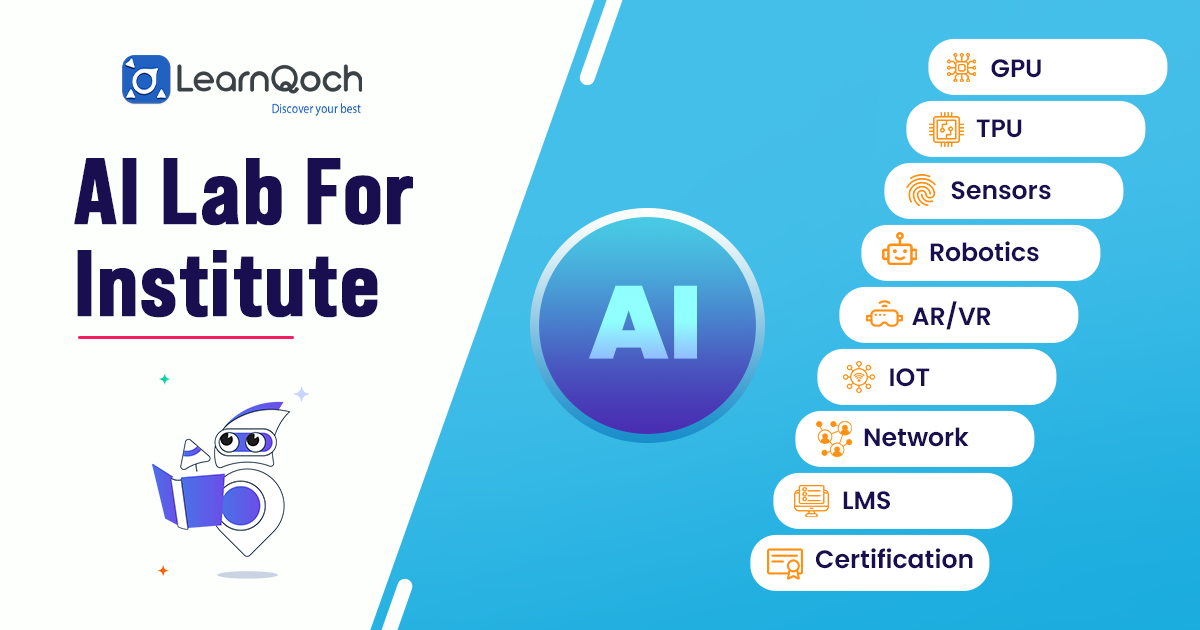
This flexibility allows institutions to create programs that are practical, future-ready, and aligned with real industry needs. By integrating AI in education, institutes can design courses that focus on real-world problem-solving, innovation, and interdisciplinary learning. One of the strongest ways to use this advantage is by setting up a Future Skill AI Lab that brings Artificial Intelligence, Robotics, IoT, Automation, and Data Science directly into the campus ecosystem.
Such initiatives promote AI in education by enabling hands-on learning, research opportunities, and industry collaboration. As AI in education continues to shape the future workforce, institutions adopting these technologies will lead in building skilled, adaptable, and innovation-ready graduates.
From Industrial Revolution 1.0 to 4.0: Why Education Must Upgrade
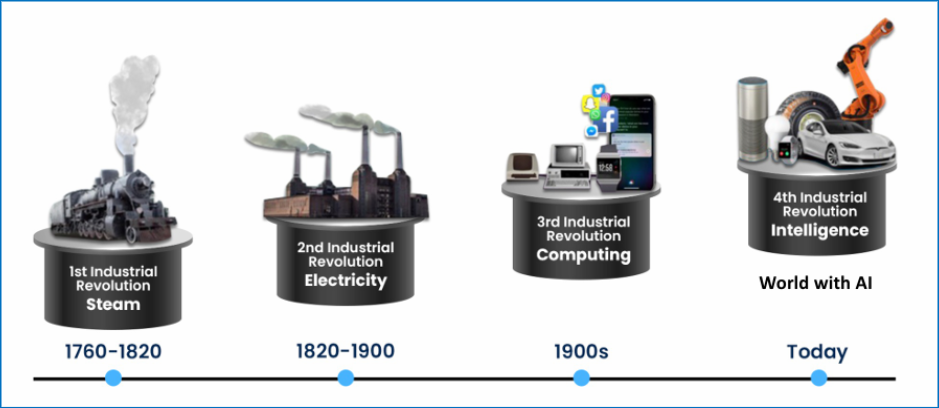
Education has always evolved along with major industrial developments:
Industrial Revolution 1.0 (Mechanical Revolution)
The First Industrial Revolution marked the transition from hand-based manual labor to machine-supported production. Steam engines introduced mechanical power, enabling factories to operate machines for spinning, weaving, and manufacturing. Production moved from homes and small workshops to centralized factories, increasing output and reducing dependence on human and animal power.
Key Impact:
- Birth of factories
- Increased production capacity
- Shift from agrarian to industrial economy
Example:
A textile mill using a steam-powered spinning machine to produce cloth faster than hand spinning.
Industrial Revolution 2.0 (Electrical & Mass Production Revolution)
The Second Industrial Revolution introduced electricity, which enabled mass manufacturing and assembly-line production. Machines became faster, safer, and more efficient. Standardized parts and division of labor reduced production time and costs, leading to large-scale industrial growth.
Key Impact:
- Mass production
- Assembly lines
- Growth of modern industries
Example:
Ford’s automobile assembly line, where electric-powered machines allow cars to be produced quickly and affordably.
Industrial Revolution 3.0 (Digital Revolution)
The Third Industrial Revolution, also known as the Digital Revolution, marked the introduction of computers, electronics, and software into industrial systems. During this phase, automation replaced repetitive manual tasks, leading to significant improvements in accuracy, efficiency, speed, and consistency of production processes.
Information technology transformed manufacturing, business operations, and communication through the use of programmable machines, computer-based control systems, and digital workflows. Industries shifted from mechanical and electrical systems to digitally controlled and software-driven operations.
Key Impact
- Automation of industrial and business processes
- Extensive use of computers, electronics, and software
- Increased productivity, precision, speed, and reliability
Companies That Drove or Supported Industry 3.0
Industrial Automation & Hardware Leaders
- IBM – Developed enterprise computing systems and industrial software for automation and data processing.
- Siemens – Pioneered Programmable Logic Controllers (PLCs) and industrial automation systems.
- General Electric (GE) – Implemented computer-based control systems in manufacturing and power plants.
- Rockwell Automation – Advanced factory automation and industrial control technologies.
- Fanuc – Specialized in CNC machines and industrial robots for high-precision manufacturing.
- Bosch – Integrated electronics and automation in automotive and industrial production
IT & Software Enablers
- Tata Consultancy Services (TCS) – Enabled digital transformation by implementing ERP systems, automation software, and IT integration for manufacturing and business operations.
- Infosys, Wipro, HCL – Supported industries through enterprise software, system integration, and digital process automation.
These companies collectively enabled the transition from manual and mechanical systems to computer-controlled, automated industrial environments.
Example
A manufacturing plant uses CNC machines supplied by Fanuc or Siemens, where computer programs control cutting, drilling, and shaping operations with high precision. At the same time, ERP systems implemented by companies like TCS manage production planning, inventory, and reporting—ensuring efficient, automated, and error-free operations.
Industrial Revolution 4.0 (Smart & Intelligent Revolution – Today)
The Fourth Industrial Revolution integrates advanced technologies such as Artificial Intelligence (AI), robotics, Internet of Things (IoT), automation, cloud computing, and data analytics, enabling industries to operate through intelligent, connected, and data-driven systems. Machines can communicate with each other, analyze real-time data, and automatically adapt production processes, leading to smart factories, faster decision-making, and improved efficiency with minimal human intervention.
At the same time, India’s large youth population—around 420 million people aged 15–29/35, nearly 27–29% of the total population—plays a critical role in this transformation. This demographic advantage provides a vast workforce capable of acquiring Industry 4.0 skills such as AI development, data analysis, robotics maintenance, and cloud system management. As industries adopt smart technologies, India’s young professionals contribute by designing, operating, and optimizing intelligent systems, helping the country strengthen innovation, productivity, and global competitiveness.
Example
A smart manufacturing plant uses IoT sensors to monitor machine performance, AI algorithms to predict equipment failures, and robots to automatically adjust production. All operational data is stored and analyzed on cloud platforms, while skilled young engineers and technicians manage these systems, turning real-time insights into continuous improvements.
Industrial Revolution 5.0
Industry 5.0 is the next step in industrial development where humans and smart technologies work together. It focuses on making production more human-friendly, sustainable, and flexible. Unlike Industry 4.0, which mainly focused on automation and efficiency, Industry 5.0 gives importance to human creativity along with machines.
In simple terms, people and technologies like Artificial Intelligence (AI) and collaborative robots (called cobots) work side by side. Machines handle repetitive and complex tasks, while humans use their creativity, thinking, and decision-making skills.
Industry 5.0 also focuses on protecting the environment by promoting eco-friendly production and reducing waste. It aims to create products that are more personalized and suited to individual needs. Overall, Industry 5.0 brings a balance between human skills and advanced technology to build a smarter and more sustainable future.
Benefits of AI Awareness and Education
Key Points:
- Enhances employability and skill development
- Promotes analytical thinking and problem-solving
- Encourages ethical and responsible use of AI
- Supports innovation and productivity
Elaboration:
AI awareness equips students and professionals with the skills needed to work in AI-driven industries, improving job prospects. It also develops critical thinking, enabling informed, data-driven decisions. Understanding AI ethics ensures responsible use of technology, while knowledge of AI applications fosters innovation, research, and improved productivity in various sectors.
Need for AI Awareness and Education
Key Points:
- Rapid integration of AI in industries and daily life
- Prepares workforce for automation and digital transformation
- Reduces misuse and ethical risks of AI
- Leverages India’s youth population for economic growth
Elaboration:
With AI being widely adopted across healthcare, manufacturing, finance, and governance, awareness is essential to adapt to these technological changes. AI education prepares individuals to collaborate with intelligent machines, prevents misuse or bias, and enables continuous upskilling. For a country like India, with a large youth population, AI literacy can transform the workforce into a competitive, future-ready talent pool.
Benefits of AI for Institute
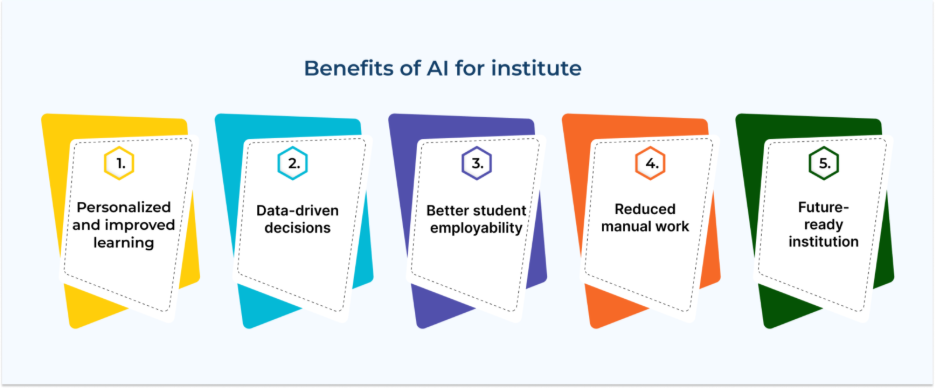
- Improved Learning Outcomes
AI enables personalized learning by adapting content to student performance, helping learners understand concepts better and progress at their own pace.
- Smarter Academic & Administrative Decisions
With data-driven insights, institutes can analyze student performance, attendance, and engagement to make informed academic and operational decisions.
- Enhanced Student Employability
AI awareness and practical exposure equip students with future-ready skills that are highly demanded across industries, improving career readiness.
- Operational Efficiency & Automation
AI reduces manual workload by automating routine tasks such as evaluations, scheduling, and reporting, allowing staff to focus on teaching and mentoring.
- Innovation & Competitive Advantage
Institutes that adopt AI position themselves as forward-thinking, attracting students, faculty, and partnerships while staying aligned with Industry 4.0.
Conclusion
From the First to the Fourth Industrial Revolution, technology has continuously transformed industries, society, and education—from mechanical power to AI, robotics, IoT, and cloud systems. Digital tools like Attendance and Timetable Management ensure accurate records, real-time monitoring, and efficient academic operations.
AI awareness and education equip students and professionals with skills for problem-solving, ethical technology use, and participation in a data-driven world. With India’s large youth population, these technologies can turn demographic strength into a skilled, innovative, and future-ready workforce.
Integrating technology, digital systems, and AI literacy ensures growth, productivity, and global competitiveness for institutions and nations in the 21st century.
The LearnQoch AI powered Academic Platform
Exams are only one part of academic management. LearnQoch goes further by providing an integrated platform that covers all aspects of institutional growth:

Institutional Digital Ecosystem: Categories & Modules
A. LearnQoch AI powered Core Academic & Learning Solutions
Facilitates modern teaching and learning while tracking student progress, assignments, assessments, and course outcomes.
Focuses on measuring learning outcomes to ensure skills, competencies, and academic objectives are met effectively.
- LearnQoch AI powered Academic Calendar & Events
Maintains academic schedules, holidays, events, and exam timelines for seamless yearly planning.
- LearnQoch AI powered Class Module
Manages class creation, faculty allocation, and student grouping while supporting timetable integration.
B. LearnQoch AI powered Examination & Evaluation Management
LearnQoch AI Powered Exam Management Module
A unified system that digitizes the entire exam cycle—right from planning, subject allocation, ATKT processing, and scheduling to question paper creation, assessments, evaluation, and result generation. It ensures transparency, accuracy, and smooth coordination across all departments.
C. LearnQoch AI powered Campus Administration & Operations
Streamlines administrative activities, simplifies student data management, and ensures workflow automation across all departments.
- LearnQoch AI powered Task Management
Organizes, prioritizes, and tracks institutional tasks to improve productivity and accountability.
- LearnQoch AI powered Committee Module
Handles committee formation, roles, activities, and meeting records to maintain governance transparency.
- LearnQoch AI powered Document Management
Stores, organizes, and retrieves institutional documents with version control and compliance tracking.
- LearnQoch AI powered Certificate Management
Manages creation and issuance of academic and administrative certificates such as Bonafide, character, and leaving certificates.
D. LearnQoch AI powered Finance & Fees Management
- LearnQoch AI powered Finance Module – Receivable (Fees)
Tracks payments, manages fee categories, handles tuition/fines, and maintains fee-related records.
- LearnQoch AI powered Advanced Fees
Payments made before the due date, helping institutions and parents manage fee planning efficiently.
- LearnQoch AI powered Excess Fees
Extra amount paid unintentionally; recorded for adjustment in future payments or refunded when necessary.
E. LearnQoch AI powered Library & Resource Management
LearnQoch AI powered Library Module
Manages book registration, issue-return process, renewals, student access, and availability tracking for efficient library operations.
F. LearnQoch AI powered Placement & Career Development
- LearnQoch AI powered Placement Module
Manages job postings, student registration, interview updates, and final offer letters with complete transparency for TPOs and students.
- LearnQoch AI powered Skill Development Solutions
Equips students with future-ready skills to enhance employability and prepare for global career opportunities.
G. LearnQoch AI powered Accreditation & Compliance
LearnQoch AI powered NAAC, NBA & NIRF Compliance
Simplifies reporting, monitoring, and auditing with ready-to-use compliance tools that reduce institutional workload.
H. LearnQoch AI powered Digital Presence & Branding
LearnQoch AI powered Website & Digital Marketing Solutions
Helps institutions build a strong online presence, attract prospective students, and engage key stakeholders effectively.
Experience LearnQoch in Action
We invite you to experience the transformative impact of LearnQoch’s AI powered Digitize Platform with a 14-Day Free Trial.
During this period, our team will implement the software for your institution, allowing you to explore its features firsthand and see the difference it can make in academic management.
👉 Are you ready to lead your institution into the future of campus management?
📞 Contact us at +91 84519 01079
📧 Email: info@learnqoch.com / sales@learnqoch.com
Explore What LearnQoch Offers:
Visit www.learnqoch.com for Full Details
Shape the Future of Learning.
Let LearnQoch help your institution move from paperwork to performance.
Also Read,
Achieve More Every Day with Task Management Software: Organize, Prioritize, and Track Tasks
Automatically Create Class Timetable with LearnQoch Software.
Struggling with Scheduling? Try LearnQoch Timetable Software
Implement NEP 2020: Where Technology & AI Matter in Education?