


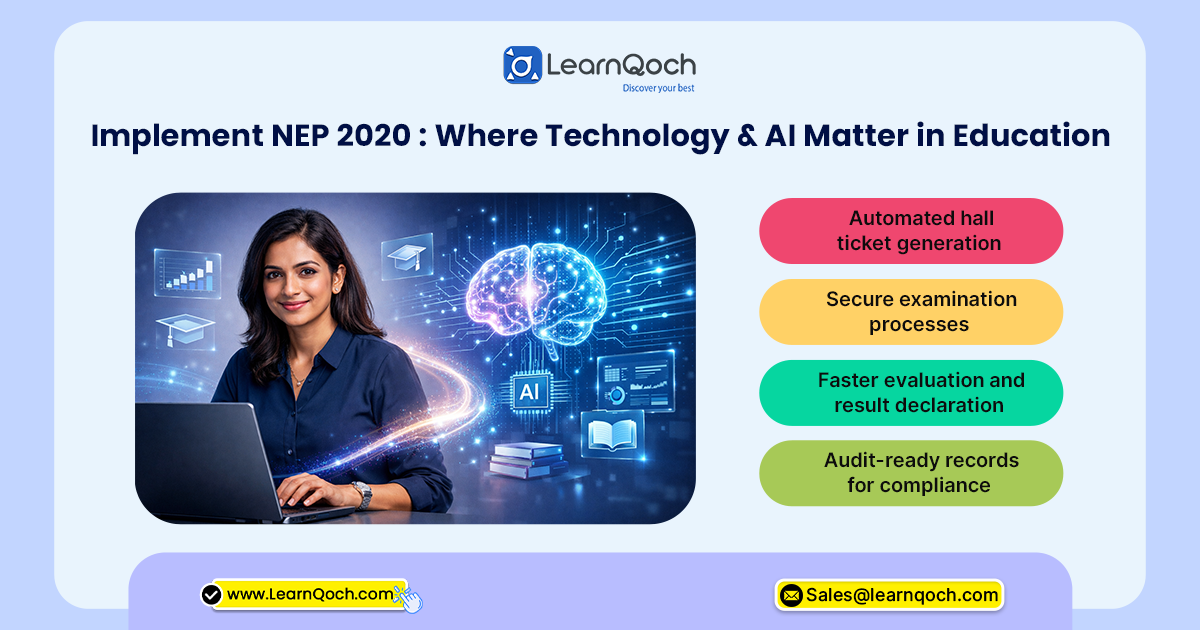
Implement NEP 2020: Where Technology & AI Matter in Education?


The National Education Policy (NEP) 2020 represents a historic transformation in India’s education system, with a strong focus on quality education, accessibility, flexibility, and future readiness. In an era defined by rapid digital transformation, NEP 2020 highlights the critical role of technology-driven education in shaping modern institutions. As explained in our previous blog, “Why AI Is Must in Your Institute?”, Artificial Intelligence (AI) is no longer a futuristic idea but a powerful force already transforming industries across the globe. Similarly, in the education sector, AI is enabling smart campuses, automated academic administration, and personalized learning experiences. Therefore, NEP 2020 strongly advocates the integration of AI, digital tools, and data-driven systems to improve governance, transparency, and learning outcomes. Moreover, by adopting AI-powered education solutions, institutions can enhance operational efficiency, support faculty, and prepare students with future-ready skills, ensuring long-term academic excellence and global competitiveness.
From Previous Blog Why AI Is Must in Your Institute?
Artificial Intelligence (AI) is transforming every industry, from healthcare and finance to manufacturing and education, marking a new phase of the industrial revolution. In the education sector, AI enables smarter administration, personalized learning, and data-driven decision-making. The National Education Policy (NEP) 2020 strongly emphasizes the use of emerging technologies like AI to improve quality, accessibility, and governance in institutions. By adopting AI, institutes can automate routine tasks, enhance teaching–learning outcomes, and improve operational efficiency. AI also prepares students with future-ready skills required in a rapidly evolving digital economy. Overall, AI adoption is no longer optional but essential for institutions aiming for excellence and sustainability.
In this blog, we explored how NEP 2020 emphasizes the role of technology and Artificial Intelligence in transforming education. We discussed why adopting AI-driven digital solutions is essential for improving academic administration, learning outcomes, and institutional efficiency. In the next blog of this series, we will focus on how AI is transforming academic administration, including admissions, examinations, and day-to-day institutional operations, to build truly future-ready educational institutions.
NEP 2020 and the Vision of Digital Transformation
NEP 2020 aims to move Indian education from a traditional, rigid system to a technology-enabled, learner-centric ecosystem. The policy highlights the importance of digital tools to improve teaching, learning, assessment, and governance. Technology is no longer seen as a support function but as a core enabler of institutional efficiency and academic excellence.
AI, data analytics, and automation play a critical role in achieving this vision. By adopting these technologies, institutions can ensure transparency, accuracy, and scalability across academic and administrative processes.
Why Technology Is Central to NEP 2020?
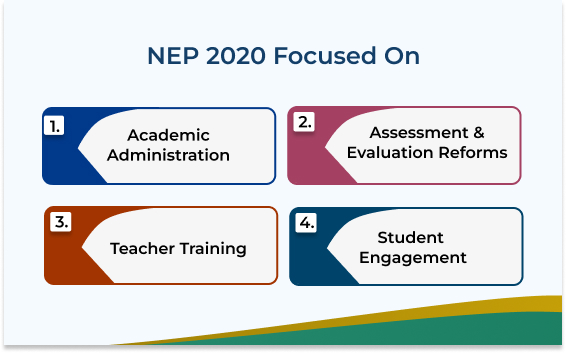
NEP 2020 encourages institutions to adopt digital solutions for:
- Academic administration and governance
- Assessment and evaluation reforms
- Teacher empowerment and training
- Student engagement and personalized learning
The National Education Policy (NEP) 2020 strongly promotes the use of technology to transform how educational institutions function and deliver value. It recognizes that traditional, manual processes can no longer support the growing complexity and scale of modern education. As a result, NEP 2020 encourages institutions to adopt digital and technology-driven solutions across key academic and administrative areas.
In academic administration and governance, technology helps streamline workflows, improve transparency, and ensure accurate record management. For assessment and evaluation reforms, digital systems enable faster evaluations, continuous assessments, and error-free result processing. NEP 2020 also highlights the importance of teacher empowerment and training, where technology supports professional development, performance insights, and reduced administrative burden.
Additionally, student engagement and personalized learning are enhanced through data-driven platforms that adapt to individual learning needs. Manual systems are time-consuming, prone to errors, and difficult to scale. Therefore, NEP 2020 clearly advocates replacing outdated practices with smart, scalable, and efficient digital systems that can meet the evolving demands of educational institutions.
Role of AI in Modern Education
As highlighted in our first blog, AI is driving the current industrial revolution across sectors. In education, AI helps institutions make data-driven decisions, reduce administrative burden, and improve learning outcomes.
AI-powered systems can:
- Automate routine tasks like attendance, exams, and reporting
- Analyze student performance and identify learning gaps
- Support faculty with insights and recommendations
- Enhance accuracy and reduce human errors
This aligns directly with NEP 2020’s goal of improving quality, efficiency, and accountability in education.
NEP 2020 and Examination Reforms
One of the key focus areas of NEP 2020 is examination reform. The policy encourages continuous assessment, transparency, and reduced stress for students. To achieve this, institutions must adopt digital exam management solutions.
AI-driven exam systems help with:
- Automated hall ticket generation
- Secure examination processes
- Faster evaluation and result declaration
- Audit-ready records for compliance
Such solutions not only meet NEP 2020 guidelines but also improve the overall exam experience for students, faculty, and administrators.
Preparing Institutions for the Future
NEP 2020 strongly emphasizes preparing students for future careers in an increasingly technology-driven and digital-first world. Institutions that proactively adopt AI and digital systems not only modernize their operations but also lead by example by fostering a culture of innovation, adaptability, and continuous improvement. Moreover, technology adoption enables institutions to improve operational efficiency, reduce manual effort, and make informed decisions through data-driven insights. In addition, digital transformation helps enhance institutional reputation, meet accreditation and compliance standards, and remain competitive in the rapidly evolving education ecosystem. As discussed in our blog “Why AI Is Must in Your Institute?”, AI adoption is no longer optional. Instead, it has become a strategic necessity for long-term sustainability, academic excellence, and future readiness.
LearnQoch and NEP 2020 Alignment
- LearnQoch solutions are built to align with NEP 2020 guidelines, supporting institutions in their digital transformation journey.
- AI-driven academic and administrative systems help automate key processes such as admissions, attendance, examinations, and reporting.
- By reducing manual effort and paperwork, LearnQoch improves operational efficiency and accuracy.
- Institutions gain better transparency, compliance, and governance through centralized digital workflows.
- Data-driven insights and analytics support informed academic and administrative decision-making.
- Overall, LearnQoch enables institutions to modernize operations while meeting national education reform standards.
Conclusion
NEP 2020 positions technology and Artificial Intelligence as the foundation of modern, future-ready education. Institutions that embrace this digital transformation can deliver high-quality, student-centric learning while managing academic and administrative operations with greater efficiency and accuracy. As highlighted in our blog “Why AI Is Must in Your Institute?”, adopting AI is not merely an innovation choice but a strategic requirement for today’s institutions. It enables alignment with NEP 2020 guidelines, supports accreditation and compliance standards, and equips students with future-ready digital skills.
Furthermore, AI-driven systems help institutions gain data-driven insights, improve transparency, and reduce operational risks. By investing in AI today, institutions can strengthen academic excellence, enhance institutional credibility, and remain competitive in India’s rapidly evolving education landscape.
The LearnQoch AI powered Academic Platform
Exams are only one part of academic management. LearnQoch goes further by providing an integrated platform that covers all aspects of institutional growth:

Institutional Digital Ecosystem: Categories & Modules
A. LearnQoch AI powered Core Academic & Learning Solutions
Facilitates modern teaching and learning while tracking student progress, assignments, assessments, and course outcomes.
Focuses on measuring learning outcomes to ensure skills, competencies, and academic objectives are met effectively.
- LearnQoch AI powered Academic Calendar & Events
Maintains academic schedules, holidays, events, and exam timelines for seamless yearly planning.
- LearnQoch AI powered Class Module
Manages class creation, faculty allocation, and student grouping while supporting timetable integration.
B. LearnQoch AI powered Examination & Evaluation Management
LearnQoch AI Powered Exam Management Module
A unified system that digitizes the entire exam cycle—right from planning, subject allocation, ATKT processing, and scheduling to question paper creation, assessments, evaluation, and result generation. It ensures transparency, accuracy, and smooth coordination across all departments.
C. LearnQoch AI powered Campus Administration & Operations
Streamlines administrative activities, simplifies student data management, and ensures workflow automation across all departments.
- LearnQoch AI powered Task Management
Organizes, prioritizes, and tracks institutional tasks to improve productivity and accountability.
- LearnQoch AI powered Committee Module
Handles committee formation, roles, activities, and meeting records to maintain governance transparency.
- LearnQoch AI powered Document Management
Stores, organizes, and retrieves institutional documents with version control and compliance tracking.
- LearnQoch AI powered Certificate Management
Manages creation and issuance of academic and administrative certificates such as Bonafide, character, and leaving certificates.
D. LearnQoch AI powered Finance & Fees Management
- LearnQoch AI powered Finance Module – Receivable (Fees)
Tracks payments, manages fee categories, handles tuition/fines, and maintains fee-related records.
- LearnQoch AI powered Advanced Fees
Payments made before the due date, helping institutions and parents manage fee planning efficiently.
- LearnQoch AI powered Excess Fees
Extra amount paid unintentionally; recorded for adjustment in future payments or refunded when necessary.
E. LearnQoch AI powered Library & Resource Management
LearnQoch AI powered Library Module
Manages book registration, issue-return process, renewals, student access, and availability tracking for efficient library operations.
F. LearnQoch AI powered Placement & Career Development
- LearnQoch AI powered Placement Module
Manages job postings, student registration, interview updates, and final offer letters with complete transparency for TPOs and students.
- LearnQoch AI powered Skill Development Solutions
Equips students with future-ready skills to enhance employability and prepare for global career opportunities.
G. LearnQoch AI powered Accreditation & Compliance
LearnQoch AI powered NAAC, NBA & NIRF Compliance
Simplifies reporting, monitoring, and auditing with ready-to-use compliance tools that reduce institutional workload.
H. LearnQoch AI powered Digital Presence & Branding
LearnQoch AI powered Website & Digital Marketing Solutions
Helps institutions build a strong online presence, attract prospective students, and engage key stakeholders effectively.
Experience LearnQoch in Action
We invite you to experience the transformative impact of LearnQoch’s AI powered Digitize Platform with a 14-Day Free Trial.
During this period, our team will implement the software for your institution, allowing you to explore its features firsthand and see the difference it can make in academic management.
👉 Are you ready to lead your institution into the future of campus management?
📞 Contact us at +91 84519 01079
📧 Email: info@learnqoch.com / sales@learnqoch.com
Explore What LearnQoch Offers:
Visit www.learnqoch.com for Full Details
Shape the Future of Learning.
Let LearnQoch help your institution move from paperwork to performance.
Also Read,
Achieve More Every Day with Task Management Software: Organize, Prioritize, and Track Tasks
Automatically Create Class Timetable with LearnQoch Software.
Struggling with Scheduling? Try LearnQoch Timetable Software