


Teachers mould students future. Let’s help them to mould it effortlessly.


गुरु बिन ज्ञान न उपजै, गुरु बिन मिलै न मोक्ष।
गुरु बिन लखै न सत्य को, गुरु बिन मिटैं न दोष।।
The above statement by the great saint Kabir has remained profoundly relevant for centuries and continues to hold meaning even today. Its timeless wisdom reflects the foundational role education plays in shaping individuals and societies alike. However, despite this enduring truth, India currently faces significant challenges in its education system, highlighting the importance of how teachers mould students’ future.
At present, nearly 25% of students in India drop out of school due to a lack of interest in their studies. Moreover, during the COVID-19 pandemic, this percentage rose sharply, largely because of the absence of physical interaction between teachers and students. Consequently, learning engagement declined, exposing a long-standing and systemic issue that now demands immediate attention from both government and private stakeholders to ensure the sustainable growth of India (Bharat) and to strengthen teacher impact, safeguard the student future, and provide adequate teaching support.
If we look globally, developed nations have consistently placed the highest importance on teachers, recognizing them as key contributors to national progress. In these countries, educators play a crucial role in delivering personalized and meaningful learning experiences, ultimately shaping responsible citizens.
Similarly, the wisdom of Chanakya powerfully reinforces this belief:
“शिक्षक कभी साधारण नहीं होता। प्रलय और निर्माण उसकी गोद में पलते हैं।”
(A teacher is never ordinary; both destruction and creation are nurtured in their hands.)
Therefore, if we truly aspire to transform the education system, we must empower teachers through respect, fair remuneration, and effective use of technology. Ultimately, educator empowerment is key to enhancing classroom efficiency and boosting student learning, making it the most sustainable path toward building an engaged, knowledgeable, and future-ready nation.
In addition to schoolteachers, it is equally important to actively involve mothers in a child’s learning journey, as they play a crucial role in helping children understand concepts with ease. As widely acknowledged, a mother is a child’s first and best teacher, and when her guidance is applied in the right way, positive learning outcomes become far more achievable. During the early years, children share the closest emotional bond with their mothers, making this phase ideal for reinforcing foundational concepts. As we see in this blog, if a system provides personalized learning updates and insights, mothers can use this information constructively to support daily learning at home. Consequently, this collaboration strengthens conceptual clarity, builds confidence, and nurtures curiosity from an early age.
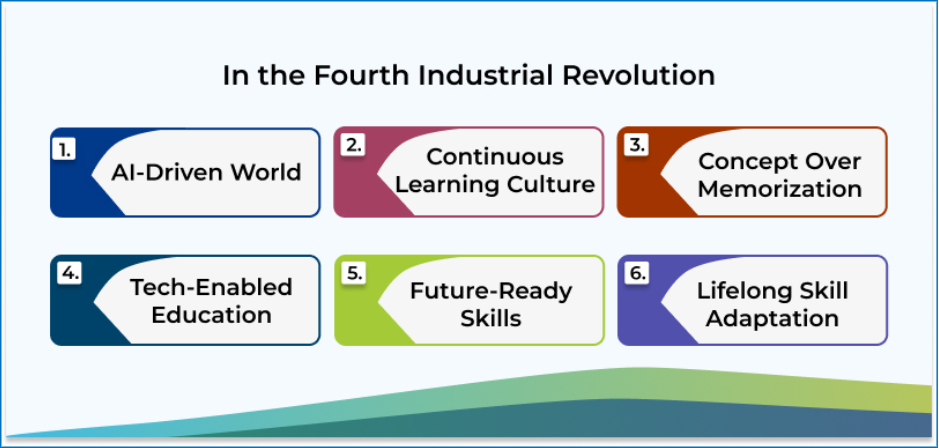
In the 4th Industrial Revolution
The Fourth Industrial Revolution (4IR) represents a powerful fusion of rapid advances in artificial intelligence (AI), robotics, the Internet of Things (IoT), genetic engineering, quantum computing, and several other emerging technologies. As a result, the nature of work, learning, and human interaction is transforming at an unprecedented pace. In this constantly evolving landscape, learning is no longer a one-time activity but a continuous and lifelong endeavor, supported by advanced teaching tools and LearnQoch AI‑powered solutions.
Therefore, to remain relevant in the era of 4IR, students must develop strong conceptual foundations instead of relying on rote memorization. Meaningful learning occurs only when students clearly understand every subject, chapter, and concept from an early age. However, such clarity does not happen automatically; it emerges only when the right support systems are in place.
At this point, the role of teachers and parents becomes critically important. Teachers act as facilitators of curiosity and critical thinking, while parents reinforce learning beyond the classroom. Digital tools help track student understanding, identify learning gaps, and recommend personalized content. Moreover, when teachers and parents work together using technology, learning becomes more engaging, consistent, and student-centric. Ultimately, empowering teachers and parents through technology is essential to prepare students for future challenges and long-term success.
Read More Follow Your Passion
Key Considerations in the Fourth Industrial Revolution (4.0)
When discussing the Fourth Industrial Revolution, it is essential to focus on how rapid technological advancements are transforming learning, work, and society. Emphasis must be placed on continuous learning, conceptual clarity, and skill adaptability to prepare individuals for an AI-driven and technology-intensive future.
- AI-Driven World
- Continuous Learning Culture
- Concept Over Memorization
- Tech-Enabled Education
- Future-Ready Skills
- Lifelong Skill Adaptation
Conclusion
In conclusion, achieving the true vision of NEP 2020 and preparing learners for the Fourth Industrial Revolution requires a strong, collaborative, and technology-enabled education ecosystem. While curriculum reforms and content availability are essential, conceptual clarity, sustained interest, and continuous engagement remain the real drivers of meaningful learning. Empowering teachers, parents—especially mothers—and institutions with data-driven insights and personalized tools bridges the gap between teaching and learning. Moreover, early childhood education emerges as the most critical phase where the right guidance can shape lifelong outcomes. When schools, families, and technology work together, education becomes inclusive, engaging, and future ready. Ultimately, strengthening these partnerships ensures not only better academic outcomes but also the holistic development of learners who can confidently contribute to the progress of India (Bharat).
The LearnQoch AI powered Academic Platform
LearnQoch goes further by providing an integrated platform that covers all aspects of institutional growth:

Institutional Digital Ecosystem: Categories & Modules
A. LearnQoch AI powered Core Academic & Learning Solutions
Facilitates modern teaching and learning while tracking student progress, assignments, assessments, and course outcomes.
Focuses on measuring learning outcomes to ensure skills, competencies, and academic objectives are met effectively.
- LearnQoch AI powered Academic Calendar & Events
Maintains academic schedules, holidays, events, and exam timelines for seamless yearly planning.
- LearnQoch AI powered Class Module
Manages class creation, faculty allocation, and student grouping while supporting timetable integration.
B. LearnQoch AI powered Examination & Evaluation Management
LearnQoch AI Powered Exam Management Module
A unified system that digitizes the entire exam cycle—right from planning, subject allocation, ATKT processing, and scheduling to question paper creation, assessments, evaluation, and result generation. It ensures transparency, accuracy, and smooth coordination across all departments.
C. LearnQoch AI powered Campus Administration & Operations
Streamlines administrative activities, simplifies student data management, and ensures workflow automation across all departments.
- LearnQoch AI powered Task Management
Organizes, prioritizes, and tracks institutional tasks to improve productivity and accountability.
- LearnQoch AI powered Committee Module
Handles committee formation, roles, activities, and meeting records to maintain governance transparency.
- LearnQoch AI powered Document Management
Stores, organizes, and retrieves institutional documents with version control and compliance tracking.
- LearnQoch AI powered Certificate Management
Manages creation and issuance of academic and administrative certificates such as Bonafide, character, and leaving certificates.
D. LearnQoch AI powered Finance & Fees Management
- LearnQoch AI powered Finance Module – Receivable (Fees)
Tracks payments, manages fee categories, handles tuition/fines, and maintains fee-related records.
- LearnQoch AI powered Advanced Fees
Payments made before the due date, helping institutions and parents manage fee planning efficiently.
- LearnQoch AI powered Excess Fees
Extra amount paid unintentionally; recorded for adjustment in future payments or refunded when necessary.
E. LearnQoch AI powered Library & Resource Management
LearnQoch AI powered Library Module
Manages book registration, issue-return process, renewals, student access, and availability tracking for efficient library operations.
F. LearnQoch AI powered Placement & Career Development
- LearnQoch AI powered Placement Module
Manages job postings, student registration, interview updates, and final offer letters with complete transparency for TPOs and students.
- LearnQoch AI powered Skill Development Solutions
Equips students with future-ready skills to enhance employability and prepare for global career opportunities.
G. LearnQoch AI powered Accreditation & Compliance
LearnQoch AI powered NAAC, NBA & NIRF Compliance
Simplifies reporting, monitoring, and auditing with ready-to-use compliance tools that reduce institutional workload.
H. LearnQoch AI powered Digital Presence & Branding
LearnQoch AI powered Website & Digital Marketing Solutions
Helps institutions build a strong online presence, attract prospective students, and engage key stakeholders effectively.
Don’t Just Take Our Word for It—Try LearnQoch Yourself!
We invite you to experience the transformative impact of LearnQoch’s Digitize Platform with a 14-Day Free Trial.
During this period, our team will implement the software for your institution, allowing you to explore its features firsthand and see the difference it can make in academic management.
👉 Are you ready to lead your institution into the future of campus management?
📞 Contact us at +91 84519 01079
📧 Email: info@learnqoch.com /sales@learnqoch.com
Explore What LearnQoch Offers:
Visit www.learnqoch.com for Full Details
Also read,
Transforming Education: How AI is Transforming the Way Students, Educators, and Principals Work
The Role of AI in Education: Personalizing Learning for Every Student
How EdTech Solutions Can Help Indian Higher Education Compete Globally
The Hidden Barriers to India’s Nobel Prize Success in Science
FAQs
1. Why is parent involvement important in NEP 2020?
NEP 2020 emphasizes holistic learning, where parents—especially mothers—support early concept of clarity and emotional development.
2. How does technology help teachers under NEP 2020?
Technology enables teachers to track learning gaps, personalize instruction, and improve teaching effectiveness through data-driven insights.
3. What role does Early Childhood Care and Education (ECCE) play?
ECCE forms the foundation of lifelong learning, as most brain development happens before the age of five.
4. How can mothers support their child’s learning at home?
With personalized learning updates, mothers can reinforce classroom concepts through daily conversations and activities.
5. Why is conceptual clarity crucial in the 4IR era?
Strong concepts foster critical thinking, problem-solving, and adaptability—skills essential for future careers.
6. How does NEP 2020 align education with real-world needs?
Focusing on skills, continuous assessment, and collaboration between schools, parents, and technology.