


Problem solving is the most essential skill of 21st century!


Personal and professional life has undergone a major shift over the past 30–40 years with the rise of urbanization, the continued emergence of new technologies, and globalization. As a result, the way we communicate, work, learn, and solve problems has completely transformed. While this shift has brought benefits such as convenience, speed, and global connectivity, it has also introduced new challenges that require adaptability and continuous learning. For learners in the city, AI problem solving Mumbai programs play a crucial role in equipping students with the skills needed to tackle modern, real-world challenges effectively.
In the context of the 4th Industrial Revolution (4IR), which encompasses the integration of Artificial Intelligence, robotics, the Internet of Things, genetic engineering, and quantum computing, learning has become not only important but a necessity. Thus, to become relevant in this changing world, students must be equipped with problem-solving skills, critical thinking, creativity, and digital literacy.
What is important to note is that the National Education Policy 2020 (NEP 2020) perfectly complements this vision to create a better future with the integration of 4IR technologies, which will not only help the students create a better future but will also create a better world for society and humanity.
How to build problem-solving skills?
There are various problem-solving courses available both online and offline, catering to different age groups. However, in this blog, we will specifically focus on problem-solving courses for the 6 to 21 age group, as this is a crucial period for building a strong foundation for both personal and professional success. During this time, learners not only acquire knowledge in their respective streams but also develop essential analytical thinking and logical reasoning skills. For students in the city, AI problem solving Mumbai programs further enhance these abilities by combining technology with practical problem-solving approaches, preparing them for future challenges.
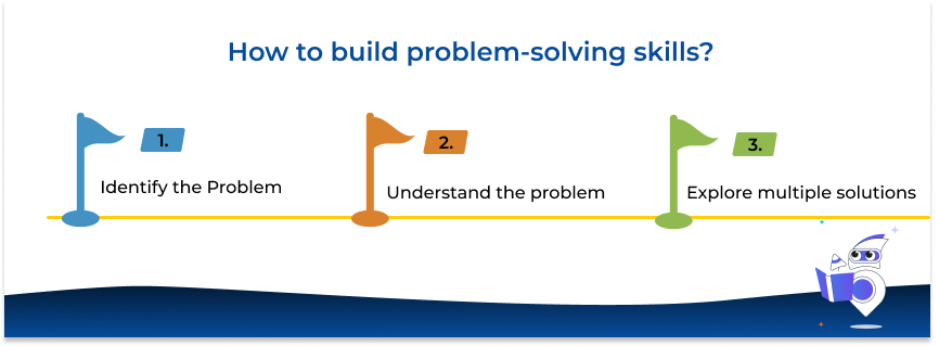
Identify the Problem
To begin with, it is very important to first identify the problem in order to solve it, as this is the most crucial step in problem-solving. In your Mathematics textbook, you must have often noticed the phrase “Solve the problem.” However, before solving it, one must clearly understand what the problem is actually asking. For learners in the region, programs like LearnQoch AI skills Vidarbha emphasize this foundational approach, helping students develop clarity in thinking before applying solutions using modern technology and AI concepts.
Although the basic concept of mathematics is based on addition, subtraction, multiplication, and division, students are often scared of mathematics. It is not the numbers themselves, but the fact that understanding the real issue at hand requires logical understanding and clarity. Instead of directly applying formulas, students should try to read the question, break it down into simpler terms, and understand exactly what is required. Once the issue is understood, the solution is quite simple.
Understand the problem
While the core essence of Maths is based on the concepts of addition, subtraction, multiplication, and division, many students end up developing a fear of the subject. This fear is not based on the subject matter, but the fear comes because, to understand the core problem, one needs to be logically clear and precise. Instead of directly using the formulas, the student needs to read the problem, break it down, and be clear about the problem before trying to solve it.
Explore multiple solutions for the problem
After you have identified the problem clearly and understood the problem, the next step is to explore different solutions to the problem. The key to problem-solving is not to find a solution to the problem, but to find the best solution to the problem. Therefore, the student has to train their minds to think differently instead of sticking to the first solution that comes to their minds.
To become good solution builders, students need to consistently practice problem-solving, which requires both patience and experience. This is why parents and teachers encourage children to regularly engage in Maths and coding activities. The more students practice, the stronger their problem-solving abilities become. For learners in the region, programs focused on problem solving skills Nagpur provide the right environment to develop these essential skills in a structured and practical way.
In addition, the key to a smart problem solver is to achieve the desired result with the least steps, time, and efforts. For example, in coding, you may write a program that works perfectly, but the optimized version of the same program may execute faster, may consume less memory, and may give a better user experience to the end users.
In the same way, in subjects such as Maths and Science, it is very important to have a clear concept before reaching conclusions. In fact, students enjoy studying these subjects when they have a good concept in the basics. Hence, instead of memorizing formulas and copying answers, it is always important to concentrate on the concept first and then make use of the best solution in an easy and enjoyable way.
Always focus on the application while solving the problem
With reference to the above mobile app example to track bus students, as a coder you need to prepare a detailed project plan to implement the solution. Follow the below steps:
- Prepare AS IS process
- Have multiple meetings with all the users who are part of AS IS & TO BE processes
- Understand end user pain points
- Prepare TO BE process
- Involve all the users while developing the application
- Explore multiple options while following the Software Development Life Cycle (SDLC)
Similarly, while solving any maths problem, follow the below steps
- 1st understand the problem
- Do require detailing to break the problem in small pieces
- Apply correct formulae
- Be cautious while doing addition / subtraction / multiplication / division
- Review your working before making the conclusion
To be a smart technical problem solver, you need to be a good STEM student, and a coding foundation will help you. Always focus on understanding specific chapter-topic concepts to be a genuine coder.
Happy Coding…
Read more Educators need a genuine technology partner
Conclusion
In conclusion, it can be said that problem-solving is not merely an academic requirement but an essential life skill that significantly influences a learner’s personal and professional journey. From recognizing a problem to understanding it in depth and exploring possible solutions, this process helps develop logical thinking and confidence. Moreover, when learners are regularly exposed to problem-solving—especially through subjects like Math, Science, and Coding—they gradually overcome fear and build clear concepts. Rather than focusing only on the final answer, learners should concentrate on the thinking and analysis process. For students in the city, programs focused on 21st century skills Mumbai play a vital role in shaping smarter, more adaptable, and future-ready individuals capable of handling real-life challenges effectively.
The LearnQoch AI powered Academic Platform
LearnQoch goes further by providing an integrated platform that covers all aspects of institutional growth:

Institutional Digital Ecosystem: Categories & Modules
A. LearnQoch AI powered Core Academic & Learning Solutions
Facilitates modern teaching and learning while tracking student progress, assignments, assessments, and course outcomes.
Focuses on measuring learning outcomes to ensure skills, competencies, and academic objectives are met effectively.
- LearnQoch AI powered Academic Calendar & Events
Maintains academic schedules, holidays, events, and exam timelines for seamless yearly planning.
- LearnQoch AI powered Class Module
Manages class creation, faculty allocation, and student grouping while supporting timetable integration.
B. LearnQoch AI powered Examination & Evaluation Management
LearnQoch AI Powered Exam Management Module
A unified system that digitizes the entire exam cycle—right from planning, subject allocation, ATKT processing, and scheduling to question paper creation, assessments, evaluation, and result generation. It ensures transparency, accuracy, and smooth coordination across all departments.
C. LearnQoch AI powered Campus Administration & Operations
Streamlines administrative activities, simplifies student data management, and ensures workflow automation across all departments.
- LearnQoch AI powered Task Management
Organizes, prioritizes, and tracks institutional tasks to improve productivity and accountability.
- LearnQoch AI powered Committee Module
Handles committee formation, roles, activities, and meeting records to maintain governance transparency.
- LearnQoch AI powered Document Management
Stores, organizes, and retrieves institutional documents with version control and compliance tracking.
- LearnQoch AI powered Certificate Management
Manages creation and issuance of academic and administrative certificates such as Bonafide, character, and leaving certificates.
D. LearnQoch AI powered Finance & Fees Management
- LearnQoch AI powered Finance Module – Receivable (Fees)
Tracks payments, manages fee categories, handles tuition/fines, and maintains fee-related records.
- LearnQoch AI powered Advanced Fees
Payments made before the due date, helping institutions and parents manage fee planning efficiently.
- LearnQoch AI powered Excess Fees
Extra amount paid unintentionally; recorded for adjustment in future payments or refunded when necessary.
E. LearnQoch AI powered Library & Resource Management
LearnQoch AI powered Library Module
Manages book registration, issue-return process, renewals, student access, and availability tracking for efficient library operations.
F. LearnQoch AI powered Placement & Career Development
- LearnQoch AI powered Placement Module
Manages job postings, student registration, interview updates, and final offer letters with complete transparency for TPOs and students.
- LearnQoch AI powered Skill Development Solutions
Equips students with future-ready skills to enhance employability and prepare for global career opportunities.
G. LearnQoch AI powered Accreditation & Compliance
LearnQoch AI powered NAAC, NBA & NIRF Compliance
Simplifies reporting, monitoring, and auditing with ready-to-use compliance tools that reduce institutional workload.
H. LearnQoch AI powered Digital Presence & Branding
LearnQoch AI powered Website & Digital Marketing Solutions
Helps institutions build a strong online presence, attract prospective students, and engage key stakeholders effectively.
Don’t Just Take Our Word for It—Try LearnQoch Yourself!
We invite you to experience the transformative impact of LearnQoch’s AI powered Digitize Platform with a 14-Day Free Trial.
During this period, our team will implement the software for your institution, allowing you to explore its features firsthand and see the difference it can make in academic management.
👉 Are you ready to lead your institution into the future of campus management?
📞 Contact us at +91 84519 01079
📧 Email: info@learnqoch.com / sales@learnqoch.com
Explore What LearnQoch Offers:
Visit www.learnqoch.com for Full Details
Also read,
From Inquiry to Enrollment: Mapping the Student Journey via Your Website
5 Things Every Principal Needs to Know About Exam Management Technology
Coding and Robotics in Remote Learning: Strategies for Success
Best LMS for Schools: The Future of Learning Management Systems