


Implement Respect for Diversity & Local Context with NEP 2020


In Bharat (India) we have 22 major languages – Assamese, Bengali, Gujarati, Hindi, Kannada, Kashmiri, Konkani, Malayalam, Manipuri, Marathi, Nepali, Oriya, Punjabi, Sanskrit, Sindhi, Tamil, Telugu, Urdu, Bodo, Santhali, Maithili and Dogri and 270 mother tongues. This clearly demonstrate our diversity for languages and culture under diversity NEP 2020 and local context implement. Ladakhi language, food, weather, and culture are quite different than Tamilnadu. Gujarati’s entrepreneurial passion and Bengali’s hunger for knowledge has done significant contribution in the overall growth of our country.
For policy makers it must be a mammoth task to ensure that all the stakeholders across the country are receiving the desired output under diversity NEP 2020 and local context implement. NEP 2020 is being designed carefully to have inclusive growth across different sections of society. In Bharat, more than 25% students drop out from the schools due to lack of interest in the studies. We as a trustee, principal, teacher, and parents need to play our role carefully to ensure success of our students and nation.
This blog highlights
This blog highlights the importance of implementing respect for diversity and local context in education to create inclusive and meaningful learning experiences through LearnQoch AI LMS diversity. To begin with, it emphasizes how acknowledging cultural, linguistic, and regional differences helps students feel valued and engaged.
Moreover, in alignment with the National Education Policy 2020, the blog stresses the need for integrating local knowledge, traditions, and languages into the curriculum through LearnQoch AI LMS diversity. As a result, learning becomes more relatable and impactful for students.
In addition, it discusses how schools can adopt flexible teaching methods and inclusive practices to address diverse learning needs. Consequently, this approach promotes equity and equal opportunities for all learners.
Ultimately, the blog concludes that respecting diversity and local context not only enhances educational quality but also fosters a more inclusive, culturally aware, and future-ready education system.
National Education Policy (NEP) 2020 overview
Let’s understand National Education Policy (NEP) 2020 in detail. Following are the key principles of NEP 2020
- Respect for Diversity & Local Context – In all curriculum, pedagogy and policy
- Equity & Inclusion – As the cornerstone of all educational decisions
- Community Participation – Encouragement and facilitation for philanthropic, private and community participation.
- Use of Technology – In teaching and learning, removing language barriers, for Divyang students, and in educational planning and management.
- Emphasize Conceptual Understanding – Rather than rote learning and learning-for-exams
- Unique Capabilities – Recognizing, identifying them in each student.
- Critical thinking and Creativity – To encourage logical decision-making and innovation
- Continuous Review – Based on sustained research and regular assessment by educational experts.
Each of the above principles need to be implemented across all the schools (Government & Private). “WHAT” part of policy is very clear, now it’s a responsibility of esteemed schools to define “HOW” part for the successful implementation of NEP 2020.
In this blog we’ll cover what to be done to ensure Respect for Diversity & Local Context while implementing NEP 2020.
Universalization of Access – from ECCE (Early Childhood Care & Education) to Secondary
NEP 2020 is transforming Curricular & Pedagogical Structure by introducing (5+3+3+4): 3 years in Angadwadi/pre-school and 12 years in school
- In foundational stage (Initial 5years), students will have multilevel, play/activity-based learning.
- In preparatory stage (3years), they’ll learn through play, discovery and activity-based and interactive classroom training
- In middle stage (3years), students will have experiential learning in the sciences, mathematics, arts, social sciences, and humanities.
- In secondary stage (final 4years), students will have multidisciplinary study, greater critical thinking, flexibility and student choice of subjects.
Early Childhood Care & Education (ECCE) Framework
Early Childhood Care & Education (ECCE) is the most important aspect of any child’s growth.
National Curricular and Pedagogical Framework for Early Childhood Education (NCPFECE) will be drafted by NCERT. NCPFECE will be aligned with the latest research on ECCE, and national and international best practices. To create interest among students’ pedagogy is comprising of alphabets, languages, numbers, counting, colours, shapes, indoor and outdoor play, puzzles, and logical thinking, problem-solving, drawing, painting and other visual art, craft, drama and puppetry, music, and movement. A 3-month play-based ‘school preparation module’ for all Grade 1 students to be developed by NCERT .
Early Childhood Education: Learning in the Formative Years
To ensure Respect for Diversity & Local Context while implementing NEP 2020, we need to inculcate following skills in our students
- Developing curiosity
- Logical thinking & problem solving
- Arts, crafts, and Music
- Relationship with Nature
- Colours, Shapes, Alphabets & Numbers
- Teamwork & Collaboration
- Play-based & Discovery-based learning
- Ethics
- Self-Identity
- Etiquette, Behaviour and Emotional Development
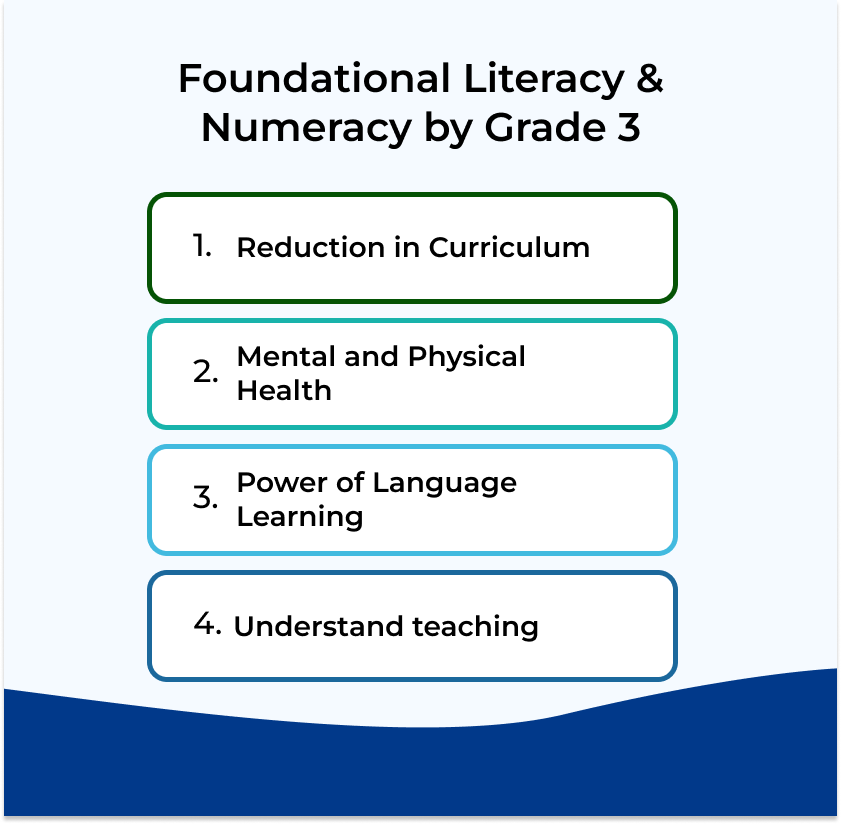
Attainment of Foundational Literacy and Numeracy by Grade 3 in Mission mode
It’s critical for every student to read & write by grade 3. Once they miss this, it’s become too difficult for them to cope up with language and mathematical concepts. Hence schools are expected to provide early learning contents in reading & video formats to ensure students are building their foundation for literacy and numeracy.
Reduction in Curriculum
NEP 2020 is focusing on Core Essentials, Critical Thinking, Interactive Classes and Experiential learning. And it’s very much possible through EdTech solutions. Curriculum and pedagogy to be transformed by 2022 to promote skill based and minimize rote based learning. Student’s interest can be created and grow if we are able to clear their concepts. To make this happen we need to implement best in class technology solution to monitor, measure and analyse overall growth of students and teachers.
Mental and Physical Health and Well-Being
To ensure mental and physical health & well-being, we need to have annual health check of our students. Reduce weight of school bags which can be done immediately with good EdTech solution. We need to put all our effort to focus on children with disability. Across the globe we have 1Bn+ people with disability hence we need to build solid eco-system to take care of them.
Multilingualism and the Power of Language Learning
If you visit any most advanced APAC countries like Japan, South Korea & Taiwan, you’ll find that they have given importance to their local language. And this has helped them to improve per capita income of their citizens. I have studied in Hindi medium till 10th grade and suddenly जल became the water. Still, I remember my struggle of learning English while clearing engineering concepts. NEP 2020 is promoting home language/ mother-tongue/ local language medium of instruction until grade 5, and preferably till Grade 8 and beyond.
Build system to understand teaching & learning strength and gaps
If 28% population of our country is under 14 years of age, then we need to do all our level best to implement scientific system to understand teaching & learning strength and gaps on daily basis. Teaching and learning are happening every day so monitoring, measurement and analysis should also happen on periodic basis.
Manually we can’t track the progress of how we are implementing respect for diversity & local context? If we provide them periodic feedback in structured format then it’ll surely help them to better their teaching and learning plans.
In conclusion, if we integrate implementation of NEP 2020 with technology then adoption will increase significantly to get the desire outcome.
Implement NEP 2020 in your educational institute with LearnQoch.
The LearnQoch AI powered Academic Platform
LearnQoch goes further by providing an integrated platform that covers all aspects of institutional growth:

Institutional Digital Ecosystem: Categories & Modules
A. LearnQoch AI powered Core Academic & Learning Solutions
Facilitates modern teaching and learning while tracking student progress, assignments, assessments, and course outcomes.
Focuses on measuring learning outcomes to ensure skills, competencies, and academic objectives are met effectively.
- LearnQoch AI powered Academic Calendar & Events
Maintains academic schedules, holidays, events, and exam timelines for seamless yearly planning.
- LearnQoch AI powered Class Module
Manages class creation, faculty allocation, and student grouping while supporting timetable integration.
B. LearnQoch AI powered Examination & Evaluation Management
LearnQoch AI Powered Exam Management Module
A unified system that digitizes the entire exam cycle—right from planning, subject allocation, ATKT processing, and scheduling to question paper creation, assessments, evaluation, and result generation. It ensures transparency, accuracy, and smooth coordination across all departments.
C. LearnQoch AI powered Campus Administration & Operations
Streamlines administrative activities, simplifies student data management, and ensures workflow automation across all departments.
- LearnQoch AI powered Task Management
Organizes, prioritizes, and tracks institutional tasks to improve productivity and accountability.
- LearnQoch AI powered Committee Module
Handles committee formation, roles, activities, and meeting records to maintain governance transparency.
- LearnQoch AI powered Document Management
Stores, organizes, and retrieves institutional documents with version control and compliance tracking.
- LearnQoch AI powered Certificate Management
Manages creation and issuance of academic and administrative certificates such as Bonafide, character, and leaving certificates.
D. LearnQoch AI powered Finance & Fees Management
- LearnQoch AI powered Finance Module – Receivable (Fees)
Tracks payments, manages fee categories, handles tuition/fines, and maintains fee-related records.
- LearnQoch AI powered Advanced Fees
Payments made before the due date, helping institutions and parents manage fee planning efficiently.
- LearnQoch AI powered Excess Fees
Extra amount paid unintentionally; recorded for adjustment in future payments or refunded when necessary.
E. LearnQoch AI powered Library & Resource Management
LearnQoch AI powered Library Module
Manages book registration, issue-return process, renewals, student access, and availability tracking for efficient library operations.
F. LearnQoch AI powered Placement & Career Development
- LearnQoch AI powered Placement Module
Manages job postings, student registration, interview updates, and final offer letters with complete transparency for TPOs and students.
- LearnQoch AI powered Skill Development Solutions
Equips students with future-ready skills to enhance employability and prepare for global career opportunities.
G. LearnQoch AI powered Accreditation & Compliance
LearnQoch AI powered NAAC, NBA & NIRF Compliance
Simplifies reporting, monitoring, and auditing with ready-to-use compliance tools that reduce institutional workload.
H. LearnQoch AI powered Digital Presence & Branding
LearnQoch AI powered Website & Digital Marketing Solutions
Helps institutions build a strong online presence, attract prospective students, and engage key stakeholders effectively.
Don’t Just Take Our Word for It—Try LearnQoch Yourself!
We invite you to experience the transformative impact of LearnQoch’s Digitize Platform with a 14-Day Free Trial.
During this period, our team will implement the software for your institution, allowing you to explore its features firsthand and see the difference it can make in academic management.
👉 Are you ready to lead your institution into the future of campus management?
📞 Contact us at +91 84519 01079
📧 Email: info@learnqoch.com /sales@learnqoch.com
Explore What LearnQoch Offers:
Visit www.learnqoch.com for Full Details
Also Read,
NEP 2020 and encouraging 21st century skills with technology
LearnQoch ERP and LMS: Empowering Teacher Training under NEP 2020
Student Engagement in NEP 2020: Making Learning Multimodal with LearnQoch
LearnQoch LMS: Bridging the Learning Gap Aligned with NEP 2020
AI in Personalized Learning: How LearnQoch’s ERP and LMS Align with NEP 2020