


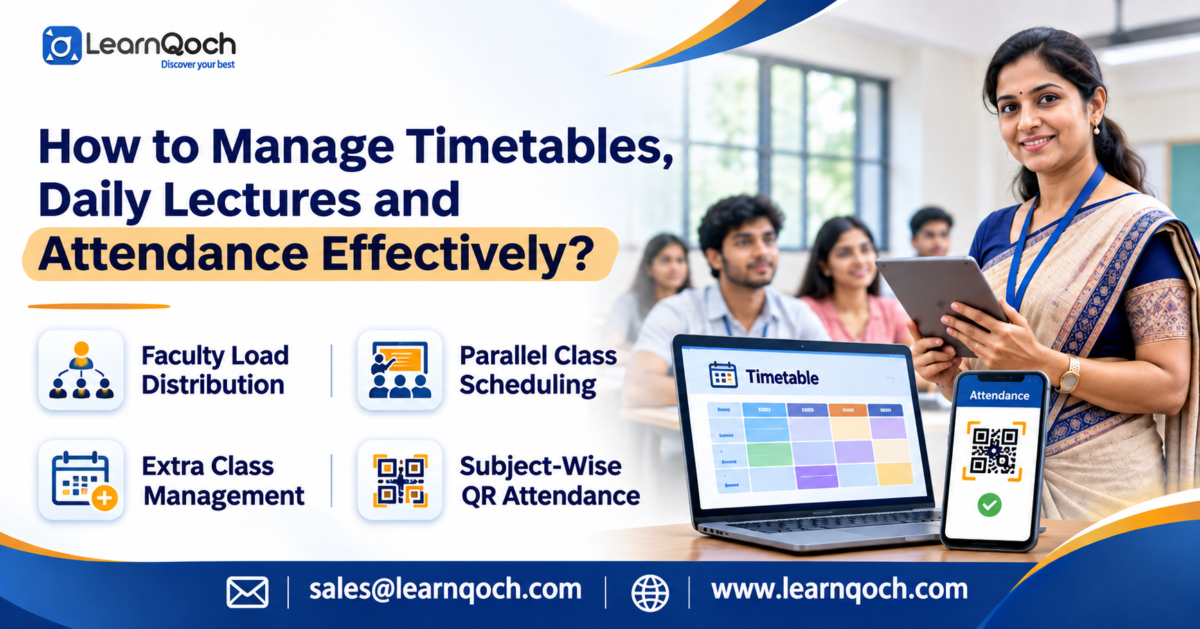
How to Manage Timetables, Daily Lectures and Attendance Effectively?


Introduction
Managing daily academic activities is an important part of running an educational institution. With NEP 2020, placing greater emphasis on quality education, flexible learning and effective academic planning, institutions need to make sure that their day-to-day academic activities run smoothly.
But things don’t always go as planned. A faculty member may be unavailable for a scheduled lecture, a last-minute timetable change may not reach everyone, or students may turn up according to an old schedule. On top of this, maintaining attendance manually across different classes, subjects and departments can take up valuable time.
For example, imagine a Mathematics lecture scheduled for 9:00 AM. The faculty member is on leave, so the department arranges a substitute. But what if students are not informed about the change? Some may miss the lecture, while others may reach the wrong classroom. Small coordination gaps like these can affect the entire day’s academic schedule.
This is where a well-organised system can make a difference. By managing timetables, daily lectures, faculty schedules and student attendance together, institutions can improve coordination, reduce manual work and keep academic activities on track.
In this blog, let’s explore how institutions can manage daily lectures more effectively and how LearnQoch’s integrated academic management platform helps simplify timetable management and QR-based student attendance.
A Day in the Life of a Teacher: Timetable & Attendance Challenges
Mrs. Neha: Good morning, everyone! Let’s start with today’s attendance.
Mrs. Verma: Excuse me, Ma’am! Could you please send a few students from your class to my classroom? I have an elective subject scheduled in this slot. Otherwise, I’ll be occupied with other sections throughout the day.
Mrs. Neha: But how is that possible, Ma’am? This is a common subject for all students. How can I send some students to your class? Besides, attendance for this subject is already quite low.
Mrs. Verma: But Ma’am, we prepared a revised timetable yesterday, and this slot has been allocated for my elective subject.
Mrs. Neha: Revised timetable? I have no idea about it! Nobody informed me about these changes.
Mrs. Verma: Oh! You were on leave yesterday, weren’t you? We probably missed informing you.
Mrs. Neha: So, what do we do now? The students are already here, and I have planned my lecture.
Mrs. Verma: I’m also worried. I need to complete my remaining lectures within this month. You must be facing the same pressure.
Mrs. Neha: Absolutely! And honestly, a lot of our teaching time goes into just calling out student names and marking attendance. We have very limited time to complete the syllabus as it is.
Mrs. Verma: Exactly, Ma’am! We need a better way to manage these daily activities.
Mrs. Neha: Why don’t we discuss this with the academic administration? Perhaps they can allow us to arrange extra lectures this week and adjust the timetable accordingly.
Mrs. Verma: That’s a good idea. But we also need to make sure everyone receives the updated schedule. Otherwise, we’ll keep facing the same confusion.
Mrs. Neha: Absolutely! Managing lectures, timetable changes and attendance is becoming a daily challenge.
Are your teachers and academic coordinators also facing similar situations?
More programmes, semesters, subjects, student batches and faculty members mean greater complexity in managing daily lectures, timetables and attendance.
A small timetable change can affect multiple classes, while taking attendance manually can consume valuable teaching time.
That’s where LearnQoch comes in!
With LearnQoch’s Timetable Management and QR-Based Attendance Management, institutions can simplify daily academic activities.
What Does This Blog Cover?
In this blog, we will explore:
- How to manage daily lectures, faculty availability and timetable changes?
- How to connect scheduled classes with student and faculty attendance?
- How integrated Timetable and Attendance Management helps simplify daily academic activities?
What Challenges Do Institutions (School, College & University) Face in Managing Daily Lectures?
Managing daily lectures is not always as simple as following a timetable. Faculty unavailability, last-minute schedule changes, missed lectures and manual attendance records can create confusion for both teachers and students.
For example, imagine a Mathematics faculty member is on leave. The department arranges a substitute, but the revised timetable does not reach everyone. Some students follow the old schedule, while others attend the revised class. This creates confusion and makes attendance tracking difficult.
Such situations highlight the need for better coordination between timetable updates, lecture schedules and student attendance.
How Can School, College & University Manage Daily Lectures More Effectively?
A timetable is useful only when it supports the smooth delivery of daily academic activities. Institutions should focus on:
- Follow Class-Wise and Subject-Wise Schedules: Ensure faculty and students have access to updated daily timetables.
- Monitor Faculty Availability: Identify faculty unavailability and plan alternatives.
- Manage Timetable Changes: Update and communicate schedule changes promptly.
- Balance Faculty Workload: Distribute teaching responsibilities effectively.
- Track Lecture Completion: Maintain records of conducted, rescheduled and pending lectures.
These practices help institutions improve coordination and minimise confusion in daily academic operations. Let’s see how LearnQoch can be helpful in this.
How Does LearnQoch Simplify Timetable and Attendance Management?
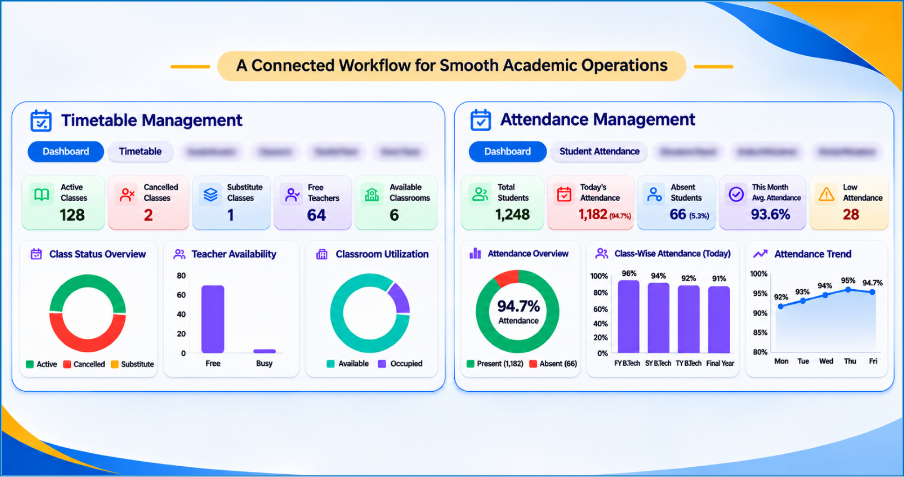
Managing daily lectures, faculty schedules and student attendance through separate registers or spreadsheets can increase administrative work. LearnQoch brings these activities together through its Timetable Management and Attendance Management modules, helping institutions organise their academic schedules and attendance more effectively.
Let’s understand how it works with a practical example.
Imagine a college managing multiple programmes, semesters, subjects and faculty members. The academic team needs to distribute teaching workloads, schedule lectures, manage combined and parallel classes, and accommodate additional lectures without creating timetable clashes.
1. Smart Timetable and Workload Distribution
LearnQoch helps institutions prepare semester-wise, class-wise and subject-wise timetables while distributing teaching workloads among faculty members. This helps academic coordinators manage faculty assignments and scheduled lectures more systematically.
2. Combined and Parallel Class Management
Suppose students from two divisions have a common subject. Instead of preparing separate schedules unnecessarily, institutions can plan combined classes. Similarly, parallel classes can be scheduled for different student groups according to their academic requirements.
3. Extra Class Management
What happens when a lecture is cancelled or a subject needs additional teaching hours? LearnQoch allows institutions to schedule extra classes through the Timetable module, helping faculty members complete pending lectures and syllabus requirements.
4. Institutional Holiday Mapping
While preparing the timetable, institutional holidays (it can be different for every institute) can also be mapped into the academic schedule. This helps institutions plan lectures around holidays and manage academic schedules more effectively.
5. QR-Based Student Attendance – Subject-Wise
LearnQoch supports QR-based attendance, with a separate QR code for each subject. During a scheduled lecture, the faculty member can share the relevant subject’s QR code with students, who can scan it to mark their attendance.
For example, when a Mathematics lecture is conducted, the faculty member shares the Mathematics QR code. Students scan it to record their attendance for that particular subject. The same process can be followed for other subjects, helping maintain subject-wise attendance records.
Conclusion:
Managing an institution’s academic activities does not end with preparing a timetable. Ensuring that scheduled lectures are coordinated, faculty members are available and student attendance is properly maintained is equally important.
When Timetable and Attendance Management work together, institutions can improve academic coordination, maintain organised records and gain better visibility into daily teaching activities.
With LearnQoch, educational institutions can bring timetable planning, faculty scheduling and digital attendance management into a connected academic environment.
The LearnQoch AI powered Academic Platform
LearnQoch goes further by providing an integrated platform that covers all aspects of institutional growth:

1. LearnQoch AI-Powered OBE (Outcome-Based Education)
Helps institutions define, measure, and analyse Course Outcomes (COs), Program Outcomes (POs), and Program Specific Outcomes (PSOs) to evaluate student attainment and support continuous academic improvement.
2. LearnQoch AI-Powered Exam Management Module
Digitises examination operations from planning and subject allocation to timetable preparation, ATKT/backlog management, question paper creation, assessment, evaluation, and result processing—improving accuracy, transparency, and coordination across departments.
3. LearnQoch AI-Powered ERP (Enterprise Resource Planning)
Brings essential institutional administration and student information management into a unified system, helping streamline departmental workflows, reduce repetitive tasks, and improve operational efficiency.
4. LearnQoch AI-Powered NAAC, NBA & NIRF Accreditation and Compliance
Simplifies accreditation preparation and compliance tracking for NAAC, NBA, and NIRF. Institutions can organise evidence, maintain documentation, monitor requirements, and manage reporting activities related to AQAR, SSR, IIQA, DVV, and SAR through a more structured approach.
5. LearnQoch AI-Powered Leave Management
Helps institutions organise employee leave requests, approval workflows, and leave records in a structured digital process. It can support better visibility into staff availability and help administrators coordinate leave-related decisions with academic and administrative responsibilities.
Experience LearnQoch Before You Decide
See how LearnQoch’s AI-powered digital platform can simplify and streamline your institution’s academic management with a 14-Days Free Trial.
Explore the platform, experience its key features, and understand how it can support your institution’s day-to-day operations.
👉 Start your 14-Days Free Trial and experience LearnQoch firsthand.
Contact us at +91 84519 01079
Email: sales@learnqoch.com
Explore What We Offers:
Visit www.learnqoch.com for Full Details