



Curricular Aspects as defined under NAAC Accreditation Guidelines


The NAAC accreditation process is a systematic, transparent, and objective framework designed to drive continuous improvement in higher education institutions. Through structured assessment, institutions can measure operational efficiency, identify strengths and weaknesses, and implement strategic actions to enhance overall academic quality and governance.
The NAAC curricular aspects represent one of the most critical stages of the NAAC accreditation process, particularly in the preparation of the Self-Study Report (SSR) by the institution. The SSR must be developed strictly in accordance with NAAC guidelines and should comprehensively address all seven assessment criteria prescribed by NAAC, ensuring accuracy, consistency, and credibility in institutional reporting of curricular design, development, and implementation.
Aligned with NEP 2020, the SSR should also highlight the institution’s commitment to holistic and multidisciplinary education, outcome-based learning, research orientation, innovation, and technology integration. NEP 2020 encourages institutions to move beyond rote learning and demonstrate how teaching, learning, and assessment practices contribute to student-centric and experiential education.
The criteria-based assessment framework of NAAC forms the backbone of the accreditation process. These seven criteria represent the core functions and activities of an institution, encompassing teaching-learning processes, research and innovation, infrastructure, student support, governance, and best practices. Together, they ensure a balanced evaluation that supports quality assurance, academic excellence, and sustainable institutional development in line with the vision of NEP 2020.
This blog says…
The blog explains that Curricular Aspects under National Assessment and Accreditation Council (NAAC) focus on how effectively an institution designs, develops, and delivers its curriculum. To begin with, it highlights the importance of having a well-structured and updated syllabus that aligns with industry needs and academic standards.
Moreover, it emphasizes curriculum planning, implementation, and flexibility, including the integration of value-added courses, skill-based programs, and interdisciplinary learning. In addition, institutions are encouraged to adopt outcome-based education to ensure that learning objectives are clearly defined and achieved.
Furthermore, the blog discusses the need for regular curriculum feedback from students, faculty, and stakeholders to ensure continuous improvement in BOS design. As a result, institutions can stay relevant and responsive to changing educational demands, while continuously refining curriculum structure, outcomes, and academic delivery.
Ultimately, the blog concludes that strong curricular practices play a crucial role in enhancing academic quality, student employability, and overall institutional excellence during NAAC accreditation.
One of the criteria that serves as the basis for assessment is:
Curricular Aspects
Curriculum is the primary element of education. It is one of the basic pillars of quality education. It is important to have a well-structured, detailed and relevant syllabus that will boost the students’ learnings and polish their skills. This criterion consists of a weightage of 100 (for affiliated colleges) and 150 (for Autonomous institutions and Universities).
This criterion AI guidelines criteria 1 is a framework around which the process of accreditation is carried out, and its judgment is based on the evaluation of key aspects. It is crucial that the institution complies with these requirements to ensure accurate assessment, transparency, and alignment with accreditation standards.
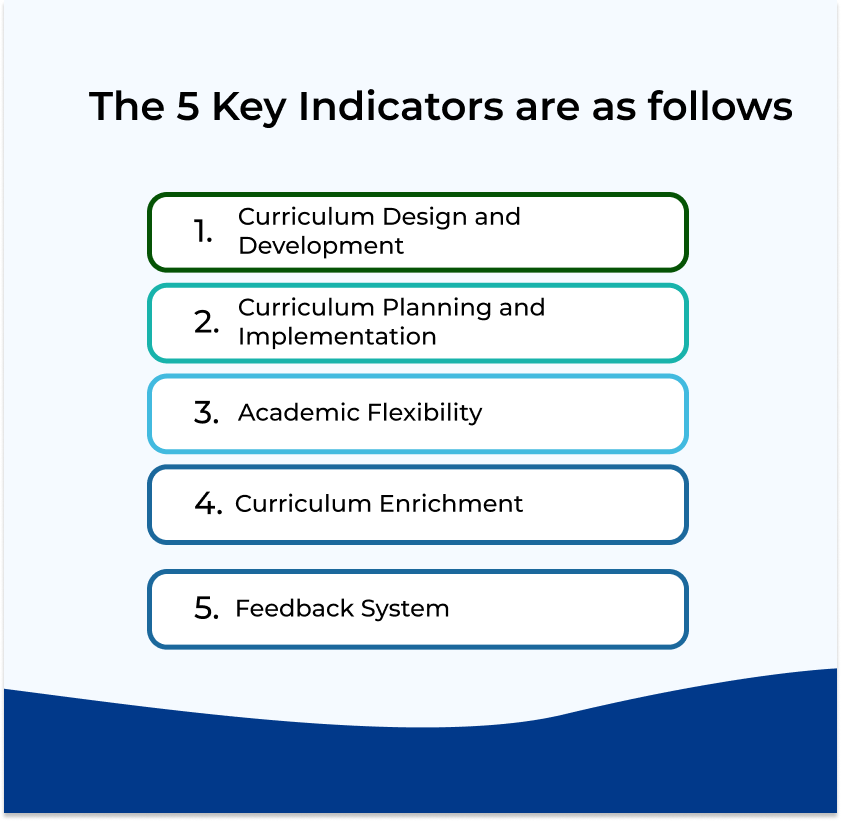
The 5 Key Indicators are as follows:
Curriculum Design and Development
This is applicable only for the universities and the Autonomous colleges.
Curriculum design and development refer to the structure of the curriculum which includes the planning and evaluation of the curriculum.
Curriculum Planning and Implementation
This is applicable only for the Affiliated Colleges.
Curriculum planning can be quite confusing. Here are a few steps to keep in mind while planning the curriculum.
- Determine the goals of the institution
- Focus on a area
- Research the content
- Make lesson plans
- Know your students well
Academic Flexibility
A planned, communicable, and flexible approach to teaching helps students enhance their skills and knowledge throughout the academic session without any interruption. Academic flexibility includes adaptability in problem-solving sessions, attendance, assessments, and extensions of deadlines.
Moreover, it allows institutions to cater to diverse learning needs and paces, ensuring that no student is left behind. As a result, students experience reduced stress and improved engagement in the learning process.
Curriculum Enrichment
Curriculum enrichment programs under Vidarbha curriculum are aligned with the core academic curriculum, helping students develop a deeper understanding of their subjects. These programs enable students to explore their interests and abilities so that they can realize their full potential.
Furthermore, activities such as workshops, seminars, and industry interactions enhance practical knowledge and real-world exposure. Consequently, students become more confident, skilled, and better prepared for future academic and career opportunities.
Feedback System
Feedback is an essential part of the entire education system. It is one of the most effective learning and teaching methods that has a direct impact on the process of acquiring knowledge. Providing students with a relevant feedback system helps them to enhance their academic performance. It gives the students clear guidance on how to improve their learning procedure and confidence. It helps them understand the subjects they are studying and improve enthusiasm to learn what they are being taught.
So, these are the 5 key indicators of criteria Circular aspects for NAAC accreditation.
LearnQoch’s ERP & LMS software for their efficient management of NAAC accreditation processes and to analyze the outcomes.
Our learning management school software is a reliable & robust NAAC accreditation software that enables colleges to make their accreditation work processes manageable, by storing institutional data to help them get ready for NAAC accreditation.
In addition, ERP software also helps in generating reports on the basis of input data from the higher education institute stakeholders. The solution helps the institution to keep all data at a single location.
It’s the right time to manage all your administrative tasks like attendance, timetables, assessment, and management reports based on NBA & NAAC guidelines under LearnQoch Mumbai’s all-in-one software, enabling institutions to streamline operations, ensure compliance, and enhance overall academic efficiency.
Enhance Accreditation-related data & enhance quality assurance standards of your institution by choosing LearnQoch Software.
Conclusion
The NAAC accreditation process serves as a powerful tool for institutions to evaluate quality, strengthen governance, and drive continuous improvement. With the Self-Study Report (SSR) at its core, institutions can present a transparent and comprehensive reflection of their academic and administrative practices across all seven NAAC criteria.
By aligning accreditation efforts with NEP 2020, institutions move towards holistic, student-centric, research-oriented, and technology-enabled education. This integrated approach not only enhances institutional credibility and reliability but also ensures sustainable growth, academic excellence, and a strong commitment to quality assurance in higher education.
Furthermore, a well-executed NAAC process fosters a culture of self-evaluation, innovation, and accountability, enabling institutions to respond effectively to evolving educational needs. Ultimately, NAAC accreditation becomes a strategic pathway for institutions to achieve long-term excellence and national recognition.
The LearnQoch AI powered Academic Platform
LearnQoch goes further by providing an integrated platform that covers all aspects of institutional growth:

Institutional Digital Ecosystem: Categories & Modules
A. LearnQoch AI powered Core Academic & Learning Solutions
Facilitates modern teaching and learning while tracking student progress, assignments, assessments, and course outcomes.
Focuses on measuring learning outcomes to ensure skills, competencies, and academic objectives are met effectively.
- LearnQoch AI powered Academic Calendar & Events
Maintains academic schedules, holidays, events, and exam timelines for seamless yearly planning.
- LearnQoch AI powered Class Module
Manages class creation, faculty allocation, and student grouping while supporting timetable integration.
B. LearnQoch AI powered Examination & Evaluation Management
LearnQoch AI Powered Exam Management Module
A unified system that digitizes the entire exam cycle—right from planning, subject allocation, ATKT processing, and scheduling to question paper creation, assessments, evaluation, and result generation. It ensures transparency, accuracy, and smooth coordination across all departments.
C. LearnQoch AI powered Campus Administration & Operations
Streamlines administrative activities, simplifies student data management, and ensures workflow automation across all departments.
- LearnQoch AI powered Task Management
Organizes, prioritizes, and tracks institutional tasks to improve productivity and accountability.
- LearnQoch AI powered Committee Module
Handles committee formation, roles, activities, and meeting records to maintain governance transparency.
- LearnQoch AI powered Document Management
Stores, organizes, and retrieves institutional documents with version control and compliance tracking.
- LearnQoch AI powered Certificate Management
Manages creation and issuance of academic and administrative certificates such as Bonafide, character, and leaving certificates.
D. LearnQoch AI powered Finance & Fees Management
- LearnQoch AI powered Finance Module – Receivable (Fees)
Tracks payments, manages fee categories, handles tuition/fines, and maintains fee-related records.
- LearnQoch AI powered Advanced Fees
Payments made before the due date, helping institutions and parents manage fee planning efficiently.
- LearnQoch AI powered Excess Fees
Extra amount paid unintentionally; recorded for adjustment in future payments or refunded when necessary.
E. LearnQoch AI powered Library & Resource Management
LearnQoch AI powered Library Module
Manages book registration, issue-return process, renewals, student access, and availability tracking for efficient library operations.
F. LearnQoch AI powered Placement & Career Development
- LearnQoch AI powered Placement Module
Manages job postings, student registration, interview updates, and final offer letters with complete transparency for TPOs and students.
- LearnQoch AI powered Skill Development Solutions
Equips students with future-ready skills to enhance employability and prepare for global career opportunities.
G. LearnQoch AI powered Accreditation & Compliance
LearnQoch AI powered NAAC, NBA & NIRF Compliance
Simplifies reporting, monitoring, and auditing with ready-to-use compliance tools that reduce institutional workload.
H. LearnQoch AI powered Digital Presence & Branding
LearnQoch AI powered Website & Digital Marketing Solutions
Helps institutions build a strong online presence, attract prospective students, and engage key stakeholders effectively.
Don’t Just Take Our Word for It—Try LearnQoch Yourself!
We invite you to experience the transformative impact of LearnQoch’s AI powered Digitize Platform with a 14-Day Free Trial.
During this period, our team will implement the software for your institution, allowing you to explore its features firsthand and see the difference it can make in academic management.
👉 Are you ready to lead your institution into the future of campus management?
📞 Contact us at +91 84519 01079
📧 Email: info@learnqoch.com / sales@learnqoch.com
Explore What LearnQoch Offers:
Visit www.learnqoch.com for Full Details
FAQs: NAAC Accreditation, SSR, and NEP 2020
1. What is the purpose of NAAC accreditation?
NAAC accreditation aims to assess, assure, and enhance the quality of higher education institutions through a structured and transparent evaluation process.
2. Why is the Self-Study Report (SSR) important in NAAC accreditation?
The SSR is the foundation of the accreditation process, presenting a detailed and evidence-based overview of the institution’s performance across all seven NAAC criteria.
Learn more:
3. How do the seven NAAC criteria support institutional quality?
The seven criteria cover core academic, administrative, and support functions, ensuring balanced evaluation of teaching-learning, research, infrastructure, governance, and student support.
4. How does NEP 2020 influence NAAC accreditation?
NEP 2020 emphasizes holistic, multidisciplinary, outcome-based, and technology-enabled education, which institutions are encouraged to reflect in their SSR and accreditation practices.
5. How can institutions ensure reliability in NAAC assessment?
Institutions can ensure reliability by following NAAC guidelines, submitting accurate data, maintaining proper documentation, and adopting continuous quality assurance mechanisms.