



Full Stack Developer Program: Is It Worth It?


This generation is very fortunate to witness the evolution of the internet from a platform for entertainment to one of the primary income sources for many people. Today, being a full-time YouTuber can pay more than several traditional professions. The technology we are surrounded with is essentially shaping our future, and that future is 100% tech driven. Pursuing a professional full stack program can equip individuals with the practical skills needed to succeed in this technology-focused era.
Now, to suffice this growing need for the tech world and online presence for all businesses and to serve the millions of users on the internet, something needs to be done. The development of this lies in developers’ hands. Everything that we interact with digitally on a daily basis is the result of millions of lines of code written by developers. Choosing a professional full stack program can be a practical step toward contributing to this digital ecosystem.
Check out the high in-demand certification course on becoming a Full Stack Web Developer.
Now, developers focus on web-based services and work on either the front end (client side) or the back end (server side). The main job of a front-end developer is to create the end-user experience, while the back-end developer ensures that the front end we see functions accurately and precisely.
But a full-stack developer is the mastermind who manages both the client side and the server side, i.e., back end and front end. Understanding full stack training benefits helps learners realize how mastering both areas increases career opportunities and versatility.
According to the Stack Overflow 2016 Developer Survey, full-stack developers are among the highest-paid and most sought-after professionals today.
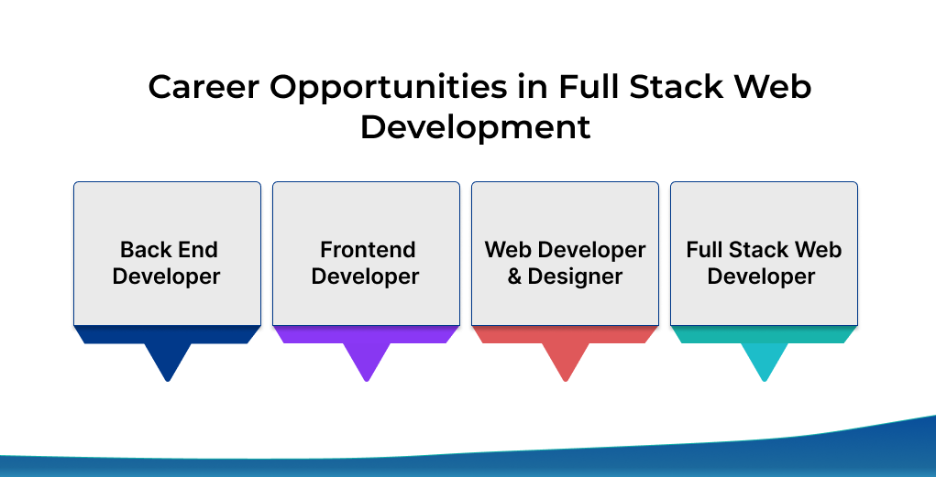
Career Opportunities in Full Stack Web Development
Let us have a look at the career opportunities in Full Stack Web Development
Back End Developer
You can use your knowledge of server-side languages such as Java Script and PHP to do server-side scripting for the company. As a server-side developer, you would be responsible for making the system of any technology. The pay of a backend developer is usually higher than other domains because the level of expertise needed to be a backend developer.
Some of the skill- sets for a back-end developer are mentioned below-
- Python: Python is a powerful, easy-to-learn programming language that has widespread use in web development, data science, and automation. It’s supported by several frameworks, Django and Flask, among them, for creating secure, scalable, high-performance back-end applications with ease.
- PHP: PHP is a server-side scripting language that has become very popular for mainly web-based developments. It aids developers in building dynamic, interactive websites and integrates well with MySQL. Various content management systems are developed around PHP, including WordPress.
- Java: Java is a powerful, platform-independent language applied to the creation of enterprise-level web applications. It follows secure, scalable, and high-performance systems. Frameworks like Spring and Hibernate make Java highly effective for building complex back-end applications.
- JavaScript: JavaScript is a universal programming language that allows developers to implement both front-end and back-end development. Node.js enables developers to build efficient server-side applications, and JavaScript improves the level of interactivity of a website, which increases user experience.
- HTML: HTML, or HyperText Markup Language, is the basic building block of web development. HTML is used for building structures in web pages using elements such as headings, paragraphs, images, and links. HTML can be used in combination with JavaScript and CSS for building fully functional websites.
- Git: Git is a version control system used by developers to monitor their changes and collaborate easily on their projects. Git enables a team to manage their projects, along with their version of history, in various collaborative development environments.
- SQL: SQL stands for “Structured Query Language.” It can be defined as a language used for managing and controlling relational databases. With SQL, data can be stored, requested, changed, and even removed. It plays a crucial role in managing the application and running the database effectively.
- CSS: CSS stands for Cascading Style Sheets and is used to style and design web pages. The key features include layout, colors, fonts, and responsiveness. It helps web developers create a web page that is both aesthetically pleasing and easy to use.
On average the salary of a backend developer is 5.5 lakhs per annum. The salary bracket ranges from 2.0 lakhs per annum to 19.7 lakhs per annum.
2. Frontend Developer
A front-end developer designs and develops the visual and interactive features of a website or web application. They use technologies such as HTML, CSS, and JavaScript to create user-friendly, responsive, and attractive interfaces. The job of a front-end developer ensures that websites work seamlessly on different devices and browsers with high performance and accessibility standards. This may require coordination with designers and back-end developers to deliver a seamless user experience. In addition, basic knowledge of back-end technologies is an advantage, as it supports better system integration. According to Glassdoor, the average salary for a front-end developer in India ranges between ₹5 lakhs to ₹10 lakhs per annum, depending on experience, technical skills, and company requirements. These opportunities clearly reflect strong web developer career growth in today’s digital landscape.
3. Web Developer & Designer
A Web Developer & Designer fulfills an important function in crafting effective and attractive websites. Unlike designers who focus mainly on user interface elements, web developers work on both front-end and back-end development to ensure consistent performance and reliable data processing. They build the structure of the website, add functionality, optimize performance, and secure the website. Enrolling in job ready training can help aspiring professionals gain the practical skills required to perform these responsibilities effectively.
- Web application Development
- Testing web applications
- Multimedia integration
- HTML & XML
- Designing the user interfaces
On the flip side, the main areas of interest of the Web Designers include the overall look and feel of the websites created. Web Designers come up with ideas regarding the overall appearance of the website. This includes the overall feel of the website. This creates an attractive user interface for the users of the website created by professionals. These professionals receive great career prospects with the rise of the necessity of digital presence.
4. Full Stack Web Developer
The full stack web developer would be tasked with working with both front and backend frameworks. This is a skill to be proud of because of the demand in the industry.
The full stack of web developers are supposed to look at client side and the server-side responsibilities. They design and develop websites.
Some of the skills required for a Full Stack Web Developer:
- HTML
- ReactJS
- JavaScript
- CSS
It is considered one of the high-paying fields where te average salary for a full stack developer is 6.5 lakhs per annum. The salary average ranges from 2.4 lakhs per annum to 17.0 lakhs per annum.
Conclusion
Full-stack development provides excellent growth and flexibility in career options, whereby professionals can deal with either front-end or back-end development. In short, full-stack developers can explore multiple career opportunities with the right technical skillset and adapt to various roles in web development.
LearnQoch, in association with NASSCOM, offers industry-relevant training in Full Stack Web Development that encompasses HTML, CSS, JavaScript, and ReactJS. The industry-relevant training provided by certified instructors offered in this course comes with a co-branded certification from FutureSkills Prime. With the onset of moving business online, especially now, this has made demand for full-stack developers increase so fast in no time, hence considered secure and highly paid under good salary packages.
The LearnQoch AI powered Academic Platform
LearnQoch goes further by providing an integrated platform that covers all aspects of institutional growth:

Institutional Digital Ecosystem: Categories & Modules
A. LearnQoch AI powered Core Academic & Learning Solutions
Facilitates modern teaching and learning while tracking student progress, assignments, assessments, and course outcomes.
Focuses on measuring learning outcomes to ensure skills, competencies, and academic objectives are met effectively.
- LearnQoch AI powered Academic Calendar & Events
Maintains academic schedules, holidays, events, and exam timelines for seamless yearly planning.
- LearnQoch AI powered Class Module
Manages class creation, faculty allocation, and student grouping while supporting timetable integration.
B. LearnQoch AI powered Examination & Evaluation Management
LearnQoch AI Powered Exam Management Module
A unified system that digitizes the entire exam cycle—right from planning, subject allocation, ATKT processing, and scheduling to question paper creation, assessments, evaluation, and result generation. It ensures transparency, accuracy, and smooth coordination across all departments.
C. LearnQoch AI powered Campus Administration & Operations
Streamlines administrative activities, simplifies student data management, and ensures workflow automation across all departments.
- LearnQoch AI powered Task Management
Organizes, prioritizes, and tracks institutional tasks to improve productivity and accountability.
- LearnQoch AI powered Committee Module
Handles committee formation, roles, activities, and meeting records to maintain governance transparency.
- LearnQoch AI powered Document Management
Stores, organizes, and retrieves institutional documents with version control and compliance tracking.
- LearnQoch AI powered Certificate Management
Manages creation and issuance of academic and administrative certificates such as Bonafide, character, and leaving certificates.
D. LearnQoch AI powered Finance & Fees Management
- LearnQoch AI powered Finance Module – Receivable (Fees)
Tracks payments, manages fee categories, handles tuition/fines, and maintains fee-related records.
- LearnQoch AI powered Advanced Fees
Payments made before the due date, helping institutions and parents manage fee planning efficiently.
- LearnQoch AI powered Excess Fees
Extra amount paid unintentionally; recorded for adjustment in future payments or refunded when necessary.
E. LearnQoch AI powered Library & Resource Management
LearnQoch AI powered Library Module
Manages book registration, issue-return process, renewals, student access, and availability tracking for efficient library operations.
F. LearnQoch AI powered Placement & Career Development
- LearnQoch AI powered Placement Module
Manages job postings, student registration, interview updates, and final offer letters with complete transparency for TPOs and students.
- LearnQoch AI powered Skill Development Solutions
Equips students with future-ready skills to enhance employability and prepare for global career opportunities.
G. LearnQoch AI powered Accreditation & Compliance
LearnQoch AI powered NAAC, NBA & NIRF Compliance
Simplifies reporting, monitoring, and auditing with ready-to-use compliance tools that reduce institutional workload.
H. LearnQoch AI powered Digital Presence & Branding
LearnQoch AI powered Website & Digital Marketing Solutions
Helps institutions build a strong online presence, attract prospective students, and engage key stakeholders effectively.
Don’t Just Take Our Word for It—Try LearnQoch Yourself!
We invite you to experience the transformative impact of LearnQoch’s Digitize Platform with a 14-Day Free Trial.
During this period, our team will implement the software for your institution, allowing you to explore its features firsthand and see the difference it can make in academic management.
👉 Are you ready to lead your institution into the future of campus management?
📞 Contact us at +91 84519 01079
📧 Email: info@learnqoch.com /sales@learnqoch.com
Explore What LearnQoch Offers:
Visit www.learnqoch.com for Full Details
Also read,
Top 10 high in demand tech skills for jobs in 2023
Top 12 Full stack web developers skills.
8 things you need to know about a full-stack web developer
Top 14 Full Stack Web Developer Interview Question and Answers