

A Beginner’s Guide to Block-based and Text-based Coding


Introduction
The ability to code has shifted from being a novelty to a necessity in just a few years. In the context of block coding guide Mumbai, what was once an optional skill in schools has now become an essential part of a child’s education. As a result, learning to code is not only crucial for building technical skills but also serves as an excellent way for children to express creativity, solve problems, and develop critical thinking from an early age.
Learning to code is part of developing valuable technical and creative skills that will grow with children into their adulthood. It enables kids to see every piece of technology as more than just a toy or a tool and allows them to become creators of technology instead of consumers. This also empowers kids to thrive in our ever-growing digital world.
Clearly, the significant advantages of learning to code cannot be overstated when it comes to our kids. Keeping that in mind, let’s explore the two primary types of coding: block-based coding, text-based coding.
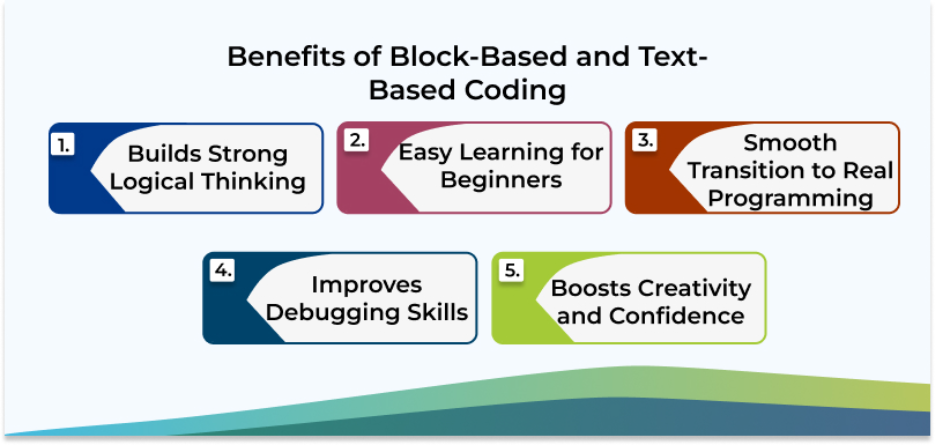
Block-based code will help you understand the basics and is a great place to start. With block code, you learn the programming logic and design better. This helps you write better text code later. Text-based coding is a natural progression for kids already versed in block-based coding.
Now let’s take a closer look at each type of coding, its advantages, and platforms that help kids learn about them while having fun.
Block-based coding
Block-based coding is the simplest and most fun way to get started for kids. It involves dragging and dropping elements instead of writing code while children still learn about coding logic. It’s a great starting point to learn how to code.
The bright and colorful interface of block-based coding is engaging and fun for most kids. It provides visual clues through predefined groups of code (blocks), such as events, controls, commands, loops, conditions, and more. These blocks can be selected, modified, and sequenced to create and run games, apps, animations, and more.
Why do we use block coding?
A block-coding environment significantly improves learnability for beginners. In the context of block coding guide Mumbai, it emphasizes recognition over recall, making it easier for novices to grasp programming concepts. By embedding computational patterns into blocks, it reduces cognitive load, prevents common errors, and enhances understanding of program structure. This approach allows learners to focus on logic and problem-solving without being overwhelmed by syntax, making coding more accessible and engaging.
In short, for a programming environment to be suitable for beginners, its design must focus on learnability. Block-based coding has proven to be effective at this. Some of the best block-coding platforms are Scratch, Blockly, and Code.org.
Text-based coding
The Text-based coding involves writing lines of code and can be introduced to kids after they get used to block-based coding. Text-based coding is essentially typing instructions in a programming language following a syntax. Syntax is the grammar and spelling rules of a programming language.
Can coding be taught to kids?
It’s possible to teach young kids the syntax of text-based programming languages, but educators need to be patient and adaptable. It’s because kids do not have fully developed psychomotor skills. They are also unfamiliar with the keyboard, which means they type and learn slowly.
Kids can become fairly competent with text-based programming languages. However, those who are passionate about coding will eventually want to move beyond block-based coding.
At that point, knowing how to command a machine using text-based programming languages is tremendously useful.
What are all examples of text-based coding languages?
Some of the popular text-based programming languages are Python, Java, and JavaScript.
Advancing from block-based to text-based coding
Block-based coding is an excellent approach to kickstart a learner’s excitement and interest in programming. It’s the perfect pathway to teach programmatic thinking while also giving an enthusiastic head start into real-world coding skills.
The blocks are created for specific instruction to save time and, more importantly, prevent errors new programmers face. Each block contains some form of code and allows a program to run.
This is a good starting point but it doesn’t offer a complete introduction to coding. Why not? Because some coding skills such as commenting, code styling, and troubleshooting do not transfer directly from block to text coding.
Block-based coding has a pallet of commands to choose from, making memorizing commands unneeded and easier for beginners. However, it may be slower to code in a block-based language than text-based, where users can quickly input commands using their keyboard.
Block-based coding allows children to learn the fundamentals of programming and create incredible projects without worrying about syntax. Then, kids can start experimenting in those same block-based activities by switching between block and text code whenever they’re ready.
Once kids become familiar with programming basics and syntax, they can move to text programming. It would be ideal for kids to begin to code with block-coding languages. Then, once they’ve learned the basics, they can transition to text-based coding.
Kids become creators by learning to code
Learning to code has endless benefits for kids! From developing their soft skills to preparing them for future job opportunities, learning to code will transform a child from consumer to creator.
Now more than ever, it’s crucial that kids become digitally literate and understand the devices they use daily. Learning to code is empowering. It gives kids the tools to bring their ideas to life, express themselves, and opens a world of options for their future.
Which type of coding is best for kids?
Block-based or text-based coding isn’t an important consideration. Instead, it’s whether a particular platform or language allows your child to bring their imagination to life in a way that’s efficient and enjoyable for them. Both text-based and block-based coding have their advantages and drawbacks.
Kids need to learn to code in a fun and engaging way. The coding platforms need to introduce kids to block-based coding and eventually help them advance to text-based coding.
LearnQoch is a platform that provides coding classes for kids based on their age and experience level. We offer courses that help you leverage the best block-based coding platforms like Scratch, Code.org. Kids learn coding through various activities, games, and animations. As they get familiar with blocks, they are introduced to text-based coding.
It’s time to get your child started on their coding journey. So go ahead and book your free coding class right away.
Conclusion
In summary, both block coding and text coding are essential parts of a beginner’s learning process when it comes to programming. On one hand, block coding enhances logical thinking by working with easily comprehensible structures, while text coding exposes learners to actual programming languages and technical knowledge. This makes a seamless transition from basic to advanced programming possible. This way, beginners can confidently progress from basic to advanced programming concepts.
The LearnQoch AI powered Academic Platform
LearnQoch goes further by providing an integrated platform that covers all aspects of institutional growth:

Institutional Digital Ecosystem: Categories & Modules
A. LearnQoch AI powered Core Academic & Learning Solutions
Facilitates modern teaching and learning while tracking student progress, assignments, assessments, and course outcomes.
Focuses on measuring learning outcomes to ensure skills, competencies, and academic objectives are met effectively.
- LearnQoch AI powered Academic Calendar & Events
Maintains academic schedules, holidays, events, and exam timelines for seamless yearly planning.
- LearnQoch AI powered Class Module
Manages class creation, faculty allocation, and student grouping while supporting timetable integration.
B. LearnQoch AI powered Examination & Evaluation Management
LearnQoch AI Powered Exam Management Module
A unified system that digitizes the entire exam cycle—right from planning, subject allocation, ATKT processing, and scheduling to question paper creation, assessments, evaluation, and result generation. It ensures transparency, accuracy, and smooth coordination across all departments.
C. LearnQoch AI powered Campus Administration & Operations
Streamlines administrative activities, simplifies student data management, and ensures workflow automation across all departments.
- LearnQoch AI powered Task Management
Organizes, prioritizes, and tracks institutional tasks to improve productivity and accountability.
- LearnQoch AI powered Committee Module
Handles committee formation, roles, activities, and meeting records to maintain governance transparency.
- LearnQoch AI powered Document Management
Stores, organizes, and retrieves institutional documents with version control and compliance tracking.
- LearnQoch AI powered Certificate Management
Manages creation and issuance of academic and administrative certificates such as Bonafide, character, and leaving certificates.
D. LearnQoch AI powered Finance & Fees Management
- LearnQoch AI powered Finance Module – Receivable (Fees)
Tracks payments, manages fee categories, handles tuition/fines, and maintains fee-related records.
- LearnQoch AI powered Advanced Fees
Payments made before the due date, helping institutions and parents manage fee planning efficiently.
- LearnQoch AI powered Excess Fees
Extra amount paid unintentionally; recorded for adjustment in future payments or refunded when necessary.
E. LearnQoch AI powered Library & Resource Management
LearnQoch AI powered Library Module
Manages book registration, issue-return process, renewals, student access, and availability tracking for efficient library operations.
F. LearnQoch AI powered Placement & Career Development
- LearnQoch AI powered Placement Module
Manages job postings, student registration, interview updates, and final offer letters with complete transparency for TPOs and students.
- LearnQoch AI powered Skill Development Solutions
Equips students with future-ready skills to enhance employability and prepare for global career opportunities.
G. LearnQoch AI powered Accreditation & Compliance
LearnQoch AI powered NAAC, NBA & NIRF Compliance
Simplifies reporting, monitoring, and auditing with ready-to-use compliance tools that reduce institutional workload.
H. LearnQoch AI powered Digital Presence & Branding
LearnQoch AI powered Website & Digital Marketing Solutions
Helps institutions build a strong online presence, attract prospective students, and engage key stakeholders effectively.
Don’t Just Take Our Word for It—Try LearnQoch Yourself!
We invite you to experience the transformative impact of LearnQoch’s AI powered Digitize Platform with a 14-Day Free Trial.
During this period, our team will implement the software for your institution, allowing you to explore its features firsthand and see the difference it can make in academic management.
👉 Are you ready to lead your institution into the future of campus management?
📞 Contact us at +91 84519 01079
📧 Email: info@learnqoch.com / sales@learnqoch.com
Explore What LearnQoch Offers:
Visit www.learnqoch.com for Full Details
Also read,
From Inquiry to Enrollment: Mapping the Student Journey via Your Website
5 Things Every Principal Needs to Know About Exam Management Technology
Coding and Robotics in Remote Learning: Strategies for Success
Best LMS for Schools: The Future of Learning Management Systems