


AI-Powered Full Stack Learning Guide | LearnQoch 2026


Common challenges faced during full-stack web development
There are many challenges which a full-stack web developer faces while controlling the development of the web application. Firstly, there is a possibility of technical complexity. Moreover, there is a need to solve the complex problems of information interchange between the client-side and the server-side. Finally, security, scalability, and optimization are very difficult tasks to achieve, but developers can achieve these aspects by learning new technology updates, new development tools, and coding standards. So, AI-powered full stack web developers can work more efficiently to develop highly scalable, user-friendly, and scalable web applications.
Wrangling with Technical Complexity:
AI-powered Full-stack developers must be proficient in various technologies, programming languages, frameworks, libraries, database management, and server-side programs. The combination of these technologies to bring a unified result can be very complex for developers to handle. However, it can be efficiently addressed by breaking the full-stack programming process into various stages, making it easier to learn and understand. Additionally, based on project requirements, developers can use specific technologies to simplify the smart coding platform full-stack programming process, making it easier for them to handle complex situations efficiently.
Juggling Frontend and Backend Development:
Full-stack web developers must maintain a balance in both front-end and backend web developments. While the former involves frontend web development, which emphasizes the creation of the user interface and the user experience, the latter relates to backend web development, which emphasizes server-side processing and API integrations, among other things. As such, communication between the frontend and backend, to facilitate efficient and efficient web application development through the effective coordination of activities among team members involved in the creation of the two components, can be a problem to be overcome.
Managing Different Technologies and Tools:
With LearnQoch AI training full-stack development, many technologies, frameworks, and development tools are used. Thereby, it could also be overwhelming to be updated with the new versions and compatibility and integrating several technologies. However, by sticking to well-organized project documentation like notes, tutorials, and technical references, developers have been able to cope with the issue. Moreover, version control systems like Git and management of project documentation help streamline development workflows. Proper organization, continuous learning, and efficient tool management, thereby allowing full-stack developers to manage multiple technologies.
Troubleshooting Bugs and Errors:
In any web development project, some problems may arise that include bad links, incorrect data representation, delays, and many security problems. Debugging all these types of problems may take enough time and may be challenging at times to solve. However, developers can overcome these challenges by adhering to some programming standards and code-writing techniques and subsequently debugging all these issues before launching the application. Also, working alongside other developers and taking advice from developer forums learn full stack may be an advantage to fix such complex problems efficiently and effectively.
Time Management and Project Organization:
While developing the whole application, developers are required to perform many tasks or manage the deadline for a particular task. In other words, developers are required to handle the expectations of different people while developing the application. Therefore, while developing the application, developers have to manage the timeline of the project or the application. In this regard, while developing the application, the application developers can conveniently manage the timeline or application development process if required. Therefore, developers can manage the timeline of the application if they adopt the said approach while developing the application.
Keeping Up with Emerging Technologies:
The web development domain is constantly changing, and new technologies and tools are being included in the domain on a regular basis. Hence, it can be difficult for full-stack developers to keep themselves updated with the latest trends and technologies in the domain. However, they can cope with the changes in the domain by regularly reading blogs, attending webinars, and being members of developer communities. Besides, developers can upgrade their technical skills and learn new technologies, which assist in maintaining their personal growth.
Collaboration and Communication:
In full-stack web development, projects usually involve collaboration and therefore require coordination among designers, testers, front-end developers, and back-end developers. In this respect, communication helps in the smooth execution of the project. However, developers can enhance collaboration through clear lines of communication and by using collaboration tools that include project management software and version control systems. In addition, regular project status updates and shared feedback help to keep the status transparent. Strong collaboration and communication have benefits in enhancing workflow efficiency, with reduced misunderstandings while ensuring successful and timely completion of the project.
Full-stack web development is a rapidly growing field with high demand and excellent career prospects.
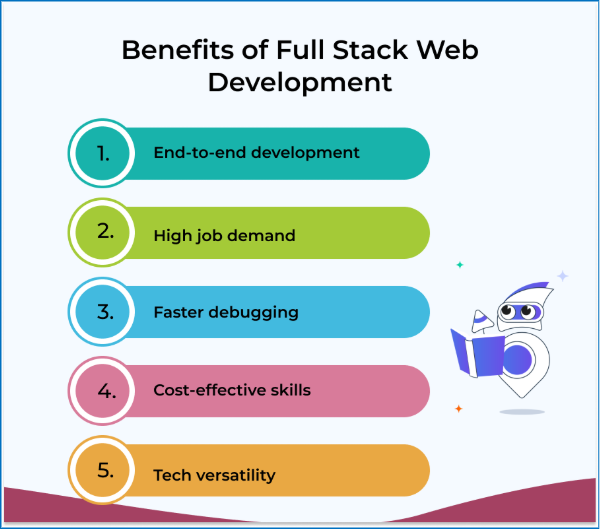
Benefits of Full Stack Web Development
If you are interested in pursuing a career in full-stack web development, LearnQoch’s Full Stack Web Development Course can provide you with the core knowledge you need to excel in this field. After the completion of the Full Stack Web Development Course, you will have the necessary skills to pursue a career as an application developer, game developer, multimedia programmer, UX designer, web developer, and more.
As a training and content partner of NASSCOM and LearnQoch’s course is approved by the government of India. LearnQoch’s dedicated placement cell will also provide you with 100% assistance until you get a job and help you with job switching with a better salary hike.
You’ll also gain experience working with databases and web development best practices, as well as hone your problem-solving skills, and learn how to collaborate with other developers. With this diverse skill set, you’ll have a variety of career paths available to you in the rapidly growing field of web development.
If you’re interested in learning full-stack web development and overcoming common challenges, consider checking out LearnQoch’s Full Stack Web Development Course. With a comprehensive curriculum and flexible learning options, LearnQoch can help you build the skills and knowledge needed to excel in web development.
Enrol today and unlock your potential as a full-stack web developer!
Conclusion
Full-stack web development gives exciting career opportunities; however, it faces several challenges, including not only technical complexity but also balancing front-end and back-end development, handling multiple technologies, troubleshooting errors, and keeping good communication within teams. From these challenges, it can be figured out that continuous learning is going to happen, proper project planning needs to be done, and problems can only be solved. A developer following structured workflows, the best coding practices, and keeping updated with burgeoning technologies can develop an effective barrier against such obstacles.
The skilled full-stack developers are in great demand due to their ability to build scalable, secure, and user-friendly web applications, and they have become very important in industries. Programs like LearnQoch’s Full Stack Web Development Course provide aspiring developers with industry-relevant knowledge and hands-on experience with modern technologies. With the right training, dedication, and enhancement of skill sets, a promising career path in full-stack development is indeed possible, along with valuable contributions that will be effective in the evolution of the digital ecosystem.
The LearnQoch AI powered Academic Platform
LearnQoch goes further by providing an integrated platform that covers all aspects of institutional growth:

Institutional Digital Ecosystem: Categories & Modules
A. LearnQoch AI powered Core Academic & Learning Solutions
Facilitates modern teaching and learning while tracking student progress, assignments, assessments, and course outcomes.
Focuses on measuring learning outcomes to ensure skills, competencies, and academic objectives are met effectively.
- LearnQoch AI powered Academic Calendar & Events
Maintains academic schedules, holidays, events, and exam timelines for seamless yearly planning.
- LearnQoch AI powered Class Module
Manages class creation, faculty allocation, and student grouping while supporting timetable integration.
B. LearnQoch AI powered Examination & Evaluation Management
LearnQoch AI Powered Exam Management Module
A unified system that digitizes the entire exam cycle—right from planning, subject allocation, ATKT processing, and scheduling to question paper creation, assessments, evaluation, and result generation. It ensures transparency, accuracy, and smooth coordination across all departments.
C. LearnQoch AI powered Campus Administration & Operations
Streamlines administrative activities, simplifies student data management, and ensures workflow automation across all departments.
- LearnQoch AI powered Task Management
Organizes, prioritizes, and tracks institutional tasks to improve productivity and accountability.
- LearnQoch AI powered Committee Module
Handles committee formation, roles, activities, and meeting records to maintain governance transparency.
- LearnQoch AI powered Document Management
Stores, organizes, and retrieves institutional documents with version control and compliance tracking.
- LearnQoch AI powered Certificate Management
Manages creation and issuance of academic and administrative certificates such as Bonafide, character, and leaving certificates.
D. LearnQoch AI powered Finance & Fees Management
- LearnQoch AI powered Finance Module – Receivable (Fees)
Tracks payments, manages fee categories, handles tuition/fines, and maintains fee-related records.
- LearnQoch AI powered Advanced Fees
Payments made before the due date, helping institutions and parents manage fee planning efficiently.
- LearnQoch AI powered Excess Fees
Extra amount paid unintentionally; recorded for adjustment in future payments or refunded when necessary.
E. LearnQoch AI powered Library & Resource Management
LearnQoch AI powered Library Module
Manages book registration, issue-return process, renewals, student access, and availability tracking for efficient library operations.
F. LearnQoch AI powered Placement & Career Development
- LearnQoch AI powered Placement Module
Manages job postings, student registration, interview updates, and final offer letters with complete transparency for TPOs and students.
- LearnQoch AI powered Skill Development Solutions
Equips students with future-ready skills to enhance employability and prepare for global career opportunities.
G. LearnQoch AI powered Accreditation & Compliance
LearnQoch AI powered NAAC, NBA & NIRF Compliance
Simplifies reporting, monitoring, and auditing with ready-to-use compliance tools that reduce institutional workload.
H. LearnQoch AI powered Digital Presence & Branding
LearnQoch AI powered Website & Digital Marketing Solutions
Helps institutions build a strong online presence, attract prospective students, and engage key stakeholders effectively.
Don’t Just Take Our Word for It—Try LearnQoch Yourself!
We invite you to experience the transformative impact of LearnQoch’s Digitize Platform with a 14-Day Free Trial.
During this period, our team will implement the software for your institution, allowing you to explore its features firsthand and see the difference it can make in academic management.
👉 Are you ready to lead your institution into the future of campus management?
📞 Contact us at +91 84519 01079
📧 Email: info@learnqoch.com /sales@learnqoch.com
Explore What LearnQoch Offers:
Visit www.learnqoch.com for Full Details
Also read,
Co-Branded Full Stack Web Development Certificate
Learning Outcomes Of FS WD Program With LearnQoch
Step-By-Step Guide To Become A Full Stack Web Developer
Why you should become Professional Full Stack Web Developer?