



Wondering How Institutional Timetables Are Planned? Explore Our Complete Guide!


Introduction
As many educational institutions across India have completed their admissions, others are approaching their admission deadlines, while some have already started their academic sessions. But once admissions are completed, what is the next major challenge for schools, colleges, and universities? Preparing the academic timetable!
Although it may look like a routine administrative task, creating a timetable requires considerable time, effort, and coordination. Institutions must prepare class-wise, section-wise, program-wise, and semester-wise schedules while considering subjects, faculty availability, lecture hours, practical sessions, and classroom requirements.
Also, academic coordinators need to discuss schedules with multiple faculty members and departments to ensure that everything fits together. Even after several discussions and revisions, overlapping classes, faculty clashes, and room conflicts can still occur. As a result, what should be a structured planning activity often becomes a stressful and time-consuming process.
This is where LearnQoch AI-Powered Timetable Management Software can help institutions simplify scheduling, coordinate academic resources, and manage timetable planning more efficiently.
What We Covered in Our Previous Blog…
Our previous blog explored the challenges of college timetable planning and how LearnQoch’s AI-powered software simplifies timetable generation, faculty workload distribution, and schedule adjustments. It also highlighted how the AI Agent supports faculty availability and how timetable management connects with Attendance, OBE, Assessment, and Accreditation workflows, including NAAC, NBA, and NIRF.
What Does This Blog Cover?
In this blog, we explore the essential requirements of effective timetable planning, key features to look for in timetable management software, faculty and classroom coordination, and how LearnQoch AI-powered solutions help institutions simplify academic scheduling and improve efficiency.
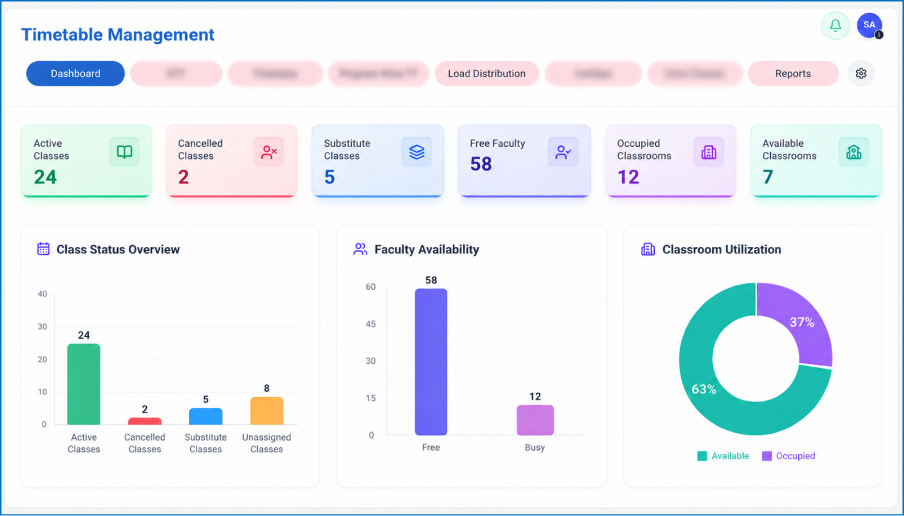
1. What Are the Requirements of Effective Institute Timetable Management?
Effective timetable management requires coordinating academic requirements, faculty availability, classrooms, student batches, and teaching hours to create a practical, conflict-free schedule.
1. Define Academic Requirements
Identify programs, semesters, subjects, lecture hours, practical sessions, and laboratory requirements before planning the timetable.
2. Consider Faculty Availability
Account for faculty availability, assigned subjects, teaching hours, and academic responsibilities.
3. Plan Classroom and Laboratory Resources
Consider room capacity, equipment, laboratory requirements, and resource availability when allocating time slots.
4. Organise Student Batches
Plan schedules according to programs, semesters, divisions, and batches, including combined and parallel classes.
5. Establish a Weekly Schedule
Distribute lectures and practical sessions across the week to meet academic requirements and use resources efficiently.
6. Allow for Changes and Approvals
Establish a process for reviewing, approving, and communicating timetable changes when academic requirements or availability change.
Defining these requirements in advance helps institutions plan effectively and choose a timetable management approach suited to their needs.
2. What Capabilities Should Institutions Evaluate in Timetable Management Software?
Once an institution understands its scheduling requirements, the next step is to choose software that can accommodate its academic structure, simplify scheduling, and support changing requirements.
Here are the key capabilities to evaluate.
1. Support for Multiple Academic Structures
The software should accommodate different programs, semesters, subjects, classes, divisions, and student batches across multiple departments.
2. Faculty and Room Allocation
Look for tools that help coordinators allocate faculty members, classrooms, and laboratories according to availability and academic requirements while identifying potential scheduling conflicts.
3. Flexible Scheduling Options
The system should support semester-wise, subject-wise, class-wise, combined-class, and parallel-class scheduling to meet different academic needs.
4. Automated Timetable Generation
Automated generation can reduce repetitive manual work by processing scheduling requirements and creating proposed timetables for review.
5. Manual Editing and Schedule Updates
Authorised users should be able to adjust schedules when academic requirements change and maintain an accurate, updated timetable.
6. Timetable Access and Communication
Faculty, students, and administrators should be able to access relevant schedules and receive information about approved changes.
7. Integration with Academic Workflows
Consider whether timetable data can connect with attendance, assessment, Outcome-Based Education (OBE), and academic reporting to reduce duplicate data entry and improve coordination.
8. Reporting and Institutional Visibility
Reports on teaching hours, faculty allocation, schedules, and resource usage can help coordinators monitor timetable effectiveness and make informed decisions.
Ultimately, institutions should select timetable management software based on their actual requirements, prioritising flexibility, ease of use, administrative control, and integration over the number of features alone.
How Does LearnQoch Simplify Timetable Management?
As discussed in our previous blog(Why Manual Timetable Planning Fails and How LearnQoch AI Timetable Software Solves It? ), we have already explored in detail the key features and benefits of LearnQoch AI-Powered Timetable Management Software.
From automated timetable generation and balanced faculty workload distribution to AI Agent assistance and integration with Attendance, OBE, Assessment, and Accreditation workflows, LearnQoch helps educational institutions simplify academic scheduling, reduce administrative effort, and improve operational efficiency.
Why Should Institutions Look Beyond Timetable Scheduling?

Choosing timetable management software should involve more than generating class schedules. Institutions should also consider how effectively it connects with other academic and administrative processes.
For example, if Mr. Rahul Gupta is absent, the Leave Management module can help identify his approved leave, while timetable information can show which classes are affected. The system can then notify an available, eligible faculty member, such as Mrs. Neha Patil, and ask whether she can handle Mr. Rahul’s scheduled class for Section B that day. This helps academic coordinators respond to faculty absences faster and minimize disruption to teaching activities.
Similarly, connecting timetable management with Attendance, Assessment, Outcome-Based Education (OBE), and Accreditation workflows can reduce duplicate data entry and improve coordination across departments.
LearnQoch brings related academic and administrative workflows together in an integrated platform, helping institutions move beyond timetable creation towards more connected, efficient academic management.
Conclusion
Effective timetable management is essential for ensuring smooth academic operations in schools, colleges, and universities. From coordinating faculty availability and classroom resources to managing multiple classes and adapting to schedule changes, institutions need a structured and flexible approach to academic planning.
Choosing the right timetable management software can help reduce manual effort, minimise scheduling conflicts, and improve coordination across academic departments. By evaluating institutional requirements and considering how timetable management fits into broader academic workflows, institutions can make informed decisions that support long-term efficiency.
LearnQoch AI-Powered Timetable Management Software helps institutions simplify academic scheduling and move towards more organised, connected academic management.
Ready to make timetable planning simpler and more efficient? Explore LearnQoch and book your free demo today!
The LearnQoch AI powered Academic Platform
LearnQoch goes further by providing an integrated platform that covers all aspects of institutional growth:

1. LearnQoch AI-Powered LMS (Learning Management System)
Enhances digital teaching and learning by enabling institutions to manage course materials, assignments, assessments, student progress, and learning activities through a connected platform.
2. LearnQoch AI-Powered OBE (Outcome-Based Education)
Helps institutions define, measure, and analyse Course Outcomes (COs), Program Outcomes (POs), and Program Specific Outcomes (PSOs) to evaluate student attainment and support continuous academic improvement.
2. LearnQoch AI-Powered Exam Management Module
Digitises examination operations from planning and subject allocation to timetable preparation, ATKT/backlog management, question paper creation, assessment, evaluation, and result processing—improving accuracy, transparency, and coordination across departments.
3. LearnQoch AI-Powered ERP (Enterprise Resource Planning)
Brings essential institutional administration and student information management into a unified system, helping streamline departmental workflows, reduce repetitive tasks, and improve operational efficiency.
4. LearnQoch AI-Powered NAAC, NBA & NIRF Accreditation and Compliance
Simplifies accreditation preparation and compliance tracking for NAAC, NBA, and NIRF. Institutions can organise evidence, maintain documentation, monitor requirements, and manage reporting activities related to AQAR, SSR, IIQA, DVV, and SAR through a more structured approach.
5. LearnQoch AI-Powered Leave Management
Helps institutions organise employee leave requests, approval workflows, and leave records in a structured digital process. It can support better visibility into staff availability and help administrators coordinate leave-related decisions with academic and administrative responsibilities.
6. LearnQoch AI-Powered Digital Presence & Branding
LearnQoch Growth+ brings institutional digital marketing activities together, including website management, social media, blog content, email campaigns, WhatsApp and SMS communication, and digital marketing. It helps educational institutions strengthen their online presence, engage prospective students, and support admission outreach.
Experience LearnQoch Before You Decide
See how LearnQoch’s AI-powered digital platform can simplify and streamline your institution’s academic management with a 14-Days Free Trial.
Explore the platform, experience its key features, and understand how it can support your institution’s day-to-day operations.
👉 Start your 14-Days Free Trial and experience LearnQoch firsthand.
📞 Contact us at +91 84519 01079
📧 Email: sales@learnqoch.com
Explore What We Offers:
Visit www.learnqoch.com for Full Details
FAQs
1. Why Does Institute (School, College & University) Timetable Planning Take So Much Time?
Institute timetable planning takes time because academic coordinators must align faculty availability, subjects, student batches, classrooms, laboratories, and teaching hours. Managing these requirements across multiple departments makes scheduling more complex, especially when changes occur during preparation.
2. How Can Institute (School, College & University) Avoid Faculty and Classroom Clashes in Timetables?
Institutes can reduce timetable clashes by checking faculty availability, classroom allocation, laboratory schedules, and overlapping class sessions before publishing the timetable. Using a digital scheduling system can help coordinators manage these requirements more systematically and identify potential conflicts.
3. How Can Institute (School, College & University) Manage Last-Minute Timetable Changes Without Disrupting Classes?
Institutes should maintain an updated timetable, review the impact of each change on faculty and classroom availability, and communicate approved revisions promptly. A digital timetable management system can make it easier to update schedules and help affected faculty members and students access the latest version.
4. How Can Institute (School, College & University) Balance Faculty Workload While Preparing Timetables?
Institutes should consider each faculty member’s assigned subjects, teaching hours, availability, and other academic responsibilities before finalising the timetable. Reviewing workload distribution alongside class schedules can help coordinators identify uneven allocations and make more informed scheduling decisions.
5. How Can Educational Institutions Reduce the Manual Effort Involved in Timetable Management?
Educational institutions can reduce manual effort by digitising scheduling processes, organising academic requirements in one system, automating timetable generation where possible, and simplifying schedule revisions. LearnQoch AI-Powered Timetable Management Software supports academic scheduling through automated generation, flexible timetable planning, and coordination of faculty, classes, and academic resources.