


Parenting in the Digital Age: How to Balance Technology and Traditional Learning at Home


Parenting in the Digital Age can often feel like walking a tightrope. On one side lies the immense potential of technology — personalized education, global connectivity, and endless access to knowledge. On the other, the dangers of overexposure are real — screen addiction, reduced physical activity, and diminishing social skills. For today’s parents, school leaders, and educators, finding that perfect balance between the digital and traditional worlds has become both a challenge and a necessity, making digital parenting Mumbai increasingly important.
In this blog, we’ll explore the rise of digital learning, the challenges of parenting in a tech-driven environment, and actionable strategies to maintain balance — all while showcasing how LearnQoch’s innovative solutions make this transition smoother, safer, and more effective.
The Rise of Technology in Education
There’s no denying that digital technology has revolutionized education. From AI-based personalized learning to virtual classrooms, technology has become an integral part of every child’s academic journey. According to a Pew Research Report, over 95% of urban Indian households now have access to at least one smartphone. This accessibility has enabled students from all backgrounds to participate in digital learning, creating new opportunities for growth and inclusion.
The pandemic further accelerated this transformation. Online classes became the norm, and tools like Google Classroom, Zoom, and interactive learning apps turned homes into virtual classrooms. Even post-pandemic, the digital wave has continued — reshaping how schools teach, students learn, and parents engage, highlighting the growing importance of tech parenting Nagpur.
A Kantar 2023 study highlighted the following trends:
| Aspect of Learning | Percentage of Students Engaged |
| Online Classes via Apps | 78% |
| Hybrid Learning (Online + Offline) | 59% |
| Traditional In-School Learning | 62% |
These figures clearly show that while traditional learning remains strong, digital tools have become deeply embedded in modern education. The real question isn’t whether technology should be used — but how effectively it should be integrated.
And that’s where LearnQoch’s hybrid learning management solutions step in, bridging the gap between innovation and tradition.
Challenges of Parenting in the Digital Age
While technology empowers learning, it also introduces a new set of parenting challenges. The ease of access to devices and digital media has created a generation that is constantly connected. However, constant connectivity doesn’t always translate to productivity.
1. Screen Time Overload
According to Common Sense Media, children now spend 4–6 hours daily on digital devices. Though part of this is educational, a large share is devoted to entertainment — from gaming to social media. Prolonged screen time contributes to:
- Eye strain and poor posture
- Shortened attention spans
- Sleep disturbances
- Behavioral dependency on devices
Parents often find themselves caught between encouraging tech-based learning and limiting digital indulgence.
2. Reduced Social Interaction
Another growing concern is the decline in face-to-face interactions. Children who rely heavily on digital communication may find it difficult to build empathy, teamwork, and social confidence — essential life skills developed through in-person interactions.
3. Quality and Safety of Online Content
Not all digital content is created equal. The internet offers immense educational resources, but it also exposes children to inappropriate, irrelevant, or unverified content. Parents often struggle to differentiate high-quality educational tools from distracting platforms.
This is where LearnQoch proves invaluable — offering a secure, curated, and structured digital ecosystem that encourages purposeful engagement rather than mindless screen time.
Steps to Balance Technology and Traditional Learning
Balancing technology with traditional education isn’t about restriction — it’s about creating intentional digital habits. Here’s how parents and educators can strike that equilibrium.
1. Define Clear Rules for Screen Time
Structure is key. Children thrive on consistency, so setting specific digital usage rules can make a huge difference.
- Create a fixed timetable: Assign dedicated hours for online learning, entertainment, and physical play.
- Introduce “tech-free” zones: For example, no devices during meals or after bedtime.
- Use parental control tools: Monitor screen time and block inappropriate content through apps designed for child safety.
These boundaries help transform digital time from passive consumption into active, goal-oriented learning.
2. Combine Digital Learning with Hands-On Activities
Technology works best when complemented by real-world experiences. Encourage children to apply what they learn digitally in everyday life as part of effective digital parenting Mumbai practices.
- If a child watches a science experiment online, replicate it physically at home.
- Use AR (Augmented Reality) learning apps that combine digital visuals with real-world exploration.
- Engage in creative offline extensions of online lessons — for instance, art projects after virtual drawing classes or outdoor math challenges.
This approach not only reinforces conceptual understanding but also improves retention and creativity.
3. Prioritize Offline Family Activities
Families play a crucial role in setting an example for balanced tech use. Allocate time each day for non-digital engagement:
- Read physical books together instead of watching TV.
- Play board games, go for walks, or cook meals as a family.
- Make at least one hour daily tech-free time for everyone — including parents.
Such habits strengthen family bonds and remind children that joy and learning exist beyond screens.
4. Leverage Hybrid Learning Models
Hybrid learning — a blend of online and offline education — has emerged as the most sustainable model for the future. It combines the flexibility of technology with the emotional connection of classroom learning.
LearnQoch’s hybrid platform perfectly embodies this balance. It enables teachers to conduct interactive online sessions while maintaining strong in-person engagement. Parents can track progress, teachers can personalize lessons, and students benefit from continuity — regardless of location.
This model ensures that digital learning complements, not replaces, traditional teaching.
5. Focus on Social and Emotional Development
In an age where digital engagement dominates, social and emotional growth must not be sidelined. Encourage activities that build teamwork, empathy, and leadership:
- Enroll children in debate clubs, art classes, or sports teams.
- Use technology to foster positive interactions — such as virtual study groups or family video calls with relatives.
- Teach digital etiquette: respectful online behavior, cyber safety, and screen mindfulness.
When technology supports emotional intelligence rather than diminishing it, learning becomes truly holistic.
The Role of Schools in Supporting Digital Parenting
Schools today are not just academic institutions; they are partners in parenting. As education becomes more digital, institutions play a key role in guiding parents and maintaining the balance between screen-based and experiential learning through modern parenting strategies.
1. Organize Parent Workshops
Schools can conduct sessions to help parents understand effective tech integration, screen time management, and safe digital practices.
2. Provide Curated Resources
Institutes can recommend child-safe apps, e-learning platforms, and offline enrichment activities. This empowers parents to choose trustworthy tools that reinforce school learning.
3. Strengthen Communication Channels
A strong parent-teacher relationship ensures that both sides collaborate in a child’s growth. LearnQoch’s LMS fosters this connection by offering real-time updates, performance analytics, and transparent communication portals.
Teachers can share feedback instantly, and parents can monitor progress anytime — creating a continuous learning loop between home and school.
How LearnQoch Empowers Digital Parenting
LearnQoch is more than just a Learning Management System — it’s a smart ecosystem that connects students, parents, teachers, and administrators under one digital roof.
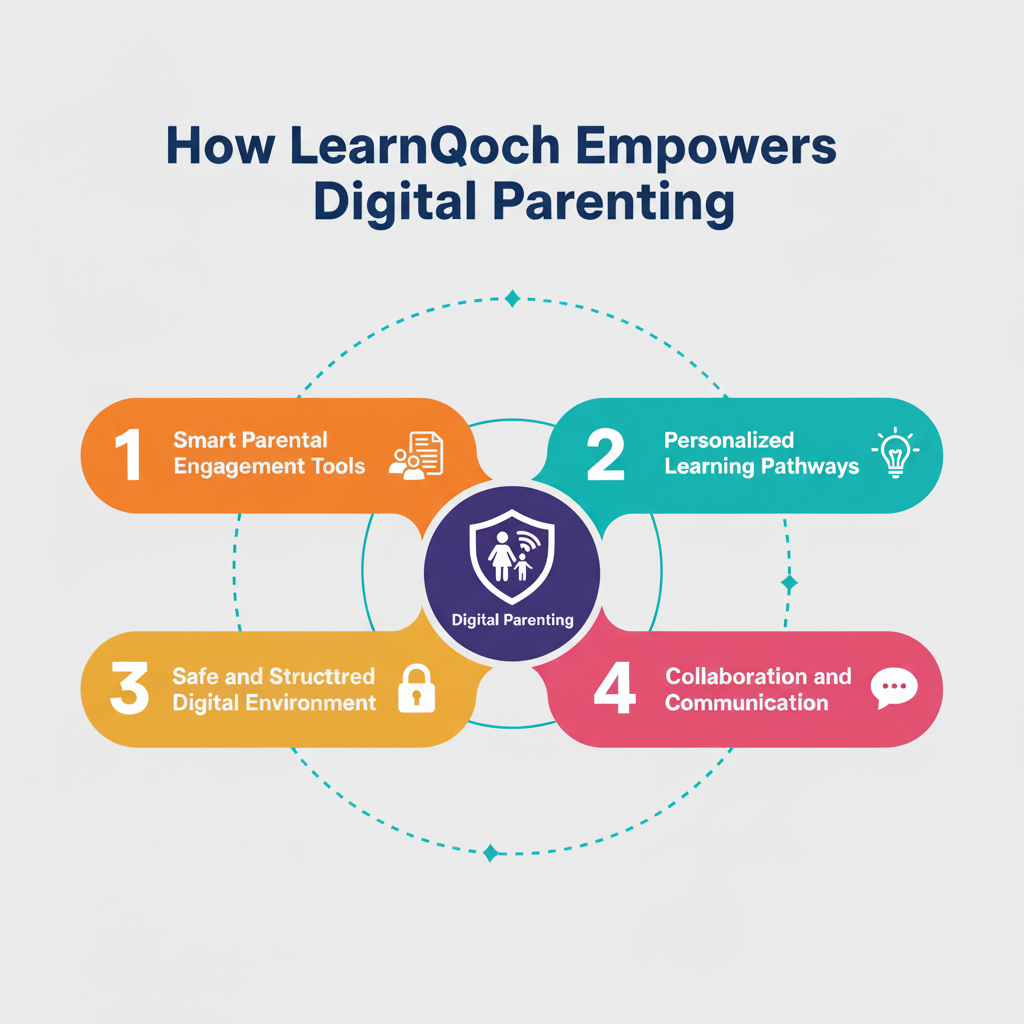
Here’s how LearnQoch helps parents navigate digital learning confidently and effectively:
1. Smart Parental Engagement Tools
Parents gain access to dashboards that provide insights into their child’s screen time, assignments, attendance, and progress. LearnQoch parenting guide Vidarbha empowers parents to stay informed and involved without micromanaging, thanks to this transparency.
2. Personalized Learning Pathways
Every child learns differently. LearnQoch’s platform uses adaptive learning analytics to recommend lessons, resources, and activities that suit each student’s unique learning style.
3. Safe and Structured Digital Environment
Unlike open platforms that may expose children to distractions, LearnQoch ensures that all interactions occur within a controlled, secure, and school-aligned space.
4. Collaboration and Communication
The system bridges the communication gap between parents and teachers, enabling direct feedback loops and continuous engagement. Everyone stays aligned toward the same goal — a child’s holistic development.
Case Study: LearnQoch in Action
A mid-sized educational institution in Mumbai faced persistent challenges with unproductive screen time and inconsistent parental involvement. Students often used digital devices for entertainment rather than learning.
After implementing LearnQoch’s hybrid LMS, the transformation was remarkable:
- Educational screen engagement increased from 42% to 78% within six months.
- Teachers reported a 35% improvement in assignment submissions and student focus.
- Parents expressed higher satisfaction due to increased visibility into their child’s learning progress.
This case demonstrates how a structured, transparent digital ecosystem can convert screen dependency into meaningful academic growth.
Conclusion: Embrace Balance, Not Extremes
Parenting in the Digital Age isn’t about choosing between technology and tradition — it’s about harmonizing the two. By setting clear boundaries, integrating experiential learning, and fostering open collaboration between schools and families, we can shape a generation that is digitally smart yet emotionally grounded.
LearnQoch understands this balance deeply. Our platform empowers parents, teachers, and institutions to create a safe, engaging, and effective learning environment — one that nurtures curiosity while protecting well-being.
As the saying goes, “Too much of anything is bad.” The same applies to digital exposure. But when managed well, technology becomes a bridge — not a barrier — to learning. With LearnQoch, you can ensure that children are not just tech-savvy, but also empathetic, creative, and future-ready.
The LearnQoch AI powered Academic Platform
LearnQoch goes further by providing an integrated platform that covers all aspects of institutional growth:

Institutional Digital Ecosystem: Categories & Modules
A. LearnQoch AI powered Core Academic & Learning Solutions
Facilitates modern teaching and learning while tracking student progress, assignments, assessments, and course outcomes.
Focuses on measuring learning outcomes to ensure skills, competencies, and academic objectives are met effectively.
- LearnQoch AI powered Academic Calendar & Events
Maintains academic schedules, holidays, events, and exam timelines for seamless yearly planning.
- LearnQoch AI powered Class Module
Manages class creation, faculty allocation, and student grouping while supporting timetable integration.
B. LearnQoch AI powered Examination & Evaluation Management
LearnQoch AI Powered Exam Management Module
A unified system that digitizes the entire exam cycle—right from planning, subject allocation, ATKT processing, and scheduling to question paper creation, assessments, evaluation, and result generation. It ensures transparency, accuracy, and smooth coordination across all departments.
C. LearnQoch AI powered Campus Administration & Operations
Streamlines administrative activities, simplifies student data management, and ensures workflow automation across all departments.
- LearnQoch AI powered Task Management
Organizes, prioritizes, and tracks institutional tasks to improve productivity and accountability.
- LearnQoch AI powered Committee Module
Handles committee formation, roles, activities, and meeting records to maintain governance transparency.
- LearnQoch AI powered Document Management
Stores, organizes, and retrieves institutional documents with version control and compliance tracking.
- LearnQoch AI powered Certificate Management
Manages creation and issuance of academic and administrative certificates such as Bonafide, character, and leaving certificates.
D. LearnQoch AI powered Finance & Fees Management
- LearnQoch AI powered Finance Module – Receivable (Fees)
Tracks payments, manages fee categories, handles tuition/fines, and maintains fee-related records.
- LearnQoch AI powered Advanced Fees
Payments made before the due date, helping institutions and parents manage fee planning efficiently.
- LearnQoch AI powered Excess Fees
Extra amount paid unintentionally; recorded for adjustment in future payments or refunded when necessary.
E. LearnQoch AI powered Library & Resource Management
LearnQoch AI powered Library Module
Manages book registration, issue-return process, renewals, student access, and availability tracking for efficient library operations.
F. LearnQoch AI powered Placement & Career Development
- LearnQoch AI powered Placement Module
Manages job postings, student registration, interview updates, and final offer letters with complete transparency for TPOs and students.
- LearnQoch AI powered Skill Development Solutions
Equips students with future-ready skills to enhance employability and prepare for global career opportunities.
G. LearnQoch AI powered Accreditation & Compliance
LearnQoch AI powered NAAC, NBA & NIRF Compliance
Simplifies reporting, monitoring, and auditing with ready-to-use compliance tools that reduce institutional workload.
H. LearnQoch AI powered Digital Presence & Branding
LearnQoch AI powered Website & Digital Marketing Solutions
Helps institutions build a strong online presence, attract prospective students, and engage key stakeholders effectively.
Don’t Just Take Our Word for It—Try LearnQoch Yourself!
We invite you to experience the transformative impact of LearnQoch’s Digitize Platform with a 14-Day Free Trial.
During this period, our team will implement the software for your institution, allowing you to explore its features firsthand and see the difference it can make in academic management.
👉 Are you ready to lead your institution into the future of campus management?
📞 Contact us at +91 84519 01079
📧 Email: info@learnqoch.com /sales@learnqoch.com
Explore What LearnQoch Offers:
Visit www.learnqoch.com for Full Details
Also Read,
Parenting is all about Patience
Australia Has Banned Social Media for Kids Under 16 – Should India Follow Suit?