


Vocational Training in India – A Comprehensive Guide


Education is the key to achieving full human potential. Vocational training India plays a crucial role in this journey by equipping learners with job-ready, industry-relevant skills. Vocational training is the instructional programme that prepares one for an occupation that requires specialized skill. It may involve imparting classroom instructions, hands-on training, or a combination of both. Still, real vocational training is imparted outside the formal education system, and it often leads to a certification or a diploma.
With the roll-out of the National Education Policy (NEP) 2020, vocational education has the required spotlight. The NEP 2020 is a comprehensive policy document that intensively discusses the updates of vocational education. The policy focuses on bringing vocational education into mainstream education. It proposes the revision and updating of all aspects of education, including the regulations, governance, & educational structure, to create a new system which is aligned with 21st century educational goals.
What this Blog Says?
This blog explores the importance of vocational training in unlocking human potential and preparing individuals for occupations that require specialized skills and practical knowledge. It explains how vocational education, traditionally offered outside the formal education system, focuses on employability through classroom instruction, hands-on training, or a blend of both. The blog further highlights how the National Education Policy 2020 brings vocational education into the mainstream by emphasizing early exposure, flexible learning pathways, and strong industry alignment, aligned with NEP 2020 guide. It also discusses the policy’s proposed reforms in governance, regulations, and educational structure to build a future-ready, skill-oriented education system aligned with 21st-century goals.
Vocational Training in the Light of NEP 2020
According to National Education Policy 2020, at least 50% of learners are expected to gain vocational exposure by 2025 through school and higher education systems. The policy also promotes the idea of “no hard separation” between academic and vocational streams, encouraging flexible learning pathways where students can seamlessly combine both. It emphasizes early and continuous exposure to skill-based learning so that students are better prepared for real-world careers.
Vocational training focuses on building job-specific technical skills through practical, hands-on learning alongside theoretical knowledge. It helps learners gain industry-relevant competencies within the formal education system, supporting better employability and career growth. With LearnQoch AI exam vocational, schools can integrate skill-based assessment and AI-driven learning support to help students explore and choose the right vocational path for long-term development.
The NEP 2020 can potentially lead to explosive growth of vocational education in the country, since it requires all educational institutions to integrate vocational education into their offerings.
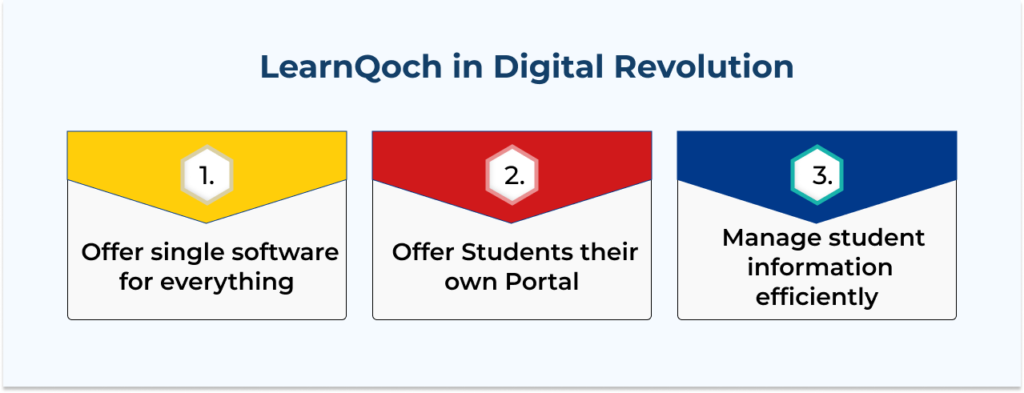
LearnQoch in Digital Revolution
India has far more room for improvement and opportunity in the sphere of rationalization. To improve the quality of education given, the Centre must allocate greater resources and collaborate closely with the state. Improving wage regulation and developing more job possibilities would be India’s primary issues in the future years. In recent years, vocational training has grown tremendously, but it has also encountered significant challenges. Facilitating effective partnerships and better articulation arrangements, as well as a diversity of approaches and greater national uniformity in a variety of sectors, are critical to better outcomes.
Vocational training, technical training, and digital education are the new educational trends that every school and college is adopting. LearnQoch transforming digital education infrastructure. It includes features such as user administration, performance management, attendance tracking, and much more. Be a part of this change by experiencing one of the finest integrated school platforms.
1.Offer single software for everything
You want to get a host of features that help improve and automate your long list of administrative processes. And that means that, with one — and only one — solution, you can reduce the overall cost of your infrastructure and stationery while you also eliminate the frustration caused by using a combination of unrelated tools.
2. Offer Students their own Portal
Helps students keep up with their studies by giving them access to their own portal. They will be able to do anything they want to.
- Check their weekly schedule: Students and parents can easily view upcoming classes, assignments, and academic activities for better planning.
- Attendance: The system tracks and records student attendance automatically, ensuring accurate monitoring and reporting.
- Data: All academic and administrative information is securely stored and accessible in a centralized digital platform.
- Grades: Students can instantly view exam results, scores, and evaluation feedback in one place.
- Performance: Detailed analytics help monitor student progress and identify areas for improvement.
- Payments, etc.: Fee payments and financial records are managed digitally for convenient and transparent transactions.
3. Manage student information efficiently
Your student profile will be generated, and you will have all your information in one dashboard. It will also make it easier for teachers, administrators, and other staff to make informed decisions and find whatever they need with a click of a button.
Upgrade your school with LearnQoch – the right ERP & LMS software for your school.
If manual data entry makes the process complicated, it is no longer suitable for your needs. Try LearnQoch, our integrated ERP & LMS software for vocational schools. Provide students, teachers & administrators personalized and quick solutions and upgrade your school offering, staying ahead of competition.
Conclusion
Vocational training in India plays a vital role in bridging the long-standing gap between formal education and real-world employability. By focusing on industry-relevant skills, practical knowledge, and hands-on experience, vocational education equips learners with the competencies required to meet evolving workforce demands. It not only enhances individual employability but also contributes significantly to economic growth and productivity. With the strong emphasis placed under initiatives such as the National Education Policy (NEP) 2020, vocational training is being integrated into mainstream education, promoting skill-based learning, inclusivity, and flexible career pathways. NEP 2020 further encourages lifelong learning, enabling individuals to upskill and reskill in response to changing industry trends. As technology and industries continue to evolve rapidly, a well-structured and robust vocational training ecosystem will be essential. Such an ecosystem can empower individuals to secure meaningful employment, foster entrepreneurship, reduce skill gaps, and ultimately contribute to sustainable national development and a future-ready workforce.
The LearnQoch AI powered Academic Platform
LearnQoch goes further by providing an integrated platform that covers all aspects of institutional growth:

Institutional Digital Ecosystem: Categories & Modules
A. LearnQoch AI powered Core Academic & Learning Solutions
Facilitates modern teaching and learning while tracking student progress, assignments, assessments, and course outcomes.
Focuses on measuring learning outcomes to ensure skills, competencies, and academic objectives are met effectively.
- LearnQoch AI powered Academic Calendar & Events
Maintains academic schedules, holidays, events, and exam timelines for seamless yearly planning.
- LearnQoch AI powered Class Module
Manages class creation, faculty allocation, and student grouping while supporting timetable integration.
B. LearnQoch AI powered Examination & Evaluation Management
LearnQoch AI Powered Exam Management Module
A unified system that digitizes the entire exam cycle—right from planning, subject allocation, ATKT processing, and scheduling to question paper creation, assessments, evaluation, and result generation. It ensures transparency, accuracy, and smooth coordination across all departments.
C. LearnQoch AI powered Campus Administration & Operations
Streamlines administrative activities, simplifies student data management, and ensures workflow automation across all departments.
- LearnQoch AI powered Task Management
Organizes, prioritizes, and tracks institutional tasks to improve productivity and accountability.
- LearnQoch AI powered Committee Module
Handles committee formation, roles, activities, and meeting records to maintain governance transparency.
- LearnQoch AI powered Document Management
Stores, organizes, and retrieves institutional documents with version control and compliance tracking.
- LearnQoch AI powered Certificate Management
Manages creation and issuance of academic and administrative certificates such as Bonafide, character, and leaving certificates.
D. LearnQoch AI powered Finance & Fees Management
- LearnQoch AI powered Finance Module – Receivable (Fees)
Tracks payments, manages fee categories, handles tuition/fines, and maintains fee-related records.
- LearnQoch AI powered Advanced Fees
Payments made before the due date, helping institutions and parents manage fee planning efficiently.
- LearnQoch AI powered Excess Fees
Extra amount paid unintentionally; recorded for adjustment in future payments or refunded when necessary.
E. LearnQoch AI powered Library & Resource Management
LearnQoch AI powered Library Module
Manages book registration, issue-return process, renewals, student access, and availability tracking for efficient library operations.
F. LearnQoch AI powered Placement & Career Development
- LearnQoch AI powered Placement Module
Manages job postings, student registration, interview updates, and final offer letters with complete transparency for TPOs and students.
- LearnQoch AI powered Skill Development Solutions
Equips students with future-ready skills to enhance employability and prepare for global career opportunities.
G. LearnQoch AI powered Accreditation & Compliance
LearnQoch AI powered NAAC, NBA & NIRF Compliance
Simplifies reporting, monitoring, and auditing with ready-to-use compliance tools that reduce institutional workload.
H. LearnQoch AI powered Digital Presence & Branding
LearnQoch AI powered Website & Digital Marketing Solutions
Helps institutions build a strong online presence, attract prospective students, and engage key stakeholders effectively.
Don’t Just Take Our Word for It—Try LearnQoch Yourself!
We invite you to experience the transformative impact of LearnQoch’s Digitize Platform with a 14-Day Free Trial.
During this period, our team will implement the software for your institution, allowing you to explore its features firsthand and see the difference it can make in academic management.
👉 Are you ready to lead your institution into the future of campus management?
📞 Contact us at +91 84519 01079
📧 Email: info@learnqoch.com /sales@learnqoch.com
Explore What LearnQoch Offers:
Visit www.learnqoch.com for Full Details
Also Read,
NEP 2020 and encouraging 21st century skills with technology
LearnQoch ERP and LMS: Empowering Teacher Training under NEP 2020
Student Engagement in NEP 2020: Making Learning Multimodal with LearnQoch
LearnQoch LMS: Bridging the Learning Gap Aligned with NEP 2020
AI in Personalized Learning: How LearnQoch’s ERP and LMS Align with NEP 2020
FAQS
Q1. What is vocational training in India?
Vocational training focuses on developing job-specific skills through practical and hands-on learning, preparing learners for employment or entrepreneurship.
Learn more: LearnQoch Blog – Vocational Training in India
Q2. How does vocational training differ from traditional education?
Unlike traditional education, vocational training emphasizes practical skills and industry readiness rather than purely academic learning.
Learn more: LearnQoch Blog – Vocational Education vs Traditional Education
Q3. How does NEP 2020 support vocational education?
NEP 2020 integrates vocational education into mainstream schooling, promotes early exposure, and aligns skills with industry needs.
Learn more: LearnQoch Blog – NEP 2020 & Vocational Training
Q4. Who can benefit from vocational training programs?
Students, school dropouts, graduates, and working professionals seeking skill enhancement or career shifts can benefit.
Learn more: LearnQoch Blog – Benefits of Vocational Training
Q5. What are the key benefits of vocational training?
Vocational training improves employability, offers hands-on experience, supports entrepreneurship, and reduces skill gaps.
Learn more: LearnQoch Blog – Advantages of Skill-Based Learning
Q6. How does technology support vocational training today?
Digital platforms, LMS tools, and virtual labs enhance access, assessment, and skill development in vocational education.
Learn more: LearnQoch Blog – Ed-Tech in Vocational Education
Q7. How can schools implement vocational training effectively?
Schools can adopt integrated ERP and LMS platforms to manage courses, track progress, and align programs with NEP 2020.
Learn more: LearnQoch Blog – Implementing Vocational Training in Schools
Q8. What role does LearnQoch play in vocational education?
LearnQoch supports vocational training through integrated ERP and LMS solutions, enabling skill tracking, assessments, and NEP 2020 compliance.
Learn more: LearnQoch Blog – LearnQoch for Vocational Training