


90% Coders do brilliantly well in STEM


Yes, you read it right! Almost 90% of coders excel exceptionally in STEM subjects (Science, Technology, Engineering, and Mathematics), provided they have a clear understanding of coding basics. In the last two years, awareness regarding coding among parents and students has improved manifold. Still, there are many parents and students who are looking for a genuine EdTech company that can assure them of measurable learning outcomes.
Coding for kids helps them understand how technology works around them. It also encourages creativity, improves mathematical thinking, and enhances writing and logical reasoning skills. Thus, coding is not just about computers; it is about developing a structured way of thinking. For young learners in the city, programs focused on AI STEM coding Mumbai provide an engaging platform to build these essential skills while preparing them for future technological advancements..
It is worth mentioning here that the National Education Policy 2020 (NEP 2020) highly recommends and supports coding, computational thinking, and experiential learning for students from middle school onwards. Furthermore, it highly recommends skill-based and multidisciplinary learning for students.
Just as it takes years of learning and practicing Hindi, Marathi, English, and Tamil, it is equally important for students to take sufficient time and effort to learn and master the basics of coding. Thus, students can excel exceptionally in coding and academics with proper guidance and learning.
Industrial Revolution
The First Industrial Revolution occurred in the late 18th century. In this revolution, mechanization was introduced in the form of steam engines and the use of water. Consequently, labor in agricultural and textile industries shifted to machines.
Then came the Second Industrial Revolution with the introduction of electricity, steel production, and assembly lines. Consequently, mass production was achieved, transportation systems improved, and industries grew.
After that, the Third Industrial Revolution marked the beginning of the digital world. With the invention of computers, electronics, and automation systems, business organizations adopted technology to communicate with each other. In this way, the three revolutions laid the foundation for the present technology-driven world.
In the 4th Industrial Revolution
The Fourth Industrial Revolution (4IR), which is a fusion of advances in artificial intelligence (AI), robotics, the Internet of Things (IoT), genetic engineering, quantum computing, and many more, emphasizes that learning must be a continuous process. To stay relevant in this rapidly evolving era, it is essential for students to have strong foundational concepts. This can only be achieved by helping them understand the basics of STEM (Science, Technology, Engineering, and Mathematics). For learners in the city, programs focused on AI STEM coding Mumbai provide a comprehensive approach to building these fundamentals and preparing students for future innovations.
All the hardware in our surroundings is getting integrated with the software. Automobile, Retail, Pharma, Education and many more industries are digitizing their product and processes which is a massive opportunity for our students to be part of the 4th industrial revolution.
Incidentally, if the student is not comfortable with technology languages, then it’ll be difficult for them to contribute while understanding the system. If they are not able to understand the system, then problem identification and solutions can’t be done. Covid-19 has validated the immediate requirement of technology and students who are putting genuine effort into learning various languages will be professionally successful.
I’ll recommend to all the parents & students to 1st focus on basics of coding and develop the logic to solve the problem. Ensure that as a parent & student, you are able to monitor, measure, and analyze your daily progress. What gets measured gets managed.
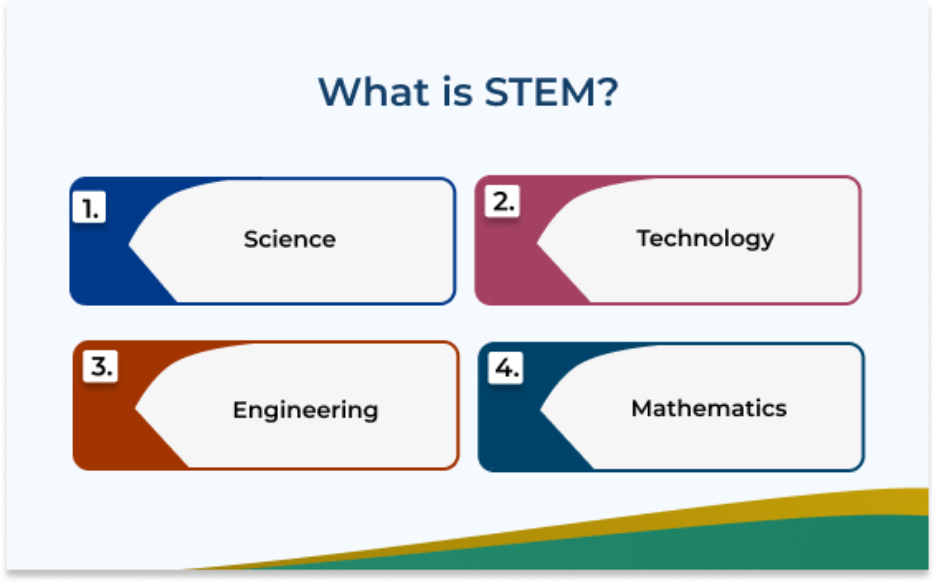
What is STEM?
STEM is an abbreviation for Science, Technology, Engineering, and Mathematics. It is a multidisciplinary approach to learning where students are encouraged to use critical thinking, problem-solving, and innovation to tackle challenges using logical and analytical thinking. Unlike learning these subjects separately, STEM integrates them and focuses on practical, hands-on application. For learners in the region, programs that promote STEM coding success Nagpur provide the right environment to apply these concepts effectively and build a strong foundation for future growth.
Science equips students with knowledge of natural laws and phenomena, whereas Technology equips them with practical applications of these phenomena using digital technology. Engineering involves designing and making, and Mathematics equips them with the basics of calculations and logical thinking. These four subjects equip students for a career in the modern world and other related fields, such as artificial intelligence, robotics, healthcare, space research, and data science.
Furthermore, STEM learning equips children with creativity, collaboration, and problem-solving skills from an early age. STEM learning allows children to design, make, and improve continuously. In the rapidly changing world of today, STEM learning is essential for academic and professional success, not only for those interested in these fields but for developing innovative thinking and adaptability, which is crucial for academic and professional success.
STEM Includes
STEM comprises four major fields of study—Science, Technology, Engineering, and Mathematics. Below are brief illustrations of what each of these fields entails. For learners in the region, programs like LearnQoch STEM results Vidarbha help translate these concepts into practical learning outcomes, ensuring students not only understand each field but also apply them effectively in real-world scenarios.
1. Science:
For instance, when learning about plants and growth, students may be asked to design an experiment where they put one plant under the sun and another under the shade. They learn concepts such as photosynthesis and the need for plants to have light.
2. Technology:
One of the best illustrations of technology is designing a simple application for a mobile device or developing a computer program for designing a presentation. They may also use programs for developing games and animations, among other applications.
3. Engineering:
One of the best illustrations of engineering is when students design a bridge using paper and popsicle sticks and are asked to determine if it can carry weight. They learn concepts related to design and improvement.
4. Mathematics:
One of the best illustrations of mathematics is when students need to calculate the total cost of items they need while going for a shopping spree. Mathematics is essential for logical thinking and decision-making.
Read more DevOps
Conclusion
To conclude, coding is not just another skill but a fundamental one that can significantly support students in their academic and professional growth. When students grasp the basics of coding, they tend to perform better in their subjects—especially in STEM—and develop strong logical reasoning abilities. For learners in the city, programs focused on coding STEM excellence Mumbai play a crucial role in nurturing these skills and preparing them for future success.
Furthermore, as awareness is spreading, parents must not only concentrate on enrolling their kids in coding programs but also make sure that the platforms provide measurable learning outcomes. As the progressive vision of the National Education Policy 2020 is promoting skill-based and technology-based education, coding has become a significant component in the learning process.
Finally, just like any language, becoming proficient in coding is a process, and with time and patience, students can reach their full potential and become innovative thinkers of the future.
The LearnQoch AI powered Academic Platform
LearnQoch goes further by providing an integrated platform that covers all aspects of institutional growth:

Institutional Digital Ecosystem: Categories & Modules
A. LearnQoch AI powered Core Academic & Learning Solutions
Facilitates modern teaching and learning while tracking student progress, assignments, assessments, and course outcomes.
Focuses on measuring learning outcomes to ensure skills, competencies, and academic objectives are met effectively.
- LearnQoch AI powered Academic Calendar & Events
Maintains academic schedules, holidays, events, and exam timelines for seamless yearly planning.
- LearnQoch AI powered Class Module
Manages class creation, faculty allocation, and student grouping while supporting timetable integration.
B. LearnQoch AI powered Examination & Evaluation Management
LearnQoch AI Powered Exam Management Module
A unified system that digitizes the entire exam cycle—right from planning, subject allocation, ATKT processing, and scheduling to question paper creation, assessments, evaluation, and result generation. It ensures transparency, accuracy, and smooth coordination across all departments.
C. LearnQoch AI powered Campus Administration & Operations
Streamlines administrative activities, simplifies student data management, and ensures workflow automation across all departments.
- LearnQoch AI powered Task Management
Organizes, prioritizes, and tracks institutional tasks to improve productivity and accountability.
- LearnQoch AI powered Committee Module
Handles committee formation, roles, activities, and meeting records to maintain governance transparency.
- LearnQoch AI powered Document Management
Stores, organizes, and retrieves institutional documents with version control and compliance tracking.
- LearnQoch AI powered Certificate Management
Manages creation and issuance of academic and administrative certificates such as Bonafide, character, and leaving certificates.
D. LearnQoch AI powered Finance & Fees Management
- LearnQoch AI powered Finance Module – Receivable (Fees)
Tracks payments, manages fee categories, handles tuition/fines, and maintains fee-related records.
- LearnQoch AI powered Advanced Fees
Payments made before the due date, helping institutions and parents manage fee planning efficiently.
- LearnQoch AI powered Excess Fees
Extra amount paid unintentionally; recorded for adjustment in future payments or refunded when necessary.
E. LearnQoch AI powered Library & Resource Management
LearnQoch AI powered Library Module
Manages book registration, issue-return process, renewals, student access, and availability tracking for efficient library operations.
F. LearnQoch AI powered Placement & Career Development
- LearnQoch AI powered Placement Module
Manages job postings, student registration, interview updates, and final offer letters with complete transparency for TPOs and students.
- LearnQoch AI powered Skill Development Solutions
Equips students with future-ready skills to enhance employability and prepare for global career opportunities.
G. LearnQoch AI powered Accreditation & Compliance
LearnQoch AI powered NAAC, NBA & NIRF Compliance
Simplifies reporting, monitoring, and auditing with ready-to-use compliance tools that reduce institutional workload.
H. LearnQoch AI powered Digital Presence & Branding
LearnQoch AI powered Website & Digital Marketing Solutions
Helps institutions build a strong online presence, attract prospective students, and engage key stakeholders effectively.
Don’t Just Take Our Word for It—Try LearnQoch Yourself!
We invite you to experience the transformative impact of LearnQoch’s AI powered Digitize Platform with a 14-Day Free Trial.
During this period, our team will implement the software for your institution, allowing you to explore its features firsthand and see the difference it can make in academic management.
👉 Are you ready to lead your institution into the future of campus management?
📞 Contact us at +91 84519 01079
📧 Email: info@learnqoch.com / sales@learnqoch.com
Explore What LearnQoch Offers:
Visit www.learnqoch.com for Full Details
Also read,
From Inquiry to Enrollment: Mapping the Student Journey via Your Website
5 Things Every Principal Needs to Know About Exam Management Technology
Coding and Robotics in Remote Learning: Strategies for Success
Best LMS for Schools: The Future of Learning Management Systems