


How to Calculate CO Attainment Using Direct and Indirect Methods?


Intorduction
Your students have appeared for examinations, completed assignments and participated in practical sessions. But can you confidently say whether they have achieved the Course Outcomes (COs) defined for the subject?
For many institutions, the real challenge is not collecting assessment marks but converting that data into meaningful CO attainment results. Faculty often need to map assessments with COs, calculate attainment levels, analyse student feedback and identify learning gaps. Managing these calculations manually can become time-consuming and complicated.
LearnQoch simplifies this process through its OBE software, helping institutions organise assessment data, calculate CO attainment using Direct and Indirect Assessment methods, and generate reports to support academic improvement.
In this blog, let’s understand both methods, explore their formulas with practical examples, and see how technology can make CO attainment calculation easier and more systematic.
Our previous blog…
In our previous blog, we discussed how to calculate Course Outcome (CO) attainment using direct and indirect assessment methods. Now, let’s take a step further and understand how to identify weak COs, POs, and PSOs by comparing actual attainment with predefined targets. We will explore how gap analysis helps faculty identify learning gaps, review assessment performance, and plan corrective actions. Learn how LearnQoch OBE Software simplifies attainment tracking, gap identification, and continuous academic improvement.
1. What Is Course Outcome (CO) Attainment?
Course Outcomes (COs) are specific statements that describe what students should know, understand, or be able to do after completing a particular course.
For example, in a Management course, a CO could be:
“Students will be able to apply management principles to solve real-world business problems.”
CO attainment measures how successfully students achieve this expected learning outcome.
In simple terms, it answers three important questions:
- How many students achieved the defined learning target?
- How well did students perform in different assessments?
- Which learning outcomes need additional attention or improvement?
Institutions generally measure CO attainment on a scale of 0 to 3, where a higher score indicates a better level of achievement.
2. What Are Direct and Indirect Methods of CO Attainment?
Before calculating attainment, it is important to understand the difference between these two assessment methods.
A. Direct Assessment
Direct assessment measures what students demonstrate through their performance in academic activities.
Common tools include:
- Continuous Internal Assessment (CIA) and Semester End Examination (SEE)
- Class Tests and Quizzes
- Assignments and Projects
- Practical Work, Viva and Presentations
- Case Studies
For example, a student scoring 35 out of 50 in an examination can be evaluated against the defined assessment target.
B. Indirect Assessment
Indirect assessment captures students’ perceptions and feedback about their learning experience.
Common tools include:
- Course Exit Surveys and Student Feedback
- Alumni and Employer Surveys
- Parent Surveys, where relevant
For example, a survey may ask students whether they can apply the concepts learned to real-world situations.
Key Difference: Direct assessment measures what students demonstrate, while indirect assessment captures how they perceive their learning.
3. How to Calculate CO Attainment Using the Direct Method
Direct CO attainment is measured using student marks in assessments mapped to specific Course Outcomes.
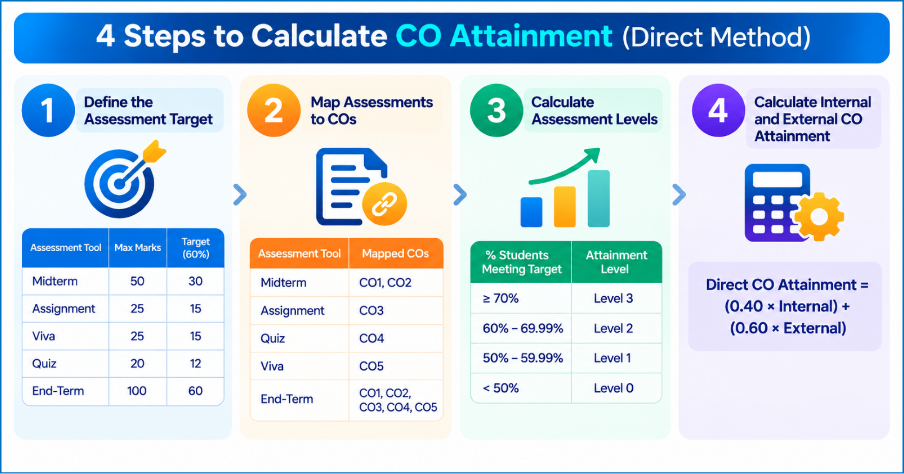
Let’s understand this with an example.
Suppose 10 students are enrolled in a subject called Resource Optimization, which has five Course Outcomes (CO1 to CO5). The faculty has configured the following assessment structure:
| Assessment Tool | Category | Weightage | Maximum Marks |
|---|---|---|---|
| Midterm Examination | Internal | 20% | 50 |
| Assignment | Internal | 10% | 25 |
| Viva | Internal | 5% | 25 |
| Quiz | Internal | 5% | 20 |
| End-Term Examination | External | 60% | 100 |
| Total | — | 100% | — |
This means Internal Assessment carries 40% weightage and External Assessment carries 60%.
Step 1: Define the Assessment Target
The institution sets a target of 60% for each assessment. Accordingly, students must score at least:
- Midterm: 30 out of 50
- Assignment: 15 out of 25
- Viva: 15 out of 25
- Quiz: 12 out of 20
- End-Term: 60 out of 100
Students scoring at or above these marks are considered to have met the target.
Step 2: Map Assessments to Course Outcomes
Next, each assessment is mapped to the COs it measures.
| Assessment Tool | Mapped COs |
|---|---|
| Midterm Examination | CO1, CO2 |
| Assignment | CO3 |
| Quiz | CO4 |
| Viva | CO5 |
| End-Term Examination | CO1, CO2, CO3, CO4, CO5 |
This mapping connects assessment performance with the specific learning outcomes.
Step 3: Calculate Assessment Attainment Levels
Now, calculate the percentage of students who meet the target in each assessment. For this example, the following attainment scale is used:
| Students Meeting Target | Attainment Level |
|---|---|
| 70% or more | Level 3 |
| 60%–69.99% | Level 2 |
| 50%–59.99% | Level 1 |
| Below 50% | Level 0 |
For example, if 8 out of 10 students score at least 30 marks in the Midterm:
Percentage = (8 ÷ 10) × 100 = 80%
Therefore, Midterm Attainment = Level 3.
Applying the same method to the other assessments gives:
| Assessment | Students Meeting Target | Percentage | Attainment |
|---|---|---|---|
| Midterm | 8/10 | 80% | 3 |
| Assignment | 9/10 | 90% | 3 |
| Quiz | 6/10 | 60% | 2 |
| Viva | 7/10 | 70% | 3 |
For the End-Term Examination, attainment is calculated separately for each CO:
| Course Outcome | Students Meeting Target | Percentage | Attainment |
|---|---|---|---|
| CO1 | 8/10 | 80% | 3 |
| CO2 | 7/10 | 70% | 3 |
| CO3 | 6/10 | 60% | 2 |
| CO4 | 7/10 | 70% | 3 |
| CO5 | 5/10 | 50% | 1 |
Step 4: Calculate Internal and External CO Attainment
Once the assessment attainment levels are available, combine the internal and external results using their configured weightages.
The formula is:
Direct CO Attainment = (0.40 × Internal Attainment) + (0.60 × External Attainment)
Let’s calculate CO3:
- Internal Attainment (Assignment) = 3
- External Attainment (End-Term) = 2
Direct CO3 Attainment = (0.40 × 3) + (0.60 × 2)
= 1.20 + 1.20 = 2.40
Using the same calculation for all five COs gives:
| Course Outcome | Internal Attainment | External Attainment | Direct CO Attainment |
|---|---|---|---|
| CO1 | 3 | 3 | 3.00 |
| CO2 | 3 | 3 | 3.00 |
| CO3 | 3 | 2 | 2.40 |
| CO4 | 2 | 3 | 2.60 |
| CO5 | 3 | 1 | 1.80 |
The final results help faculty understand which Course Outcomes have been achieved and where students may need additional support.
Note: The assessment weightages, targets and attainment thresholds used here are illustrative. Institutions should follow their approved academic assessment scheme.
4. How to Calculate CO Attainment Using the Indirect Method
Direct assessment measures student performance, but does it reveal how confident students feel about applying what they have learned? This is where indirect assessment helps.
For example, a Course Exit Survey may include questions about students’ understanding of concepts, practical application and problem-solving abilities. Each question is mapped to the relevant CO and evaluated using a defined rating scale.
Example calculation:
Suppose 60 students respond to a survey, and 43 meet the defined target.
Percentage meeting the target = (43 ÷ 60) × 100 = 71.67%
Using the illustrative attainment criteria:
- 70% or more: Level 3
- 60%–69.99%: Level 2
- 50%–59.99%: Level 1
- Below 50%: Level 0
Therefore, the Indirect CO Attainment is Level 3. Institutions should consistently follow their approved survey scoring and target criteria.
5. How to Calculate Overall CO Attainment Using Direct and Indirect Methods
LearnQoch’s OBE handbook illustrates a 90:10 weightage distribution:
- Direct Assessment: 90%
- Indirect Assessment: 10%
Formula:
Overall CO Attainment = (0.90 × Direct Attainment) + (0.10 × Indirect Attainment)
Example:
Direct Attainment = 2.40
Indirect Attainment = 3.00
Overall Attainment = (0.90 × 2.40) + (0.10 × 3.00)
= 2.16 + 0.30 = 2.46 out of 3.00
This combined result reflects both student performance and feedback. Institutions can use it to identify learning gaps and plan improvements.
Note: The 90:10 distribution is illustrative, as shown in the LearnQoch OBE handbook. Institutions may follow another justified distribution under their approved academic policy. LearnQoch OBE software allows you to configure your institute Direct & Indirect weightage.
6.How LearnQoch Simplifies CO Attainment and Continuous Improvement?
Calculating CO attainment manually involves multiple steps, from mapping assessment tools and entering marks to calculating attainment levels and preparing reports. When several subjects and semesters are involved, this can become time-consuming for faculty and IQAC teams.

LearnQoch’s OBE Attainment Module brings these activities together in one structured workflow. It helps institutions:
- Configure COs: Define Course Outcomes and Bloom’s Taxonomy levels.
- Map Outcomes: Connect COs with relevant POs and PSOs.
- Map Assessments: Link internal and external assessment tools with COs.
- Set Targets: Configure target percentages and attainment criteria.
- Calculate Attainment: Use examination marks and configured weightages to calculate direct attainment.
- Measure Indirect Attainment: Map survey questions to outcomes and calculate attainment from feedback.
- Generate Reports: Review CO attainment and identify learning gaps.
But calculating attainment is only the beginning. When a CO shows low attainment, faculty can take corrective steps such as conducting remedial classes, providing additional assignments, using practical exercises, or reviewing teaching and assessment methods.
By simplifying attainment calculations and making performance data easier to review, LearnQoch helps institutions support continuous academic improvement.
The LearnQoch AI Powered Integrated Solution
A unified platform that connects administration, academics, examinations, placements, and accreditation on a single digital ecosystem, helping institutions manage their complete academic journey efficiently.
1. AI powered LMS (Learning Management System)
Facilitates modern teaching and learning while tracking student progress, assignments, assessments, and course outcomes.
2. LearnQoch AI Powered Exam Management Module
A unified system that digitizes the entire exam cycle—right from planning, subject allocation, ATKT processing, and scheduling to question paper creation, assessments, evaluation, and result generation. It ensures transparency, accuracy, and smooth coordination across all departments.
3. AI powered NAAC, NBA & NIRF Compliance
Simplifies accreditation with ready-to-use templates, QLM/QNM data matrices, DVV support, and accreditation-ready reports, reducing manual effort and keeping institutions audit-ready.
4. AI powered Digital Presence & Branding
LearnQoch AI-powered Growth+ – Manage social media, campaigns, and website activities from one platform, with performance reports in sheets, PDFs, and graphical dashboards for better insights.
Experience LearnQoch Before You Decide
See how LearnQoch’s AI-powered digital platform can simplify academic and campus management with a 14-Days Free Trial.
Our team will help implement the platform for your institution, giving you the opportunity to explore its features, understand its capabilities, and experience the difference firsthand.
👉 Ready to transform the way your institution manages academics and campus operations?
📞 Contact us at +91 84519 01079
📧 Email: sales@learnqoch.com
Explore What we Offers:
Visit www.learnqoch.com for Full Details
Frequently Asked Questions
1. What is the difference between direct and indirect CO attainment?
2. What is the formula for calculating overall CO attainment?
Overall CO Attainment = (90% × Direct CO Attainment) + (10% × Indirect CO Attainment)
Institutions may use justified weightage distributions according to their academic assessment policy.