


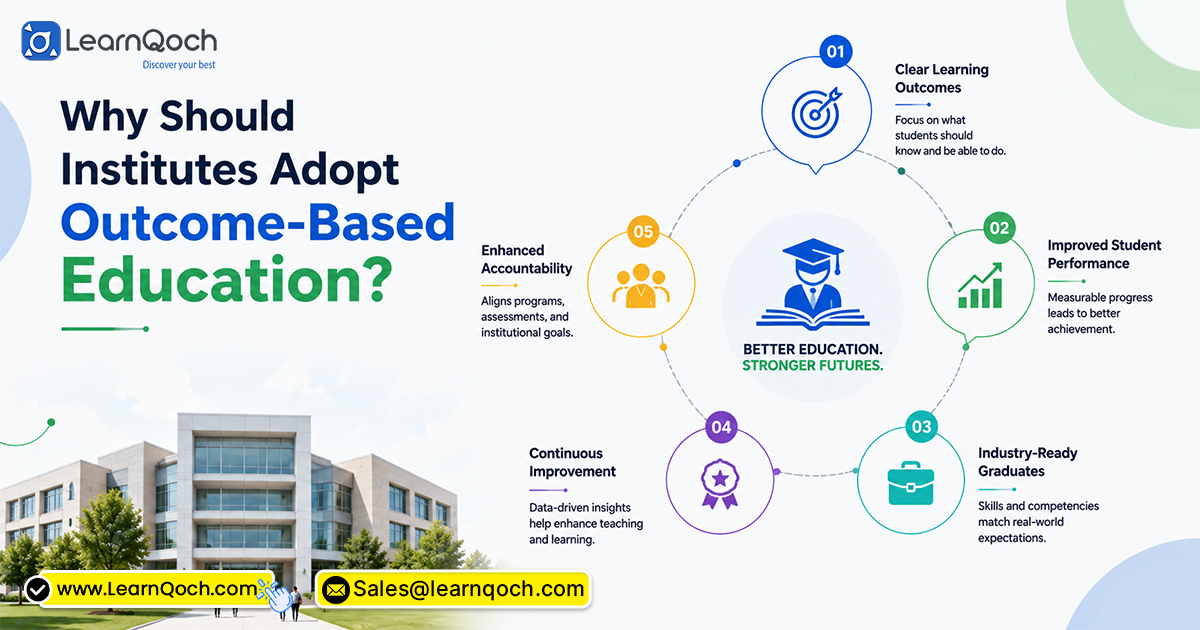
Why Should Institutions Adopt Outcome Based Education(OBE)?


Introduction
Higher education is placing greater emphasis on student learning outcomes, competencies, and measurable academic performance. To address these priorities, many institutions are adopting Outcome-Based Education (OBE) to better connect curriculum, teaching, assessment, and learning outcomes.
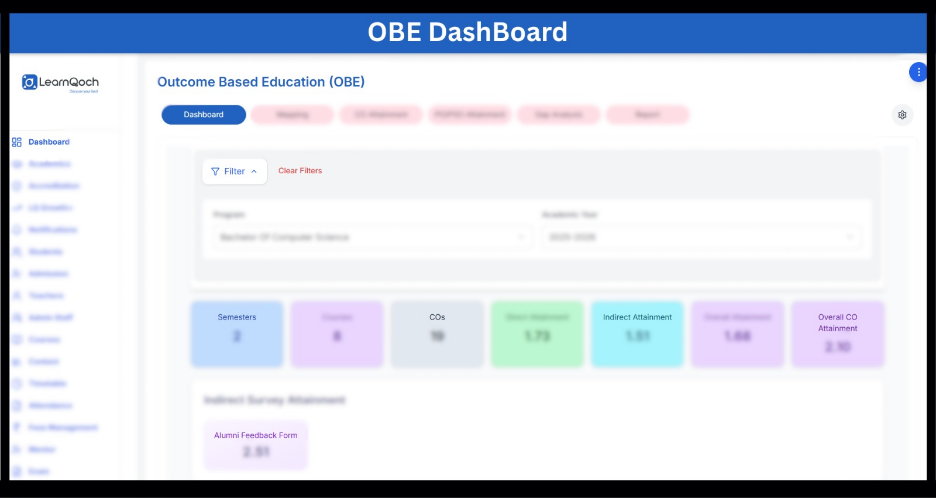
Advanced platforms like LearnQoch OBE help institutions manage key OBE activities digitally, including CO-PO-PSO mapping, assessment, attainment tracking, and academic analysis. By bringing these processes together, institutions can reduce manual work and maintain more structured academic data.
This approach also supports the broader focus on skill development, competency-based learning, digital education, and measurable outcomes highlighted in the National Education Policy (NEP 2020). For institutions working toward NAAC and NBA accreditation, organized OBE data can also help maintain assessment, attainment, and continuous improvement of records.
So, why do institutions adopt Outcome-Based Education?
Let’s explore the key benefits of adopting OBE and how OBE can support better learning, academic decision-making, and continuous improvement.
When two Professor friends meet?
Prof. Verma: Hello! Arey, after a very long time we meet! What are you doing here?
Prof. Sharma: Verma! What a pleasant surprise! I’m just here for this OBE training workshop. And you?
Prof. Verma: For the same! Honestly, I don’t understand why it is so important. Principal sir just sent me here to complete the training.
Prof. Sharma: Same here. The doors are opening, let’s join.
(After the session…)
Prof. Verma: Wow yaar, I understand the benefits now! Purpose-Driven Curriculum Design makes so much sense—mapping courses backward ensures the entire syllabus stays structurally sound. Plus, it drives Student-Centric Teaching Methodologies like experiential learning, which directly fulfills NEP 2020 mandates.
Prof. Sharma: True, but if we do this entire process manually, it’s going to be incredibly lengthy. Tracking CO, PO, and PSOs on spreadsheets will drive us crazy!
Prof. Verma: Don’t take stress! They called us for the next meeting to discuss digital tools, so we can just ask for a digitized platform.
Prof. Sharma: Sure! We can search first for such things then suggest to others. But first we clear our concepts like our teaching theory and practical.
(Haha!… Both are laugh)
Talk with LearnQoch Experts!What This Blog Covers?
This blog explains why institutions should adopt Outcome-Based Education (OBE) and how it can improve teaching, assessment, academic planning, and continuous improvement. It covers:
- Why Institutions Should Adopt OBE and the shift toward outcome-focused education
- Key Benefits of OBE for students, faculty, and institutions
- OBE for Academic Improvement and Accreditation, including its connection with NBA and NAAC.
- How LearnQoch Supports OBE through digital mapping, assessment, attainment tracking, analytics, and academic reporting
Overall, this blog shows how OBE can help institutions build a more structured, measurable, and student-focused academic system, while we supports the digital management of key OBE processes.
What Is Outcome-Based Education (OBE)?
Outcome-Based Education is an educational framework that focuses on clearly defined learning outcomes—what students are expected to know, understand, and be able to perform at the end of a course or program.
Instead of emphasizing inputs such as teaching hours or syllabus coverage, OBE prioritizes outputs like:
- Knowledge application
- Skill development
- Critical thinking
- Problem-solving ability
- Professional readiness
In essence, OBE answers a fundamental question:
“What value does education create for the learner?”
Why Traditional Education Models Are No Longer Enough?
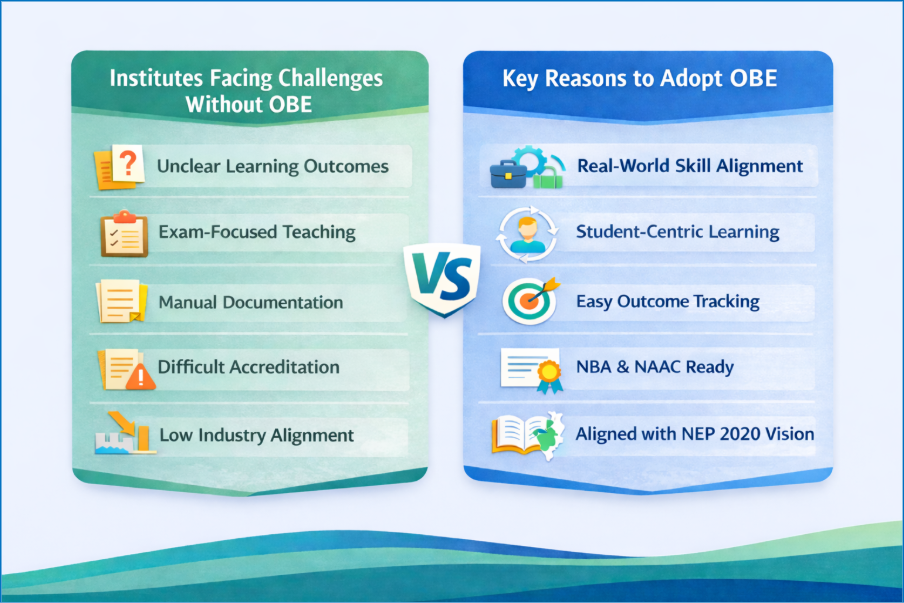
First and foremost, traditional education systems often suffer from several limitations:
- Learning is exam-centric rather than skill-centric
- Student performance is measured by marks, not mastery
- Curriculum design is disconnected from industry needs
- Continuous assessment is minimal
- Teaching effectiveness is difficult to evaluate
Consequently, students may graduate with degrees but lack practical skills, confidence, and employability.
In contrast, Outcome-Based Education directly addresses these gaps by aligning curriculum, teaching, assessment, and evaluation with clearly defined outcomes.
Key Reasons Institutions Should Adopt Outcome-Based Education
Adopting Outcome-Based Education (OBE) helps institutions connect curriculum, teaching, assessment, and student achievement with clearly defined outcomes. With a digital OBE software , institutions can manage these processes in a more structured and connected way.
1. Creates Clear Learning Expectations
OBE defines what students are expected to know, understand, and achieve by the end of a course or program. This gives faculty clear academic objectives and helps students understand what their learning should lead to.
2. Connects Curriculum, Teaching, and Assessment
OBE helps institutions align Course Outcomes (COs), Program Outcomes (POs), and Program Specific Outcomes (PSOs) with curriculum and assessment activities. Software supports this alignment through centralized outcome mapping and assessment management.
3. Makes Attainment Data More Useful
Instead of treating assessment results only as marks, institutions can use them to analyze CO, PO, and PSO attainment. We help organize attainment data and analytics so faculty and academic teams can review performance across courses, semesters, and programs.
4. Supports Continuous Academic Improvement
Attainment and assessment of insights can help institutions identify areas that require attention and review of teaching methods, curriculum delivery, and assessment strategies. This creates a continuous cycle of assessment, analysis, action, and improvement.
5. Simplifies OBE and Accreditation Documentation
OBE involves maintaining mapping, assessment, attainment, and improvement of records. LearnQoch brings these activities into a centralized platform, helping institutions maintain structured academic data and reports that can support OBE implementation and accreditation-related documentation, including NAAC and NBA.
Benefits of Outcome-Based Education for Key Stakeholders
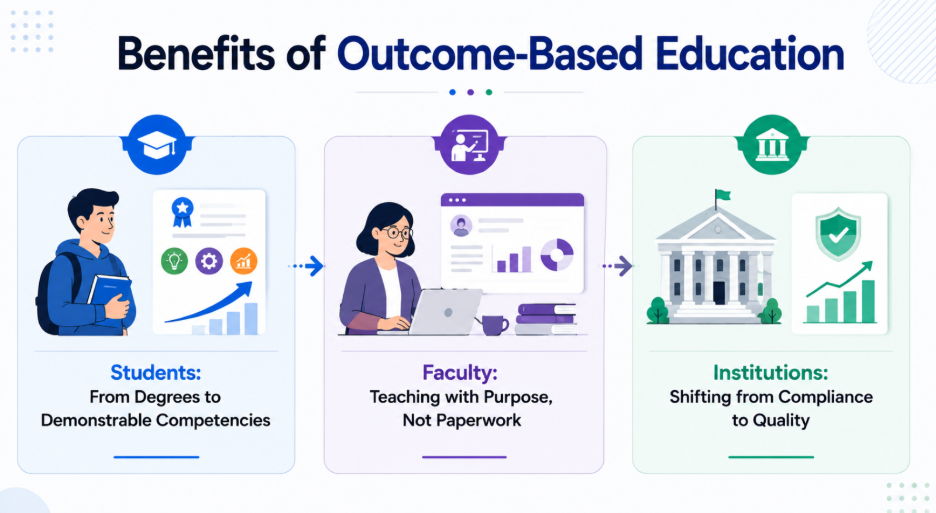
Adopting Outcome-Based Education (OBE) helps institutions connect curriculum, teaching, assessment, and student achievement with clearly defined learning outcomes. When these processes are managed digitally, faculty and administrators can spend less time on manual data handling and more time using academic insights for improvement.
1. Students: Clearer Learning Goals
OBE makes learning expectations more transparent by defining what students should know, understand, and be able to do. Outcome-aligned assessments and practical learning activities help students understand their progress and areas that need improvement.
2. Faculty: Better Teaching and Less Manual Work
Faculty can align courses, assessments, and teaching activities with defined Course Outcomes (COs). With our OBE software, faculty can manage CO-PO-PSO mapping, assessment data, Bloom’s Taxonomy, attainment, and academic reports through a centralized system, reducing repetitive manual work.
3. Institutions: Data-Driven Academic Management
OBE provides institutions with structured data to review CO, PO, and PSO attainment across courses, departments, and programs. We help bring mapping, assessments, attainment analysis, and reporting together, making academic data easier to track and review.
4. Continuous Improvement: From Data to Action
Attainment results can highlight areas where expected outcomes are not being achieved. Institutions can use these findings to review curriculum delivery, teaching methods, assessment strategies, and academic activities, creating a continuous improvement cycle.
Conclusion
Managing OBE, assessments, attainment, and accreditation records manually can create extra workload, scattered data, and difficulties in tracking academic outcomes. Institutions need a connected approach that makes these processes easier to manage and review.
LearnQoch OBE software provides a centralized platform for managing CO-PO-PSO mapping, assessments, attainment, analytics, and academic reports. By connecting these activities digitally, institutions can reduce manual work, improve data consistency, and maintain organized evidence for OBE and accreditation processes.
With the right digital solution, institutions can turn OBE from a time-consuming compliance activity into a structured process for measuring outcomes and supporting continuous academic improvement.
The LearnQoch AI-powered Academic Platform
LearnQoch goes further by providing an integrated platform that covers all aspects of institutional growth:

| Category | Software’s | Key Purpose |
|---|---|---|
| Academic & Learning | AI powered LMS , OBE , Academic Calendar & Events, Class Module | Supports teaching, learning, OBE, academic planning, classes, assessments, and student progress. |
| Examination & Administration | Exam Management , ERP , Task, Committee, Document & Certificate Management | Digitizes examinations and streamlines institutional workflows, records, tasks, committees, and certificates. |
| Finance, Library & Careers | Finance & Fees, Advanced/Excess Fees, Library, Placement & Skill Development | Manages fees, library resources, placements, student skills, and career-related activities. |
| Accreditation & Digital Presence | NAAC, NBA & NIRF Compliance , Website & Digital Marketing Solutions | Supports accreditation documentation, compliance tracking, institutional branding, website management, and digital outreach. |
Don’t Just Take Our Word for It—Try LearnQoch Yourself!
We invite you to experience the transformative impact of LearnQoch’s AI powered Digitize Platform with a 14-Day’s Free Trial.
Book your free Demo Now!During this period, our team will implement the software for your institution, allowing you to explore its features firsthand and see the difference it can make in academic management.
👉 Are you ready to lead your institution into the future of campus management?
📞 Contact us at +91 84519 01079
📧 Email: sales@learnqoch.com
Visit www.learnqoch.com for full details.