



Why Faculty Development Is Key to Outcome-Based Education Success?


The Changing Landscape of Higher Education
In today’s fast-paced educational environment, simply delivering lectures anIntroduction
Instead of focusing only on syllabus completion, Outcome-Based Education (OBE) asks institutions to consider what students are expected to learn and how effectively they achieve those learning outcomes. This makes faculty development in OBE especially important, as teachers play a key role in translating outcome-based frameworks into effective teaching and assessment practices.
Faculty need to understand Course Outcomes (COs), Program Outcomes (POs), assessment methods, Bloom’s Taxonomy, and attainment analysis to implement OBE effectively. Moreover, they need practical tools to align courses and assessments, track student performance, and use academic data for continuous improvement.
This is where LearnQoch OBE can contribute. By providing digital tools for CO-PO-PSO mapping, assessment, attainment tracking, analytics, and academic reporting. It helps faculty manage key OBE activities in a more structured way. As a result, educators can spend less time handling repetitive academic data and more time focusing on teaching and student learning.
So, how can institutions strengthen faculty development for OBE, and how can digital solutions such as LearnQoch support educators throughout this process?
In our previous blog…
In our previous blog, we explored CO-PO mapping in Outcome-Based Education (OBE) and how it connects course-level learning with broader program outcomes.
While effective mapping provides a strong foundation for OBE, its success ultimately depends on how well faculty understand and apply these concepts in their teaching, assessment, and academic planning.
What This Blog Covers?
- Why Faculty Development Matters in OBE and its role in effective implementation
- Key Skills Faculty Need for outcome-based teaching, assessment, and attainment analysis
- Faculty Training Strategies to strengthen OBE practices and continuous improvement
- Challenges in Faculty Adoption of OBE and practical ways to address them
- How LearnQoch Supports Faculty with CO-PO-PSO mapping, assessment, attainment tracking, analytics, and academic reporting
Understanding the Role of Faculty in OBE
Faculty are central to successful OBE implementation. They translate defined outcomes into teaching, assessment, and improvement activities.
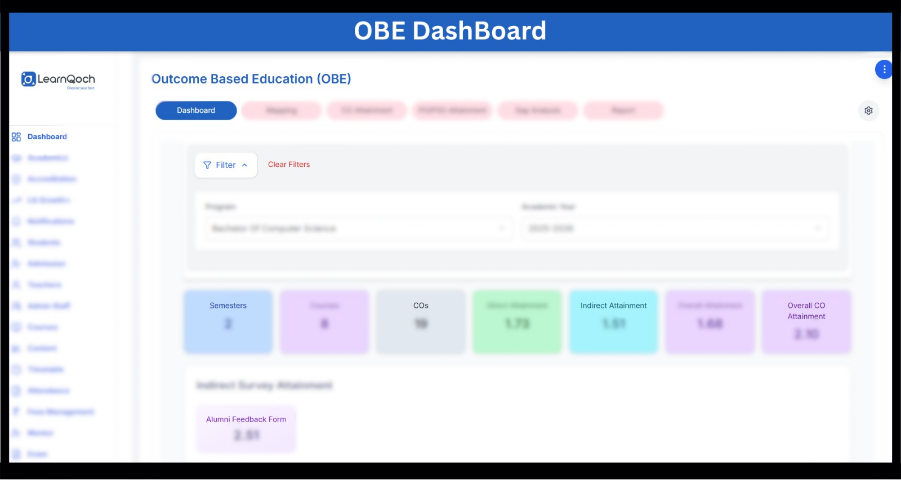
Key responsibilities include:
- Define clear Course Outcomes (COs) for their courses.
- Map COs with relevant POs and PSOs as per the OBE framework.
- Design outcome-aligned teaching and assessments using appropriate methods.
- Record and analyze assessment data to measure attainment.
- Review results and identify areas for improvement in teaching and learning.
- Maintain accurate OBE records for academic review and accreditation-related documentation.
Therefore, faculty need both OBE knowledge and hands-on experience to apply these responsibilities effectively.
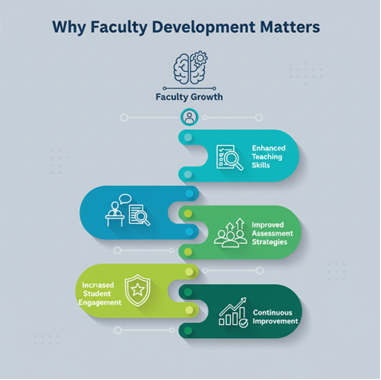
Why Faculty Development Matters?
Faculty development helps educators gain the knowledge, practical skills, and confidence needed to implement OBE effectively.
It prepares them to understand OBE processes, apply outcome-based teaching and assessment methods, use digital tools, and work with attainment data.
More import, hands-on training helps faculty move from simply understanding OBE concepts to applying them correctly in their day-to-day academic work.
How LearnQoch Helps Faculty Implement OBE Effectively?
Successful OBE implementation requires more than a one-day workshop. Faculty need practical training, hands-on experience, clear guidance, and ongoing support so they can confidently apply OBE processes in their regular academic work. A structured approach can help institutions achieve this.
Step 1: Understand Faculty Training Needs
Before implementation, institutions should identify what faculty already understand about OBE and where additional guidance is required. Training can then focus on areas such as CO formulation, CO-PO-PSO mapping, assessment methods, attainment calculation, and academic data management.
Step 2: Provide Practical OBE Learning Resources
Faculty need clear reference material that they can use while working on OBE activities. LearnQoch provides an OBE handbook covering important processes such as CO-PO-PSO mapping, attainment calculation, direct and indirect assessment, and the data required for OBE reporting.
This gives faculty a practical reference instead of relying only on training sessions or verbal instructions.
Step 3: Give Faculty Hands-On Access to the Platform
Understanding OBE concepts is only one part of the process. Faculty also need to learn how those concepts are implemented in an actual OBE system.
LearnQoch provides teacher login access and a hands-on practice environment, allowing faculty to work with the platform and become familiar with the workflow. They can practise entering academic data, creating mappings, managing assessments, and working with attainment-related information before applying the process to their regular academic activities.
Step 4: Train Faculty on the Complete OBE Workflow
We help faculty understand the OBE process by taking them through the platform step by step. Faculty learn how to enter their academic data, create and map COs with POs and PSOs, add assessment details, work with attainment, and generate the required reports.
Instead of only explaining the process theoretically, faculty can practise each step on the platform. This helps them understand where the data goes, how different OBE activities are connected, and how their inputs are reflected in the final reports.
From entering data to generating reports, faculty get hands-on experience with the complete OBE workflow.
Step 5: Help Faculty Verify Their Work
One important part of OBE training is knowing whether the work has been completed correctly. Faculty can review their mappings, assessment data, attainment information, and generated reports to identify possible gaps or inconsistencies.
LearnQoch also helps institutions maintain a more structured trail of OBE-related data, so faculty can understand how their academic inputs contribute to the final reports and documentation.
Step 6: Prepare Faculty for DVV and Academic Review
OBE documentation may later be reviewed by the institution’s authorized team during DVV and accreditation-related processes. Giving faculty visibility into how their data is used in reports can help them understand the importance of accurate and complete entries.
This creates a stronger connection between faculty-level academic work and institution-level documentation, helping educators recognize whether their OBE activities are being carried out as expected.
Step 7: Provide Continuous Handholding and Support
Faculty may need time to become comfortable with a new OBE workflow. Therefore, training should not end after the initial session.
The LearnQoch team provides ongoing handholding and support, helping faculty resolve questions and understand the platform as they work through actual OBE activities. The objective is to help educators become sufficiently familiar with the system and processes rather than simply completing a one-time training session.
Conclusion:
Successful Outcome-Based Education (OBE) depends not only on frameworks and technology but also on the people who implement them. Faculty members bring OBE principles into the classroom through effective teaching, outcome-aligned assessment, feedback, and continuous academic improvement.
Therefore, investing in faculty development and training can help institutions:
- Improve teaching and assessment practices
- Strengthen student engagement and learning outcomes
- Apply OBE processes more consistently across courses and programs
- Use attainment data to support continuous academic improvement
- Maintain better-structured evidence for accreditation and academic review
With the right training, institutional support, and digital tools, faculty can implement OBE more effectively and focus more on meaningful teaching and measurable student outcomes. Platforms such as LearnQoch can further support educators by bringing OBE activities such as CO-PO-PSO mapping, assessment, attainment tracking, analytics, and reporting into a structured digital workflow.
Beyond Outcome-Based Education: Redefine Academic Management with LearnQoch
LearnQoch offers an integrated technology platform that addresses all aspects of academic and institutional management:

- ERP (Enterprise Resource Planning): Streamlines administration, simplifies student data management, and ensures smooth workflow across all departments.
- LMS (Learning Management System): Facilitates modern teaching and learning experiences while tracking student progress and course outcomes.
- NAAC, NBA & NIRF Compliance: Accreditation-ready tools simplify reporting, monitoring, and auditing processes, reducing administrative burden.
- Website & Digital Marketing Solutions: Helps institutions establish a strong online presence to attract prospective students and stakeholders.
- Skill Development Solutions: Equips students with future-ready skills, enhancing employability and global career opportunities.
Don’t Just Take Our Word for It—Try LearnQoch Yourself!
We invite you to experience the transformative impact of LearnQoch’s Digitize Platform with a 14-Day Free Trial.
During this period, our team will implement the software for your institution, allowing you to explore its features firsthand and see the difference it can make in academic management.
👉 Are you ready to lead your institution into the future of campus management?
📞 Contact us at +91 84519 01079
📧 Email: sales@learnqoch.com
Explore What LearnQoch Offers:
Visit www.learnqoch.com for Full Details
FAQs
What are the biggest challenges institutions face when implementing OBE?
Institutions may face challenges such as inconsistent OBE practices, limited faculty experience, time constraints, and difficulty managing assessment and attainment data across departments.
How can institutions make OBE implementation consistent across departments?
Institutions can establish common OBE guidelines, provide regular faculty support, standardize assessment practices, and use centralized systems to maintain consistent academic processes and records.
How can institutions evaluate whether their OBE practices are working effectively?
They can review assessment quality, attainment trends, faculty implementation, student performance, and continuous improvement actions to determine whether OBE practices are producing meaningful academic insights.
Why is LearnQoch a practical solution for faculty implementing OBE?
LearnQoch brings key OBE activities into one centralized platform, reducing the need to manage scattered spreadsheets and records. It supports CO-PO-PSO mapping, assessment, attainment tracking, analytics, and reporting, helping faculty manage OBE more efficiently while institutions maintain structured academic data.