



From Rote to Real Learning with OBE


Imagine a classroom where success is measured not just by how much students remember, but by what they can actually understand, apply, and achieve. Every lesson, assessment, and learning activity is connected to clear learning outcomes and real-world skills. This is the idea behind Outcome-Based Education (OBE).
As education continues to change, many colleges and universities are asking an important question: Is traditional education enough for today’s students and industry needs? While traditional education often focuses on syllabus completion and examinations, OBE focuses on measurable learning outcomes, practical skills, and student achievement.
With LearnQoch, institutions can bring OBE into their academic processes through assessment, CO-PO mapping, attainment tracking, and continuous improvement, helping them move from traditional teaching toward a more outcome-focused approach.
From Our Previous Blog…
In our previous blog, we explored how Outcome-Based Education (OBE) helps institutions focus on measurable learning outcomes, practical skills, and student competencies. We also discussed the challenges of managing OBE manually, including CO mapping, attainment tracking, assessment data, and accreditation requirements.
In this blog, we take the discussion further by looking at how OBE differs from traditional education. Instead of focusing mainly on syllabus completion and memorization, OBE focuses on what students can understand, apply, and achieve.
Let’s explore the key differences between these two approaches and understand why education is gradually moving from rote learning to real learning.
What Is Outcome-Based Education (OBE)?
Outcome-Based Education (OBE) is an approach that focuses on what students are able to learn, apply, and achieve by the end of a course or programme. Instead of measuring success mainly through syllabus completion or exam scores, OBE looks at whether students have developed the expected knowledge, skills, and competencies.
In simple terms, traditional education often starts with “What should we teach?”, while OBE starts with “What should students be able to do after learning?” This outcome then guides course planning, teaching activities, and assessment.
For example, rather than simply teaching programming concepts and testing students through a written exam, an OBE approach may expect students to develop a working application, solve a practical problem, or demonstrate a specific technical skill.
This makes OBE more focused on demonstrated learning rather than content completion, helping institutions connect teaching and assessment with clearly defined learning outcomes.
Talk with LearnQoch Experts!OBE vs Traditional: Side-by-side Comparison
From these contrasts, it’s clear OBE shifts much of the educational architecture toward outcome alignment, learner agency, and adaptability.
| Feature | Traditional Education | Outcome-Based Education |
|---|---|---|
| Focus | Input (content, syllabus, teaching hours) | Output (what student can do) |
| Assessment | Summative, high-stakes exams | Continuous, formative + summative aligned with outcomes |
| Role of teacher | Content deliverer / lecturer | Facilitator, mentor, coach |
| Role of student | Passive, receptor of knowledge | Active, responsible for achieving outcomes |
| Pace of learning | Uniform, fixed | Flexible, adaptive |
| Curriculum design | Forward design (teacher → content) | Backwards design (outcome → content & assessment) |
| Comparability | Grades, class rank | Competency attainment, outcomes alignment |
| Challenges | May ignore higher-order skills, rote focus | Complexity in implementation, assessment design |
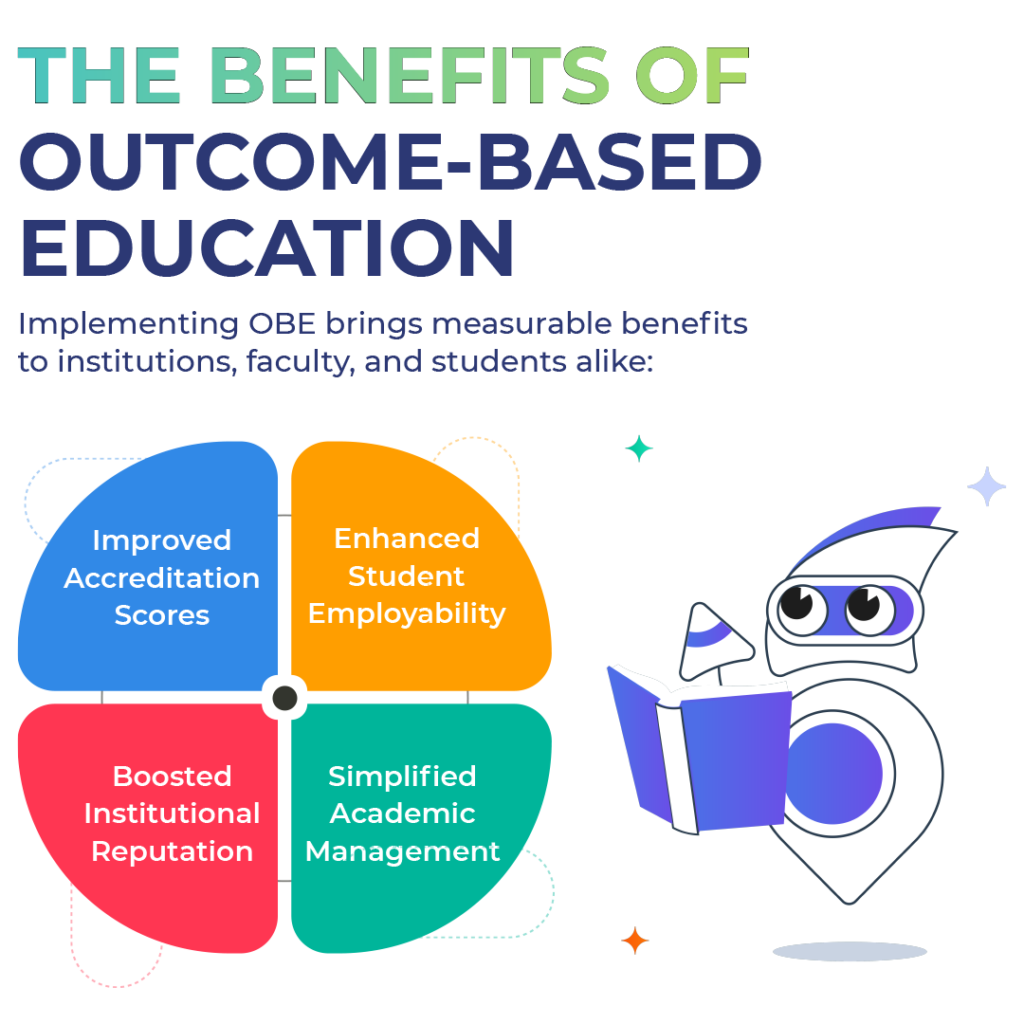
- Improved Accreditation Readiness
OBE provides structured learning outcome, assessment, and attainment data, making it easier to prepare evidence for accreditation.
Example: During an NBA accreditation review, an institution can present CO-PO mapping, attainment reports, assessment records, and evidence of continuous improvement in a structured manner.
- Enhanced Student Employability
By focusing on practical skills, problem-solving, and real-world application, OBE helps students develop skills that are valuable for their careers.
Example: Instead of only testing programming concepts through written exams, students may be assessed through a real-world software project that evaluates coding, problem-solving, and application skills.
- Better Academic Management
Connecting learning outcomes, assessments, performance, and attainment makes academic processes more structured and easier to manage.
Example: A department can review CO attainment reports after an examination to identify which course outcomes were achieved well and which need additional teaching support.
- Continuous Improvement
Outcome and assessment data help institutions identify learning gaps and improve teaching, curriculum, and assessment practices.
Example: If students show low attainment in a particular CO, the faculty can introduce remedial classes, additional practice questions, or a different teaching approach in the next academic cycle.
- Stronger Institutional Performance
A consistent focus on student outcomes and academic improvement can contribute to better educational quality and institutional reputation.
Example: When an institution consistently improves student learning outcomes, practical skills, and placement readiness, it can strengthen its academic performance and build greater confidence among students, parents, and recruiters.
How LearnQoch Supports Outcome-Based Education?
Implementing OBE becomes easier when learning outcomes, academic activities, and assessment data are connected in one system. LearnQoch supports institutions with features designed to manage the OBE process in a structured way.
- PEO, PO, PSO & CO Management – Define and manage different levels of educational outcomes within the academic framework.
- CO-PO-PSO Mapping – Map Course Outcomes with Program Outcomes and Program Specific Outcomes to establish clear relationships between courses and program-level outcomes.
- Bloom’s Taxonomy Alignment – Classify questions and assessments according to different cognitive levels, helping institutions design outcome-aligned assessments.
- Question-to-CO Mapping – Connect individual questions with relevant Course Outcomes so assessment data can be linked directly to the intended outcomes.
- Direct & Indirect Attainment – Bring together assessment-based direct attainment and other feedback-based indirect inputs to provide a broader view of outcome achievement.
- CO, PO & PSO Attainment Reports – Generate structured attainment data and reports that help departments review outcome performance across courses and programs.
- Gap Analysis – Identify areas where expected attainment levels are not being met and highlight outcomes that may require further attention.
- OBE Data in One Connected Platform – Connect OBE with LMS, assessments, examination, and academic processes, reducing the need to manage outcome-related information across separate systems.
Conclusion
Outcome-Based Education (OBE) shifts the focus from what is taught to what students achieve. By aligning teaching, assessment, and learning outcomes, it helps institutions create a more learner-focused and measurable education system.
However, successful OBE implementation requires clear outcomes, effective assessment, and continuous improvement. Institutions can start small by aligning course outcomes and assessments before gradually expanding OBE across their academic processes.
With LearnQoch’s OBE solution, institutions can simplify CO-PO mapping, assessment, attainment, and outcome-based academic tracking—making the transition to outcome-focused education more structured and manageable.
Beyond Outcome Based Education : The LearnQoch AI powered Academic Platform
LearnQoch goes further by providing an integrated platform that covers all aspects of institutional growth:

- ERP (Enterprise Resource Planning) – Manage academic and administrative processes through one centralized system.
- LMS (Learning Management System) – Support course delivery, learning, assessments, and student engagement.
- Attendance Management – Track student attendance and maintain academic participation records.
- Exam Management – Simplify the complete examination process with automatic question paper creation, CO-based question mapping, On-Screen Marking (OSM), digital evaluation, result processing, and automated grading.
Don’t Just Read About OBE—Experience It Yourself!
We invite you to experience the power of LearnQoch’s Outcome-Based Education (OBE) Solution with a 14-Day’s Free Trial.
Book Your Free Demo!During this period, our team will help implement the OBE solution for your institution, allowing you to explore its features and see how easily you can manage CO-PO mapping, assessments, attainment, and outcome-based academic data in one platform.
👉 Ready to move from traditional learning to a more outcome-focused education system?
📞 Contact us at +91 84519 01079
📧 Email:sales@learnqoch.com
Explore What LearnQoch Offers:
Visit www.learnqoch.com for Full Details