


Outcome-Based Education vs. Competency-Based Learning: What’s the Difference?


Understanding the Shift in Modern Education
Education is changing rapidly. Traditional approaches that depend mainly on lectures, rote memorization, and exam-focused assessment are no longer enough to prepare students for today’s world. Students need more than theoretical knowledge—they need the ability to apply what they learn, develop practical skills, and solve real-world problems.
As a result, institutions are moving toward learning models that focus on measurable outcomes and practical competencies. Two important approaches are Outcome-Based Education (OBE) and Competency-Based Learning (CBL).
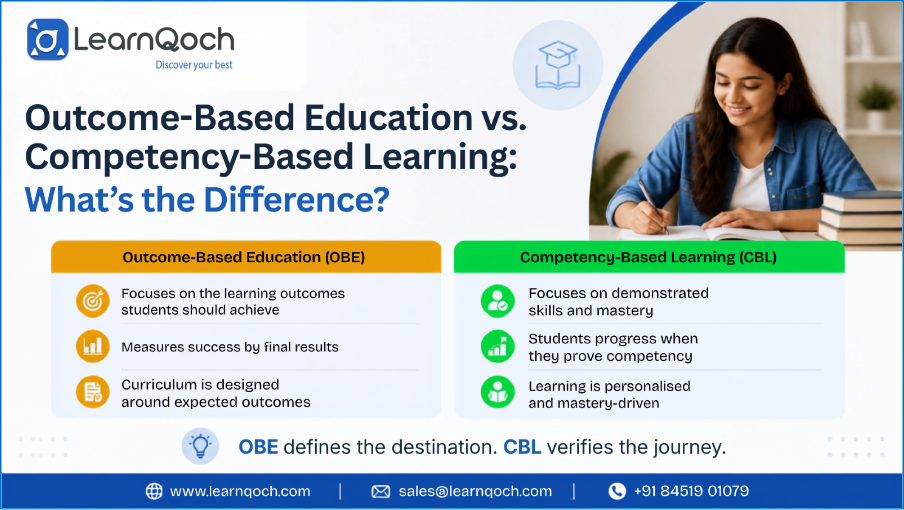
Although OBE and CBL are closely connected, they have different focuses. OBE measures what students are expected to achieve, while CBL focuses on the skills and competencies students can demonstrate. Understanding these differences can help educators and institutions improve learning outcomes, support student employability, and meet accreditation and quality requirements more effectively.
From our previous blog…
In our previous blog, “Why Faculty Development Is Key to Outcome-Based Education Success,” we discussed how faculty development supports successful OBE implementation through outcome-aligned teaching and assessment.
Building on this, it is important to understand the difference between Outcome-Based Education (OBE) and Competency-Based Learning (CBL). While OBE focuses on what students should achieve, CBL emphasizes the skills and competencies they can demonstrate.
In this blog, we explore OBE vs CBL, their key differences, benefits, challenges, implementation, and the role of technology in making both approaches more effective.
What Is Outcome-Based Education (OBE)?
Outcome-Based Education (OBE) focuses on what students should know, understand, and demonstrate after completing a course or program. It aligns teaching, learning, and assessment with measurable outcomes rather than simply focusing on syllabus completion or teaching hours.
For example, an engineering program may define POs for problem-solving and teamwork, while a Data Structures course may define COs related to algorithm design and implementation.
By connecting outcomes, teaching, assessment, and attainment, OBE supports better learning outcomes, continuous improvement, and accreditation requirements.
Benefits of OBE
Outcome-Based Education (OBE) helps institutions create a more structured, student-focused, and outcome-driven learning environment.
- Industry Alignment: Connects learning outcomes with the skills and competencies expected by employers.
- Student-Centred Learning: Focuses on what students can achieve and apply, rather than only on syllabus completion.
- Clear Expectations: Gives students and faculty a clear understanding of learning outcomes, teaching objectives, and assessment criteria.
- Accreditation Support: Provides structured outcome data and evidence to support NAAC, NBA, and other quality assurance requirements.
- Continuous Improvement: Uses assessment and attainment data to identify gaps and improve teaching, curriculum, and student performance.
Overall, OBE helps institutions make learning measurable, transparent, and focused on continuous improvement, while preparing students for academic and professional success.
What Is Competency-Based Learning (CBL)?
Competency-Based Learning (CBL) is an educational approach that focuses on helping students develop and demonstrate specific skills and competencies. Instead of measuring learning mainly by classroom hours or course completion, CBL emphasizes whether a student has achieved the required level of proficiency.
These competencies can include technical skills, problem-solving, communication, critical thinking, and professional behaviours. Students can receive continuous feedback, practice their skills, and work toward mastery based on their individual learning needs.
For example, in a software development course, students may need to demonstrate proficiency in coding, debugging, and software design. A student who has not yet mastered a particular skill can receive additional practice and feedback before moving to more advanced competencies.
In this way, CBL shifts the focus from simply completing a course to demonstrating what a student can actually do.
Benefits of CBL
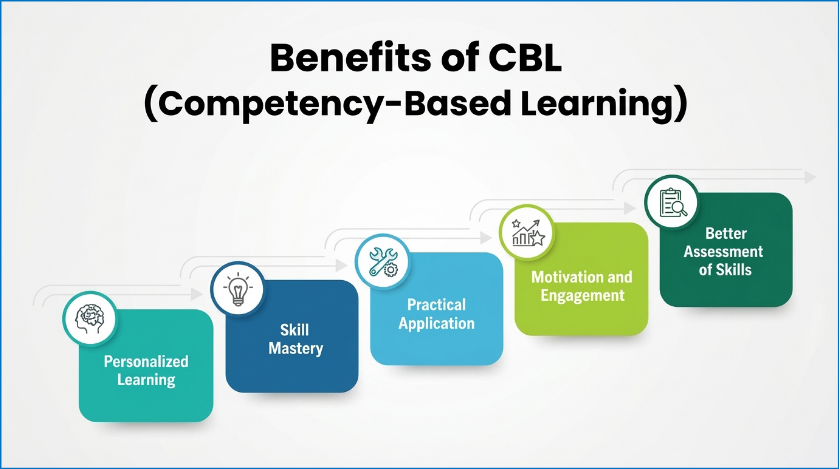
- Personalized Learning: Adapts to each student’s strengths and weaknesses.
- Skill Mastery: Ensures learners truly acquire competencies rather than superficially covering content.
- Practical Application: Encourages real-world problem-solving and project-based learning.
- Motivation and Engagement: Students progress at their own pace, reducing frustration and increasing confidence.
- Better Assessment of Skills: Competency-based evaluations focus on what students can do, not just what they know.
Consequently, CBL is ideal for vocational, technical, and professional education programs where skill proficiency is critical.
Key Differences Between OBE and CBL
Although OBE and CBL share similarities, understanding their differences is essential for implementation.
| Aspect | Outcome-Based Education (OBE) | Competency-Based Learning (CBL) |
|---|---|---|
| Focus | Achieving predefined learning outcomes (knowledge, skills, abilities) | Developing mastery in specific competencies (skills, abilities, behaviors) |
| Pacing | Fixed program duration | Flexible, based on learner mastery |
| Assessment | Outcome-based assessments aligned with course and program objectives | Competency-based assessments focusing on skill mastery |
| Curriculum | Structured to meet program-level goals | Structured around specific competencies rather than program schedule |
| Progression | Typically cohort-based with set timelines | Learner progresses individually upon mastery |
| Scope | Broader, encompassing program outcomes and course outcomes | Narrower, focused on specific competencies |
| Use Case | Academic programs like engineering, business, science | Vocational training, professional certifications, technical skills |
In essence, OBE is broader, program-focused, and outcome-oriented, whereas CBL is narrower, learner-focused, and competency-oriented. However, both aim to produce graduates who are competent, employable, and ready for real-world challenges.
How OBE and CBL Work Together?
OBE and CBL complement each other by connecting expected learning outcomes with measurable skill development. OBE defines what students should achieve, while CBL focuses on whether they have developed and demonstrated the competencies required to achieve those outcomes.
For example, an institution can define Course Outcomes (COs) through OBE and then use competency-based activities, projects, practical assessments, and rubrics to help students develop and demonstrate those outcomes.
A connected approach can help institutions:
- Align COs, POs, competencies, teaching, and assessment
- Measure student performance and competency development
- Identify learning gaps and provide targeted support
- Improve curriculum and teaching strategies using assessment data
- Maintain structured evidence for accreditation and quality improvement
Challenges, Solutions, and the Role of LearnQoch
Although OBE and CBL can improve learning outcomes, implementing both approaches can be challenging. Faculty may need time to adapt to outcome-focused teaching, assessments can become more complex, and institutions may face difficulties in tracking competencies and analyzing performance data.
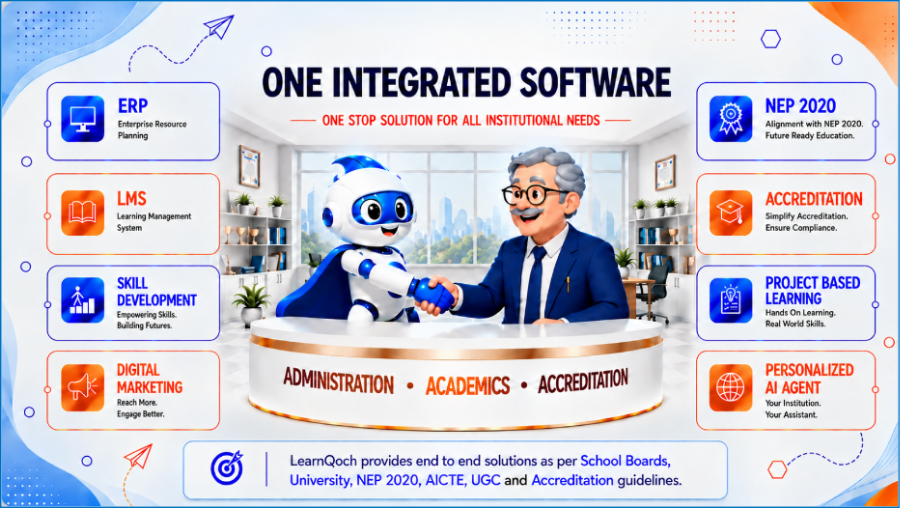
A digital platform can help make this transition more structured and manageable. LearnQoch’s AI-powered academic platform supports institutions in connecting outcomes, assessments, performance tracking, and academic improvement in one ecosystem.
Key challenges can be addressed through:
- Faculty adaptation: Faculty training, continuous development, and easy-to-use digital tools can support the shift from traditional teaching to outcome- and competency-focused education.
- Assessment complexity: Digital assessment tools can help align assessments with COs, POs, competencies, and learning outcomes, while reducing manual work.
- Tracking student progress: Performance and attainment data can help faculty monitor student progress and identify areas that need attention.
- Learning gaps: LQ AI Agent can analyze academic data to identify learning gaps and suggest suitable improvement strategies.
- Resource constraints: Starting with selected courses or departments and gradually expanding implementation can make digital adoption more manageable.
With the right combination of faculty development, structured processes, and technology, institutions can overcome implementation challenges and make OBE and CBL more measurable, efficient, and focused on continuous improvement.
Case Study: Integrating OBE and CBL at DMTIMS Institute
DMTIMS Institute integrated Competency-Based Learning (CBL) with its Outcome-Based Education (OBE) framework to strengthen practical skills and industry readiness.
The institute defined POs and COs, mapped them with key competencies, and used projects, case studies, and digital simulations for practical learning. Student performance was tracked through academic analytics for timely feedback and support.
Results:
- 90% improvement in student skill proficiency
- Higher student engagement and project participation
- Smoother accreditation and quality assurance processes
- Better documentation and continuous academic improvement
Conclusion:
Choosing the Right Approach for Your Institution
OBE focuses on program-level outcomes, while CBL focuses on student competencies and skill mastery. When combined, they help institutions improve learning outcomes, industry readiness, and continuous academic improvement.
LearnQoch’s AI-powered academic platform helps institutions connect outcomes, assessments, attainment, performance tracking, and learning-gap analysis in one platform. It supports CO-PO-PSO mapping, attainment analysis, accreditation readiness, and data-driven improvement.
With LearnQoch, institutions can make OBE and CBL more structured, measurable, and actionable.
Beyond Outcome-Based Education: Redefine Academic Management with LearnQoch

| Category | Software’s | Key Purpose |
|---|---|---|
| Academic & Learning | AI powered LMS, OBE, Academic Calendar & Events, Class Module | Supports teaching, learning, OBE, academic planning, classes, assessments, and student progress. |
| Examination & Administration | Exam Management, ERP, Task, Committee, Document & Certificate Management | Digitizes examinations and streamlines institutional workflows, records, tasks, committees, and certificates. |
| Finance, Library & Careers | Finance & Fees, Advanced/Excess Fees, Library, Placement & Skill Development | Manages fees, library resources, placements, student skills, and career-related activities. |
| Accreditation & Digital Presence | NAAC, NBA & NIRF Compliance, Website & Digital Marketing Solutions | Supports accreditation documentation, compliance tracking, institutional branding, website management, and digital outreach. |
Don’t Just Take Our Word for It—Try LearnQoch Yourself!
We invite you to experience the transformative impact of Outcome Based Education with a 14-Days Free Trial.
During this period, our team will implement the software for your institution, allowing you to explore its features firsthand and see the difference it can make in academic management.
👉 Are you ready to lead your institution into the future of campus management?
📞 Contact us at +91 84519 01079
📧 Email: sales@learnqoch.com
Explore What We Offers:
Visit www.learnqoch.com for Full Details