



CO-PO Mapping in OBE: The Secret to Effective Learning Outcome Alignment


Why CO-PO Mapping Matters in Modern Education?
Higher education is increasingly focused on what students can achieve and apply, rather than simply what they can remember. Employers and accreditation bodies look for graduates with practical knowledge, problem-solving abilities, and relevant competencies. Therefore, institutions need a structured approach to connect teaching with measurable learning outcomes.
This is where Outcome-Based Education (OBE) becomes important. At its core, CO-PO mapping connects Course Outcomes (COs) with Programme Outcomes (POs), showing how individual courses contribute to broader programme-level goals.
Moreover, effective mapping helps faculty align teaching and assessment with expected outcomes, while providing measurable evidence of student achievement. It also supports continuous improvement and strengthens accreditation readiness.
However, managing COs, POs, assessments, mapping, and attainment manually can be time-consuming. LearnQoch simplifies this process through an integrated OBE workflow, while the LQ AI Agent can assist with assessment generation, identify learning gaps, and suggest academic strategies for improvement.
Understanding CO-PO Mapping
What Are Course Outcomes (COs) and Program Outcomes (POs)?
Course Outcomes (COs) are specific skills, knowledge, and competencies that students are expected to acquire by the end of a course. For example, in a computer programming course, COs may include the ability to write algorithms, debug code, and apply object-oriented programming concepts.
Program Outcomes (POs), on the other hand, represent broader competencies that students should achieve upon completing the entire program. For instance, an engineering degree might have POs such as problem-solving, ethical responsibility, teamwork, and lifelong learning.
Why Map COs to POs?
CO-PO mapping helps institutions see whether what students learn in a course is actually contributing to the broader program outcomes. For example, if a programming course focuses on problem-solving, its COs can be mapped to the relevant POs and tracked through assessments.
- In practice, CO-PO mapping helps institutions:
- Connect course learning with program goals
- Track student performance through assessments
- Identify gaps in learning outcomes
- Measure CO and PO attainment with actual assessment data
- Use the results to improve teaching and course delivery
With digital OBE solutions such as LearnQoch, institutions can manage these mappings and view attainment data more systematically instead of relying on manual calculations and spreadsheets.
Talk With LearnQoch Experts!The Benefits of CO-PO Mapping
Implementing CO-PO mapping effectively can revolutionize the educational experience. Furthermore, it offers several key advantages for students, faculty, and institutions.
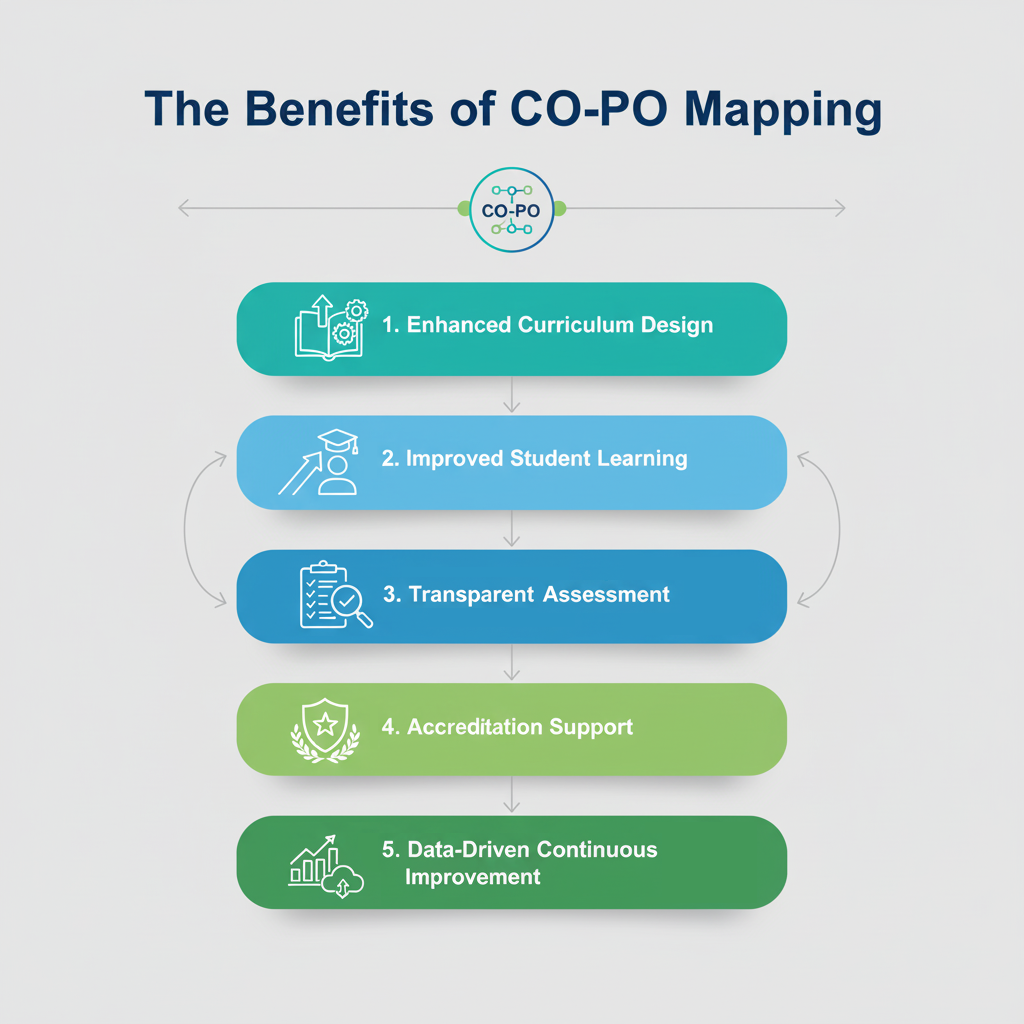
1. Enhanced Curriculum Design
A well-mapped curriculum ensures that every course contributes to program objectives, creating a cohesive learning path. As a result, redundancies are reduced, gaps are minimized, and teaching becomes more effective.
2. Improved Student Learning
By aligning COs with POs, educators can employ teaching methods and activities that target specific competencies. Additionally, students understand the purpose behind every lecture, assignment, or project, boosting motivation and engagement.
3. Transparent Assessment
CO-PO mapping provides a clear framework for evaluation. Both students and faculty know how each activity contributes to program objectives, ensuring fairness and objectivity. Moreover, this transparency fosters accountability in the teaching-learning process.
4. Accreditation Support
Mapping COs to POs creates concrete evidence of outcome alignment, simplifying compliance with accreditation bodies like NBA, NAAC, and AICTE. Consequently, audits become smoother, and institutional credibility is enhanced.
5. Data-Driven Continuous Improvement
Institutions can use CO-PO mapping data to identify weaknesses in courses or programs. Therefore, corrective actions can be taken to continuously enhance teaching strategies and student performance.
Step-by-Step CO-PO Mapping Process
CO-PO mapping starts by defining what students should learn and achieve in each course. These Course Outcomes are then connected with the broader Program Outcomes they support.
Next, institutions create a CO-PO mapping matrix and align assessments such as quizzes, assignments, projects, and exams with the defined outcomes.
The assessment results are then used to measure CO and PO attainment, identify learning gaps, and understand where students need more support.
Finally, faculty can review the results and make necessary changes in teaching methods, assessments, or course delivery. This makes CO-PO mapping a continuous process focused on improving student learning outcomes.
CO-PO Mapping, Bloom’s Taxonomy with LearnQoch
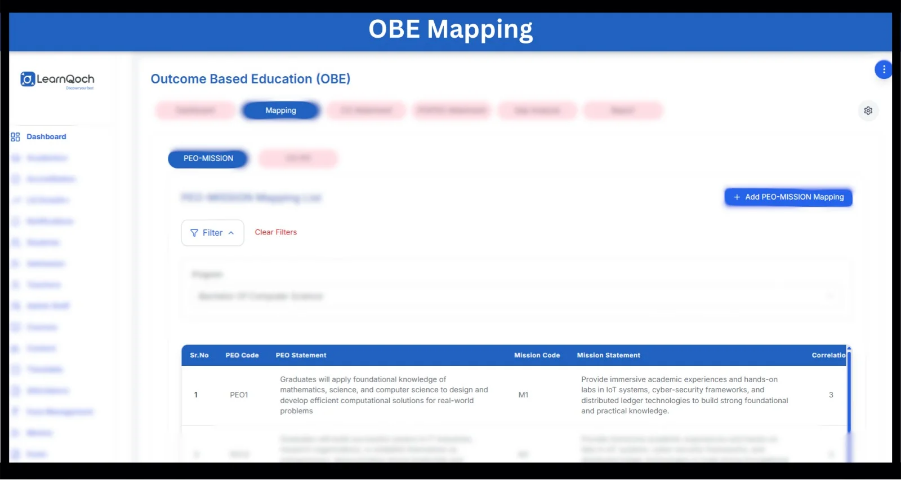
- CO-PO mapping becomes more meaningful when aligned with Bloom’s Taxonomy, connecting course outcomes with appropriate levels of learning—from remembering and understanding to analyzing, evaluating, and creating.
- For example, in a Diploma in Computer Engineering, a Course Outcome such as “Develop programs using object-oriented programming concepts” can be mapped with PO1 – Engineering Knowledge and PO3 – Design/Development of Solutions, at the Apply and Create levels of Bloom’s Taxonomy.
- Similarly, a CO such as “Analyze and debug programming problems” can be mapped with PO2 – Problem Analysis at the Analyze level.
- Manually managing such mappings across multiple courses and assessments can become complex. LearnQoch simplifies the process by allowing institutions to define COs, map them with POs/PSOs, align assessments with Bloom’s levels, and calculate attainment using assessment data.
This integrated approach reduces manual effort, helps identify learning gaps, and supports continuous improvement and accreditation reporting.
Case Study Example
For instance, an engineering college implemented CO-PO mapping using a digital OBE platform. They mapped COs from 30 courses to 11 POs, tracked student performance through LMS analytics, and used the data to improve weak courses.
As a result:
- PO attainment scores improved by 25%
- Student engagement in practical labs increased
- Accreditation process with NBA and NAAC became smoother
This demonstrates the tangible impact of systematic CO-PO mapping on student outcomes and institutional quality.
How Does the LearnQoch AI Agent Support OBE?
The LearnQoch AI Agent can analyse CO-PO attainment data across different programs and branches and identify where improvement is needed.
For example, in a Diploma in Civil Engineering, if PO3 has achieved the expected attainment but PO1 is below the target, the AI Agent can identify the gap, analyse the courses and assessments contributing to PO1, and suggest where additional academic focus may be required.
Similarly, for a B.E./B.Tech in Mechanical Engineering, if PO1–PO5 have achieved the expected attainment but PO6 and PO7 is below the target, the AI Agent can highlight the gap and recommend relevant courses, assessments, or learning activities that can help improve those outcomes.
This helps faculty and administrators move beyond simply viewing attainment reports and use real-time academic data to make informed decisions for continuous improvement.
Conclusion
CO-PO mapping is not just an accreditation requirement; it helps institutions understand whether classroom teaching and assessments are actually contributing to the desired learning outcomes. By connecting Course Outcomes with Program Outcomes and measuring them through real assessment data, faculty can identify learning gaps and improve teaching strategies.
With an integrated OBE platform like LearnQoch, institutions can simplify CO-PO mapping, assessment alignment, attainment calculation, and outcome analysis in one place. This reduces manual work while giving faculty and administrators clearer insights into student performance.
Ultimately, effective CO-PO mapping turns OBE from a documentation exercise into a continuous process of measuring, improving, and strengthening student learning outcomes.
LearnQoch: The Complete Academic Platform

LearnQoch brings administration, academics, assessment, accreditation, and institutional growth together on one integrated platform. Each area is connected, allowing institutions to manage their daily operations while using the same data to improve academic quality and accreditation readiness.
1. Administration – Building the Foundation
The ERP manages student, faculty, attendance, finance, documents, and other administrative processes. This creates a centralised and organised foundation for institutional data.
2. Academics – Turning Data into Learning
Academic modules such as LMS, Timetable, Attendance, Academic Calendar, and Assessment connect daily teaching and learning activities with student performance. This helps faculty plan, deliver, and monitor learning more effectively.
3. Assessment & OBE – Measuring Outcomes
Assessment and Exam data can be connected with COs, POs, and PSOs to measure learning outcomes and attainment. The LQ AI Agent can help generate assessments, identify learning gaps, and suggest academic strategies for improvement.
4. Accreditation – Turning Evidence into Quality
The data generated through administration, academics, assessment, and OBE can support NAAC, NBA, and NIRF processes. LearnQoch helps organise relevant records, reports, and evidence, reducing repetitive documentation work.
5. Digital Marketing – Connecting the Institution with Stakeholders
Website and Digital Marketing solutions help institutions strengthen their online presence and engage prospective students and stakeholders, while Skill Development solutions support student employability and career readiness.
This connected approach helps institutions move from managing information to using it for better decisions, improved learning outcomes, quality improvement, and long-term growth.
Don’t Just Take Our Word for It—Try LearnQoch Yourself!
We invite you to experience the transformative impact of LearnQoch’s Digitize Platform with a 14-Days Free Trial.
Book Your Free Demo Now!During this period, our team will implement the software for your institution, allowing you to explore its features firsthand and see the difference it can make in academic management.
👉 Are you ready to lead your institution into the future of campus management?
📞 Contact us at +91 84519 01079
📧 Email: sales@learnqoch.com
Explore What LearnQoch Offers:
Visit www.learnqoch.com for Full Details
FAQs
1. What is the difference between direct and indirect assessment in OBE?
Direct assessment measures student performance through exams, assignments, projects, practicals, and other academic assessments. Indirect assessment uses feedback from students, alumni, employers, or other stakeholders to understand outcome achievement.
2. How are CO-PO attainment calculated in OBE?
CO-PO attainment is calculated by analysing how well students achieve Course Outcomes and how these outcomes contribute to Programme Outcomes. Assessment results, mapping levels, and defined attainment criteria are typically used for this analysis.
3. Which assessments can be used for CO-PO mapping?
Institutions can use internal assessments, end-semester exams, assignments, projects, practicals, quizzes, and other relevant evaluation methods. The selected assessment should be aligned with the intended Course Outcomes.
4. How can technology simplify OBE assessment and attainment?
Managing COs, PO mapping, direct and indirect assessments, attainment calculations, and reports manually can become time-consuming. LearnQoch provides an integrated OBE workflow to manage outcome mapping, assessment data, attainment analysis, and reports, while the LQ AI Agent can help identify learning gaps and suggest academic strategies for improvement.