


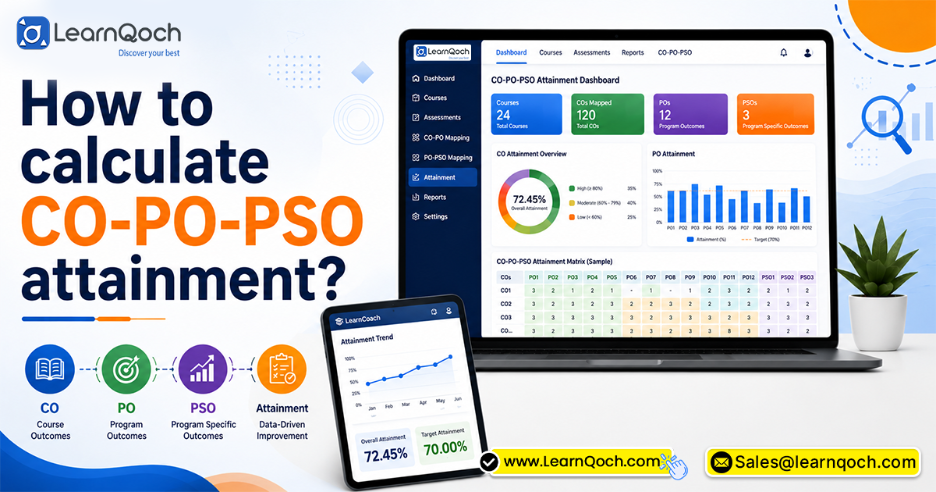
How to calculate CO-PO-PSO attainment?


Higher education institutions in India are increasingly focusing on measurable learning outcomes, continuous assessment, skill development, and academic quality improvement. In this context, Outcome-Based Education (OBE) provides a structured approach to defining, assessing, and improving what students are expected to learn and achieve.
A key part of OBE is CO-PO-PSO mapping and attainment calculation, which helps institutions measure student achievement against defined course and program outcomes. These processes also provide useful academic data for identifying learning gaps and supporting continuous improvement.
For institutions preparing NBA accreditation, maintaining clear and reliable evidence of learning outcomes, assessments, attainment, and improvement is particularly important.
Understanding how OBE works, how CO-PO-PSO attainment is calculated, and how assessment data is documented can help institutions build a more structured approach to accreditation and academic quality improvement. LearnQoch supports this process by bringing OBE, assessment, attainment, and academic data together in one integrated software.
At society dinner Party (Three professor friends are talking)
Riya:
Sima, are you okay? You look worried these days.
Sima:
No no, I’m fine. Just a little busy with college work.
Neha:
Busy? Nowadays you come late from work every day, and you even stopped joining our evening walks. Is everything really fine?
Sima:
Honestly, I’m exhausted because of NBA documentation and CO-PO attainment calculations. Mapping, formulas, attainment sheets, reports… everything is becoming too confusing and time-consuming.
Riya:
That’s true. Manual attainment calculations can become very stressful.
Neha:
Why don’t you read the CO-PO-PSO attainment blog series? They explain everything step by step with practical examples and easy formulas.
Sima:
Really? I’ve been trying to understand direct attainment and PO mapping for weeks.
Neha:
I’ll share the link with you — just read the LearnQoch blog series once, it explains the complete CO-PO-PSO attainment process in a very simple and practical way..
Sima:
Wait… so the system automatically calculates everything?
Neha:
Yes. It reduces manual work, avoids calculation errors, and makes NBA documentation much easier.
Sima:
That sounds exactly what I need. I’ll read the LearnQoch blog series tonight and book the free demo too.
Riya:
Good! Now maybe we’ll finally get you back on our evening walks too.
What This Blog Covers?
In this blog, we will cover:
- What is CO, PO, and PSO in OBE?
- CO-PO-PSO Mapping and its role in OBE
- CO-PO-PSO Attainment Important?
- How digital software can handle easily with benefits.
What is CO, PO, and PSO in OBE?
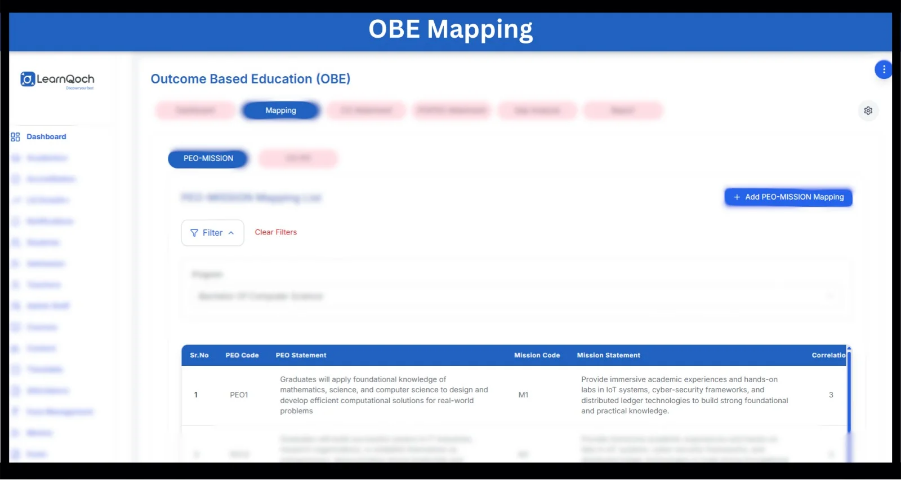
Before understanding attainment calculation, it is important to understand the meaning of CO, PO, and PSO.
What is Course Outcome (CO)?
Course Outcomes (COs) describes what students are expected to learn after completing a particular subject or course. In other words, COs measure subject-level learning outcomes.
Generally, every subject contains 4 to 6 COs.
Example of COs
For a Programming subject:
- CO1: Understand programming fundamentals
- CO2: Develop programs using C language
- CO3: Apply arrays and looping concepts
- CO4: Solve real-world programming problems
Thus, COs focuses on specific knowledge and skills gained from a course.
What is Program Outcome (PO)?
Program Outcomes (POs) represent the overall abilities and competencies students should achieve after completing an entire degree program.
Furthermore, NBA has defined standard Program Outcomes for engineering education.
Examples of POs
- Engineering knowledge
- Problem-solving ability
- Modern tool usage
- Teamwork and communication
- Ethics and professionalism
The number of Program Outcomes (POs) is not the same for every program. For example, engineering diploma and undergraduate programs may have 11 POs, while some postgraduate and management programs may have 5 POs, depending on the applicable framework.
What is Program Specific Outcome (PSO)?
Program Specific Outcomes (PSOs) are department-specific outcomes that focus on specialized knowledge areas. Unlike POs, PSOs vary from department to department.
Example of PSOs for Computer Engineering
- PSO1: Develop software applications using modern technologies
- PSO2: Apply AI, data analytics, and cloud computing concepts
Therefore, PSOs help institutions measure domain-specific expertise.
Why Is CO-PO-PSO Attainment Important?

CO-PO-PSO attainment turns assessment results into measurable evidence of outcome achievement. Instead of looking only at overall marks, institutions can understand how individual courses contribute to broader program outcomes and use the data for academic planning.
1. Connect Course Performance with Program Outcomes
CO-PO-PSO mapping shows how individual courses contribute to POs and PSOs. This helps departments understand how effectively the curriculum supports the overall goals of the program.
2. Set and Review Attainment Targets
Institutions can define attainment targets for COs and compare actual performance with these targets. This helps determine whether the expected level of outcome achievement is being reached.
3. Support Academic Review and Improvement
Attainment trends provide useful evidence for reviewing course content, assessment methods, teaching approaches, and academic activities. Departments can use these findings to plan appropriate improvements.
4. Strengthen Program-Level Planning
PO and PSO attainment provides a broader view of program performance. It can support decisions related to curriculum changes, practical learning, projects, academic activities, and other program-level initiatives.
5. Maintain Evidence for Accreditation
Well-maintained attainment records create a clear connection between outcomes, assessment, student performance, attainment, and continuous improvement. This helps institutions organize OBE-related evidence and stay better prepared for NBA accreditation and academic reviews.
How ERP Software Helps in CO-PO-PSO Attainment?
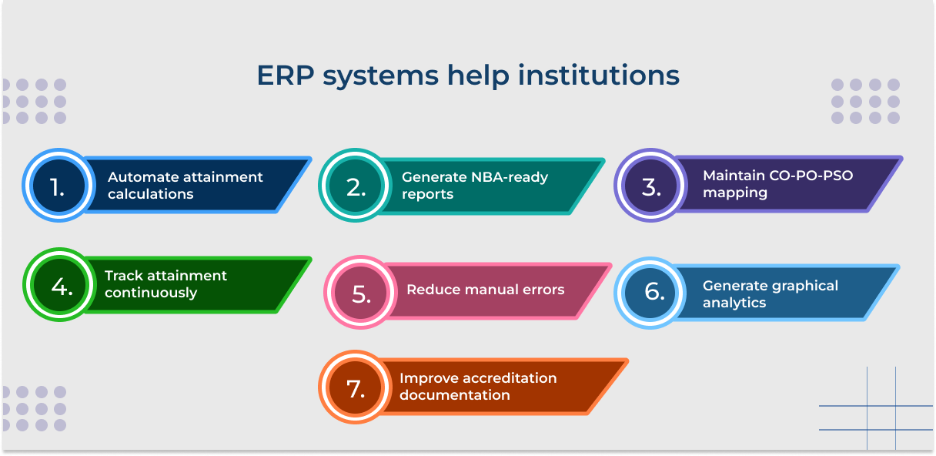
Modern ERP platforms simplify the complete OBE and NBA process.
1. Manage CO-PO-PSO Mapping
Faculty can define Course Outcomes (COs) and map them with relevant Program Outcomes (POs) and Program Specific Outcomes (PSOs). Mapping levels and weightages can be maintained within the system, while the OBE coordinator can review and finalize the mappings.
2. Connect Assessments with Outcomes
Assessment data from exams, quizzes, assignments, and other evaluation activities can be connected with defined course outcomes. This provides structured inputs for measuring student performance against the expected outcomes.
3. Calculate CO Attainment
LearnQoch can use assessment performance and predefined attainment criteria or targets to calculate CO attainment. This reduces the need for repeated manual calculations and helps faculty track outcome achievement more efficiently.
4. Derive PO and PSO Attainment
Once CO attainment is available, the mapped CO-PO and CO-PSO relationships can be used to support PO and PSO attainment analysis. This creates a connected path from course-level assessment data to program-level outcome measurement.
5. Include Direct and Indirect Assessment
LearnQoch supports outcome assessment using direct assessment data as well as indirect assessment through surveys. This allows institutions to consider multiple sources of evidence while preparing final attainment analysis.
6. Maintain Centralized OBE Records
Instead of maintaining separate spreadsheets and files, institutions can keep mapping, assessment, attendance, performance, attainment, and academic records within a centralized platform. This improves traceability and makes required information easier to retrieve.
7. Generate Academic and Accreditation Reports
LearnQoch can generate structured OBE and accreditation-related reports, helping institutions organize attainment data and supporting evidence for NBA and other quality-assurance processes.
Conclusion
CO-PO-PSO attainment helps institutions measure learning outcomes, identify gaps, and support continuous improvement through Outcome-Based Education (OBE). With proper mapping, assessment, and automation, institutions can reduce manual work and improve the accuracy of attainment calculations and academic reporting.
LearnQoch ERP brings CO-PO-PSO mapping, attainment calculation, assessment tracking, analytics, and academic reporting together in one software, helping faculty and management make informed decisions using structured academic data.
The LearnQoch AI powered Softwares

A. LearnQoch AI powered Core Academic & Learning Solutions
Facilitates modern teaching and learning while tracking student progress, assignments, assessments, and course outcomes.
Focuses on measuring learning outcomes to ensure skills, competencies, and academic objectives are met effectively.
B. AI Powered Exam Management Module
A unified system that digitizes the entire exam cycle—right from planning, subject allocation, ATKT processing, and scheduling to question paper creation, assessments, evaluation, and result generation. It ensures transparency, accuracy, and smooth coordination across all departments.
C. ERP (Enterprise Resource Planning)
Streamlines administrative activities, simplifies student data management, and ensures workflow automation across all departments.
D. Accreditation & Compliance NAAC, NBA & NIRF Compliance
Simplifies reporting, monitoring, and auditing with ready-to-use compliance tools that reduce institutional workload.
See How LearnQoch Can Simplify OBE Management?
Managing CO-PO-PSO mapping, attainment calculations, assessments, and academic reports manually can take significant time. LearnQoch brings these processes together in one integrated platform to help institutions manage OBE more efficiently.
Start with a 14-days free trial and explore the platform’s features with your institution’s requirements in mind.
Ready to simplify your OBE and academic management? Try LearnQoch today.
📞 Contact us at +91 84519 01079
📧 Email: sales@learnqoch.com
Explore What LearnQoch Offers:
Visit www.learnqoch.com for Full Details
FAQs
How is PO attainment calculated from CO attainment?
PO attainment is calculated using the correlation between COs and POs along with the attained CO values. The mapped CO attainment values are aggregated according to the institution’s defined calculation methodology.
How is PSO attainment calculated?
PSO attainment is calculated by analyzing the attainment of COs mapped to specific PSOs. The mapped CO attainment values are combined according to the defined correlation and attainment criteria.
What data is required to calculate CO-PO-PSO attainment?
Common inputs include assessment marks, student performance, CO mapping, CO-PO-PSO correlation levels, attainment targets, and defined calculation criteria.
Can CO-PO-PSO attainment be calculated automatically?
Yes. OBE software can automate data collection, mapping, attainment calculations, and reporting, reducing manual calculations and making the process easier to track and review.