


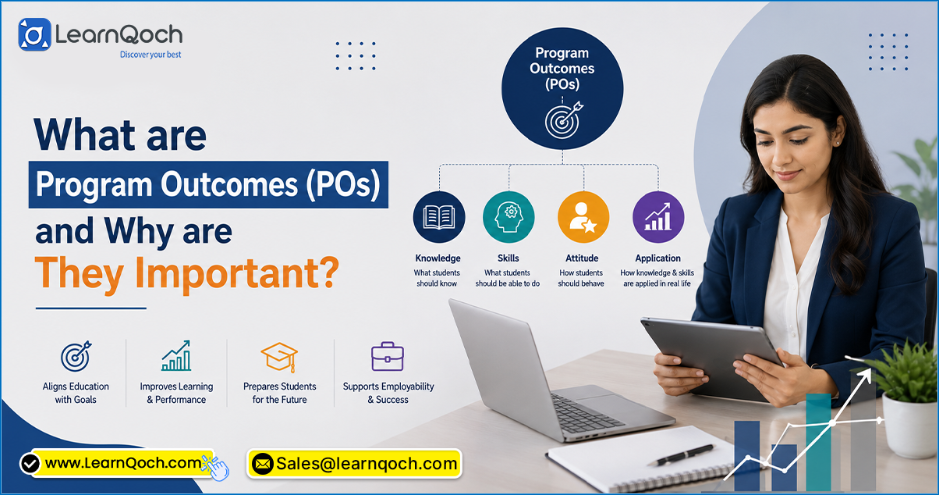
What are Program Outcomes (POs) and Why are They Important?


Introduction
Educational institutions are increasingly adopting Outcome Based Education (OBE) to improve student learning outcomes and measure academic achievement more effectively. Program Outcomes (POs) define the knowledge, skills, and competencies students are expected to achieve by the end of an academic program. Therefore, accurate CO-PO mapping and attainment tracking have become essential for continuous academic improvement, accreditation, and data-driven decision-making.
However, managing Program Outcomes and attainment manually can be time-consuming and prone to errors. As a result, many schools, colleges, and universities are adopting OBE software to automate outcome mapping, simplify attainment calculations, and gain meaningful academic insights through a centralized platform.
From previous blog…
In our previous blog on Course Outcomes (COs), we explained how CO mapping helps measure student learning outcomes in Outcome Based Education (OBE). We covered CO creation, Bloom’s Taxonomy, CO-PO alignment, attainment calculation, and assessment mapping, showing how accurate CO mapping supports academic quality and accreditation readiness.
When principal call to one of officer to know work status…
One evening, the principal called the Exam Officer to check the academic report status.
Principal: Are the CO mapping and attainment reports finalized now?
Exam Officer: Yes sir, Course Outcomes are almost finalized. Now all departments are working together to finalize the Program Outcomes and proper CO-PO mapping with accurate attainment data.
Principal: Good. Then tomorrow let’s have a detailed discussion with all department heads and coordinators.
Next Day – Discussion at the Principal’s Office
Teacher: Our COs are ready. Now we need accurate CO-PO mapping and Program Outcome attainment for every course.
Accreditation Coordinator: Yes, managing COs, POs, and attainment manually takes a lot of time during accreditation and reporting.
Exam Officer: Sir, I think we may have found a solution. I recently watched a LearnQoch Instagram reel demonstrating CO-PO mapping, attainment calculation, and academic reports on a single dashboard.
Principal: If it automates reporting and reduces manual work, let’s schedule a demo and explore it for our institution.
What does the blog say?
- Understanding Program Outcomes (POs): Learn what Program Outcomes are and why they are essential in Outcome Based Education (OBE).
- CO-PO Mapping & Attainment: Understand the relationship between Course Outcomes (COs) and Program Outcomes (POs), along with CO-PO mapping and attainment calculation.
- Academic Quality & Accreditation: Discover how accurate PO management supports continuous improvement, academic transparency, and accreditation requirements.
- Automating OBE with LearnQoch: Explore how OBE Software simplifies CO-PO mapping, Program Outcome management, attainment calculations, and academic reporting through a centralized platform.
What are Program Outcomes (POs)?
Program Outcomes (POs) are statements that describe the knowledge, practical skills, analytical ability, and professional competencies students are expected to achieve after completing an academic program.
In simple words, POs define what students should know and what they should be able to do by the end of their degree or diploma program.
These outcomes are usually defined according to NBA guidelines and relate to Course Outcomes (COs) through CO-PO mapping.
Common Examples of Program Outcomes
Some commonly used Program Outcomes in engineering and higher education include:
- Engineering knowledge
- Problem-solving ability
- Modern tool usage
- Teamwork and communication skills
Relationship Between COs and POs

Course Outcomes (COs) and Program Outcomes (POs) are directly connected in Outcome Based Education.
COs measure learning for individual subjects, while POs measure the overall achievement of the academic program. Through CO-PO mapping, institutions can identify how each course contributes toward achieving Program Outcomes.
This mapping process also helps in attainment calculation and accreditation reporting.
How are Program Outcomes Measured? And roll of LearnQoch…
Program Outcomes are measured using different academic assessments and attainment methods such as:
- Internal Assessments – Prof. Anjali Sharma creates objective, subjective, or mixed-format assessments on the platform. Student Rahul Verma completes the assessment online, and the faculty evaluates and publishes the marks directly through the system.
- Semester Examinations – Prof. Rajesh Mehta manages both theory and practical examinations using the Exam Management Module, while the results are automatically integrated with the OBE Module for attainment calculation.
- Assignments and Quizzes – After completing a unit, Prof. Priya Nair creates assignments and quizzes through the LMS. Student Aditi Patel submits them online, enabling the faculty to evaluate learning outcomes and track Course Outcome achievement.
- Student Performance Analysis – Prof. Vivek Gupta monitors Student Neha Singh’s progress through weekly, monthly, and semester-wise analytics. At the same time, Neha can access her own dashboard to view strengths, identify areas for improvement, and track overall academic performance.
- CO Attainment Reports – After assessments and examinations are completed, Prof. Anjali Sharma can generate CO Attainment Reports instantly through the OBE Module. The system automatically calculates attainment levels and presents detailed reports without requiring manual calculations.
Additionally, institutions use attainment calculations and mapping matrices to evaluate whether POs are being achieved successfully.
Benefits of Using an OBE System for PO Management
1.Faculty
- Create and manage assessments through the LMS and Exam Management Module.
- Map questions and assessments to Course Outcomes (COs), Bloom’s Taxonomy, and Program Outcomes (POs) using the OBE Module.
- Access real-time attainment reports and student performance analytics to identify learning gaps and improve teaching strategies.
2.Examination Department
- Plan and manage internal, practical, and semester examinations from a single platform.
- Ensure every assessment aligns with the required COs and POs.
- Automatically generate CO and PO attainment reports, eliminating manual calculations and reducing errors.
3.Accreditation Department
- Monitor attainment levels, outcome analytics, and supporting documentation across departments through a centralized dashboard.
- Simplify audit preparation with automated reporting and compliance records.
4.Administration
- Manage academic, examination, and OBE activities from a unified platform.
- Track department-wise progress, attainment status, and institutional performance in real time.
- Maintain centralized academic records for improved planning, monitoring, and decision-making.
Conclusion
Program Outcomes (POs) are a key component of Outcome Based Education (OBE), enabling institutions to measure student learning outcomes, evaluate academic quality, and continuously improve teaching and learning. Accurate CO-PO mapping and attainment analysis also help institutions generate reliable academic reports and strengthen accreditation readiness.
With OBE Software in India, schools, colleges, and universities can automate CO-PO mapping, Program Outcome management, attainment calculations, and outcome-based assessment from a centralized platform along with rubric assessment with respect to blooms taxonomy LearnQoch OBE Software simplifies the entire process, helping institutions improve academic efficiency, data accuracy, and student learning outcomes, accreditation ready report.
The LearnQoch AI powered Academic Platform
LearnQoch goes further by providing an integrated platform that covers all aspects of institutional growth:

1. LearnQoch AI-Powered Core Academic & Learning Solutions
Provides a centralized platform for digital teaching and learning by managing course materials, assignments, assessments, student progress, and course outcomes.
Enables institutions to measure learning outcomes by aligning teaching, assessments, and academic objectives with the required skills and competencies.
2.LearnQoch AI-Powered Academic Calendar & Events
Organizes academic calendars, institutional events, holidays, and examination schedules to support smooth academic planning throughout the year.
Digitizes the complete examination process, including exam planning, subject allocation, scheduling, ATKT management, question paper generation, assessments, evaluation, and result processing. The module improves transparency, accuracy, and coordination across departments.
centralizes student information, automates day-to-day institutional operations, streamlines task management, and manages committee activities, meeting records, and administrative workflows from a single platform.
- Finance & Fees Management
streamlines fee administration by managing student fee collections, multiple fee categories, advance payments, excess fee adjustments, tuition fees, fines, and complete payment records from a single centralized platform.
Simplifies accreditation activities by providing ready-to-use tools for reporting, monitoring, and auditing. It helps institutions reduce manual effort while preparing documentation for NAAC, NBA, and NIRF compliance.
Stop Managing Complexity. Start Managing Smarter.
Join educational institutions that are replacing manual processes with LearnQoch’s AI-powered academic platform.
Experience the platform with a 14-Days Free Trial, complete implementation support, and hands-on guidance from our experts.
👉 Are you ready to lead your institution into the future of campus management?
📞 Contact us at +91 84519 01079
📧 Email: info@learnqoch.com
Explore What LearnQoch Offers:
Visit www.learnqoch.com for Full Details