


How to Digitize OBE with Exam Management?


Why Outcome-Based Education Needs Digital Exam Management?
In today’s higher education landscape, Outcome-Based Education (OBE) is not only about defining learning outcomes—it is about measuring whether students actually achieve them. However, when examinations, assessments, and OBE activities are managed separately, connecting results with learning outcomes can become difficult.
A Digital Exam Management System helps bridge this gap by connecting question papers, assessments, student performance, and results with COs, POs, and PSOs. This makes it easier to calculate attainment, identify learning gaps, and use academic data for continuous improvement and accreditation.
This is where LearnQoch can be a practical solution. Its integrated Exam Management and OBE capabilities connect the complete journey—from exam scheduling and CO-based question paper management to evaluation, results, CO-PO-PSO attainment, and outcome analysis.
As a result, institutions can reduce manual work, improve transparency, and turn examination data into meaningful OBE insights. In simple terms, LearnQoch connects exams with outcomes, helping institutions make OBE more measurable, structured, and actionable.
From our previous blog…
Our previous blog explains the key differences between Outcome-Based Education (OBE) and Competency-Based Learning, including their focus, assessment approaches, and learning goals. It also highlights how both approaches focus on measurable student learning and skill development, while using different frameworks to achieve these goals. Understanding this difference provides useful context for seeing how OBE connects assessment, learning outcomes, and continuous improvement.
A Quick Conversation: When Question Paper Preparation Meets OBE
Mrs. Neha Yadav (Accreditation Coordinator):
“Team, while preparing the question paper, make sure each question is mapped with the relevant CO, PO, and Bloom’s Taxonomy level. If you’re unsure about anything, just check the OBE manual once and note down the required POs.”
Prof. Priya:
“Wait… we’re preparing a question paper, right? Why do we need to check COs, POs, and Bloom’s levels too? What exactly are we supposed to look for?”
Prof. Rahul:
Honestly, I was thinking the same! Question paper banana tha… ye CO-PO kaha se aa gaya?
Mrs. Neha Yadav:
“Don’t worry, it’s actually connected. The questions we put in the exam are not just for testing students. They also help us measure whether the Course Outcomes and Program Outcomes are being achieved.”
Prof. Priya:
“So, for every question, we need to know which CO and PO it relates to and what level of Bloom’s Taxonomy it tests?”
Mrs. Neha Yadav:
“Exactly. Later, the exam results can be used to calculate CO attainment and PO/PSO attainment. That’s how exam data becomes useful for OBE.”
Prof. Rahul:
“Oh! Now it makes sense. We’re not just preparing a question paper. We’re creating assessment data that will be used for OBE analysis.”
Mrs. Neha Yadav:
“Right. But remembering every OBE guideline while preparing papers can be difficult. We need something that can guide us through the complete process.”
The Solution: LearnQoch
This is where LearnQoch can simplify the process. Its integrated Exam Management and OBE capabilities connect question paper creation, CO-PO mapping, Bloom’s Taxonomy, evaluation, results, attainment, and OBE analysis in one workflow.
The LearnQoch OBE Handbook also provides guidance on COs, POs, Bloom’s Taxonomy, mapping, attainment, and the connection between Examination and OBE.
Talk to LearnQoch Experts!What This Blog Covers?
- Why Digital Exam Management is Essential for OBE: How digital assessments help institutions measure learning outcomes more effectively.
- Exam Data to OBE Insights: How question papers, results, and assessment data support CO-PO-PSO mapping, attainment, and learning gap analysis.
- LearnQoch as an Integrated Solution: How LearnQoch connects Exam Management and OBE to streamline assessment, improve transparency, and support continuous improvement.
Understanding OBE and Exam Management Integration
What Is Outcome-Based Education (OBE)?
Outcome-Based Education (OBE) focuses on what learners know, understand, and can do by the end of a course or program. It emphasizes:
- Clearly defined learning outcomes
- Measurable assessment strategies
- CO-PO-PSO mapping
- CO, PO, and PSO attainment
- Data-driven evaluation
- Identifying learning gaps
- Continuous improvement
In essence, OBE shifts the focus from what is taught to what students actually achieve.
What Is an Exam Management System?
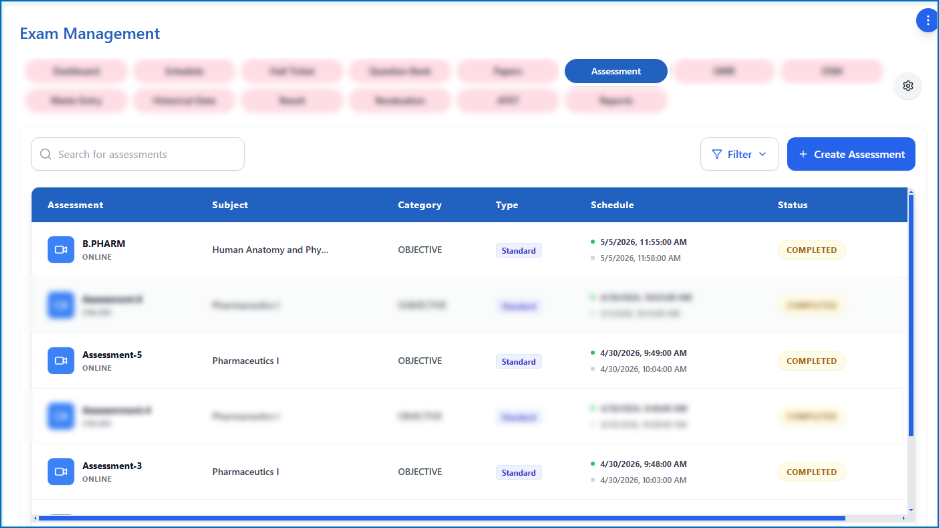
An Exam Management System (EMS) is a digital platform that manages the examination process from planning to results. It can include:
- Exam scheduling and subject allocation
- Question paper creation and management
- Question-to-CO and Bloom’s Taxonomy mapping
- CO-PO-PSO alignment
- Exam evaluation and grading
- Rubric-based assessment
- Result processing and analysis
- Re-evaluation and ATKT / Backlog management
- Reports and academic analytics
Why Manual Exams Undermine OBE Goals?
Despite well-defined outcomes, manual exam processes introduce multiple inefficiencies.
1. Misalignment Between Questions and Outcomes
Without digital mapping, questions may not adequately cover all COs or cognitive levels.
2. Human Errors in Evaluation
Manual checking and calculations increase the risk of inconsistencies and inaccuracies.
3. Delayed Feedback
Late result processing affects timely improvement actions.
4. Poor Traceability
Accreditation bodies require evidence of linking outcomes, assessments, and results—something manual systems fail to provide.
Consequently, institutions miss out on the true benefits of OBE.
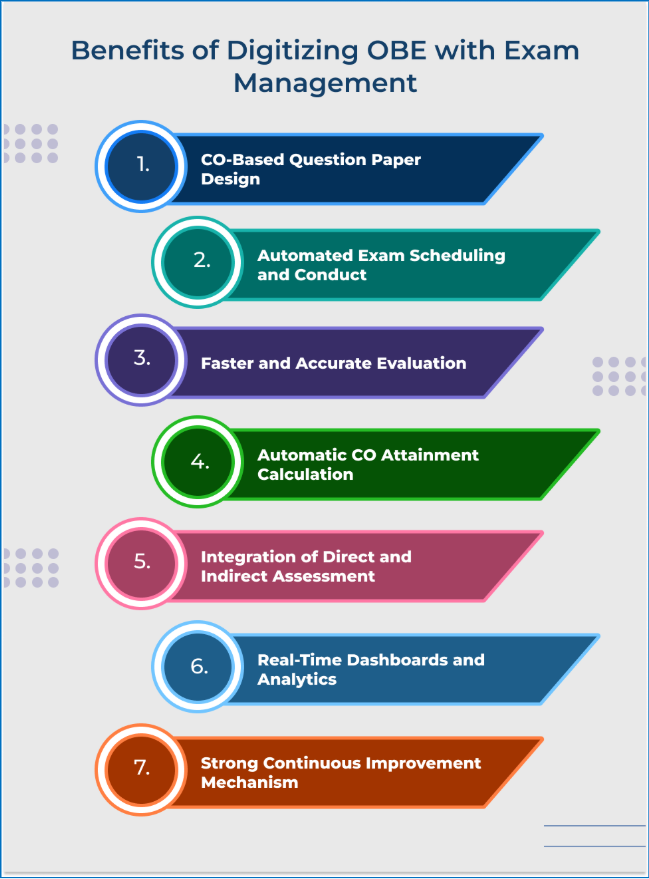
Benefits of Digitizing OBE with Exam Management
Now that the challenges are clear, let us explore why digitization is the ideal solution.
1. CO-Based Question Paper Design
First and foremost, digital exam management allows faculty to design CO-mapped question papers, where each question is systematically aligned with defined learning outcomes. Each question is tagged with specific parameters such as Course Outcomes (COs), Bloom’s Taxonomy levels, and difficulty indices. This structured approach is a key feature of AI CO-PO mapping in Nagpur, enabling institutions to ensure precise alignment between assessments and learning objectives while improving the accuracy of outcome measurement.
- Course Outcome (CO)
- Bloom’s taxonomy level
- Marks weightage
As a result, assessments become structured, balanced, and outcome oriented.
2. Automated Exam Scheduling and Conduct
Furthermore, an EMS simplifies exam planning by enabling:
- Centralized exam calendars
- Conflict-free scheduling
- Online, offline, or hybrid exams
- Secure question paper distribution
This not only saves time but also improves transparency and control.
3. Faster and Accurate Evaluation
One of the most significant advantages is automation in evaluation. Digital systems support:
- Online evaluation
- CO-wise marks capture
- Automated total calculation
- Error-free result generation
Consequently, accuracy improves while faculty workload reduces substantially.
4. Automatic CO Attainment Calculation
Moreover, digitizing OBE with exam management ensures real-time attainment calculation. The system:
- Aggregates student performance
- Applies predefined attainment thresholds
- Calculates CO attainment levels
- Maps CO attainment to PO and PSO
Thus, institutions can track outcome achievement instantly.
5. Integration of Direct and Indirect Assessment
In addition to exams, OBE requires indirect assessment methods such as:
- Course exit surveys
- Student feedback
- Alumni and employer surveys
A digital EMS seamlessly integrates these inputs, providing a comprehensive attainment picture.
6. Real-Time Dashboards and Analytics
Another powerful benefit is visual analytics. Dashboards display:
- CO and PO attainment trends
- Course-wise performance gaps
- Department-level insights
- Year-on-year comparisons
Therefore, academic leaders can take informed, timely decisions.
7. Strong Continuous Improvement Mechanism
Digitization also strengthens the continuous improvement cycle. Based on attainment data, institutions can:
- Identify weak outcomes
- Analyze root causes
- Plan corrective actions
- Monitor improvements in subsequent exams
As a result, improvement becomes evidence-based rather than assumption-based.
Step-by-Step Guide: How to Digitize OBE with Exam Management
Let us now walk through a structured roadmap for implementation.
Step 1: Define and Digitize Outcomes
To start with, define:
- Course Outcomes (COs)
- Program Outcomes (POs)
- Program Specific Outcomes (PSOs)
Digitize them in a centralized system with version control and approval of workflows.
Step 2: Map COs with POs and PSOs
Next, establish CO-PO-PSO mapping digitally using correlation levels. This ensures:
- Standardization
- Transparency
- Easy updates
Thus, mapping always becomes audit ready.
Step 3: Design CO-Mapped Question Banks
After mapping, create a digital question bank where each question is linked to:
- CO
- Bloom’s level
- Difficulty level
This allows automatic generation of balanced, outcome-aligned question papers.
Step 4: Conduct Exams Through EMS
Conduct internal, practical, and even university-level exams using the EMS. The system captures marks CO-wise, which is critical for accurate attainment.
Step 5: Automate Evaluation and Result Processing
Once exams are completed, the system:
- Evaluates responses
- Generates results
- Calculates CO attainment
This significantly reduces turnaround time and errors.
Step 6: Analyze Attainment and Take Action
Finally, review dashboards and reports to:
- Identify gaps
- Plan improvements
- Implement changes
- Reassess outcomes
Thus, the OBE loop is effectively closed.
Why Digitized OBE and Exam Management Matter?
From an SEO and institutional branding standpoint, adopting a digital OBE-exam ecosystem helps institutions position themselves as:
- Outcome-driven
- Quality-focused
- Accreditation-ready
- Student-centric
High-value search terms such as OBE exam management system, digital OBE assessment, outcome-based exam software, and OBE automation reflect the growing demand for such solutions.
Transform Your OBE Journey with Digital Exam Management
In conclusion, digitizing OBE with exam management is the key to turning outcomes into measurable success. Institutions that adopt this approach benefit from:
- Accurate and transparent assessments
- Faster evaluation and reporting
- Data-driven continuous improvement
- Stronger accreditation readiness
So, instead of managing exams and OBE separately, it is time to integrate them into a unified digital ecosystem.
The future of education is outcome-driven—and the future of outcomes is digital.
Take action today. Start digitizing your OBE framework with a smart exam management system and move confidently toward academic excellence. This step is crucial for institutions aiming to meet quality benchmarks like Vidarbha NAAC accreditation, where data-driven processes, transparency, and continuous improvement play a vital role in achieving and sustaining academic excellence.
Conclusion
Digitizing Exam Management with OBE helps institutions turn examination data into meaningful academic insights. From question-to-CO mapping and evaluation to results, attainment analysis, and learning gap identification, every stage contributes to measuring and improving learning outcomes.
With an integrated digital process, institutions can reduce manual work, improve transparency, and use reliable exam data for CO-PO-PSO attainment and continuous academic improvement.
Ultimately, connecting Exam Management with OBE creates a more structured, data-driven, and outcome-focused approach to education. LearnQoch brings these processes together in one integrated platform, helping institutions manage examinations, OBE, attainment, and academic improvement through a connected digital workflow.
A Software: Connecting Exam Management with OBE
LearnQoch brings the key academic processes together so that attendance, assessment, examination, and learning outcomes can work as part of one connected workflow.

1. Exam Management
Manages the complete examination cycle, including exam scheduling, subject allocation, question paper creation, question-to-CO mapping, evaluation, results, re-evaluation, and ATKT/Backlog. This provides the assessment data needed for outcome analysis.
2. OBE (Outcome-Based Education)
Connects assessment with CO-PO-PSO mapping, attainment calculation, Bloom’s Taxonomy, and learning outcome analysis. As a result, exam performance can be used to measure whether defined outcomes are being achieved.
3. Attendance Management
Maintains student attendance records and provides an additional academic data point for monitoring student participation and performance. This can complement assessment and OBE analysis where attendance is part of the institution’s academic process.
Experience LearnQoch in Action
Explore how Exam Management and OBE work together with a 14-day’s free trial.
See the complete flow from exam planning and evaluation to CO-PO-PSO attainment and OBE analysis—all in one integrated platform.
👉 Are you ready to lead your institution into the future of campus management?
📞 Contact us at +91 84519 01079
📧 Email: sales@learnqoch.com
Explore What LearnQoch Offers:
Visit www.learnqoch.com for Full Details
FAQs
How does exam management support OBE?
Exam questions, marks, results, and assessment data can be linked with COs, POs, and PSOs to measure learning outcome attainment.
What exam data is useful for OBE analysis?
Question-wise performance, assessment marks, results, and attainment reports can help identify learning gaps and support academic improvement.
What are the benefits of digitizing OBE with exam management?
It reduces manual work, improves accuracy and transparency, simplifies attainment calculations, and provides data for continuous improvement and accreditation reporting.
How does LearnQoch help digitize OBE with exam management?
LearnQoch connects exam planning, question-to-CO mapping, evaluation, results, CO-PO-PSO attainment, and OBE reports in one integrated platform, helping institutions manage the complete assessment-to-outcome cycle digitally.