



What are Course Outcomes (COs) in Outcome Based Education?


Introduction
India’s higher education system is rapidly transforming with the implementation of the National Education Policy 2020 and the vision of Viksit Bharat 2047. Today, institutions are expected not only to provide theoretical education but also to focus on skill development, employability, innovation, practical learning, and measurable academic outcomes.
Therefore, Outcome-Based Education (OBE) has become one of the most important frameworks in modern higher education. Moreover, accreditation bodies such as the National Board of Accreditation emphasize continuous assessment, measurable learning outcomes, and attainment-based evaluation to improve educational quality and global competitiveness.
Under NEP 2020, institutions are encouraged to:
Under the National Education Policy 2020, educational institutions are encouraged to promote student-centric learning, improve multidisciplinary education, focus on practical and skill-based learning, strengthen digital education systems, ensure measurable academic outcomes, and align education with industry requirements. As a result, Course Outcomes (COs) have become the foundation of Outcome-Based Education (OBE) because they help institutions measure what students learn after completing a course. Additionally, proper CO planning and attainment analysis help institutions improve teaching effectiveness, measure student performance accurately, support National Board of Accreditation requirements, implement OBE successfully, and enhance continuous quality improvement across academic processes.
In this blog, we will understand
- What are Course Outcomes (COs)?
- Importance of COs in OBE
- How to write effective COs
- Bloom’s Taxonomy for CO writing
- CO examples
- CO target setting process
Conversation in one of the institutes
Teacher: I completed the CO mapping for my subject, but now we need proper attainment analysis before exams.
Exam Officer: Yes, because COs are directly connected with internal assessment, question paper setting, and result evaluation.
Accreditation Coordinator: Exactly. During NBA accreditation, CO attainment reports become very important to prove learning outcomes and academic quality.
Admission Coordinator: Even parents and students now ask whether institutions follow Outcome-Based Education and measurable learning systems.
Teacher: Managing all this manually is becoming difficult and time-consuming.
Exam Officer: We really need a smart system for this. Recently, I saw one post from LearnQoch ERP on Instagram where they showed everything — CO-PO mapping, attainment calculation, exam data, and accreditation reports — managed on a single dashboard.
Accreditation Coordinator: That actually sounds useful. We should try it once because handling everything manually is becoming stressful now.
What are Course Outcomes (COs)?
Course Outcomes (COs) are measurable statements that describe what students should know, understand, and perform after completing a particular course or subject.
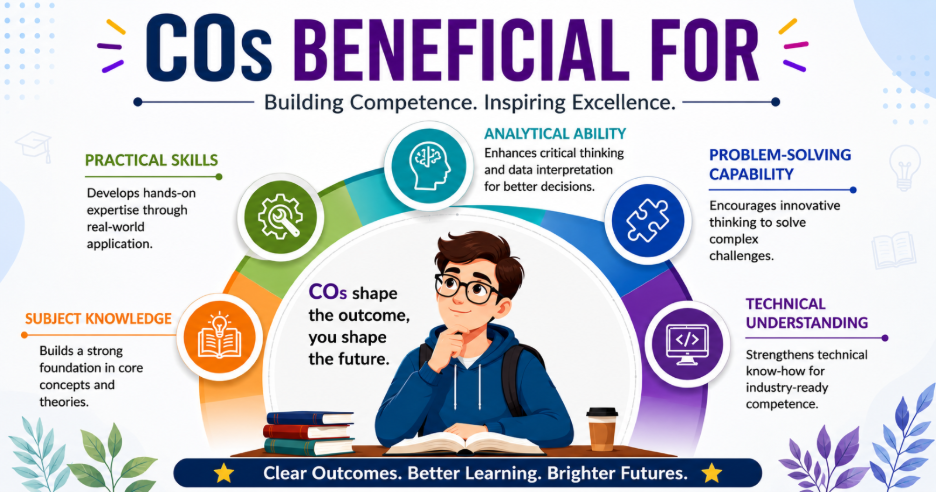
In simple words, COs define the expected learning outcomes achieved at the end of a course.
Furthermore, COs help faculty evaluate whether students have gained:
- Subject knowledge
- Practical skills
- Analytical ability
- Problem-solving capability
- Technical understanding
Generally, every course contains 4 to 6 COs based on the syllabus and learning objectives.
Example of Course Outcomes
For a C Programming subject:
- CO1: Explain basic programming concepts
- CO2: Develop programs using loops and conditional statements
- CO3: Apply arrays and functions in problem-solving
- CO4: Analyze and debug programming errors
Thus, each CO focuses on a specific learning objective and measurable skill.
Why are Course Outcomes Important in OBE?
Course Outcomes are extremely important because they help institutions measure actual student learning instead of only exam performance.
Apart from that properly designed COs support:
- Student performance evaluation
- CO-PO-PSO attainment calculation
- Continuous Quality Improvement (CQI)
- NBA accreditation documentation
- Better teaching and assessment planning
Therefore, COs play a major role in successful OBE implementation.
1. Measure Student Learning Effectiveness
COs help institutions evaluate whether students are achieving the expected learning outcomes of a course.
Example
If students successfully develop programs using loops and arrays, the related CO is considered achieved.
As a result, institutions can measure practical learning outcomes effectively.
2. Improve Teaching Strategies
Faculty members can analyze low-performing COs and improve teaching methodologies accordingly.
Example
If students struggle in practical programming concepts, faculty can conduct additional lab sessions, quizzes, or demonstrations.
Therefore, CO analysis supports student-centric teaching improvements.
3. Support NBA Accreditation
The National Board of Accreditation requires institutions to maintain proper CO design, mapping, and attainment records.
Hence, well-defined COs have become an essential part of NBA documentation and evaluation processes.
4. Enable Continuous Quality Improvement
CO attainment analysis helps institutions identify weak learning areas and improve academic quality continuously.
Example
If one CO consistently shows low attainment, departments can revise assessment methods or teaching approaches.
Consequently, institutions can improve overall academic effectiveness.
How to Write Effective Course Outcomes?
Writing effective COs is extremely important because unclear or poorly written COs create problems in assessment, mapping, and attainment calculation.
Therefore, COs should always be:
Clear, Measurable ,Action-oriented, Student-focused, Aligned with Bloom’s Taxonomy
Steps to Write Effective COs
Step 1: Identify Learning Objectives
First, identify what students should achieve after completing the course.
This may include:
- Knowledge
- Technical skills
- Practical applications
- Analytical abilities
Step 2: Use Action Verbs
Always use measurable action verbs while writing COs.
Examples of Good Action Verbs
Define, Explain, Apply, Analyze, Design, Evaluate
Avoid vague words such as:
- Know
- Learn
- Understand
because they are difficult to measure properly.
Bloom’s Taxonomy in CO Writing
It helps faculty classify learning outcomes according to cognitive learning levels.
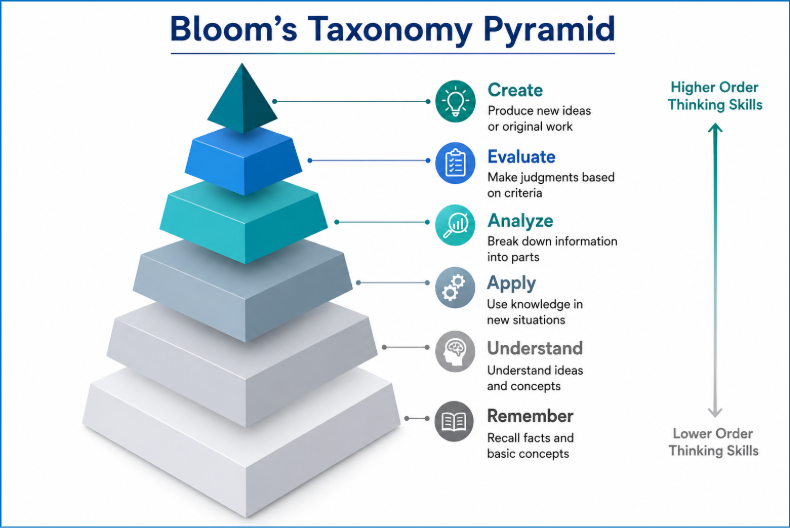
It contains six important levels:
| Level | Description | Action Verbs | CO |
|---|---|---|---|
| Remember | Recall information | Define, List | Define programming fundamentals |
| Understand | Explain concepts | Describe, Explain | Explain functions in C language |
| Apply | Use knowledge | Apply, Implement | Develop programs using loops |
| Analyze | Break concepts | Analyze, Differentiate | Analyze programming errors |
| Evaluate | Make judgments | Evaluate, Justify | – |
| Create | Develop new solutions | Design, Create | Design mini software applications |
Therefore, Bloom’s Taxonomy helps create structured and measurable Course Outcomes.
CO Examples for Different Courses
Engineering Subject COs
CO1: Explain engineering fundamentals
CO2: Apply numerical methods for problem-solving
CO3: Analyze technical systems
CO4: Design engineering solutions
Management Subject COs
CO1: Explain marketing concepts
CO2: Analyze business strategies
CO3: Develop marketing plans
Mathematics Subject COs
CO1: Solve differential equations
CO2: Apply matrix operations
CO3: Analyze numerical techniques
CO Attainment Calculation
CO attainment measures the extent to which students have achieved the defined Course Outcomes (COs) of a subject. It helps institutions evaluate student learning and identify whether the desired academic objectives have been successfully met.
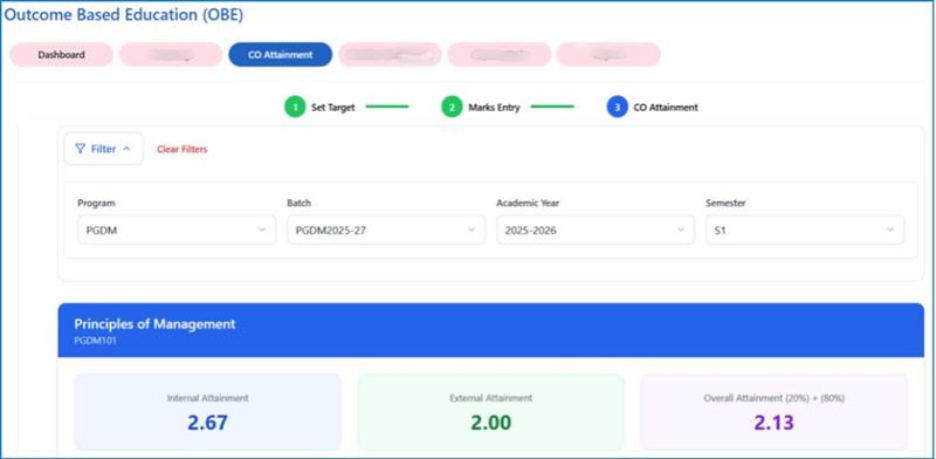
The process includes:
Target Setting
Institutions define performance targets for each Course Outcome (CO) before conducting assessments. These targets serve as benchmarks to measure student achievement and determine whether the desired learning outcomes have been successfully attained.
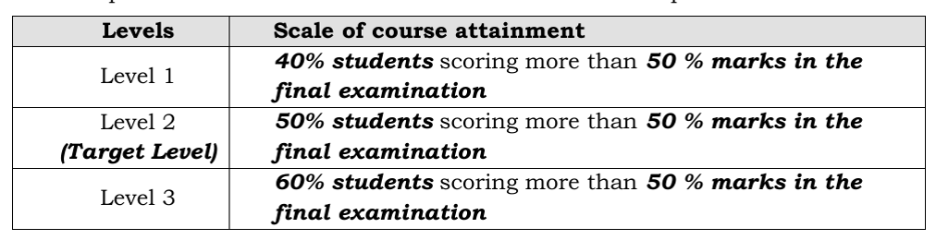
Assessment Collection
Assessment data is collected from various internal and external evaluation methods to measure student performance against defined Course Outcomes. Common assessment tools include Theory Examinations, Practical Examinations, Internal Tests, Unit Tests, Assignments, Journals, and Lab Assessments. These assessments provide the data required for accurate attainment calculations.
Attainment Calculation
Typically:
- External Assessment Weightage = 80%
- Internal Assessment Weightage = 20%
Final CO attainment is calculated using weighted averages from internal and external assessments.
The LearnQoch Exam Module automates assessment collection and attainment calculations, eliminating manual spreadsheet work.
Common Mistakes While Writing COs
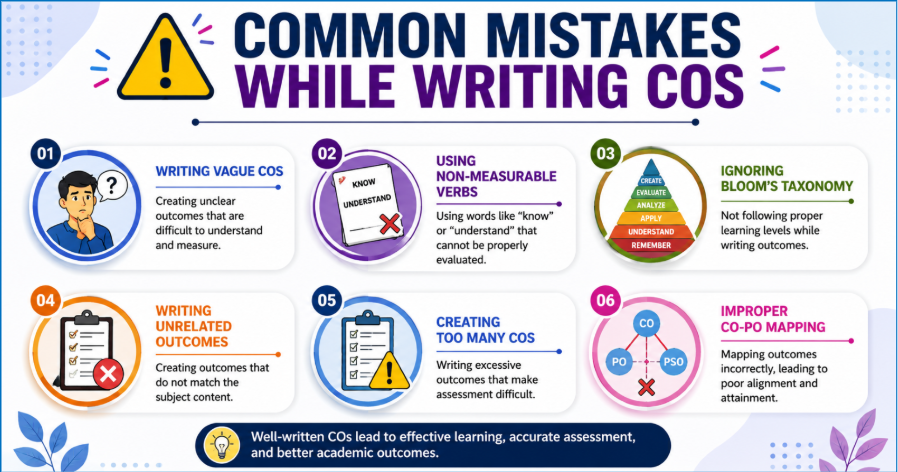
Many institutions make mistakes such as:
- Writing vague COs: Creating unclear outcomes that are difficult to understand and measure.
- Using non-measurable verbs: Using words like “know” or “understand” that cannot be properly evaluated.
- Ignoring Bloom’s Taxonomy: Not following proper learning levels while writing outcomes.
- Writing unrelated outcomes: Creating outcomes that do not match the subject content.
- Creating too many COs: Writing excessive outcomes that make assessment difficult.
- Improper CO-PO mapping: Incorrectly linking Course Outcomes with Program Outcomes.
Therefore, proper faculty training and structured OBE planning are essential.
How Does LearnQoch Automate Course Outcome (CO) Attainment?
Course Outcomes (COs) are measured through assessments such as Mid Semester Exams (MSE), End Semester Exams (ESE), Assignments, Quizzes, Practicals, and Projects. These assessments help evaluate students’ knowledge, skills, and learning progress.
With the LearnQoch OBE Exam Module, institutions don’t need to calculate CO attainment manually. The software automatically links assessment questions to the relevant Course Outcomes (COs) and Bloom’s Taxonomy levels, making the entire process faster and more accurate.
LearnQoch helps institutions by:
- Automatically mapping assessment questions to Course Outcomes (COs).
- Calculating CO attainment using marks from MSE, ESE, assignments, quizzes, practicals, and projects.
- Generating real-time CO attainment reports and dashboards.
- Identifying learning gaps to support continuous improvement.
- Providing accreditation-ready reports with minimal manual effort.
- By automating CO attainment, LearnQoch OBE Software saves faculty time, reduces manual work, improves accuracy, and helps institutions meet Outcome-Based Education (OBE) and accreditation requirements with confidence.
Conclusion
Course Outcomes (COs) are the foundation of Outcome-Based Education (OBE). With LearnQoch OBE Software, institutions can automate CO mapping, attainment calculations, analytics, and accreditation-ready reporting—reducing manual effort while improving accuracy and academic quality.
Up Next: How to Create Effective CO-PO Mapping in Outcome-Based Education? Learn practical mapping techniques, attainment levels, and how LearnQoch simplifies the entire CO-PO mapping process.
The LearnQoch AI powered Academic Platform
LearnQoch goes further by providing an integrated platform that covers all aspects of institutional growth:

Institutional Digital Ecosystem: Categories & Modules
| Category | Modules Available | What It Does (Core Capability) |
|---|---|---|
| A. Core Academic & Learning | LMS, OBE, Academic Calendar, Class Module | Digitizes modern teaching, manages timetables, and maps specific student skill metrics. |
| B. Examination & Evaluation | Exam Management Module | Automates the complete exam lifecycle: planning, ATKT processing, and automated question paper generation. |
| C. Campus Administration | ERP, Task Management, Committee, Document, Certificate Management | Automates student data, workflow management, corporate governance, and instant certificate issuance. |
| D. Finance & Fees | Receivable (Fees), Advanced Fees, Excess Fees | Tracks fee categories, handles online tuition collections, and records advanced or excess payment adjustments. |
| E. Library & Resource | Library Module | Streamlines textbook registration, student tracking, renewals, and live book availability. |
| F. Placement & Careers | Placement Module, Skill Development | Connects TPOs with job openings, student registration, and future-ready job training. |
| G. Digital Marketing & Institution Growth | LQ Growth+ | A unified dashboard to manage social media, WhatsApp, Email, SMS campaigns, and website health metrics. |
| H. Accreditation & Quality | NAAC, NBA & NIRF Compliance | Drastically reduces institutional audit workload with one-click compliance reporting tools. |
| I. Digital Presence | Website & Digital Marketing Solutions | Build custom web portals and automated communication funnels to attract prospective students. |
Don’t Just Take Our Word for It-Try LearnQoch Your self!
We invite you to experience the transformative impact of LearnQoch’s AI powered Digitize Platform with a 14-Days Free Trial.
During this period, our team will implement the software for your institution, allowing you to explore its features firsthand and see the difference it can make in academic management.
👉 Are you ready to lead your institution into the future of campus management?
📞 Contact us at +91 84519 01079
📧 Email: sales@learnqoch.com
Explore What LearnQoch Offers:
Visit www.learnqoch.com for Full Details
Frequently Asked Questions
1. What are Course Outcomes in OBE?
Course Outcomes are measurable learning objectives that define what students should achieve after completing a course.
2. How many COs should a subject contain?
Generally, a subject contains 4 to 6 Course Outcomes, depending on the syllabus structure and learning objectives.
3. Why is Bloom’s Taxonomy important in CO writing?
Bloom’s Taxonomy helps faculty create measurable and structured learning outcomes based on different cognitive learning levels.