


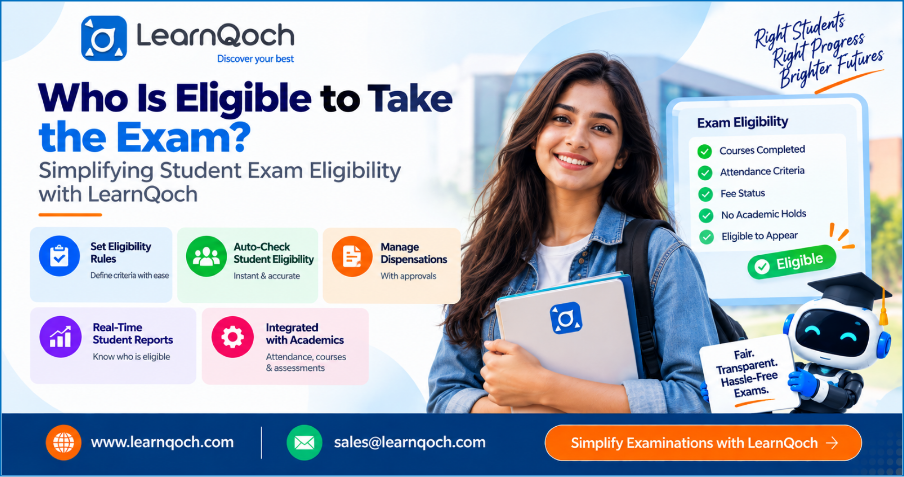
Who Is Eligible to Take the Exam? Simplifying Student Exam Eligibility with LearnQoch.


Introduction
Before every examination, one question becomes important for every institution:
“Which students are actually eligible to appear for the exam?”
In many institutions, checking eligibility is still a time-consuming activity. Examination teams may need to look at attendance, academic records, subject registrations, internal assessments, previous results, ATKT/backlog status and other institutional criteria before preparing the final eligibility list.
This becomes even more challenging when student data is maintained across different spreadsheets, departments or systems.
At LearnQoch, we believe exam eligibility should not be a last-minute manual exercise. When academic and examination data are connected, institutions can identify eligible students more systematically and get a clearer view of the examination process.
A Small Conversation: “Why Are We Doing This One Day Before the Exam?”
Teacher: “Students, tomorrow is your examination. Today we need to complete the hall ticket process. Please collect this clearance form and get the required signatures.”
Student: “Ma’am, signatures? From where?”
Teacher: “First, go to the Accounts section and get clearance for any pending fees. Then go to your Department and Library for their clearance. Once everything is signed, submit the form and collect your hall ticket.”
Student: “But ma’am, why are we being told this today? Our exam is tomorrow. We could have completed all this last week.”
Another Student: “Exactly! There are so many students here at the same time. We are standing in different queues just to get signatures.”
Teacher: “I understand. We also have to check who is eligible for the examination, pending fees, department clearances and library dues before issuing the hall tickets. When all these records are maintained separately, it becomes difficult to complete everything smoothly.”
Student: “Then why can’t the system check all this before the exam?”
Teacher: “That is exactly the kind of process we should be moving towards.”
In this Blog …
In this blog, we explore how institutions can simplify student exam eligibility by bringing academic, attendance, fee and other relevant information together before the examination. We also look at how connected digital processes can reduce last-minute work, simplify hall-ticket generation and help examination teams manage the complete process more efficiently.
- Understanding student exam eligibility and the criteria involved
- Identifying students who need verification before the examination
- Reducing last-minute clearance and hall-ticket challenges
- Connecting fees, library, academics and examination processes
- How LearnQoch and its AI Agent can help institutions understand and manage examination data
1. Exam Eligibility Starts Before the Examination
Exam eligibility is not the same for every type of examination. National or competitive examinations(NEET,SET,NET,CET) may have eligibility requirements based on age, qualification, category, entrance criteria, nationality and other examination-specific rules.
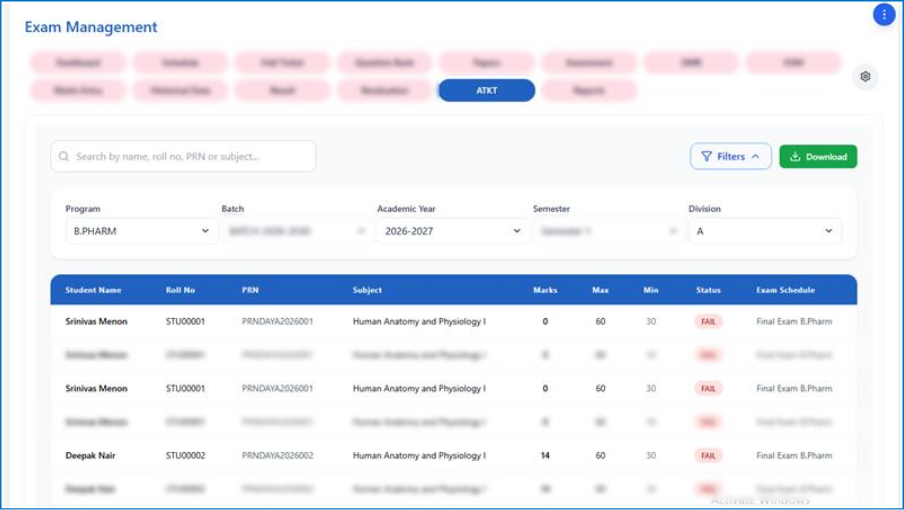
Institutional examinations are different. Colleges and universities may consider factors such as:
- Required attendance
- Subject registration
- Internal assessment
- Academic status
- ATKT or backlog status
- Examination registration
- Pending fees or other institution-defined requirements
When this information is maintained across different records or departments, the examination team may have to spend considerable time checking and verifying it.
With the right digital system, these details can be brought together earlier so that eligibility can be checked well before the examination, giving the institution enough time to resolve any pending requirements.
2. From Student Data to Eligibility List
This is where LearnQoch can simplify the examination process.
Instead of manually checking different records, the institution can use connected academic and examination data to check students against the eligibility criteria defined by the institution.
For example, an examination team may identify that most students are eligible, while a few students require further verification because of attendance, internal assessment or academic requirements.
The important thing is that these cases can be identified before the last day, giving the concerned department and students time to resolve the issue.
LearnQoch’s examination module brings examination activities together, from planning and subject allocation to scheduling, assessment, evaluation and result generation.
3. What Happens When a Student Is Not Eligible?
Finding a student who is not eligible is only the beginning. The examination team also needs to know why the student has not met the required criteria.
For example:
- A student may have attendance below the required level.
- A required internal assessment may not have been completed.
- A subject registration may still be pending.
- An ATKT or academic requirement may need verification.
When the reason is clearly available, the examination team can take the necessary action instead of searching through different records.
More importantly, these issues can be identified well before the examination, rather than becoming a problem when students are already waiting for their hall tickets.
4. LearnQoch AI Agent: Understand What Is Happening
At LearnQoch, we believe an AI Agent should do more than automate routine tasks. It should also help the examination team understand what is happening across the institution.
Once examination, attendance and academic information is connected, the LearnQoch AI Agent can analyse the available data and bring important information to the attention of the examination team.
For example, before an examination, the examination officer may need to know whether all students are ready for the next stage of the process or whether some students still need verification.
Instead of going through attendance records, academic details and examination information separately, the AI Agent can bring the relevant information together and highlight areas that need attention.
This helps the examination team act earlier rather than waiting until the last moment.
5. From Eligibility to Hall Ticket
With LearnQoch Examination Software, the examination team can check important requirements such as eligibility, pending fees, academic requirements and other clearances in advance.
Once everything is clear, the hall ticket can be generated through the Hall Ticket module and made available directly in the student’s login. Students can simply view and download it online.
This saves time, paperwork and unnecessary visits for students, while reducing queues and last-minute administrative work for the institution.
6. Making Examination Data More Useful
For us, examination software should do more than store information.
When academic, fees, library and examination data are connected, institutions can identify pending requirements earlier, reduce last-minute work and make better use of the information they already have.
That is the idea behind LearnQoch — connect the data, simplify the process and help institutions act at the right time.
Conclusion
Exam eligibility may look like a small step in the examination process, but it involves checking several pieces of student information. When this is done manually, it can take considerable time and make it difficult for the examination team to get a clear picture.
At LearnQoch, we want to make this process simpler by bringing student eligibility, examination activities, assessment, evaluation and results together on one connected platform.
The LearnQoch AI Agent can add another layer of support by helping the examination team understand the available data, identify areas that need attention and get a clearer picture of what is happening across the examination process.
For us, it is not only about finding out who is eligible to take the exam. It is about making the entire examination process simpler, connected and easier to manage.
The LearnQoch AI powered Academic Platform
LearnQoch goes further by providing an integrated platform that covers all aspects of institutional growth:

Institutional Digital Ecosystem: Categories & Modules
| Category | Modules Available | What It Does (Core Capability) |
|---|---|---|
| A. Core Academic & Learning | LMS, OBE, Academic Calendar, Class Module | Digitizes modern teaching, manages timetables, and maps specific student skill metrics. |
| B. Examination & Evaluation | Exam Management Module | Automates the complete exam lifecycle: planning, ATKT processing, and automated question paper generation. |
| C. Campus Administration | ERP, Task Management, Committee, Document, Certificate Management | Automates student data, workflow management, corporate governance, and instant certificate issuance. |
| D. Placement & Careers | Placement Module, Skill Development | Connects Training & Placement Officers (TPOs) with job openings, student registration, and future-ready job training. |
| E. Digital Marketing & Institution Growth | LQ Growth+ | A single unified dashboard to manage institutional social media (Facebook, Instagram, LinkedIn, X/Twitter), launch multi-channel marketing campaigns (WhatsApp, Email, SMS), and monitor website health metrics. |
| F. Accreditation & Quality | NAAC, NBA & NIRF Compliance | Reduces institutional audit workload with compliance reporting tools. |
Don’t Just Take Our Word for It—Try LearnQoch Yourself!
We invite you to experience the transformative impact of LearnQoch’s AI powered Digitize Platform with a 14-Days Free Trial.
During this period, our team will implement the software for your institution, allowing you to explore its features firsthand and see the difference it can make in academic management.
👉 Are you ready to lead your institution into the future of campus management?
📞 Contact us at +91 84519 01079
📧 Email: sales@learnqoch.com
Explore What LearnQoch Offers:
Visit www.learnqoch.com for Full Details