


Teaching Kids to Code: Tips, tricks & best practices


In today’s digital era, coding and programming skills are in high demand. Whether your child aspires to a career in technology or another field, learning to code offers numerous benefits. It enhances logical thinking, problem-solving, creativity, and analytical abilities. As a concerned parent, you may ask: Is my child ready to learn coding? Can they pick up new programming languages? How can they learn coding effectively? And most importantly, will these skills remain relevant in the future? This highlights the importance of teaching kids coding in Mumbai.
Furthermore, with the implementation of the National Education Policy 2020, technology integration and skill-based learning have received considerable importance in the Indian education system. The NEP 2020 places considerable emphasis on computational thinking, experiential learning, and early introduction to coding concepts. Hence, it is even more important to understand how to guide your child through this digital age. In this blog, we will discuss these important questions and provide you with tips and strategies to help your child learn coding effectively and confidently.
Is my child ready for coding/programming?
Children can start learning coding as early as six years old. Coding is much like learning a new language—we begin with the basics, similar to the alphabet, and gradually progress to forming words, sentences, and eventually expressing ideas. Over the past few decades, the software industry has revolutionized the world, making technology an essential part of everyday life. Therefore, introducing children to coding early—tailored to their interests and abilities—is crucial. This underscores the importance of teaching kids coding in Mumbai.
Will they be able to cope with new coding languages?
There are numerous programming languages, but children don’t need to learn them all at once. Depending on their age, students can begin with block coding and the basics of HTML, then gradually advance to languages like C/C++, Java, Python, and DevOps. By building a strong foundation and increasing complexity step by step, learners can confidently adapt to new coding languages and emerging technologies. LearnQoch supports this structured progression, making it easier for kids to learn coding effectively in Vidarbha.
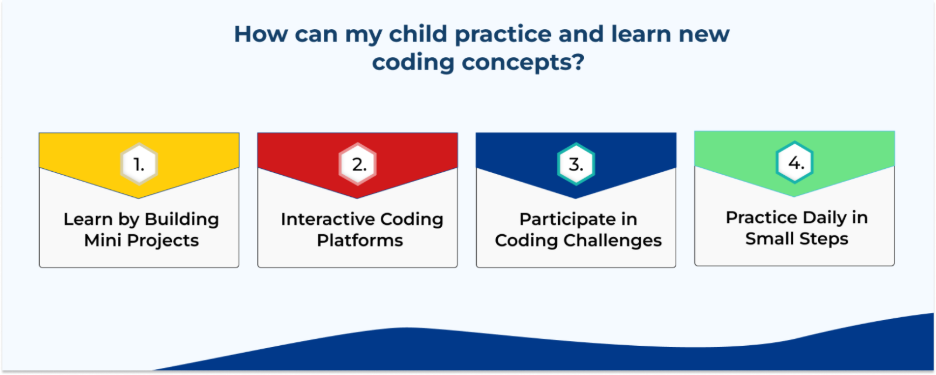
How can my child practice and learn new coding concepts?
To understand coding concepts thoroughly, practice is essential. Here are some tips and tricks to facilitate effective coding learning:
In this blog, we will explore valuable tips, tricks, and best practices for teaching kids to code, helping them develop strong problem-solving skills, creativity, and confidence while making learning fun and engaging in Mumbai.
Additionally, we will highlight the unique features offered by LearnQoch, an exceptional coding education provider.
Start with Visual Programming Languages:
Visual programming languages provide a user-friendly and intuitive introduction to coding for young learners. Platforms like Scratch or Blockly use drag-and-drop code blocks that fit together like puzzle pieces, eliminating the need for typing syntax. Visual languages allow children to focus on understanding programming logic without getting overwhelmed by syntax errors. They can create interactive animations, games, and stories by simply snapping the blocks together, making coding accessible and enjoyable.
Encourage Hands-On Activities:
Incorporating hands-on activities into coding lessons can greatly enhance children’s understanding and engagement. Introduce physical computing platforms like Arduino or Raspberry Pi, which enable kids to connect sensors, actuators, and other electronic components to their code. By physically interacting with their creations, children gain a deeper understanding of how code controls real-world objects. They can build robots, create smart devices, or design interactive art installations, fostering creativity and problem-solving skills.
Foster a Problem-Solving Mindset:
Coding is essentially a problem-solving endeavour. Encourage children to approach coding challenges with a problem-solving mindset. Teach them to break down complex problems into smaller, more manageable parts. Emphasize the importance of analyzing problems, identifying patterns, and developing step-by-step solutions. Encourage them to experiment, try different approaches, and learn from failures. Building a resilient problem-solving mindset not only benefits coding but also prepares children for challenges they may encounter in other areas of life.
Project-Based Learning:
Project-based learning is a powerful approach to teaching coding. Assign real-world projects that require children to apply their coding skills to solve specific problems or create useful applications. Projects can be tailored to their interests, allowing them to explore topics like game development, website design, data visualization, or robotics. Project-based learning encourages creativity, independent thinking, and self-directed learning. It also helps children develop skills such as project management, critical thinking, and collaboration.
Collaborative Learning:
Promote collaborative learning environments where children can work together on coding projects. Collaboration not only enhances teamwork and communication skills but also fosters peer learning. Encourage students to share their knowledge, help each other troubleshoot issues, and provide feedback on each other’s code. Collaborative learning experiences create a supportive and dynamic coding community, where children can learn from each other’s approaches, gain different perspectives, and develop problem-solving skills collectively.
Gamify Learning:
Gamification can make the coding learning process more enjoyable and motivating. Integrate coding games, puzzles, and challenges into the curriculum to engage children and make learning fun. Platforms like Code.org and CS First offer interactive coding games and puzzles that progressively introduce coding concepts. Design coding challenges that require children to apply their skills and problem-solving abilities. Introduce elements like points, levels, badges, or leaderboards to create a sense of achievement and healthy competition. Gamification can inspire children to practice coding outside of class and explore new coding concepts independently.
Introduce Real-World Examples:
To make the coding concepts more familiar, it is important to give examples that children can relate to. They can be made aware of how coding is used in their daily lives, such as developing mobile apps, websites, or video games. They can be shown how coding is used in different sectors such as healthcare, transportation, and entertainment. Can also be shown examples of how coding has transformed different sectors such as artificial intelligence, data science, and virtual reality. By doing so, children will be able to understand the applications of coding and its relevance in the world around them.
Learning coding is one of the best investments for a child’s future. For parents and teachers, choosing the right coding education partner is essential to ensure effective learning. LearnQoch stands out as an ideal choice, offering an industry-aligned curriculum that integrates both academic concepts and real-world applications. With its hybrid learning model and advanced EdTech platform with LMS, LearnQoch provides a structured learning progression while enabling teachers and parents to monitor and assess students’ understanding effectively. This makes it a top option for kids coding in Nagpur.
The LearnQoch AI powered Academic Platform
LearnQoch goes further by providing an integrated platform that covers all aspects of institutional growth:

Institutional Digital Ecosystem: Categories & Modules
A. LearnQoch AI powered Core Academic & Learning Solutions
Facilitates modern teaching and learning while tracking student progress, assignments, assessments, and course outcomes.
Focuses on measuring learning outcomes to ensure skills, competencies, and academic objectives are met effectively.
- LearnQoch AI powered Academic Calendar & Events
Maintains academic schedules, holidays, events, and exam timelines for seamless yearly planning.
- LearnQoch AI powered Class Module
Manages class creation, faculty allocation, and student grouping while supporting timetable integration.
B. LearnQoch AI powered Examination & Evaluation Management
LearnQoch AI Powered Exam Management Module
A unified system that digitizes the entire exam cycle—right from planning, subject allocation, ATKT processing, and scheduling to question paper creation, assessments, evaluation, and result generation. It ensures transparency, accuracy, and smooth coordination across all departments.
C. LearnQoch AI powered Campus Administration & Operations
Streamlines administrative activities, simplifies student data management, and ensures workflow automation across all departments.
- LearnQoch AI powered Task Management
Organizes, prioritizes, and tracks institutional tasks to improve productivity and accountability.
- LearnQoch AI powered Committee Module
Handles committee formation, roles, activities, and meeting records to maintain governance transparency.
- LearnQoch AI powered Document Management
Stores, organizes, and retrieves institutional documents with version control and compliance tracking.
- LearnQoch AI powered Certificate Management
Manages creation and issuance of academic and administrative certificates such as Bonafide, character, and leaving certificates.
D. LearnQoch AI powered Finance & Fees Management
- LearnQoch AI powered Finance Module – Receivable (Fees)
Tracks payments, manages fee categories, handles tuition/fines, and maintains fee-related records.
- LearnQoch AI powered Advanced Fees
Payments made before the due date, helping institutions and parents manage fee planning efficiently.
- LearnQoch AI powered Excess Fees
Extra amount paid unintentionally; recorded for adjustment in future payments or refunded when necessary.
E. LearnQoch AI powered Library & Resource Management
LearnQoch AI powered Library Module
Manages book registration, issue-return process, renewals, student access, and availability tracking for efficient library operations.
F. LearnQoch AI powered Placement & Career Development
- LearnQoch AI powered Placement Module
Manages job postings, student registration, interview updates, and final offer letters with complete transparency for TPOs and students.
- LearnQoch AI powered Skill Development Solutions
Equips students with future-ready skills to enhance employability and prepare for global career opportunities.
G. LearnQoch AI powered Accreditation & Compliance
LearnQoch AI powered NAAC, NBA & NIRF Compliance
Simplifies reporting, monitoring, and auditing with ready-to-use compliance tools that reduce institutional workload.
H. LearnQoch AI powered Digital Presence & Branding
LearnQoch AI powered Website & Digital Marketing Solutions
Helps institutions build a strong online presence, attract prospective students, and engage key stakeholders effectively.
Don’t Just Take Our Word for It—Try LearnQoch Yourself!
We invite you to experience the transformative impact of LearnQoch’s AI powered Digitize Platform with a 14-Day Free Trial.
During this period, our team will implement the software for your institution, allowing you to explore its features firsthand and see the difference it can make in academic management.
👉 Are you ready to lead your institution into the future of campus management?
📞 Contact us at +91 84519 01079
📧 Email: info@learnqoch.com / sales@learnqoch.com
Explore What LearnQoch Offers:
Visit www.learnqoch.com for Full Details
Also read,
From Inquiry to Enrollment: Mapping the Student Journey via Your Website
5 Things Every Principal Needs to Know About Exam Management Technology
Coding and Robotics in Remote Learning: Strategies for Success
Best LMS for Schools: The Future of Learning Management Systems