


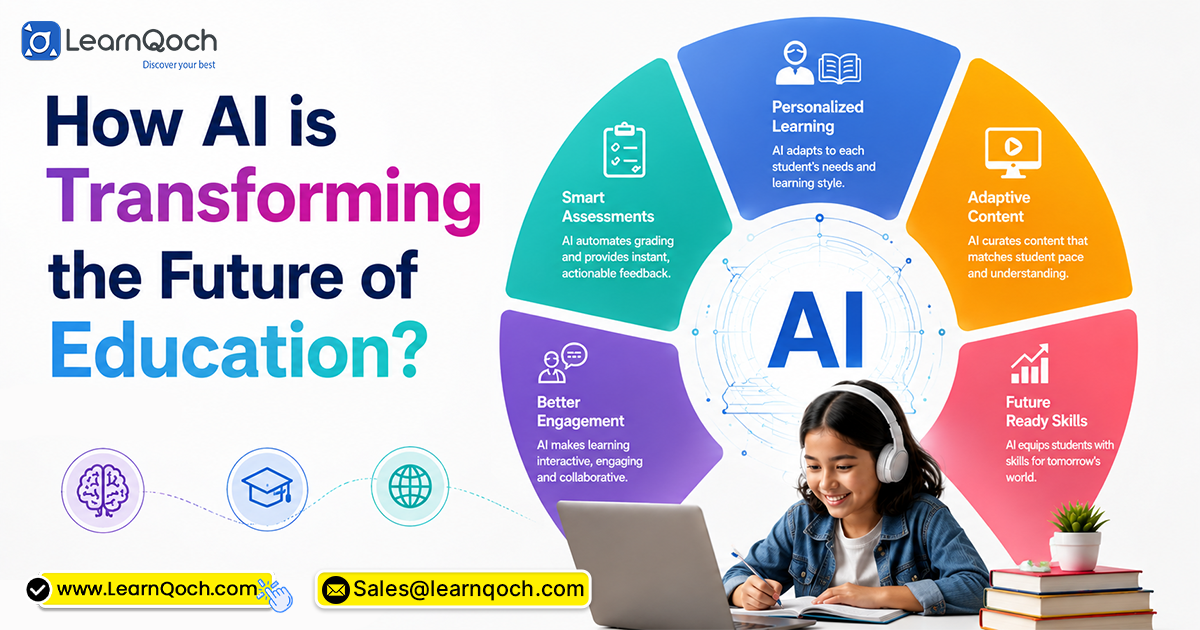
How is AI transforming the future of education?


Education is changing rapidly because technology continues to transform teaching, learning, and institutional management across the world. Today, artificial intelligence plays a significant role in creating smarter, faster, and more personalized learning experiences for students and educators alike. Therefore, educational institutions increasingly adopt AI-powered technologies to improve academic performance, automate administrative tasks, and enhance student engagement effectively. As a result, how AI is transforming the future of education has become one of the most discussed topics in the modern academic landscape.
Moreover, the implementation of NEP 2020 has accelerated digital transformation in schools, colleges, and universities. The policy strongly promotes technology integration, skill-based learning, and innovative teaching approaches. Consequently, institutions now focus on adopting AI-powered ERP, LMS, exam management, and timetable management systems to improve operational efficiency and learning outcomes.
In addition, the vision of Viksit Bharat Adhiniyam 2026 encourages institutions to build a future-ready education ecosystem driven by innovation and digital excellence. Furthermore, AI-powered platforms also support competitive examination preparation, including UGC NET, through personalized learning and automated assessments. Therefore, how AI is transforming the future of education clearly reflects the growing importance of intelligent technologies in building a smarter, more accessible, and student-centric education system for the future.
From a previous blog…
The previous blog explained how technology and artificial intelligence play a vital role in successfully implementing the National Education Policy 2020 across educational institutions. We covered how AI-powered tools improve personalized learning, digital classrooms, administrative efficiency, and student engagement effectively. Additionally, the blog highlighted the importance of smart technologies in supporting skill-based, flexible, and future-ready education systems. Finally, we explored how LearnQoch helps institutions adopt NEP 2020 goals through AI-driven ERP, LMS, timetable, and exam management solutions.
How AI Helps Students Learn Faster and Smarter?
“Ma’am, I studied for hours, but I still could not understand mathematics properly,” said Aarav during his online class.
His teacher replied, “Many students face the same challenge. However, AI-powered learning platforms can now identify weak areas and provide personalized practice questions instantly.”
Aarav looked surprised and asked, “Does that mean AI can teach according to my learning speed?”
“Yes,” the teacher explained. “Unlike traditional classrooms, artificial intelligence analyzes student performance continuously. As a result, students receive customized lessons, instant feedback, and interactive learning support.”
Meanwhile, Aarav’s mother joined the discussion and shared another concern. “Sometimes, children hesitate to ask questions in class because they fear embarrassment.”
“That is true,” the teacher answered. “However, AI chatbots and virtual tutors encourage students to ask questions freely. Consequently, students become more confident and engaged in learning.”
Furthermore, educational institutions are now using LearnQoch for attendance tracking, automated grading, performance analytics, and smart content recommendations. Therefore, teachers can focus more on creativity, mentoring, and student development instead of repetitive administrative tasks.
Today, AI in education is not replacing teachers. Instead, platforms like LearnQoch are helping educators create smarter, faster, and more personalized learning experiences for every student while supporting the vision of digital education under NEP 2020.
This blog explains…
This blog explains how artificial intelligence is transforming the education sector through automation, personalization, and smart learning solutions. We covered the benefits of AI for students, teachers, parents, administrators, and institutional staff in improving academic experiences and operational efficiency. Additionally, the blog discussed major challenges of both AI-based and traditional education systems. Finally, we explored how LearnQoch supports educational institutions with AI-powered ERP, LMS, timetable, and exam management solutions to create future-ready learning environments.
AI is revolutionizing personalized learning.
Traditional classrooms often follow the same teaching approach for every student. However, students learn differently because each learner has unique strengths and weaknesses. Therefore, artificial intelligence helps institutions deliver personalized learning experiences according to individual student performance.
AI-powered learning systems analyze student behavior, learning speed, and assessment performance continuously. Consequently, teachers can identify struggling students quickly and provide targeted support immediately. Additionally, personalized recommendations help students improve academic understanding without unnecessary pressure.
Many institutions now use advanced LMS platforms to support adaptive learning experiences effectively. For example, LearnQoch AI-powered LMS solutions help educators track student progress and improve engagement levels significantly. Moreover, these systems allow students to access learning materials anytime from any location.
Smart classrooms are enhancing student engagement.
Modern classrooms increasingly integrate AI technologies to improve interaction between teachers and students. As a result, educational institutions now create smarter and more collaborative learning environments. Furthermore, smart classrooms encourage students to participate actively during lectures and discussions.
AI-powered virtual assistants answer common student questions instantly and reduce teacher workload considerably. Additionally, automated attendance systems simplify administrative tasks while improving operational efficiency. These innovations help teachers focus more on delivering quality education instead of managing repetitive tasks.
Interactive tools also improve classroom communication and increase student participation levels consistently. Therefore, institutions adopting AI technologies often achieve better academic performance and improved student satisfaction.
AI-Powered Exam Management is Improving Assessment Processes.
Examination management remains one of the biggest challenges for educational institutions. However, AI-powered exam management systems now simplify examination planning, scheduling, and evaluation processes efficiently.
LearnQoch: AI-powered exam management Solutions help institutions automate examination workflows effectively. Consequently, administrators reduce manual errors while improving transparency during assessments. Furthermore, automated evaluation systems save significant time for educators and administrators.
AI also improves online examination security through intelligent monitoring and proctoring technologies. Therefore, institutions can conduct fair and secure examinations without excessive operational complexity. Additionally, automated result processing ensures faster publication of examination outcomes.
AI-Based ERP Systems are Streamlining Institutional Operations
Educational institutions manage large volumes of student, faculty, financial, and operational data daily. Therefore, institutions increasingly implement AI-powered ERP systems to simplify administrative management.
Learn Qoch AI-powered ERP solutions. Help institutions automate admissions, fee management, attendance tracking, and academic reporting efficiently. As a result, institutions reduce paperwork while improving operational productivity. Moreover, centralized data management enables administrators to make informed decisions quickly.
AI-based ERP systems also improve communication between students, teachers, and administrators effectively. Consequently, institutions maintain better transparency and stronger collaboration across departments.
AI is supporting the vision of NEP 2020.
The National Education Policy 2020 emphasizes technology integration to improve educational accessibility, flexibility, and quality. Therefore, artificial intelligence plays a crucial role in achieving NEP 2020 objectives successfully.
AI technologies support skill-based learning, multilingual education, and digital transformation initiatives across educational institutions. Furthermore, AI-driven platforms improve remote learning accessibility for students in rural and urban regions alike.
Educational institutions adopting AI solutions can align more effectively with NEP 2020 recommendations. Additionally, smart learning technologies help educators deliver competency-based education and improve student outcomes significantly.
AI and Viksit Bharat 2047 Vision
India’s Viksit Bharat 2047 vision focuses strongly on innovation, digital transformation, and skill development. Therefore, AI-powered education systems will contribute significantly toward achieving these national goals.
AI enables institutions to prepare students for future careers requiring technological and analytical skills. Moreover, intelligent learning systems encourage creativity, problem-solving, and critical thinking abilities among students.
Educational technology platforms like LearnQoch support digital transformation initiatives by offering AI-powered LMS, ERP, timetable management, and examination systems. Consequently, institutions can modernize academic operations while preparing students for future industry demands.
AI-powered timetable management is saving time.
Timetable creation often becomes a complex and time-consuming administrative responsibility. However, AI-powered timetable management systems now automate scheduling processes efficiently.
LearnQoch AI-powered timetable management solutions help institutions create optimized schedules without conflicts or resource waste. Additionally, automated timetable systems improve faculty coordination and classroom utilization significantly.
These systems also reduce manual scheduling errors while ensuring better academic planning. Therefore, institutions save administrative time and improve operational efficiency considerably.
Challenges of Traditional Education
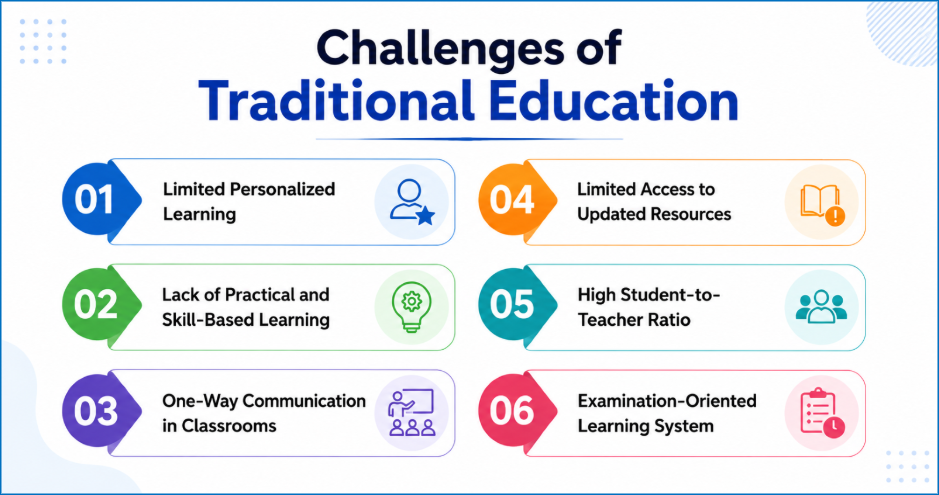
1. Limited Personalized Learning
Traditional classrooms follow the same teaching method for all students regardless of their learning pace.
As a result, some students struggle to understand concepts while others feel unchallenged.
2. Lack of Practical and Skill-Based Learning
Traditional education mainly focuses on theoretical knowledge and memorization techniques.
Students often receive fewer opportunities for hands-on experience and real-world skill development.
3. One-Way Communication in Classrooms
Teachers usually deliver lectures while students remain passive listeners during lessons.
This method reduces classroom interaction, creativity, and active participation in learning.
4. Limited Access to Updated Resources
Printed textbooks and fixed syllabi may not include the latest information and industry trends.
Therefore, students may learn outdated concepts that are less relevant in modern careers.
5. High Student-to-Teacher Ratio
Large classroom sizes make it difficult for teachers to provide individual attention to every student.
Consequently, many learners face difficulties in clearing doubts and improving performance.
6. Examination-Oriented Learning System
Traditional education often emphasizes marks and examinations more than actual understanding.
This approach increases academic pressure and reduces innovation, curiosity, and critical thinking skills.
The Future of AI in Education and How LearnQoch Supports Educational Institutions
LearnQoch supports students, teachers, parents, administrators, and institutional staff through AI-powered educational solutions and smart automation systems. As a result, institutions can improve academic management, communication, and learning experiences efficiently.
For students, LearnQoch provides smart LMS platforms, digital learning resources, online assessments, and personalized learning support. Consequently, students can access learning materials anytime and improve engagement and academic performance.
For teachers, LearnQoch simplifies attendance tracking, timetable management, assignment handling, grading, and report generation through automation. Therefore, teachers can focus more on effective teaching and student development instead of repetitive administrative work.
For parents, the platform offers real-time notifications regarding attendance, academic progress, examinations, fees, and important announcements. This transparency strengthens parent involvement and improves communication with institutions.
For administrators and staff members, LearnQoch offers AI-powered ERP systems, exam management solutions, data analytics, and automated workflows. Furthermore, these tools reduce manual workload, improve operational accuracy, and support faster decision-making processes.
By integrating advanced AI technologies into academic operations, LearnQoch helps educational institutions become more efficient, organized, and future-ready in the digital education era.
Conclusion
Artificial intelligence is transforming education by improving learning experiences, simplifying administration, and supporting institutional growth. Moreover, AI technologies align strongly with NEP 2020 goals and the Viksit Bharat vision for digital transformation.
Institutions adopting AI-powered solutions can enhance academic quality, operational efficiency, and student success significantly. Therefore, the future of education will depend heavily on intelligent technologies that create smarter, more accessible, and more efficient learning ecosystems.
The LearnQoch AI-powered Academic Platform
Exams are only one part of academic management. LearnQoch goes further by providing an integrated platform that covers all aspects of institutional growth:

Institutional Digital Ecosystem: Categories & Modules
A. LearnQoch AI-powered Core Academic & Learning Solutions
Facilitates modern teaching and learning while tracking student progress, assignments, assessments, and course outcomes.
Focuses on measuring learning outcomes to ensure skills, competencies, and academic objectives are met effectively.
- LearnQoch AI-powered Academic Calendar & Events
Maintains academic schedules, holidays, events, and exam timelines for seamless yearly planning.
- LearnQoch AI-powered Class Module
Manages class creation, faculty allocation, and student grouping while supporting timetable integration.
B. LearnQoch AI-powered Examination & Evaluation Management
LearnQoch AI-Powered Exam Management Module
A unified system that digitizes the entire exam cycle—right from planning, subject allocation, ATKT processing, and scheduling to question paper creation, assessments, evaluation, and result generation. It ensures transparency, accuracy, and smooth coordination across all departments.
C. LearnQoch AI-powered Campus Administration & Operations
Streamlines administrative activities, simplifies student data management, and ensures workflow automation across all departments.
- LearnQoch AI-powered Task Management
Organizes, prioritizes, and tracks institutional tasks to improve productivity and accountability.
- LearnQoch AI-powered Committee Module
Handles committee formation, roles, activities, and meeting records to maintain governance transparency.
- LearnQoch AI-powered Document Management
Stores, organizes, and retrieves institutional documents with version control and compliance tracking.
- LearnQoch AI-powered Certificate Management
Manages creation and issuance of academic and administrative certificates such as Bonafide, character, and leaving certificates.
D. LearnQoch AI-powered Finance & Fees Management
- LearnQoch AI-powered Finance Module – Receivable (Fees)
Tracks payments, manages fee categories, handles tuition/fines, and maintains fee-related records.
- LearnQoch AI-powered Advanced Fees
Payments made before the due date, helping institutions and parents manage fee planning efficiently.
- LearnQoch AI-powered Excess Fees
Extra amount paid unintentionally; recorded for adjustment in future payments or refunded when necessary.
E. LearnQoch AI-powered Library & Resource Management
LearnQoch AI-powered Library Module
Manages book registration, issue-return process, renewals, student access, and availability tracking for efficient library operations.
F. LearnQoch AI-powered Placement & Career Development
- LearnQoch AI-powered Placement Module
Manages job postings, student registration, interview updates, and final offer letters with complete transparency for TPOs and students.
- LearnQoch AI-powered Skill Development Solutions
Equips students with future-ready skills to enhance employability and prepare for global career opportunities.
G. LearnQoch AI-powered Accreditation & Compliance
LearnQoch AI-powered NAAC, NBA & NIRF Compliance
Simplifies reporting, monitoring, and auditing with ready-to-use compliance tools that reduce institutional workload.
H. LearnQoch AI-powered Digital Presence & Branding
LearnQoch AI-powered Website & Digital Marketing Solutions
Helps institutions build a strong online presence, attract prospective students, and engage key stakeholders effectively.
Experience LearnQoch in Action.
We invite you to experience the transformative impact of LearnQoch’s AI-powered Digitize Platform with a 14-Day Free Trial.
During this period, our team will implement the software for your institution, allowing you to explore its features firsthand and see the difference it can make in academic management.
👉 Are you ready to lead your institution into the future of campus management?
📞 Contact us at +91 84519 01079
📧 Email: info@learnqoch.com / sales@learnqoch.com
Explore What LearnQoch Offers:
Visit www.learnqoch.com for full details.
Shape the Future of Learning.
Let LearnQoch help your institution move from paperwork to performance.
Also Read,
Implement NEP 2020: Where Technology & AI Matter in Education?
Why is AI a must in your institute?