

A complete guide on Coding for kids


The First Industrial Revolution (late 18th century) and the Second Industrial Revolution (late 19th to early 20th century) occurred during the colonial period when India was exploited for economic gain. Thus, the benefits of mechanization, electricity, and mass production could not be derived by the Indian economy. Although India was a part of the Third Industrial Revolution, which was based on computers and information technology in the late 20th century, it remained a developing country and was struggling to develop its industrial sector. For young learners interested in technology, resources like kids coding guide Mumbai can help build foundational skills in computing and programming, preparing them to contribute to India’s future industrial and technological growth.
However, the Fourth Industrial Revolution, also known as Industry 4.0, is moving at an unprecedented and exponential rate. The technologies involved in the Fourth Industrial Revolution include Artificial Intelligence (AI), Augmented Reality (AR), Virtual Reality (VR), Internet of Things (IoT), robotics, big data, and automation. Therefore, the Indian industries, including manufacturing, communication, media, logistics, and banking, are increasingly adopting smart technologies to improve their productivity, efficiency, and competitiveness in the global market.
Relation with Industrial Revolution…
In addition, Industry 4.0 places a great deal of importance on computer programming, robotics, and coding. As a result, the education system worldwide is undergoing changes to incorporate these skills in children from a young age. In this regard, the National Education Policy 2020 (NEP 2020) in India plays a critical role. The NEP 2020 supports coding, computational thinking, vocational education, and experiential education from a primary level onwards. Furthermore, it supports digital literacy, multidisciplinary education, and innovation education to equip children for a technology-based economy.
In this way, through the alignment of the education system with Industry 4.0 requirements, India is not only equipping its children with the necessary skills for the 21st century but also ensuring the long-term economic development of the country.
We might compete with China in terms of manufacture, but India can definitely give a tough competition in Technology.
This blog explore
This blog explores how the evolution of the Industrial Revolutions—especially the rise of Industry 4.0—has reshaped the global economy and highlighted the urgent need for technology-driven skills. It explains how India, despite missing earlier industrial advantages, is now rapidly adopting advanced technologies like AI, IoT, and automation to stay competitive. In this context, the blog connects the importance of education reforms aligned with the National Education Policy 2020 (NEP 2020), which emphasizes coding, computational thinking, and digital literacy from an early age.
Furthermore, the blog highlights why coding is becoming an essential skill for children—not just for careers but for developing creativity, problem-solving, and logical thinking. It also addresses common concerns about early learning and explains how coding can be introduced through engaging, gamified, and age-appropriate methods like block-based programming.
In addition, the blog showcases how LearnQoch supports this transformation by offering interactive, project-based, and industry-aligned coding programs. With features like learning progressions, assessment mechanisms, and real-world exposure, it ensures effective skill development for young learners. Resources such as kids coding guide Mumbai further complement these programs by providing step-by-step guidance, making coding accessible, engaging, and practical for children.
Ultimately, the blog emphasizes that early exposure to coding, combined with the right EdTech platform, empowers students with future-ready skills, aligns with NEP 2020 goals, and contributes to India’s long-term technological and economic growth.
Why should kids learn coding?
Coding is a basic literacy in the digital age, and kids need to understand and work with and understand the technology around them. Coding enables children to become independent citizens in a world where technology is ubiquitous.
Learning to code helps students better understand one aspect of the digital world in which we live and, in some ways, become better prepared for it. The objective behind learning to code is no longer restricted to becoming a skilled coder and meeting the job market’s needs. It enables children to progress in all aspects of life & helps children with communication, creativity, math, writing, and confidence.
“Teaching kids coding is an investment in your child’s future”
When should kids learn to code?
Can we teach coding to a student who is in grade 1?
Yes, And why not? Learning how to code at an early age can set your child up for a lifetime of success.
According to cognitive-development theory, children at the age of 5 are in the preoperational stage. At this stage, a child begins to understand the world through the use of mental representations via words and images.
Following this theory – and other modern accessibility of educational technology – many experts agree that a child can start learning to code at 5 years old.
Now, some parents may feel apprehensive about this age. And we understand that.
But did you know that coding basics can be gamified (and simplified) to make it more kid-friendly?
LearnQoch teaches the concept of block-based coding to kids. They incorporate visual coding blocks into fun, colorful games that both engage and educate a child. The combination of block coding and visual programming is much less overwhelming, making it easier for young learners to grasp concepts. For students across the region, the LearnQoch complete coding Vidarbha program provides a structured pathway, ensuring comprehensive learning from basics to more advanced coding skills.
How LearnQoch can help Kids Learn Coding?
LearnQoch runs the best online coding classes for kids. LearnQoch powers the creativity of thousands of students and serves hundreds of schools. Students learn the basics of an “area” or take a series of courses that, over time, provide the ability to communicate complex ideas effectively. For learners in Nagpur, resources like the kids coding roadmap Nagpur guide students step-by-step, helping them progress from simple coding concepts to advanced projects with confidence.
Our interactive story-based learning allows kids and teens to learn the basics with easy block-based coding challenges before seamlessly transitioning to real-world text-based languages like JavaScript and Python
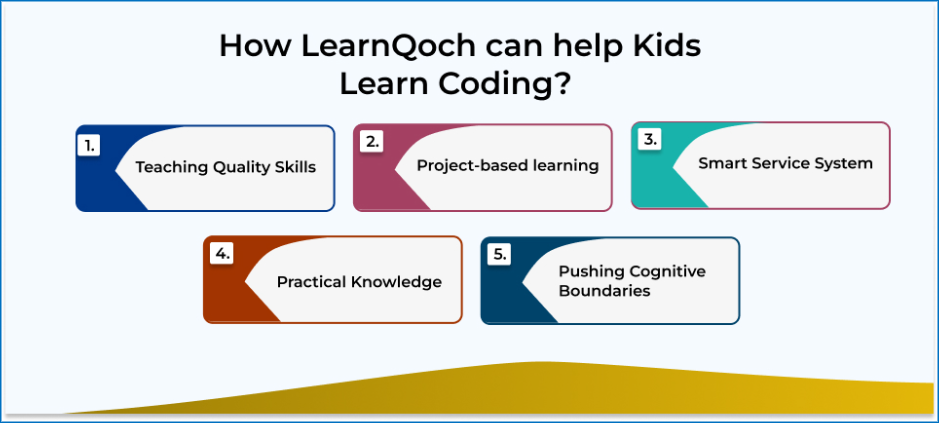
- Teaching Quality Skills – Strict selection of faculty, trained under exclusive Inhouse mentoring System, ensures higher standards.
- Project-based learning material and projects for each month, which breaks down into weekly phases.
- Smart Service System – Teacher-student class sessions support a best-in-class LMS system to track the progress of individual students.
- Practical Knowledge – Sessions focus on Foundation building and all practical – no Theory.
- Pushing Cognitive Boundaries – Instilling skills like Computational Thinking and Enhancing Left and Right Brain Development.
In the last couple of years, lots of online players have started teaching coding. They miss the following points to make you a successful coder.
- Learning progressions
- Mechanism to check the understanding
- Association with the industry to implement concepts in real environments.
Hence, LearnQoch is very unique in terms of
- Industry based curriculum
- Align with the central agencies.
- Hybrid model – industry academic and based teachers & trainers
- We also provide our ed tech platform & LMS to check the understanding of a student and learning progression.
Conclusion
In light of the exponential changes brought about by the Fourth Industrial Revolution, it is the need of the hour for parents and students to make informed and future-oriented decisions regarding education. Coding, robotics, and technology skills are no longer a luxury but a necessity in a technology-driven world. Hence, we would like to strongly emphasize that parents and students should invest their precious time, effort, and resources in learning from authentic and credible EdTech partners.
The best online coding courses should have industry-oriented and project-based learning content that is relevant to real-world applications such as AI, Data Science, and IoT. In addition to this, a robust Learning Management System is essential for organized learning, tracking progress, and providing engaging experiences. Industry-experienced faculty members play a key role in offering real-world insights and guidance. For beginners and young learners, resources like the coding guide Mumbai serve as an excellent roadmap, helping them navigate these courses effectively and build practical skills step by step.
In line with the vision of the National Education Policy 2020, early introduction to coding and computational thinking helps students prepare for the future. Finally, making the right choice with the EdTech platform enables students to acquire future-ready skills and helps build a strong economic future for India.
The LearnQoch AI powered Academic Platform
LearnQoch goes further by providing an integrated platform that covers all aspects of institutional growth:

Institutional Digital Ecosystem: Categories & Modules
A. LearnQoch AI powered Core Academic & Learning Solutions
Facilitates modern teaching and learning while tracking student progress, assignments, assessments, and course outcomes.
Focuses on measuring learning outcomes to ensure skills, competencies, and academic objectives are met effectively.
- LearnQoch AI powered Academic Calendar & Events
Maintains academic schedules, holidays, events, and exam timelines for seamless yearly planning.
- LearnQoch AI powered Class Module
Manages class creation, faculty allocation, and student grouping while supporting timetable integration.
B. LearnQoch AI powered Examination & Evaluation Management
LearnQoch AI Powered Exam Management Module
A unified system that digitizes the entire exam cycle—right from planning, subject allocation, ATKT processing, and scheduling to question paper creation, assessments, evaluation, and result generation. It ensures transparency, accuracy, and smooth coordination across all departments.
C. LearnQoch AI powered Campus Administration & Operations
Streamlines administrative activities, simplifies student data management, and ensures workflow automation across all departments.
- LearnQoch AI powered Task Management
Organizes, prioritizes, and tracks institutional tasks to improve productivity and accountability.
- LearnQoch AI powered Committee Module
Handles committee formation, roles, activities, and meeting records to maintain governance transparency.
- LearnQoch AI powered Document Management
Stores, organizes, and retrieves institutional documents with version control and compliance tracking.
- LearnQoch AI powered Certificate Management
Manages creation and issuance of academic and administrative certificates such as Bonafide, character, and leaving certificates.
D. LearnQoch AI powered Finance & Fees Management
- LearnQoch AI powered Finance Module – Receivable (Fees)
Tracks payments, manages fee categories, handles tuition/fines, and maintains fee-related records.
- LearnQoch AI powered Advanced Fees
Payments made before the due date, helping institutions and parents manage fee planning efficiently.
- LearnQoch AI powered Excess Fees
Extra amount paid unintentionally; recorded for adjustment in future payments or refunded when necessary.
E. LearnQoch AI powered Library & Resource Management
LearnQoch AI powered Library Module
Manages book registration, issue-return process, renewals, student access, and availability tracking for efficient library operations.
F. LearnQoch AI powered Placement & Career Development
- LearnQoch AI powered Placement Module
Manages job postings, student registration, interview updates, and final offer letters with complete transparency for TPOs and students.
- LearnQoch AI powered Skill Development Solutions
Equips students with future-ready skills to enhance employability and prepare for global career opportunities.
G. LearnQoch AI powered Accreditation & Compliance
LearnQoch AI powered NAAC, NBA & NIRF Compliance
Simplifies reporting, monitoring, and auditing with ready-to-use compliance tools that reduce institutional workload.
H. LearnQoch AI powered Digital Presence & Branding
LearnQoch AI powered Website & Digital Marketing Solutions
Helps institutions build a strong online presence, attract prospective students, and engage key stakeholders effectively.
Don’t Just Take Our Word for It—Try LearnQoch Yourself!
We invite you to experience the transformative impact of LearnQoch’s AI powered Digitize Platform with a 14-Day Free Trial.
During this period, our team will implement the software for your institution, allowing you to explore its features firsthand and see the difference it can make in academic management.
👉 Are you ready to lead your institution into the future of campus management?
📞 Contact us at +91 84519 01079
📧 Email: info@learnqoch.com / sales@learnqoch.com
Explore What LearnQoch Offers:
Visit www.learnqoch.com for Full Details
Also read,
From Inquiry to Enrollment: Mapping the Student Journey via Your Website
5 Things Every Principal Needs to Know About Exam Management Technology
Coding and Robotics in Remote Learning: Strategies for Success
Best LMS for Schools: The Future of Learning Management Systems