



Students Performance as defined by NBA Accreditation


Another key step in the accreditation process conducted by the National Board of Accreditation is the preparation of the Self-Assessment Report (SAR). The SAR is of critical importance as it helps in assessing the overall quality, effectiveness, and performance of an institution. Moreover, it provides a comprehensive overview of academic practices, infrastructure, and institutional processes. Furthermore, the SAR is prepared through a detailed self-evaluation of internal work processes and activities carried out by the institution. In addition, it enables institutions to analyze their strengths, identify areas for improvement, and maintain transparency in academic operations. Therefore, it becomes essential for institutions to present clear, accurate, and well-documented information while preparing the SAR so that evaluators can effectively assess the institution’s standards and quality.
Moreover, another important criterion that needs to be focused upon while preparing the Self-Assessment Report is Student Performance, especially for institutions aiming to achieve NBA accreditation best in India. In this regard, this criterion assesses various key areas of an institution, including student success rate, academic performance, and higher education opportunities. Additionally, it evaluates how effectively institutions support student performance and overall achievement. Furthermore, in the same context, it is observed that the objectives of this criterion strongly align with the vision of the National Education Policy 2020. Therefore, it is essential for institutions to consistently focus on student performance and academic excellence to successfully meet NBA accreditation standards and stand out at a national level.
Students Performance
The outcome of the program offered describes the knowledge and skills of a student. Assessment of these outcomes can be done in two ways that are direct and indirect. Direct methods can include direct examination and observation of students’ knowledge in measurable indicators. Indirect methods can be based on ascertaining opinion or self-reporting.
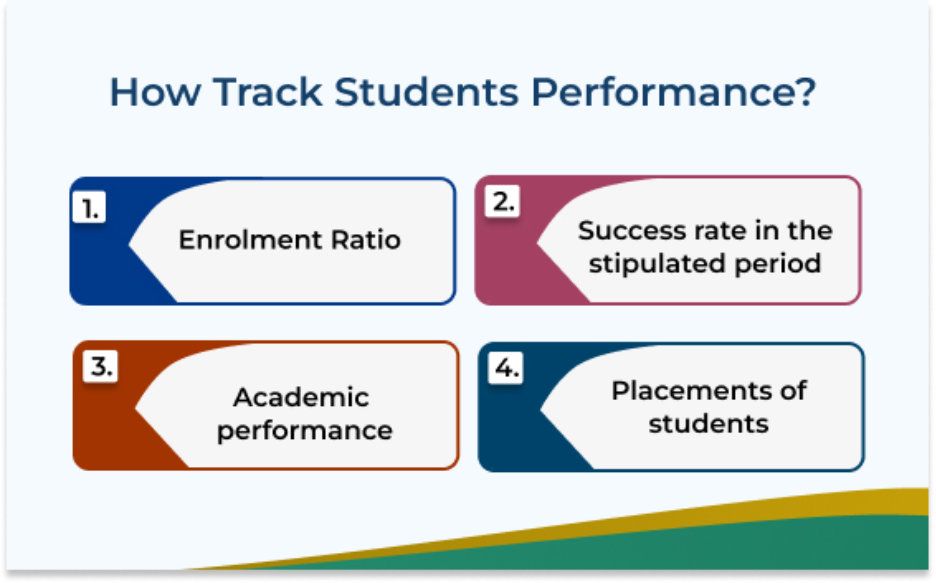
Enrolment Ratio
Enrolment Ratio= N1/N
| Item Marks (Students enrolled at the first year on a average basis during the period of assessment) | Marks |
| >= 90% students | 20 |
| >= 80% students | 18 |
| >= 70% students | 16 |
| >= 60% students | 14 |
| Otherwise | 0 |
Success rate in the stipulated period of the program
2.1. Rate of success without backlogs in any semester or year of study
SI = (no. of all the students who have graduated from the program without backlog) / (no. of all the students admitted in the first year of that batch and admitted in 2nd year via lateral entry and separate division, if applicable)
Average SI = Mean of Success Index(SI) for past three batches Success rate without backlogs in any year of study = 25 × AverageSI
2.2. Rate of success in stipulated period
SI=(no. of all the students who graduated from the program in the stipulated period of course duration) / (no. of all the students admitted in the first year of that batch and admitted in 2nd year via lateral entry and separate division, if applicable)
Average SI = mean of Success Index (SI) for past three batches Assessment = 15 × Average SI
Academic Performance in Second Year
Academic Performance = 1.5 * Average API
API= Academic Performance Index
API = ((Mean of 2nd year average grade point of all successful students on a 10 point scale)
or
API= (Mean of the percentage of marks of all successful students in Second Year / 10)x (number of successful students / number of students appeared in the examination)
Successful students are the students who are permitted to proceed to the final year.
Placement, Higher Studies and Entrepreneurship
Assessment Score = 40*(Average Placement)
Placement Index = (x+y+z)/N
Average Placement = (P1 + P2 + P3)/3
N= total no. of final year students.
X= no. of students who get a placement in the companies or government sector.
Y= no. of students admitted who are admitted for higher studies with valid qualifying scores.
Z= no. of students turned entrepreneurs in engineering/technology.
One of the most crucial documents of the NBA accreditation process is the self-assessment report. A self-assessment report is a place where a lot of mistakes occur, but it should be error-free and clear to be accepted by the NBA.
NBA has already mentioned that the Self-assessment reports should be error free to get accreditation; the LearnQoch’s ERP and LMS solution can take you one step closer.
What LearnQoch Does?
LearnQoch AI-powered LMS is specifically designed and developed to help higher educational institutions efficiently manage their data and generate error-free accreditation reports. Moreover, our accreditation management software serves as a comprehensive, one-stop solution that simplifies complex processes. In addition, it streamlines data collection, organization, and reporting, thereby reducing manual effort and minimizing errors. As a result, institutions can seamlessly work towards achieving NBA accreditation. Ultimately, LearnQoch enables institutions to attain accreditation successfully while enhancing overall operational efficiency and academic quality.
Our NBA accreditation software offers a detailed analysis of data entered by the institution, resulting in helping you to compile and handle data from one centralized platform. The benefit of learning management software is not only accreditation data management, but it goes beyond it.
Use LearnQoch software to get personalized learning and teaching plans which’ll improve teaching outcomes. Identify slow, average, and fast learners from our next generation of LMS software. Provide personal feedback to individual teachers to improve their performance. Use LearnQoch software to monitor, measure, and analyze all critical learning and teaching processes. Let students and teachers engage to improve their understanding and learning outcomes
LearnQoch is a Web and Cloud-based integrated ERP & LMS software designed for educational institutions. It automates the lengthy process of management & smooth organization operations such as student admission operations & management, fee payments, transportational operations, digital library, enrolment process, MIS reports (often requested by NAAC) and many more. Your educational institutions will have superior & standout points from the other organizations with the help of our Accreditation Management Software.
Conclusion
Thus, in conclusion, it is clearly understood that the Self-Assessment Report (SAR) is an integral part of the accreditation process conducted by the National Board of Accreditation for educational institutions, especially for Mumbai and Nagpur colleges striving for academic excellence. Moreover, with respect to the Student Performance criterion, institutions can effectively evaluate student success, academic progress, and career prospects. Furthermore, this evaluation helps measure key outcomes such as placements, higher studies, and entrepreneurship opportunities. In addition, the implementation of the National Education Policy 2020 strongly aligns with this criterion, as it emphasizes outcome-based education, skill development, and holistic student growth. Consequently, by continuously improving student performance and maintaining proper documentation in the SAR, institutions can enhance academic quality and successfully achieve NBA accreditation, thereby strengthening their reputation and competitiveness.
The LearnQoch AI powered Academic Platform
LearnQoch goes further by providing an integrated platform that covers all aspects of institutional growth:

Institutional Digital Ecosystem: Categories & Modules
A. LearnQoch AI powered Core Academic & Learning Solutions
Facilitates modern teaching and learning while tracking student progress, assignments, assessments, and course outcomes.
Focuses on measuring learning outcomes to ensure skills, competencies, and academic objectives are met effectively.
- LearnQoch AI powered Academic Calendar & Events
Maintains academic schedules, holidays, events, and exam timelines for seamless yearly planning.
- LearnQoch AI powered Class Module
Manages class creation, faculty allocation, and student grouping while supporting timetable integration.
B. LearnQoch AI powered Examination & Evaluation Management
LearnQoch AI Powered Exam Management Module
A unified system that digitizes the entire exam cycle—right from planning, subject allocation, ATKT processing, and scheduling to question paper creation, assessments, evaluation, and result generation. It ensures transparency, accuracy, and smooth coordination across all departments.
C. LearnQoch AI powered Campus Administration & Operations
Streamlines administrative activities, simplifies student data management, and ensures workflow automation across all departments.
- LearnQoch AI powered Task Management
Organizes, prioritizes, and tracks institutional tasks to improve productivity and accountability.
- LearnQoch AI powered Committee Module
Handles committee formation, roles, activities, and meeting records to maintain governance transparency.
- LearnQoch AI powered Document Management
Stores, organizes, and retrieves institutional documents with version control and compliance tracking.
- LearnQoch AI powered Certificate Management
Manages creation and issuance of academic and administrative certificates such as Bonafide, character, and leaving certificates.
D. LearnQoch AI powered Finance & Fees Management
- LearnQoch AI powered Finance Module – Receivable (Fees)
Tracks payments, manages fee categories, handles tuition/fines, and maintains fee-related records.
- LearnQoch AI powered Advanced Fees
Payments made before the due date, helping institutions and parents manage fee planning efficiently.
- LearnQoch AI powered Excess Fees
Extra amount paid unintentionally; recorded for adjustment in future payments or refunded when necessary.
E. LearnQoch AI powered Library & Resource Management
LearnQoch AI powered Library Module
Manages book registration, issue-return process, renewals, student access, and availability tracking for efficient library operations.
F. LearnQoch AI powered Placement & Career Development
- LearnQoch AI powered Placement Module
Manages job postings, student registration, interview updates, and final offer letters with complete transparency for TPOs and students.
- LearnQoch AI powered Skill Development Solutions
Equips students with future-ready skills to enhance employability and prepare for global career opportunities.
G. LearnQoch AI powered Accreditation & Compliance
LearnQoch AI powered NAAC, NBA & NIRF Compliance
Simplifies reporting, monitoring, and auditing with ready-to-use compliance tools that reduce institutional workload.
H. LearnQoch AI powered Digital Presence & Branding
LearnQoch AI powered Website & Digital Marketing Solutions
Helps institutions build a strong online presence, attract prospective students, and engage key stakeholders effectively.
Don’t Just Take Our Word for It—Try LearnQoch Yourself!
We invite you to experience the transformative impact of LearnQoch’s AI powered Digitize Platform with a 14-Day Free Trial.
During this period, our team will implement the software for your institution, allowing you to explore its features firsthand and see the difference it can make in academic management.
👉 Are you ready to lead your institution into the future of campus management?
📞 Contact us at +91 84519 01079
📧 Email: info@learnqoch.com / sales@learnqoch.com
Explore What LearnQoch Offers:
Visit www.learnqoch.com for Full Details
Also read,
From Inquiry to Enrollment: Mapping the Student Journey via Your Website
5 Things Every Principal Needs to Know About Exam Management Technology
Coding and Robotics in Remote Learning: Strategies for Success
Best LMS for Schools: The Future of Learning Management Systems
FAQS
1. What is the Self-Assessment Report (SAR) in NBA accreditation?
The Self-Assessment Report is a key document required by the National Board of Accreditation that presents an institution’s self-evaluation of its academic processes, performance, and quality standards.
2. Why is the SAR important in the NBA accreditation process?
The Self-Assessment Report (SAR) is important in the accreditation process of the National Board of Accreditation because it provides a clear overview of an institution’s teaching–learning practices, infrastructure, student performance, and overall academic quality. Moreover, it helps evaluators assess whether the institution meets the required standards.
3. What does the Student Performance criterion focus on?
The Student Performance criterion mainly evaluates student success rate, academic results, placements, and opportunities for higher education.
4. How does student performance impact NBA accreditation?
Strong student performance indicates effective teaching and learning practices, which positively influences the accreditation outcome.
5. How is this criterion related to NEP 2020?
The focus on student outcomes and skill development aligns with the goals of the National Education Policy 2020, which emphasizes outcome-based education and holistic student development.