

How to Check Students’ Concept Understanding Daily?


In today’s rapidly evolving education system, teachers face a major challenge in determining whether students truly grasp concepts after each class. Additionally, assessing each student’s level of understanding within limited classroom time is often difficult. When this question was asked to over 1,000 principals, teachers, and parents, nearly all agreed that it is almost impossible to monitor concept understanding on a daily basis.
However, if educators do not address this issue regularly, gaps in learning may gradually develop. Consequently, these gaps can create difficulties for students as they move to the next grade level. Furthermore, students are often expected to have prior knowledge of previously taught concepts, which may lead to confusion, stress, and lack of confidence if those concepts were not clearly understood earlier.
Therefore, it is crucial for teachers and educational institutions to help students identify their learning gaps promptly. Regular feedback and continuous assessment can support students in enhancing their understanding and reinforcing their concepts. Ultimately, when students address their learning gaps early, they become more confident, motivated, and better prepared for future academic challenges through LMS formative assessment.
We have ~300Mn+ students in our education system in K-12 & Higher Education and ~60%+ are not employable because they don’t have the basic skill set which is required by the industry.
In the current technological era of the 4IR, it is essential to understand that technology is constantly changing how we live, work, and learn. This revolution is driven by powerful technologies like Artificial Intelligence (AI), robotics, Internet of Things (IoT), genetic engineering, and quantum computing. For students to be relevant in the current world and in future careers, it is essential to understand that it is crucial for students to have a solid foundation in STEM: Science, Technology, Engineering, and Math. Once students understand basic STEM concepts, it is essential for them to understand that it enables students to think innovatively and creatively. Therefore, it is essential for students to have a solid foundation in STEM to help them adapt to the current technological world.
In today’s digital learning environment
In today’s digital learning environment, it is recommended that Mumbai schools, Nagpur colleges, and Vidarbha schools use advanced EdTech software for better student learning outcomes. These technologies can create customized learning reports for all stakeholders in the learning process: students, teachers, parents, and trustees. Hence, all stakeholders can take timely steps in the learning process. These technologies can identify knowledge gaps in subject-wise, chapter-wise, and topic-wise knowledge acquisition for improved learning outcomes.
In addition, if personalized learning materials like reading materials and videos are used for learning, students can use these materials for better learning at any given time. Once the learning process is complete, topic-wise assessments must be undertaken to understand how well each student is learning. Based on the assessments, it is recommended that a scientific and personalized learning plan be created for better knowledge acquisition. Finally, reassessment must be undertaken to ensure that students understand all the concepts well, completing the learning process successfully. LearnQoch LMS facilitates this entire process, providing tools for personalized content, assessments, and progress tracking to enhance student learning outcomes.
All this is achievable through technology and the involvement of all the stakeholders. Let’s remove the mystery from the education system and adopt a data-based approach to strengthen the knowledge of every teacher and student.
Ways Teachers Can Check Students’ Concept Understanding Every Day
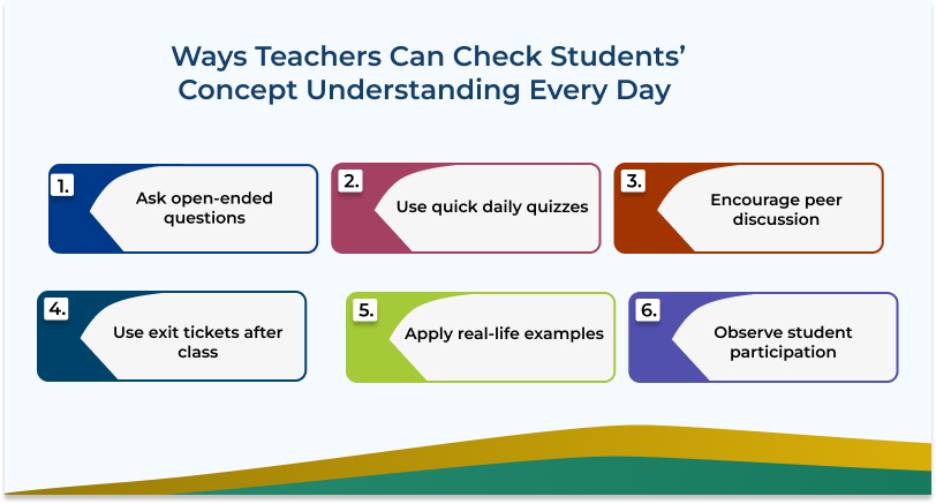
- Ask Open-Ended Questions
Encourage students to explain concepts in their own words instead of giving yes/no answers.
- Use Quick Daily Quizzes
Short quizzes help teachers instantly check whether students understood the concept.
- Think–Pair–Share Method
Students first think individually, then discuss with a partner, and finally share with the class.
- Concept Mapping
Ask students to create small concept maps to show how different ideas are connected.
- Exit Tickets
At the end of the class, ask students to write one thing they learned and one doubt they still have.
- Peer Teaching
Let students explain the topic to classmates. Teaching others often reveals their level of understanding.
- Interactive Polls or Digital Tools
Use online tools or classroom apps to quickly collect students’ responses and feedback.
- Observation of Participation
Teachers can observe students’ engagement, questions, and body language to gauge understanding.
- Real-Life Application Questions
Ask students how they would apply the concept in real-life situations.
- Encourage Reflection
Ask students to reflect on what they understood and where they need more clarity.
Conclusion
In conclusion, educators may find it difficult to track students’ learning progress on a daily basis; however, they can address this challenge effectively by using the right technology. As the education system continues to evolve in response to the demands of the Fourth Industrial Revolution (4IR), teachers must equip students with strong knowledge in STEM subjects—Science, Technology, Engineering, and Mathematics—to help them stay relevant in their future careers.
By actively integrating technology and continuous learning assessments, educators can transform the traditional learning process into a more effective and engaging experience. Moreover, teachers, parents, students, and educational institutions must work together to support the learning journey. Through collaboration and the adoption of modern learning approaches, educators can significantly improve the quality of education and ensure that students develop the knowledge, skills, and conceptual understanding required for future success.
The LearnQoch AI powered Academic Platform
LearnQoch goes further by providing an integrated platform that covers all aspects of institutional growth:

Institutional Digital Ecosystem: Categories & Modules
A. LearnQoch AI powered Core Academic & Learning Solutions
Facilitates modern teaching and learning while tracking student progress, assignments, assessments, and course outcomes.
Focuses on measuring learning outcomes to ensure skills, competencies, and academic objectives are met effectively.
- LearnQoch AI powered Academic Calendar & Events
Maintains academic schedules, holidays, events, and exam timelines for seamless yearly planning.
- LearnQoch AI powered Class Module
Manages class creation, faculty allocation, and student grouping while supporting timetable integration.
B. LearnQoch AI powered Examination & Evaluation Management
LearnQoch AI Powered Exam Management Module
A unified system that digitizes the entire exam cycle—right from planning, subject allocation, ATKT processing, and scheduling to question paper creation, assessments, evaluation, and result generation. It ensures transparency, accuracy, and smooth coordination across all departments.
C. LearnQoch AI powered Campus Administration & Operations
Streamlines administrative activities, simplifies student data management, and ensures workflow automation across all departments.
- LearnQoch AI powered Task Management
Organizes, prioritizes, and tracks institutional tasks to improve productivity and accountability.
- LearnQoch AI powered Committee Module
Handles committee formation, roles, activities, and meeting records to maintain governance transparency.
- LearnQoch AI powered Document Management
Stores, organizes, and retrieves institutional documents with version control and compliance tracking.
- LearnQoch AI powered Certificate Management
Manages creation and issuance of academic and administrative certificates such as Bonafide, character, and leaving certificates.
D. LearnQoch AI powered Finance & Fees Management
- LearnQoch AI powered Finance Module – Receivable (Fees)
Tracks payments, manages fee categories, handles tuition/fines, and maintains fee-related records.
- LearnQoch AI powered Advanced Fees
Payments made before the due date, helping institutions and parents manage fee planning efficiently.
- LearnQoch AI powered Excess Fees
Extra amount paid unintentionally; recorded for adjustment in future payments or refunded when necessary.
E. LearnQoch AI powered Library & Resource Management
LearnQoch AI powered Library Module
Manages book registration, issue-return process, renewals, student access, and availability tracking for efficient library operations.
F. LearnQoch AI powered Placement & Career Development
- LearnQoch AI powered Placement Module
Manages job postings, student registration, interview updates, and final offer letters with complete transparency for TPOs and students.
- LearnQoch AI powered Skill Development Solutions
Equips students with future-ready skills to enhance employability and prepare for global career opportunities.
G. LearnQoch AI powered Accreditation & Compliance
LearnQoch AI powered NAAC, NBA & NIRF Compliance
Simplifies reporting, monitoring, and auditing with ready-to-use compliance tools that reduce institutional workload.
H. LearnQoch AI powered Digital Presence & Branding
LearnQoch AI powered Website & Digital Marketing Solutions
Helps institutions build a strong online presence, attract prospective students, and engage key stakeholders effectively.
Don’t Just Take Our Word for It—Try LearnQoch Yourself!
We invite you to experience the transformative impact of LearnQoch’s Digitize Platform with a 14-Day Free Trial.
During this period, our team will implement the software for your institution, allowing you to explore its features firsthand and see the difference it can make in academic management.
👉 Are you ready to lead your institution into the future of campus management?
📞 Contact us at +91 84519 01079
📧 Email: info@learnqoch.com /sales@learnqoch.com
Explore What LearnQoch Offers:
Visit www.learnqoch.com for Full Details
Also read,
Teachers as Ed-Tech Integrators: Navigating the Transition
Unlocking Student Success: How Assessment and Feedback Tools in LMS Improve Learning Outcomes
Interactive Best LMS in Mumbai Features: The Secret to Engaging Classrooms with LearnQoch
Personalized Learning Journey: Customizing Education with Technology Tools
Frequently Asked Questions (FAQs)
1. How can teachers check students’ concept understanding daily?
Teachers can use digital assessments, quizzes, and EdTech platforms to evaluate students’ understanding after each lesson. These tools provide instant feedback and help identify learning gaps early.
2. Why is concept clarity important for students in today’s education system?
Concept clarity helps students build a strong foundation for advanced learning. When students clearly understand basic concepts, they perform better academically and feel more confident in higher classes.
3. How does EdTech help improve student learning outcomes?
EdTech platforms provide personalized learning reports, interactive content, and topic-based assessments. These features help teachers, parents, and students track progress and improve learning efficiency.
4. Why is STEM education important in the Fourth Industrial Revolution (4IR)?
STEM education develops critical thinking, problem-solving, and innovation skills. These abilities are essential for careers related to technologies such as Artificial Intelligence, Robotics, and the Internet of Things.
5. What role do personalized learning plans play in student success?
Personalized learning plans help students focus on their weak areas and improve their understanding step by step. They provide customized content, assessments, and guidance based on individual learning needs.