


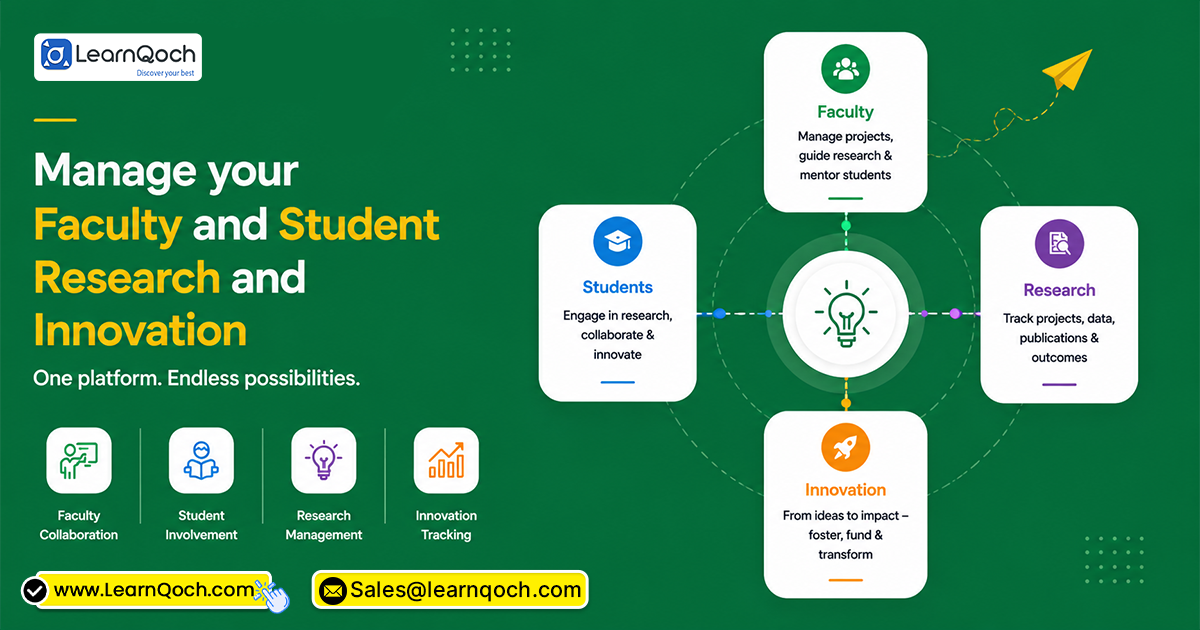
Manage your faculty and student research and innovation with LearnQoch ERP.


Introduction
Research and innovation have become essential parts of modern education systems. Today, colleges and universities focus on research publications, innovation projects, patents, startup activities, funded research, and industry collaboration. Additionally, institutions following NEP 2020, NAAC accreditation, NBA guidelines, and the vision of Viksit Bharat 2047 require proper research management and innovation tracking systems. However, many institutions still manage research activities manually through spreadsheets and paperwork. As a result, departments face delays, missing records, reporting confusion, and difficulty during audits and accreditation reviews.
A centralized ERP system helps institutions manage faculty and student research activities more efficiently. Furthermore, digital research management improves transparency, collaboration, reporting accuracy, and innovation tracking across departments. LearnQoch ERP provides centralized dashboards, research tracking systems, publication management, innovation records, fund management, grant tracking, researcher management, fund utilization monitoring, fund distribution tracking, expense management, and research request handling for institutions. Therefore, colleges and universities can simplify research management while supporting academic excellence, innovation, culture, and continuous institutional growth.
From a previous blog
In this blog, we covered the importance of database performance appraisal for modern institutions and organizations. Additionally, the blog explained challenges in manual appraisal management, centralized ERP dashboards, automated reporting, and real-time performance tracking. We also discussed department-wise benefits, data-driven decision-making, and the role of ERP systems in improving transparency and productivity. Furthermore, the blog highlighted how LearnQoch ERP helps institutions simplify appraisal management through centralized analytics, automation, and smart performance tracking solutions.
Conversation Related to Research and Innovation Management
Research Coordinator: Today is the final date for research and R&D submission, but data from every department is scattered in mail, spreadsheets, and personal folders.
Faculty Member: We are trying to gather everything in one place, but publication records, patents, and student projects are stored separately.
Admin Officer: Even the department head has some important files, but he is absent today, and his phone is not reachable.
Principal: This creates confusion every semester during report submission and accreditation of work. We need one centralized platform for all research activities.
Research Coordinator: Yesterday, I saw a LearnQoch reel showing centralized research tracking, publication management, and ERP dashboards.
Faculty Member: Yes, their system looked useful because every department could upload and manage research data from a single platform.
Principal: Then contact LearnQoch immediately and arrange a demo meeting. If their system solves this problem, it can simplify research and innovation management for the entire institution.
What Does This Blog Cover?
In this blog, we explained the importance of managing faculty and student research activities through centralized ERP systems. Additionally, the blog covers research management challenges, innovation tracking, publication management, patent records, and automated reporting systems. We also discussed department-wise benefits, real-time dashboards, research transparency, and accreditation support. Furthermore, the blog highlights how ERP systems improve collaboration, reduce manual work, and support institutional innovation culture. Finally, the blog explains how LearnQoch ERP simplifies research and innovation management through centralized dashboards and smart automation tools.
Why is research and innovation management important?
Research and innovation improve institutional quality, academic excellence, and industry collaboration. Therefore, universities and colleges continuously encourage faculty members and students to participate in research activities.

Research management helps institutions:
Institutions can track faculty research activities and monitor student innovation projects more effectively through centralized systems. Additionally, they can maintain publication records, manage patents and copyrights, and support startup activities efficiently. Furthermore, proper research management improves NAAC and NBA readiness, enhances institutional rankings, and encourages better industry collaboration.
Additionally, institutions aligned with National Education Policy 2020 focus strongly on innovation, entrepreneurship, and research-driven education systems.
Common Challenges in Manual Research Management
Many institutions still manage research activities manually, which creates several operational problems.
- Research Data in Different Departments
Publication, patent, and project records are stored separately across departments.
- Difficulty in Tracking Publications
Manual records often create missing entries and duplicate publication data.
- Time-Consuming Report Preparation
Faculty and admin teams spend excessive time preparing research reports manually.
- Lack of Centralized Innovation Tracking
Student projects, startup ideas, and innovation activities are managed separately.
- Accreditation Reporting Problems
Manual systems create confusion during NAAC and NBA documentation and verification.
Benefits of Research and Innovation Management Systems
- Improves Research Transparency
- Centralized systems maintain organized and transparent research records.
- Reduces Manual Work
- Faculty members spend less time handling spreadsheets and paperwork.
- Simplifies Accreditation Reporting
- Institutions can generate research reports instantly during NAAC and NBA audits.
- Encourages Collaboration
- Departments can share research information and collaborate more efficiently.
- Supports Institutional Rankings
- Proper research management improves institutional visibility and ranking performance.
- Promotes Innovation Culture
- ERP systems encourage students and faculty to participate in innovation activities continuously.
Importance of Innovation in Higher Education
Innovation helps institutions improve practical learning, entrepreneurship, and industry readiness. Therefore, modern education systems encourage innovation-based learning approaches.
According to Atal Innovation Mission – Government of India, innovation and entrepreneurship are essential for future-ready education and national growth.
Additionally, innovation activities support startup culture, skill development, and industry collaboration.
Role of ERP in Research and Innovation Management
ERP systems simplify institutional operations by integrating research, academic, and administrative activities on a centralized platform.
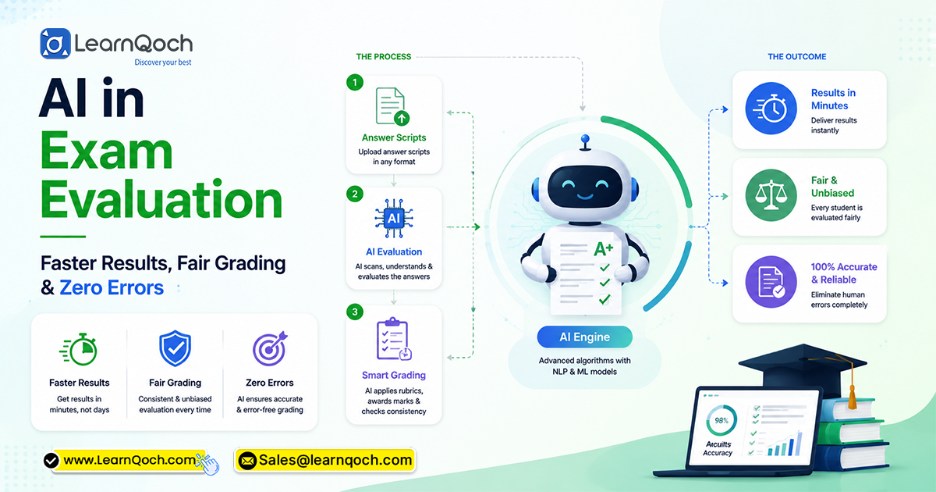
According to Wikipedia—Enterprise Resource Planning, ERP systems integrate organizational processes for improved operational efficiency and centralized management.
Therefore, research ERP systems to help institutions.
- Store research data centrally
- Automate reporting processes
- Track innovation activities
- Improve collaboration between departments
- Simplify accreditation documentation
- Monitor institutional performance continuously
You can also explore research and ERP management insights on the official LearnQoch website.
How Does LearnQoch ERP Help Manage Research and Innovation?
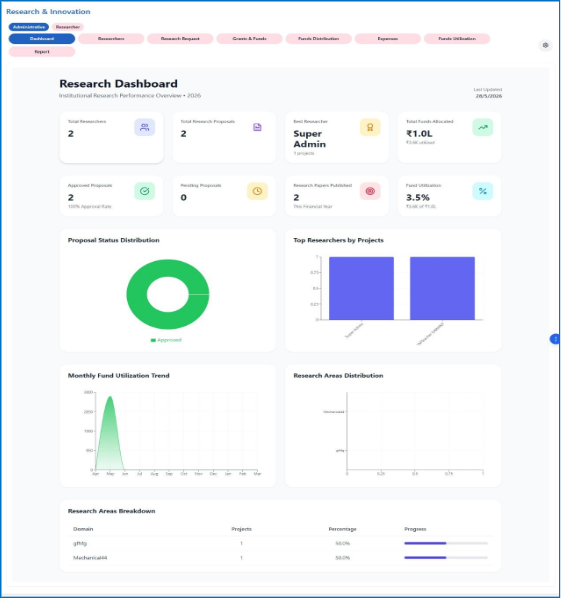
- Centralized Dashboard Management: Connects all research activities, grants, publications, expenses, and innovation records through one dashboard.
- Research Fund Management: Helps institutions manage research funds, approvals, and financial tracking efficiently.
- Grant Tracking System: Tracks research grants, funding status, approvals, and utilization records.
- Researcher Management: Maintains researcher profiles, activities, publications, and research contributions systematically.
- Fund Utilization Tracking: Monitors how research funds are used across departments and projects.
- Fund Distribution Management: Simplifies research fund allocation and distribution processes for institutions.
- Research Expense Tracking: Tracks research-related expenses, budgets, and financial records accurately.
- Research Request Handling: Manages research proposals, approvals, and research requests through a centralized system.
- Publication and Patent Tracking: Stores and monitors publications, patents, copyrights, and innovation activities easily.
- Student Innovation Management: Tracks student projects, startup activities, competitions, and innovation programs effectively.
- Automated Reports and Analytics: Generates research reports instantly and provides real-time analytics for performance monitoring.
- Reduced Administrative Workload: Reduces manual documentation, spreadsheets, and repetitive administrative tasks for faculty and coordinators.
Conclusion
The future of research and innovation management is moving toward AI-powered and centralized ERP systems. Additionally, institutions following NEP 2020 and Viksit Bharat 2047 require stronger research and innovation ecosystems. Therefore, manual research management is no longer effective.
LearnQoch ERP helps institutions manage research activities through centralized dashboards, publication tracking, innovation monitoring, automated reports, and real-time analytics. Furthermore, it reduces manual work, improves transparency, and supports continuous institutional growth and digital transformation.
The LearnQoch AI-powered Academic Platform
LearnQoch goes further by providing an integrated platform that covers all aspects of institutional growth:

Institutional Digital Ecosystem: Categories & Modules
A. LearnQoch AI-powered Core Academic & Learning Solutions
Facilitates modern teaching and learning while tracking student progress, assignments, assessments, and course outcomes.
Focuses on measuring learning outcomes to ensure skills, competencies, and academic objectives are met effectively.
- LearnQoch AI-powered Academic Calendar & Events
Maintains academic schedules, holidays, events, and exam timelines for seamless yearly planning.
- LearnQoch AI-powered Class Module
Manages class creation, faculty allocation, and student grouping while supporting timetable integration.
B. LearnQoch AI-powered Examination & Evaluation Management
LearnQoch AI-Powered Exam Management Module
A unified system that digitizes the entire exam cycle—right from planning, subject allocation, ATKT processing, and scheduling to question paper creation, assessments, evaluation, and result generation. It ensures transparency, accuracy, and smooth coordination across all departments.
C. LearnQoch AI-powered Campus Administration & Operations
Streamlines administrative activities, simplifies student data management, and ensures workflow automation across all departments.
- LearnQoch AI-powered Task Management
Organizes, prioritizes, and tracks institutional tasks to improve productivity and accountability.
- LearnQoch AI-powered Committee Module
Handles committee formation, roles, activities, and meeting records to maintain governance transparency.
- LearnQoch AI-powered Document Management
Stores, organizes, and retrieves institutional documents with version control and compliance tracking.
- LearnQoch AI-powered Certificate Management
Manages creation and issuance of academic and administrative certificates such as Bonafide, character, and leaving certificates.
D. LearnQoch AI-powered Finance & Fees Management
- LearnQoch AI-powered Finance Module—Receivable (Fees)
Tracks payments, manages fee categories, handles tuition/fines, and maintains fee-related records.
- LearnQoch AI-powered Advanced Fees
Payments made before the due date, helping institutions and parents manage fee planning efficiently.
- LearnQoch AI-powered Excess Fees
Extra amount paid unintentionally; recorded for adjustment in future payments or refunded when necessary.
E. LearnQoch AI-powered Library & Resource Management
LearnQoch AI-powered Library Module
Manages book registration, the issue-return process, renewals, student access, and availability tracking for efficient library operations.
F. LearnQoch AI-powered Placement & Career Development
- LearnQoch AI-powered Placement Module
Manages job postings, student registration, interview updates, and final offer letters with complete transparency for TPOs and students.
- LearnQoch AI-powered Skill Development Solutions
Equips students with future-ready skills to enhance employability and prepare for global career opportunities.
G. LearnQoch AI-powered Accreditation & Compliance
LearnQoch AI-powered NAAC, NBA & NIRF Compliance
Simplifies reporting, monitoring, and auditing with ready-to-use compliance tools that reduce institutional workload.
H. LearnQoch AI-powered Digital Presence & Branding
LearnQoch AI-powered Website & Digital Marketing Solutions
Helps institutions build a strong online presence, attract prospective students, and engage key stakeholders effectively.
Don’t Just Take Our Word for It—Try LearnQoch Yourself!
We invite you to experience the transformative impact of LearnQoch’s AI-powered Digitize Platform with a 14-day free trial.
During this period, our team will implement the software for your institution, allowing you to explore its features firsthand and see the difference it can make in academic management.
👉 Are you ready to lead your institution into the future of campus management?
📞 Contact us at +91 84519 01079
📧 Email: info@learnqoch.com / sales@learnqoch.com
Explore What LearnQoch Offers:
Visit www.learnqoch.com for full details.
FAQs
1. Why is research and innovation management important for institutions?
Research and innovation management helps institutions track publications, patents, projects, and innovation activities efficiently while improving accreditation of readiness and academic quality.
2. How does an ERP system help manage research activities?
An ERP system centralizes research data, automates reporting, tracks innovation activities, and simplifies NAAC and NBA documentation processes.
3. What challenges do institutions face in manual research management?
Institutions often face scattered data, missing publication records, delayed reports, duplicate entries, and difficulty during accreditation audits.
4. How does LearnQoch ERP support research and innovation management?
LearnQoch ERP provides centralized dashboards, publication tracking, innovation management, automated reports, and real-time analytics for institutions.
Read more.
Fix Manual Admissions Forever with LearnQoch AI Powered Solutions.
Why is Manual Admission Process Failing Educational Institutions Today?