


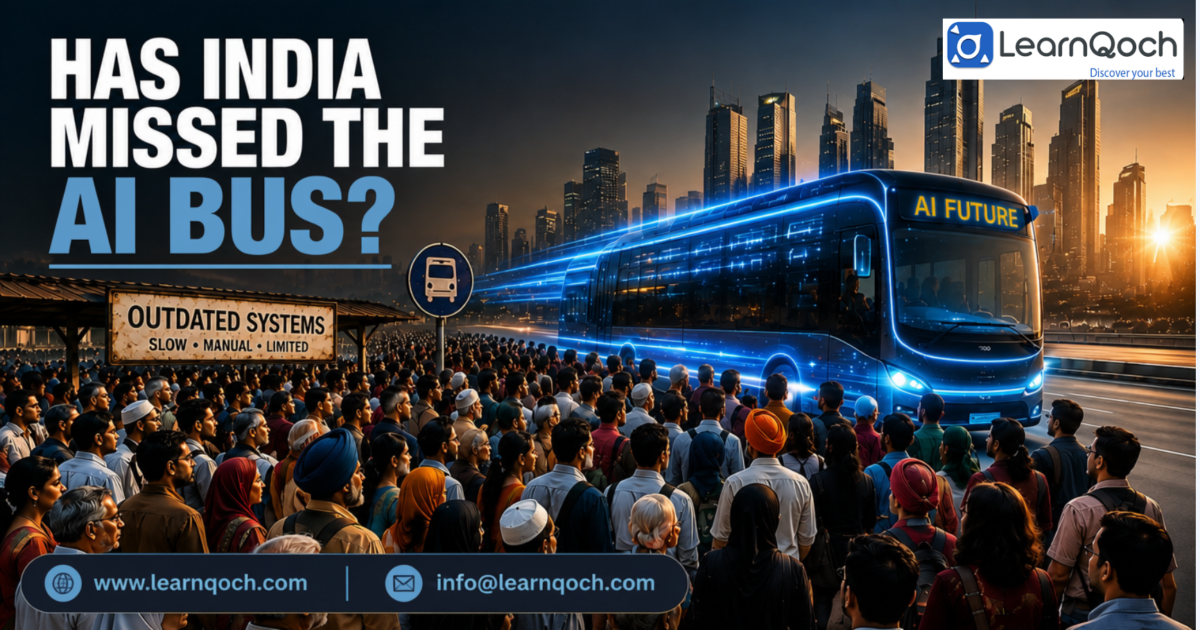
Has India Missed the AI Bus? Understanding India’s Position in the Global AI Race.


Introduction
Artificial Intelligence (AI) is no longer a futuristic concept—it is transforming economies, industries, education, healthcare, manufacturing, and governance worldwide. Countries such as the United States and China are investing heavily in AI infrastructure, foundation models, semiconductor technologies, and AI-powered services, positioning themselves as global leaders in the next industrial revolution.
As AI reshapes the global economy, an important question arises: Has India missed the AI bus, or does it still have an opportunity to become a global AI powerhouse?
While India has produced world-class technology talent and successfully executed large-scale digital initiatives like UPI, Aadhaar, and DigiLocker, it still lacks a strong presence across the AI value chain. However, India’s greatest opportunity may not lie in competing directly with the US or China but in leveraging its strengths in large-scale execution, digital public infrastructure, and skilled workforce to build AI solutions for billions of people.
What we discuss about in this blog?
This blog explores whether India can transform its vast population, strong digital infrastructure, and skilled workforce into a global AI advantage. It examines the opportunities and challenges of AI adoption, the importance of responsible AI development, and why preparing the next generation with AI skills is essential for the country’s future. The focus is not only on competing with global AI leaders but on building AI solutions that solve real-world problems at population scale and position India as a global AI innovator.
Where Does India Stand in the Global AI Race?
The AI ecosystem is rapidly evolving, with different countries leading different parts of the AI stack.
| Country | Strength |
|---|---|
| United States | Foundation models, cloud infrastructure, AI platforms, enterprise AI. |
| China | AI applications, manufacturing, large-scale deployment, and hardware ecosystem. |
| Taiwan | Semiconductor manufacturing. |
| South Korea | Advanced memory chips and AI hardware. |
| Israel | AI research, cybersecurity, and deep technology innovation. |
| Japan | Robotics and industrial AI. |
| India | Digital public infrastructure, software talent, and large-scale technology adoption. |
India has one of the world’s largest technology talent pools and a rapidly growing AI startup ecosystem. However, the country is still strengthening its capabilities in foundation AI models, advanced semiconductor manufacturing, and AI infrastructure. While other nations currently lead these areas, India’s scale, talent, and digital ecosystem position it to become a major AI powerhouse in the coming years.
What India Has Done This Before
The India has repeatedly demonstrated that it can lead the world through execution, even when it was not the first country to invent the underlying technology.
- Affordable Digital Connectivity
India offers one of the world’s most affordable mobile internet ecosystems, making digital services accessible to millions.
India has become the global leader in real-time digital payments through the Unified Payments Interface (UPI), processing billions of transactions every month and setting a global benchmark for digital financial inclusion.
Digital public infrastructure such as Aadhaar, DigiLocker, eKYC, Digital Signature, and Account Aggregator has transformed governance and financial services.
These examples show that India’s strength lies in scaling technology rapidly across a large population.
The Missing Piece: India’s AI Ecosystem
India has made remarkable progress in digital transformation and technology adoption. However, becoming a global AI leader requires more than a large talent pool and a growing startup ecosystem. There are still several challenges that India must overcome to compete with countries like the United States and China.
1. Limited AI Research
India excels in software development but invests less in foundational AI research than leading AI nations.
2. Dependence on Imported Hardware
Most AI chips and high-performance computing hardware are imported, increasing costs and limiting scalability.
3. Brain Drain
Many skilled AI researchers and engineers move abroad for better research opportunities and funding.
4. Lack of Quality Datasets
India needs larger, high-quality datasets in healthcare, agriculture, education, governance, and regional languages to build effective AI solutions.
5. Limited AI Education
Many schools and colleges still lack practical AI education, reducing opportunities to build a future-ready workforce.
6. Need for Better AI Infrastructure
Greater investment in AI research labs, computing power, and innovation ecosystems is essential to compete globally.
The Road Ahead
If these challenges are not addressed, India may continue using AI technologies developed elsewhere rather than creating its own. However, by investing in research, infrastructure, talent, education, and innovation, India has the opportunity to become not just one of the world’s largest AI users, but also one of its leading AI innovators.
Five Steps That Can Help India Build an AI Economy

1. Retain India’s Best AI Talent
India produces some of the world’s best engineers and AI researchers. Creating world-class research opportunities, competitive funding, and startup incentives can encourage more talent to build AI innovations within the country.
2. Build High-Quality Indian AI Datasets
Large language models require high-quality datasets.
India should invest in multilingual datasets covering:
- Healthcare
- Agriculture
- Education
- Governance
- Legal systems
- Regional languages
These datasets can become one of India’s biggest competitive advantages.
3. Increase Investment in AI Infrastructure
India’s AI Mission is an important step, but long-term leadership requires significantly greater investment in:
- GPU clusters
- AI supercomputers
- Semiconductor ecosystem
- AI research canters
- Startup funding
Public-private partnerships can play a critical role in accelerating AI infrastructure.
4. Make AI Education a National Mission
AI literacy should begin at the school level.
Governments, universities, and industry bodies can collaborate to:
- Train teachers in AI fundamentals
- Introduce AI into school and college curricula
- Build AI skill development programs
- Promote responsible AI practices
Preparing today’s students is essential for tomorrow’s AI workforce.
5. Measure Outcomes, Not Just Activities
India often focuses on implementation rather than measurable outcomes.
Success metrics should include:
- AI startups created
- Research publications
- Patents filed
- AI jobs generated
- Global AI exports
- AI adoption across industries
These indicators will provide a clearer picture of India’s progress.
Why AI Matters for India’s Future?
Electricity transformed the global economy during the Industrial Revolution, while the internet reshaped communication and commerce.
Artificial Intelligence has the potential to become the defining technology of the next economic era.
If AI innovation remains concentrated within a few countries, the economic benefits may also become highly concentrated. For India, investing in AI is not just about technological advancement—it is about strengthening competitiveness, creating employment opportunities, improving public services, and supporting long-term economic growth.
Conclusion
India’s AI future depends not only on advanced technology but also on preparing students, educators, and institutions to use AI responsibly. LearnQoch supports this transformation by helping schools and colleges adopt AI-powered solutions for academics, examinations, administration, and institutional growth. Through intelligent automation, data-driven insights, and digital learning tools, LearnQoch enables educational institutions to improve efficiency, embrace digital transformation, and prepare future-ready learners for an AI-driven world.
The LearnQoch AI powered Academic Platform
LearnQoch goes further by providing an integrated platform that covers all aspects of institutional growth:

Institutional Digital Ecosystem: Categories & Modules
| Category | Modules Available | What It Does (Core Capability) |
|---|---|---|
| A. Core Academic & Learning | LMS, OBE, Academic Calendar, Class Module | Digitizes modern teaching, manages timetables, and maps specific student skill metrics. |
| B. Examination & Evaluation | Exam Management Module | Automates the complete exam lifecycle: planning, ATKT processing, and automated question paper generation. |
| C. Campus Administration | ERP, Task Management, Committee, Document, Certificate Management | Automates student data, workflow management, corporate governance, and instant certificate issuance. |
| D. Finance & Fees | Receivable (Fees), Advanced Fees, Excess Fees | Tracks fee categories, handles online tuition collections, and records advanced or excess payment adjustments. |
| E. Library & Resource | Library Module | Streamlines textbook registration, student tracking, renewals, and live book availability. |
| F. Placement & Careers | Placement Module, Skill Development | Connects TPOs with job openings, student registration, and future-ready job training. |
| G. Digital Marketing & Institution Growth | LQ Growth+ | A unified dashboard to manage social media, WhatsApp, Email, SMS campaigns, and website health metrics. |
| H. Accreditation & Quality | NAAC, NBA & NIRF Compliance | Drastically reduces institutional audit workload with one-click compliance reporting tools. |
| I. Digital Presence | Website & Digital Marketing Solutions | Build custom web portals and automated communication funnels to attract prospective students. |
Don’t Just Take Our Word for It—Try LearnQoch Yourself!
We invite you to experience the transformative impact of LearnQoch’s AI powered Digitize Platform with a 14-Day Free Trial.
During this period, our team will implement the software for your institution, allowing you to explore its features firsthand and see the difference it can make in academic management.
👉 Are you ready to lead your institution into the future of campus management?
📞 Contact us at +91 84519 01079
📧 Email: info@learnqoch.com / sales@learnqoch.com
Explore What LearnQoch Offers:
Visit www.learnqoch.com for Full Details
FAQs
1. Has India really missed the AI race compared to countries like the US and China?
No. India has strong digital infrastructure, skilled talent, and the ability to scale AI solutions, giving it significant long-term potential.
2. What are India’s biggest challenges in becoming a global AI leader?
India needs more investment in AI research, computing infrastructure, quality datasets, AI education, and semiconductor capabilities.
3. How can India compete in the global AI ecosystem?
By leveraging its technology talent, digital platforms, and large population to build affordable and scalable AI solutions.
4. Why is AI education important for India’s future?
AI education equips students with future-ready skills and prepares them for careers in an AI-driven economy.
5. Can India become a creator of AI solutions instead of only an AI consumer?
Yes. With greater investment in research, innovation, and talent, India can develop AI solutions for both domestic and global needs.