



Leveraging ICT for NAAC Accreditation and Quality Enhancement


In the modern digital world, technology is an important aspect of our lives, and its importance in our education is undeniable. From learning to management, schools nowadays use Information and Communication Technology (ICT) in their daily lives. But the most important point to note is that the incorporation of technology in schools reflects the vision of our newly introduced National Education Policy (NEP) 2020, which emphasizes digital learning, blended learning, and outcome-based learning to create a learning environment that is more student-centric.
Gone are the days when textbooks and whiteboards were considered the primary sources of education. The advent of computers, smartphones, tablets, and the internet has given education a whole new dimension. In addition, the numerous possibilities that these innovations offer, including access to vast knowledge sources, collaboration, and creativity, are some of the greatest achievements of the educational sector. This being the vision of NEP 2020, information and communication technology has become the catalyst that is transforming the traditional classroom setup into a dynamic, interactive, and personalized platform, ready to meet the requirements of the 21st century.
One area where technology has had a significant impact is in the accreditation process of educational institutions. The National Assessment and Accreditation Council (NAAC) is an autonomous body in India responsible for assessing and accrediting higher education institutions. With the integration of ICT in the NAAC accreditation process, schools can leverage technology to enhance the quality of education they provide.
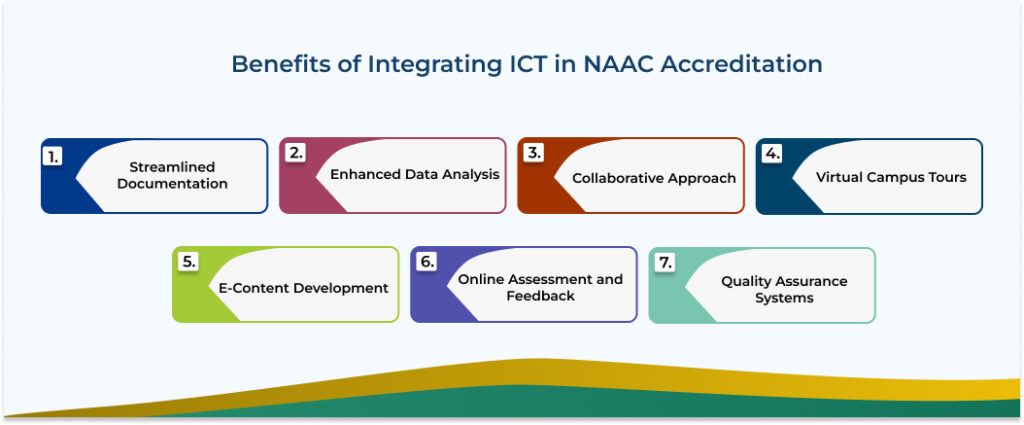
Benefits of Integrating ICT in NAAC Accreditation:
Streamlined Documentation:
Traditionally, the NAAC accreditation process involved extensive paperwork and documentation. However, with the integration of ICT, schools can now digitize and store data electronically, making it easily accessible and reducing the chances of document loss or damage. This not only saves time and effort but also ensures accuracy and efficiency in the accreditation process.
Enhanced Data Analysis:
Technology enables schools to collect and analyze data more effectively. By leveraging data analytics tools, educational institutions can identify trends, patterns, and areas for improvement in their academic programs. This data-driven approach helps schools make informed decisions, implement evidence-based practices, and enhance the overall quality of education.
Collaborative Approach:
Technology promotes collaboration among stakeholders, including students, teachers, administrators, and external assessors. Online platforms and tools facilitate communication and information sharing, allowing for a collaborative approach to the accreditation process. This fosters transparency, encourages teamwork, and enables effective coordination among different departments within the institution.
Virtual Campus Tours:
Virtual reality (VR) and augmented reality (AR) technologies have transformed the way educational institutions showcase their facilities and infrastructure. With virtual campus tours, schools can provide a realistic and immersive experience to external assessors, enabling them to assess physical resources and facilities remotely. This not only saves time and resources but also enhances the overall evaluation process.
E-Content Development:
Technology has revolutionized the way educational content is created, shared, and accessed. With the integration of ICT in NAAC accreditation, schools can develop interactive e-content, including online courses, digital libraries, and multimedia resources. These resources provide students and faculty with anytime, anywhere access to learning materials, fostering a self-paced and personalized learning experience.
Online Assessment and Feedback:
Technology has made assessments more efficient and comprehensive. Schools can now conduct online assessments, including quizzes, tests, and surveys, which not only save time but also provide instant feedback to students. Additionally, online feedback mechanisms enable stakeholders to share their opinions, suggestions, and grievances, fostering a culture of continuous improvement.
Quality Assurance Systems:
Technology plays a vital role in establishing quality assurance systems within educational institutions. Through the integration of ICT, schools can implement robust mechanisms for monitoring and evaluating the quality of education. This includes tools for tracking student progress, monitoring faculty performance, and conducting peer reviews. These systems ensure accountability, enhance transparency and facilitate the implementation of quality enhancement strategies.
Conclusion
As technology continues to evolve, its role in education is becoming increasingly significant. The integration of ICT in NAAC accreditation enables institutions to enhance educational quality through streamlined documentation, effective data analysis, improved collaboration, virtual campus tours, e-content development, online assessments, and robust quality assurance systems.
However, successful integration requires a clear vision and strategic planning. Institutions must invest in the right infrastructure, provide adequate training to faculty and staff, and proactively address potential challenges. With a thoughtful and holistic approach, technology can transform the education system, foster continuous quality improvement, and create a dynamic learning environment for 21st-century learners.
LearnQoch helps institutions strengthen their readiness for NAAC accreditation by simplifying complex processes. Our accreditation software not only manages institutional data efficiently but also streamlines workflows, ensuring better organization and compliance with NAAC requirements.
Our web- and cloud-based integrated ERP & LMS solution is specifically designed for educational institutions. It automates lengthy administrative processes, enhances operational efficiency, and supports seamless management. With LearnQoch’s Accreditation Management Software, institutions can improve performance, maintain quality standards, and stand out in the competitive education landscape.
The LearnQoch AI powered Academic Platform
LearnQoch goes further by providing an integrated platform that covers all aspects of institutional growth:

Institutional Digital Ecosystem: Categories & Modules
A. LearnQoch AI powered Core Academic & Learning Solutions
Facilitates modern teaching and learning while tracking student progress, assignments, assessments, and course outcomes.
Focuses on measuring learning outcomes to ensure skills, competencies, and academic objectives are met effectively.
- LearnQoch AI powered Academic Calendar & Events
Maintains academic schedules, holidays, events, and exam timelines for seamless yearly planning.
- LearnQoch AI powered Class Module
Manages class creation, faculty allocation, and student grouping while supporting timetable integration.
B. LearnQoch AI powered Examination & Evaluation Management
LearnQoch AI Powered Exam Management Module
A unified system that digitizes the entire exam cycle—right from planning, subject allocation, ATKT processing, and scheduling to question paper creation, assessments, evaluation, and result generation. It ensures transparency, accuracy, and smooth coordination across all departments.
C. LearnQoch AI powered Campus Administration & Operations
Streamlines administrative activities, simplifies student data management, and ensures workflow automation across all departments.
- LearnQoch AI powered Task Management
Organizes, prioritizes, and tracks institutional tasks to improve productivity and accountability.
- LearnQoch AI powered Committee Module
Handles committee formation, roles, activities, and meeting records to maintain governance transparency.
- LearnQoch AI powered Document Management
Stores, organizes, and retrieves institutional documents with version control and compliance tracking.
- LearnQoch AI powered Certificate Management
Manages creation and issuance of academic and administrative certificates such as Bonafide, character, and leaving certificates.
D. LearnQoch AI powered Finance & Fees Management
- LearnQoch AI powered Finance Module – Receivable (Fees)
Tracks payments, manages fee categories, handles tuition/fines, and maintains fee-related records.
- LearnQoch AI powered Advanced Fees
Payments made before the due date, helping institutions and parents manage fee planning efficiently.
- LearnQoch AI powered Excess Fees
Extra amount paid unintentionally; recorded for adjustment in future payments or refunded when necessary.
E. LearnQoch AI powered Library & Resource Management
LearnQoch AI powered Library Module
Manages book registration, issue-return process, renewals, student access, and availability tracking for efficient library operations.
F. LearnQoch AI powered Placement & Career Development
- LearnQoch AI powered Placement Module
Manages job postings, student registration, interview updates, and final offer letters with complete transparency for TPOs and students.
- LearnQoch AI powered Skill Development Solutions
Equips students with future-ready skills to enhance employability and prepare for global career opportunities.
G. LearnQoch AI powered Accreditation & Compliance
LearnQoch AI powered NAAC, NBA & NIRF Compliance
Simplifies reporting, monitoring, and auditing with ready-to-use compliance tools that reduce institutional workload.
H. LearnQoch AI powered Digital Presence & Branding
LearnQoch AI powered Website & Digital Marketing Solutions
Helps institutions build a strong online presence, attract prospective students, and engage key stakeholders effectively.
Don’t Just Take Our Word for It—Try LearnQoch Yourself!
We invite you to experience the transformative impact of LearnQoch’s AI powered Digitize Platform with a 14-Day Free Trial.
During this period, our team will implement the software for your institution, allowing you to explore its features firsthand and see the difference it can make in academic management.
👉 Are you ready to lead your institution into the future of campus management?
📞 Contact us at +91 84519 01079
📧 Email: info@learnqoch.com / sales@learnqoch.com
Explore What LearnQoch Offers:
Visit www.learnqoch.com for Full Details
Also read,
One Login, Infinite Possibilities: NBA, and NIRF Accreditation
A Proven Approach to Ensure NAAC Compliance and Elevate Education Outcomes
IMPORTANT: Big Changes Ahead! NAAC Accreditation Changes Explained Action Plan for HEIs in 2025
People Also Search For
Role of ICT in higher education
ICT improves the quality of teaching, learning, and administration by facilitating online resources, virtual classrooms, online assessments, and collaborative learning.
NAAC accreditation and technology integration
Technology integration in NAAC will be helpful in enhancing documentation efforts, monitoring KPIs, supporting SSR preparation, and complying with accreditation standards.
Digital learning tools in schools and colleges
Tools such as LMS, e-books, simulations, and virtual labs help facilitate interactive learning, tailored education, and ongoing assessments.
NEP 2020: Digital Education Guidelines
The emphasis in the new policy is on ICT-facilitated modes of teaching, blended learning, online content, virtual labs, and smart classrooms for the development of a student-centric and accessible education system
Benefits of ICT in teaching and learning
ICT can enhance learner engagement, collaboration, global resource utilization, personalization, and instant feedback to produce better learning results. E-learning sites pertaining to quality enhancement E-learning platforms like LearnQoch, Moodle, and Google Classroom enable institutions to effectively manage courses, tests, and learning analytics in order to improve academic quality. ERP and LMS software for NAAC compliance ERP and LMS can help by providing better data collection tools, automated reporting tools, faculty/student records, and accreditation documentation. Technology-enabled student-centric learning With digital tools,