


LQ OBE Handbook For All Educational Institutes.


Introduction
The shift toward modern education has completely changed how colleges and universities operate. Under the National Education Policy (NEP 2020) and national missions like Viksit Bharat 2047, Indian education has officially transitioned from rote learning to a competency-based, skill-oriented model.
For institutional leaders, this means regulatory bodies like the National Board of Accreditation (NBA), National Assessment and Accreditation Council (NAAC), and NIRF now look deeply at measurable data, student-centric learning, and systematic outcome tracking.
To help academic management bridge the gap between complex theories and actual classroom implementation, LearnQoch has created this definitive Outcome-Based Education (OBE) Handbook. This guide explains the complete OBE implementation process, attainment calculations, gap analysis, continuous improvement strategies, and accreditation reporting, enabling institutions to align with NEP 2020 goals and contribute towards the vision of Viksit Bharat 2047.
From the last blog
Why Should Every Educational Institution Implement OBE?
Whether an institution serves KG, School, Diploma, UG, PG, or Professional Education programs, OBE provides several advantages:
1. Improves Real-World Learning
OBE empowers students to apply theoretical concepts to real-world situations and practical challenges.
2. Aligns Education with Industry Needs
OBE helps institutions design curriculum and learning outcomes that match industry expectations and future workforce requirements.
3. Supports Diverse Learning Needs
Students learn differently. OBE allows educators to provide multiple learning opportunities and alternative assessment methods to help every student achieve desired outcomes.
4. Enables Global Competitiveness
By following internationally accepted outcome frameworks, institutions prepare students for global opportunities and higher education pathways.
5. Promotes Continuous Improvement
OBE follows the Plan-Do-Check-Act (PDCA) cycle, ensuring continuous feedback, evaluation, and academic improvement.
The Real-World Breakthrough: From Theory to Practice
(The next Meet, outside the seminar hall for the digital tools session…)
Before we dive into the technical checklist, consider this conversation overheard outside a recent digital education seminar hall:
Prof. Verma: Mr. Sharma! Over here! Remember last time we decided to search for a digitized platform before suggesting anything to our principals? Look at what I found! (Shows his tablet/phone)
Prof. Sharma: What is it, Mr.Verma? You look like you won the lottery.
Prof. Verma: Better! It’s the LearnQoch OBE handbook. I went through it last night—it explains all the core OBE theory, framework setup, and step-by-step attainment mapping. It completely clears up all those theory and practical concepts we were worrying about!
Prof. Sharma: Oh wow, that is excellent! But is it just another heavy guidebook, or does it actually solve our spreadsheet headache?
Prof. Verma: That’s the best part—I checked out their website, and they provide a complete live demo of the software! We can see exactly how it automates the question of paper generation, Bloom’s Taxonomy mapping, and real-time data analytics.
Prof. Sharma: Outstanding! So, we don’t just have an idea; we have a Specific verified solution. Let’s attend this final session, and right after, we’ll book the LearnQoch demo together so we can present it confidently to our management!
Prof. Verma: Yes! Let’s do it. but before that you just go through this handbook first my friend then you really understand.
.
What we cover in this blog?
In this blog(LQ OBE Handbook for all educational Institutes), we provide a complete handbook for implementing Outcome-Based Education (OBE) in educational institutions. We explain the importance of OBE in achieving NEP 2020 goals, supporting Viksit Bharat 2047, and meeting accreditation requirements such as NBA, NAAC, and NIRF. The blog covers OBE configuration, PEO-Mission mapping, CO-PO mapping, attainment calculations, direct and indirect assessment methods, and gap analysis. It also highlights how LearnQoch OBE automates the entire OBE lifecycle, simplifies accreditation reporting, and enables continuous academic improvement through data-driven decision-making.
The 8-Step IQAC Checklist for Effective OBE Implementation
For an Internal Quality Assurance Cell (IQAC) team, running an automated OBE lifecycle requires following these eight fundamental operational steps:
Step 1: OBE Configuration
Successful OBE implementation starts with proper academic configuration.
Institutions should define the following terms first:
Program Vision, Mission, PEOs, POs, PSOs, and Course Outcomes (COs) to establish clear learning goals and expectations. They should also identify internal and external assessment tools and align Course Outcomes with Bloom’s Taxonomy levels. A well-structured OBE framework ensures accurate outcome measurement, effective attainment tracking, and smooth compliance with NBA, NAAC, NIRF, and NEP 2020 requirements.
A strong OBE foundation ensures accurate outcome measurement throughout the academic lifecycle.
Step 2: PEO-Mission Mapping
The IQAC team should map Program Educational Objectives (PEOs) with Program Mission statements.
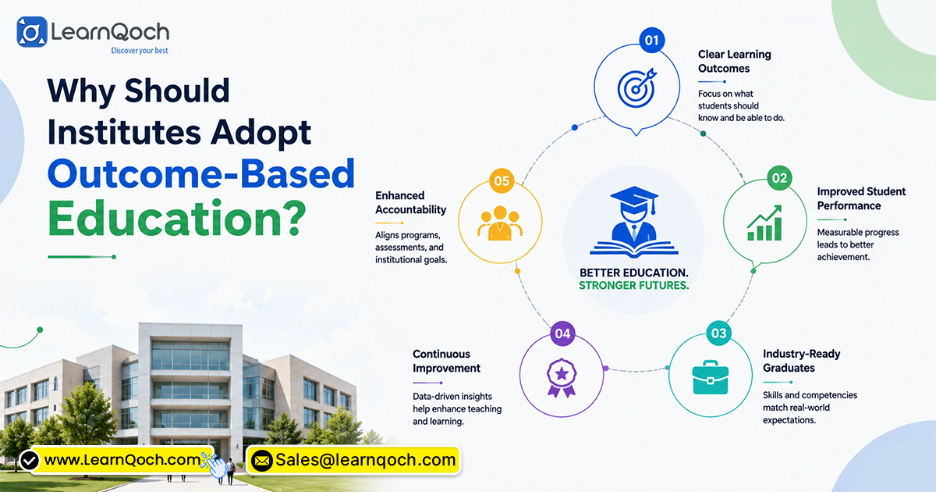
This mapping ensures that institutional goals align with expected graduate achievements and educational objectives. It helps verify that the program’s vision and mission are effectively contributing to student development, career readiness, and long-term educational outcomes. Proper PEO-Mission mapping also supports accreditation requirements and continuous academic improvement.
Step 3: CO-PO Mapping
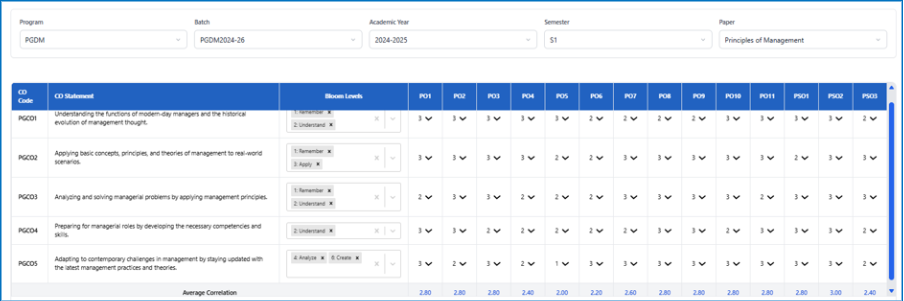
Course teachers perform Course Outcome (CO) to Program Outcome (PO) mapping for every course.
CO-PO Mapping helps institutions understand how individual courses contribute toward achieving overall program outcomes.
Proper mapping enables accurate attainment of calculations and accreditation reporting.
Step 4: CO Attainment Calculation
CO attainment measures the extent to which students have achieved the defined Course Outcomes (COs) of a subject. It helps institutions evaluate student learning and identify whether the desired academic objectives have been successfully met.
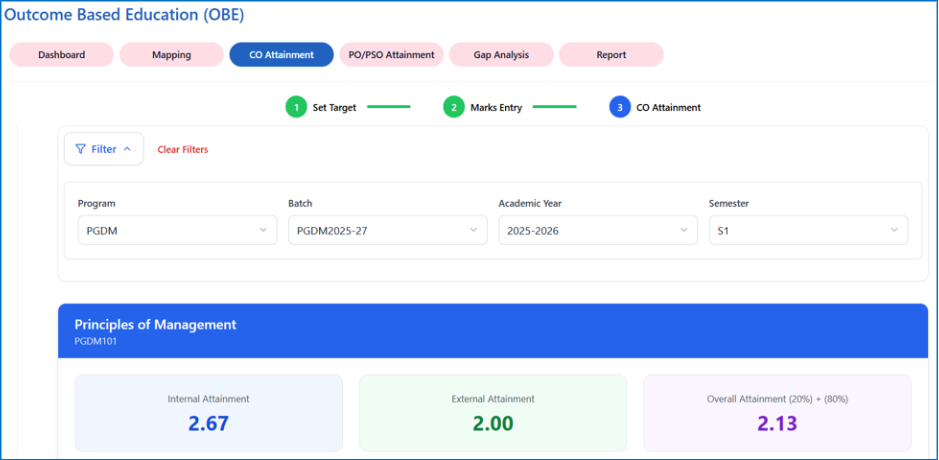
The process includes:
Target Setting
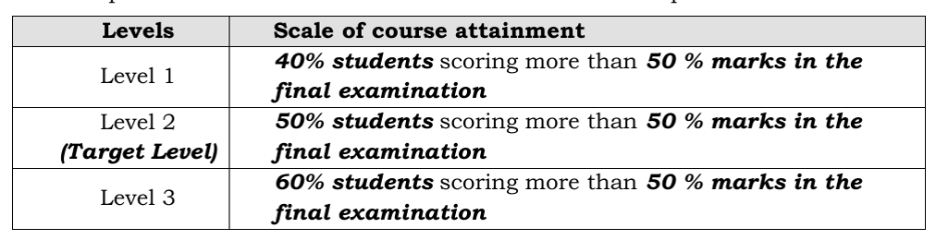
Institutions define performance targets for each Course Outcome (CO) before conducting assessments. These targets serve as benchmarks to measure student achievement and determine whether the desired learning outcomes have been successfully attained.
Assessment Collection
Assessment data is collected from various internal and external evaluation methods to measure student performance against defined Course Outcomes. Common assessment tools include Theory Examinations, Practical Examinations, Internal Tests, Unit Tests, Assignments, Journals, and Lab Assessments. These assessments provide the data required for accurate attainment calculations.
Attainment Calculation
Typically:
- External Assessment Weightage = 80%
- Internal Assessment Weightage = 20%
Final CO attainment is calculated using weighted averages from internal and external assessments.
The LearnQoch Exam Module automates assessment collection and attainment calculations, eliminating manual spreadsheet work.
Step 5: Direct PO and PSO Attainment
Program Outcome (PO) and Program Specific Outcome (PSO) attainment are calculated using course attainment data.
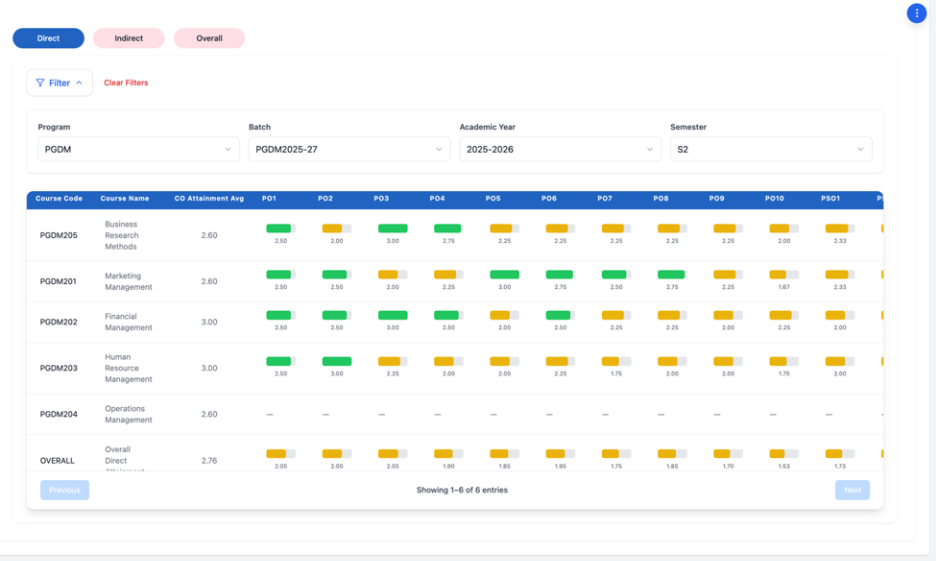
The process includes:
- Collecting average CO attainments
- Mapping COs to POs and PSOs
- Calculating overall direct attainment
LearnQoch OBE automatically performs these calculations through its Direct Attainment Module.
Step 6: Indirect PO and PSO Attainment
Indirect PO and PSO attainment is measured through feedback and surveys collected from various stakeholders, including students, alumni, employers, and faculty members. This method helps institutions evaluate outcome achievement from a stakeholder perspective and supports continuous improvement.
Step 7: Gap Analysis
After attainment calculations, institutions identify:
- Weak Course Outcomes
- Weak Program Outcomes
- Weak Program Specific Outcomes
Gap analysis helps faculty take corrective actions and implement improvement strategies for future academic cycles.
Step 8: Accreditation Reporting
OBE implementation generates large amounts of academic data.
LearnQoch OBE simplifies report generation for:
- NBA Accreditation
- NAAC Accreditation
- NIRF Rankings
- Autonomous Audits
- Internal Quality Assurance
Institutions can generate reports instantly without manual compilation.
How does the LearnQoch Exam Module automate CO Attainment?
The LearnQoch Exam Module automates CO attainment by integrating assessment tools directly with your course outcome configuration. When faculty input marks for unit tests, assignments, or practical exams, the platform maps individual question performance back to its designated Bloom’s Taxonomy level, calculating weighted averages automatically and removing manual spreadsheet entry completely.
What is the difference between Direct and Indirect Attainment in OBE?
Direct Attainment measures actual student performance through quantitative data like internal tests, practicals, and university semester exams. Indirect Attainment measures qualitative success through structured feedback surveys gathered from alumni, employers, and faculty. Most institutional frameworks combine them using an 80% Direct to 20% Indirect weight ratio.
Conclusion
Focus on Education, Not Admin
Managing Outcome-Based Education manually consumes immense chunks of faculty time, driving up administrative fatigue and the risk of non-compliance errors. By digitizing your entire academic framework with LearnQoch OBE, your institute can transition from tedious data compilation to meaningful data analysis.
Let your software handle the compliance reporting so your educators can focus on what matters most: boosting academic quality, closing learning gaps, and driving student success.
The LearnQoch AI powered Academic Platform
LearnQoch goes further by providing an integrated platform that covers all aspects of institutional growth:

Institutional Digital Ecosystem: Categories & Modules
| Category | Modules Available | What It Does (Core Capability) |
|---|---|---|
| Core Academic & Learning | LMS, OBE, Academic Calendar, Class Module | Digitizes modern teaching, manages timetables, and maps specific student skill metrics. |
| Examination & Evaluation | Exam Management Module | Automates the complete exam lifecycle: planning, ATKT processing, and automated question paper generation. |
| Campus Administration | ERP, Task Management, Committee, Document, Certificate Management | Automates student data, workflow management, corporate governance, and instant certificate issuance. |
| Finance & Fees | Receivable (Fees), Advanced Fees, Excess Fees | Tracks fee categories, handles online tuition collections, and records advanced or excess payment adjustments. |
| Digital Marketing & Institution Growth | LQ Growth+ | A unified dashboard to manage social media, WhatsApp, Email, SMS campaigns, and website health metrics. |
| Accreditation & Quality | NAAC, NBA & NIRF Compliance | Drastically reduces institutional audit workload with one-click compliance reporting tools. |
Don’t Just Take Our Word for It—Try LearnQoch Yourself!
We invite you to experience the transformative impact of LearnQoch’s AI powered Digitize Platform with a 14-Days Free Trial.
During this period, our team will implement the software for your institution, allowing you to explore its features firsthand and see the difference it can make in academic management.
👉 Want to implement this operational blueprint seamlessly on your campus?
📞 Contact us at +91 84519 01079
📧 Email: sales@learnqoch.com
Explore What LearnQoch Offers:
Visit www.learnqoch.com for Full Details
FAQs
Que: What is Outcome-Based Education (OBE)?
OBE is a student-centered learning model that focuses on measuring student performance through specific, pre-defined outcomes. Instead of focusing on what the instructor teaches (content delivery), OBE emphasizes what students are actually able to do after completing a course or program.
Read More
Que: What are the primary elements of the OBE framework?
The framework relies on a hierarchy of objectives and measurable outcomes:
- Program Educational Objectives (PEOs): Broad statements describing the career and professional accomplishments graduates should achieve 3 to 5 years after graduation.
- Program Outcomes (POs): Specific skills, knowledge, and behaviour students are expected to acquire by the time they graduate. These align closely with global graduate attributes.
- Course Outcomes (COs): Detailed statements describing the significant and essential learning students will achieve and demonstrate at the end of a specific course.